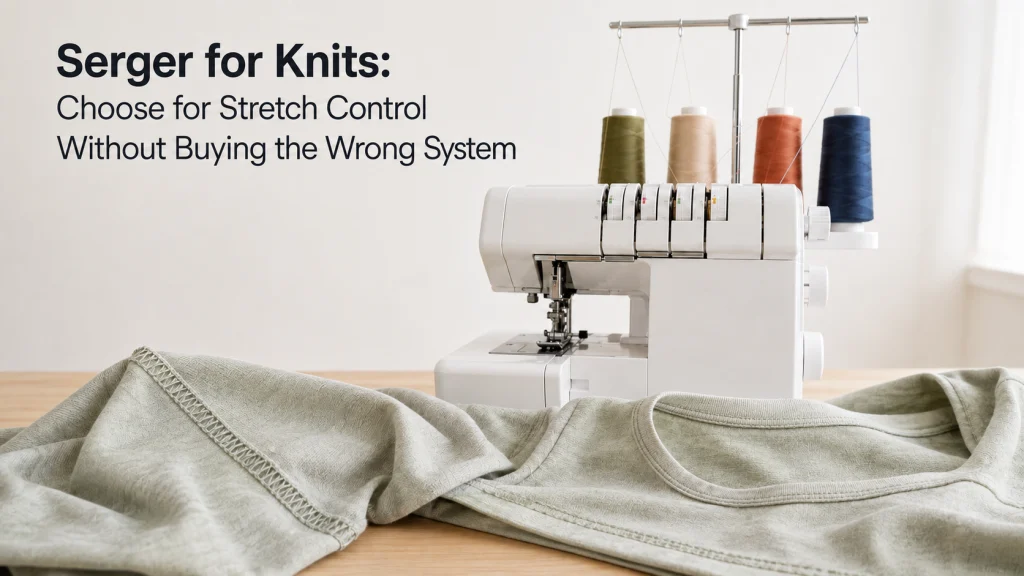
A serger can be a useful specialist machine for repeated knit garment construction, but it does not replace every sewing-machine or coverstitch operation. The buying decision should start with the seams, edge finishes, elastic applications, and hems you make most often, then move to current documentation for differential feed, thread configurations, threading workflow, and garment-access features. The best choice is the machine that owns enough of your real knit workflow to justify a separate system, with any untested fabric or seam condition left as unknown rather than assumed.
Knit sewing is a workflow, not one machine
A serger for knits makes the most sense when overlock construction and edge finishing occur often enough to justify a specialist machine. Picture a basic knit T-shirt: the shoulder and side seams may suit overlock construction, a neckband may benefit from controlled feeding, topstitching may still belong on a regular sewing machine, and the familiar parallel-line hem may call for a coverstitch system. Buying before separating those operations is how a useful specialist machine gets mistaken for an all-purpose answer.
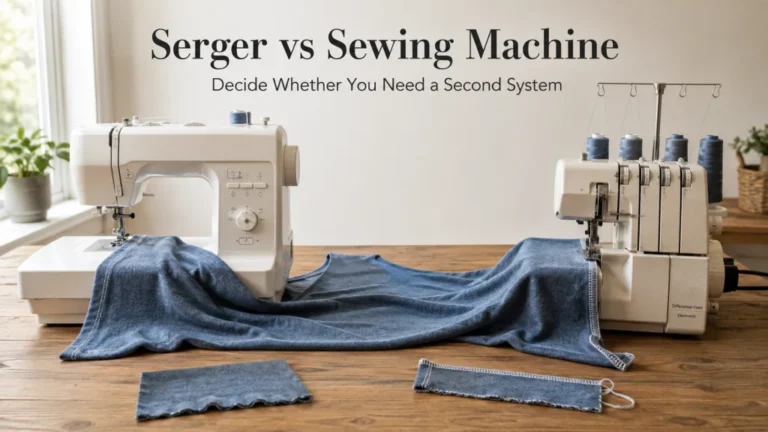
The first decision is therefore not which serger has the longest feature list. It is which operations you want the serger to own, which jobs must remain on another machine, and which features are actually documented for each candidate. If you are still deciding whether this machine class belongs in the sewing room at all, compare sergers with sewing machines before building a purchase shortlist.
List the knit garments and recurring operations
Start with finished garments, not machine features. A sewist making T-shirts, leggings, knit pajamas, and simple pullovers may repeat a narrow set of operations: joining stretch seams, trimming and enclosing raw edges, attaching bands, working around cuffs, and finishing selected edges. Another sewist may mostly alter ready-made knits, where seam access and occasional edge finishing matter more than continuous garment construction.
Write down the operation next to the garment and mark how often it occurs. This keeps a rarely used decorative feature from outranking a core construction need. It also exposes jobs that only look similar from the outside but require a different stitch system.
| Knit operation | Likely machine role | What to verify |
|---|---|---|
| Join shoulder or side seams | Often suitable for an overlock serger | Required overlock configuration and sample performance on the actual knit |
| Trim and finish a raw edge | Core serger task | Cutting-width adjustment, stitch choice, and manual instructions |
| Topstitch a neckline or seam allowance | Usually a regular sewing-machine job | Stretch-capable stitch and the owned machine’s setup |
| Create a typical T-shirt cover hem | Coverstitch or combination-system job | Actual coverstitch capability, not an overlock label |
| Work around cuffs or narrow tubes | Depends on access and construction sequence | Free-arm design if that access matters to your garments |
This map is more useful than a generic “knits” label because it ties each feature to a repeated action. Once the operations are visible, the machine class becomes easier to keep in its proper lane.
Keep the regular sewing-machine jobs visible
A serger is not a reason to retire a functioning domestic sewing machine. Straight stitching where appropriate, zigzag or other stretch-capable stitches, basting, topstitching, attaching certain closures, sewing in areas where trimming is unwanted, and other construction steps can still belong on the regular machine. The division depends on the garment and the capabilities of the machine already owned.
This is a common first-time misunderstanding: a shopper sees knit garments associated with sergers and assumes the specialist machine should perform the entire garment. In practice, a T-shirt can move between systems during construction. Before spending for a separate specialist machine, identify whether the current sewing machine already handles the non-overlock work reliably enough to stay in the workflow.
Define the overlock jobs that justify a serger
The strongest case for a home serger is repeated work that benefits from overlock stitch formation while the machine trims and encloses an edge. Knit garment seams are one obvious example, but the purchase still needs to be tied to actual seam construction rather than the vague idea of getting a more “professional” finish. A cleaner-looking edge alone does not prove that a specialist system is necessary for a particular sewist.
Look for frequency and concentration. If most projects repeatedly need stretch-oriented overlock seams, edge trimming, and fast edge finishing, the serger has a clear job description. If the machine would come out only for an occasional raw edge while the regular sewing machine performs nearly everything else, the case for another machine is weaker.
Key point: A serger is justified by recurring overlock work, not by the fact that the fabric stretches.
That distinction also prevents the purchase from drifting into technique advice. Settings for one jersey, rib knit, or athletic knit are test conditions for that project, not universal buying proof for every knit fabric.
Keep cover hems and coverstitch needs separate
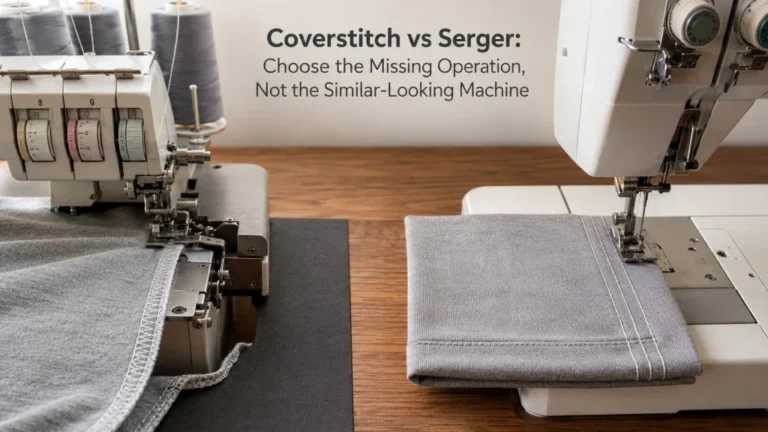
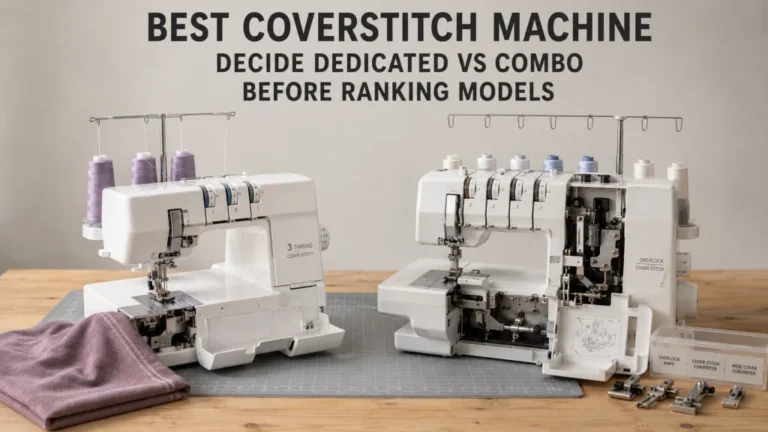
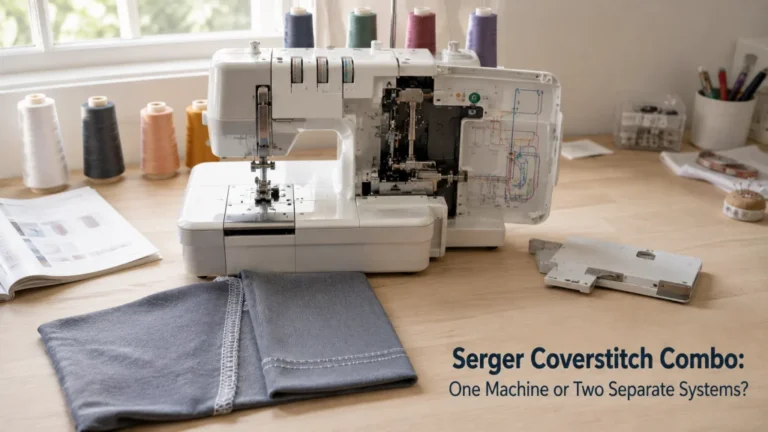
The double or triple rows commonly seen on knit hems are a different requirement from basic overlock construction. A dedicated coverstitch machine creates coverstitch and chain-stitch formations, while some combination systems can switch between overlock and coverstitch functions. A standard overlock serger should not be assumed to make a true cover hem simply because both machine classes are marketed for garments.
This matters before shortlisting because hems can dominate expectations. If the main frustration is finishing T-shirt hems rather than joining and finishing seams, an overlock-only purchase may leave the original problem untouched. Treat cover hemming as its own requirement and route it to the correct system before comparing serger features.
When both operations matter, the decision becomes separate machines versus a combination system, not a search for an ordinary serger with a hidden coverstitch function.

The Brother 2340CV is a coverstitch-dedicated machine with two-needle, 2-3-4 cover stitch functions for stretch fabrics, necklines, and hems. It provides tri-cover, wide, and narrow cover stitches, plus color-coded threading and a fast looper-threading system. The listing also specifies a maximum speed of 1,100 stitches per minute and differential feed.
Check On AmazonIf you click this link and buy, we earn a commission at no additional cost to you.
Check how differential feed is implemented on the candidate
Differential feed is one of the most relevant serger features for knit-heavy sewing because it changes the relationship between the machine’s feed sections. Current manufacturer documentation shows that home sergers can provide adjustable differential feed, but the stated adjustment range and the surrounding controls vary by model. The presence of the feature is therefore a starting point, not proof that every knit seam will feed flat under every condition.
For each machine under consideration, check the current product page and manual for the differential-feed control, its documented range, and any model-specific instructions. Then separate the specification from the result you still need to test. Fabric recovery, thickness, seam direction, cut edge, thread, needle, presser-foot pressure where adjustable, and the rest of the setup can change the finished seam.
Note: Current Brother, JUKI, and Janome documentation confirms that differential feed is a documented feature across multiple home sergers, while adjustment ranges and related controls differ. That supports model-level comparison, not treating “differential feed” as a universal performance rating.
A practical verification card should therefore record four things: the feature is present, the manual explains its adjustment, the planned overlock configuration exists, and the target fabric and seam condition has either been tested or remains unknown.

The JUKI MO-50E is a 3 or 4 thread serger with lay-in tensions and an automatic lower looper threader. Its Amazon listing specifies adjustable differential feed, an adjustable calibrated knife, and a built-in rolled hem. The product description also notes easy lower-looper threading and those controls as part of its home-serging setup.
Check On AmazonIf you click this link and buy, we earn a commission at no additional cost to you.
Match thread configurations to the seams you plan to sew
Thread count is not a simple higher-is-better specification. Current home sergers may support different combinations such as two-thread, three-thread, four-thread, or additional stitch systems, and those configurations serve different construction or finishing purposes. The useful question is whether the candidate provides the overlock formations you plan to use and whether its manual clearly documents the conversion between them.
For example, a sewist who mainly joins knit garment seams may care more about a documented construction overlock than about a long list of decorative options. A second sewist who also uses narrow edge finishes may need a different set of configurations. Read the stitch chart, needle and looper arrangement, and any required converter or setup parts instead of assuming the number printed in a product title explains the whole stitch system.
Compare manual and air-supported threading only as workflow choices
Threading matters because a serger uses multiple thread paths and loopers, and the machine becomes far less useful if rethreading discourages normal setup changes. Manual color-coded paths, assisted lower-looper systems, and air-supported looper threading can all reduce different parts of that friction. None of those labels, by itself, proves better knit handling or better stitch quality.
Compare the actual sequence you will perform. Check whether the manual clearly shows the thread order, whether the paths are accessible, what must be rethreaded when changing configurations, and whether the threading system adds maintenance or service considerations you are comfortable owning. Air-supported threading can be valuable for frequent thread changes, but it should win the comparison because it improves your workflow, not because it sounds more advanced.

The Brother Airflow 3000 is an air-threading serger that cuts and finishes seams in one pass. Its threading system uses a blast of air after thread is inserted into the threading port and the button is pressed. The listing also specifies up to 1,300 stitches per minute, flatlock, overlock, rolled hem stitches, differential feed, and LED work-area lighting.
Check On AmazonIf you click this link and buy, we earn a commission at no additional cost to you.
Check free-arm and rolled-edge features only when the garment mix needs them
A free arm can matter when the construction sequence requires access around cuffs, sleeves, or other tubular areas. Rolled-edge capability can matter for selected lightweight edges or decorative finishes. Both are legitimate features, but neither should outrank the overlock jobs that caused the serger purchase in the first place.
Use garment frequency as the filter. If narrow tubular access appears in nearly every project, inspect the free-arm shape and how the machine converts to it. If rolled edges are rare, confirm the function exists if desired, then keep it lower on the shortlist than differential feed, required overlock configurations, threading clarity, service access, and the controls you will use weekly.
Set the evidence threshold for knit-performance claims
Specifications can prove that a control or stitch configuration exists. They cannot prove that a particular jersey, rib knit, swim knit, brushed knit, or multi-layer seam will feed and recover exactly as you want. Claims such as “handles knits” or “prevents waviness” need stronger evidence when they are used to predict a real project result.
The strongest performance evidence is a model-specific test that identifies the material and the conditions. Useful details include knit construction and fiber where known, number of layers, seam geometry, thread, needle system and size, overlock configuration, differential-feed setting, presser-foot pressure when adjustable, and the observed result. Without that level of disclosure, treat broad performance language as a claim to investigate rather than a result you can transfer to your own project.
- Use the manufacturer page or manual to verify features, controls, stitch systems, included parts, safety instructions, and service boundaries.
- Use an independent test only when the tested machine, fabric, seam, and setup are disclosed well enough to compare with your work.
- Use owner discussions to identify common questions and workflow friction, not to turn one person’s result into universal machine capability.
- Mark anything not tested on your material and seam as unknown.
That evidence threshold is deliberately stricter than a retailer-style feature comparison. It protects the purchase decision from confident claims that do not describe the condition you actually need to sew.
Build a current serger shortlist by knit workflow
The useful meaning behind a search for the best serger for knits is not one machine that wins for everyone. It is a current shortlist in which each candidate has enough documented features to own the buyer’s core overlock work without charging attention or budget for unrelated capabilities. Because product lines change, build that shortlist from current manufacturer pages and manuals rather than from an old model ranking.
Start with the workflow package that matches the sewing you actually do. A serger for knit fabrics that will mostly construct T-shirts and leggings needs a different priority order from one used primarily for edge finishing, narrow tubular work, or frequent thread changes.
| Workflow profile | Put near the top | Leave as secondary | Untested condition |
|---|---|---|---|
| Frequent knit garment construction | Differential feed, required construction overlock, clear threading, service support | Decorative extras not used in construction | Exact jerseys, ribs, and bulky seam intersections |
| Frequent cuffs and tubular areas | Core overlock requirements plus useful free-arm access | Rolled edge if rarely used | Smallest tube and actual construction sequence |
| Frequent color or stitch changes | Clear manual threading or air-supported looper workflow, easy configuration changes | Speed claims that do not reduce setup time | Real rethreading time and preferred thread types |
| Mostly edge finishing | Required overlock finishes, cutting-width control, simple setup | Capabilities that belong to coverstitch work | Actual edge behavior on project fabrics |
Do not turn the table into a point system. A feature that solves a weekly operation can matter more than several features that will never leave the manual.
Mark untested fabrics and seam conditions as unknown
A current specification sheet can narrow the field, but it cannot complete the knit test for you. If the available evidence does not show the candidate on a comparable knit and seam, write “unknown” instead of converting a feature into a result. That is especially important for very lightweight knits, highly elastic fabrics, thick seam crossings, elastic insertion, or combinations of layers that behave differently from a flat two-layer sample.
This also makes a dealer demonstration or return-period test more useful. Bring or prepare scraps that represent the actual project, reproduce the seam geometry, and check the operations that caused the purchase. The goal is not to prove the machine can sew “knits” in general; it is to reduce the unknowns that matter in your own garment workflow.
Stop the serger shortlist when the real need is a general-purpose sewing machine
Stop comparing sergers if the unmet jobs are mainly regular sewing operations rather than overlock construction and edge finishing. A buyer who needs better control for topstitching, buttonholes, zipper insertion, basting, general garment assembly, or broader everyday sewing may be solving a domestic sewing-machine problem. Adding a serger does not repair a weak or unsuitable general-purpose workflow.
The same stop rule applies when the owned sewing machine is unreliable on ordinary tasks that should remain on that machine. Diagnose or replace the general-purpose system on its own merits. For a wider view of where specialist systems fit, understand specialist sewing machine types before assuming another machine class is the next purchase.
Stop the serger shortlist when the real need is coverstitch or a combination system
Stop again if the defining requirement is a true cover hem or chain-stitch operation. Those jobs should be compared within coverstitch or combination-system choices, not smuggled into an overlock shortlist. This keeps the buyer from praising an excellent serger for everything except the one operation that mattered most.
If overlock construction remains the dominant need after that check, return to the serger shortlist and compare only the features that support those operations. For broader purchase factors such as service access, manuals, threading workflow, and ownership considerations, compare home serger buying factors without turning the knit-specific decision into a general machine ranking.
Final Thoughts: choose the machine for the knit operation it actually owns
Knit sewing becomes easier to shop for when the garment is broken into operations before any machine is shortlisted. A serger earns its place through repeated overlock construction and edge-finishing work, supported by documented differential feed, the needed thread configurations, understandable threading, and any access features the garment mix really uses.
Keep the regular sewing machine and coverstitch jobs visible, and do not convert an untested fabric condition into a promise. If a candidate survives those boundaries, test the actual knit and seam when possible, confirm the current manual and support path, and choose from the evidence that matches the work you will really put under the presser foot.
Frequently Asked Questions
Most knit-serger questions become easier once the machine class and operation are separated. These answers keep the decision at owner level and point back to the machine documentation, fabric, seam, or stitch system that changes the result.
They are intentionally short because the main decision work belongs in the operation map and verification steps above.
🧵 Do I need a serger to sew knit fabric?
No. Many knit projects can be sewn on a suitable domestic sewing machine with an appropriate stitch, needle, thread, and setup. A serger becomes a separate buying decision when overlock construction and edge finishing recur often enough to justify it.
⚙️ Is differential feed necessary for a knit-focused serger?
It is a highly relevant feature to verify because it changes the relationship between feed sections, but it is not a guarantee of flat seams on every knit. Check the candidate’s documented range and instructions, then test the actual material and seam condition.
👕 Can a regular serger make the hem on a T-shirt?
Do not assume it can make the typical coverstitch hem. Standard overlock and true coverstitch are different stitch-system requirements, so verify whether the desired hem belongs to a dedicated coverstitch or combination machine.
🪡 Are four threads always better than three on a serger?
No. Thread configurations support different seam and finishing jobs. Verify which overlock formation the project needs and whether the machine manual documents that configuration.
💨 Is air threading worth paying for?
It can be worthwhile if looper threading or frequent thread changes are a major workflow cost for you. Treat it as a threading convenience, not evidence that the machine will handle a particular knit seam better.
📏 What should I test before keeping a serger for knit garments?
Test the actual fabric, layer count, seam geometry, and overlock operation that matter to your projects. Record the thread, needle, differential-feed setting, and other relevant controls so the result can be tied to a real condition rather than a general “knits” claim.
If an answer changes when the fabric, machine class, or stitch operation changes, treat that condition as part of the buying decision rather than an exception to it.
References and Sources
These manufacturer sources are included because this article depends on current distinctions between overlock, coverstitch, thread configurations, differential feed, rolled-edge capability, and threading systems. They support feature and machine-class verification, not universal claims about results on every knit fabric.
- Brother sergers and coverstitch lineup: shows current overlock-serger and coverstitch products as distinct machine choices and documents model-specific feature sets.
- JUKI home serging lineup: documents current overlock thread configurations, differential feed, rolled hem, air-threading options, and separate coverstitch-capable systems.
- Janome current serger specifications: provides a current example of model-specific thread conversion, differential-feed range, air threading, and rolled-hem capability.
Always recheck the current product page and manual before purchase because product availability, controls, included items, and documented capabilities can change.