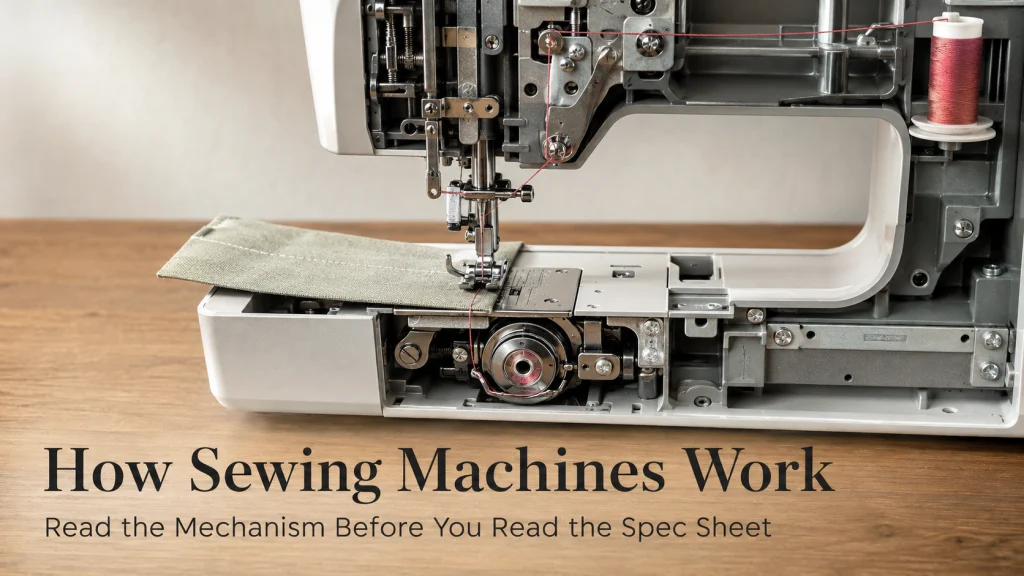
A domestic lockstitch machine works by coordinating four jobs: driving the moving parts, controlling upper thread, supplying and capturing lower thread, and holding then advancing the fabric. The visible needle is only one part of that cycle, and machines that make the same basic lockstitch can use different hook layouts, feed systems, and controls. Reading those subsystems separately makes published specifications much more useful because a hook type or feed description tells you how part of the machine is arranged, not whether the machine will automatically produce better stitches or handle every material. The practical goal is to trace what each mechanism does, then check the exact model manual when the layout or terminology differs.
Two lockstitch machines can describe very different mechanisms
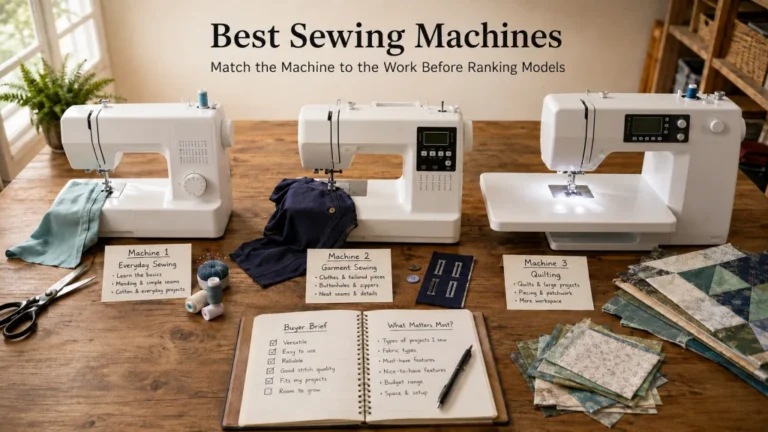
If you are trying to understand how sewing machines work, start with a useful contradiction: two current home machines can make the same basic two-thread lockstitch while publishing different mechanical descriptions. Janome lists the Toile Romance with a front-loading vertical oscillating hook and a 3-piece feed dog, while the Sewist 740DC is listed with a top-loading full rotary hook and a 7-piece feed dog. Both descriptions are meaningful, but neither one is a complete explanation of the machine by itself.
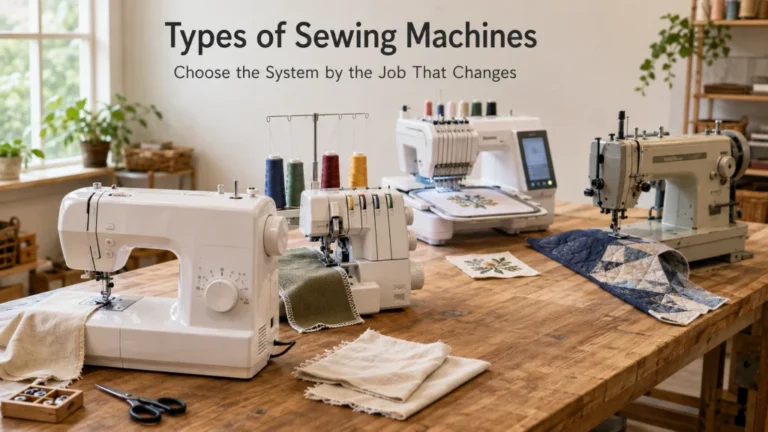
That is why a single universal cutaway diagram can be misleading. The working principle of a sewing machine remains recognizable across these examples, but the lower-thread path, hook motion, bobbin access, feed architecture, and user controls can differ by model. This article stays at that system level. It does not cover threading steps, fabric-specific settings, accessory fit, fault diagnosis, repair procedures, or the detailed mechanisms of sergers, coverstitch machines, embroidery systems, longarms, and industrial equipment.
Define the domestic lockstitch scope before following the cycle
A typical home lockstitch machine uses an upper thread carried by the needle and a lower thread supplied from a bobbin area below the needle plate. The machine repeatedly creates an upper-thread loop below the fabric, captures that loop with a hook or shuttle mechanism, passes it around the lower-thread assembly, removes the resulting slack, and advances the fabric for the next stitch. The threads interlace within the stitch structure rather than being tied into a literal knot at every needle penetration. In this stitch class, the two thread supplies are part of the basic mechanism: the upper thread forms the loop that travels around a separate lower thread, so both are needed to create the lockstitch described here. A one-thread stitch uses a different stitch-forming system, which is outside this article’s scope.
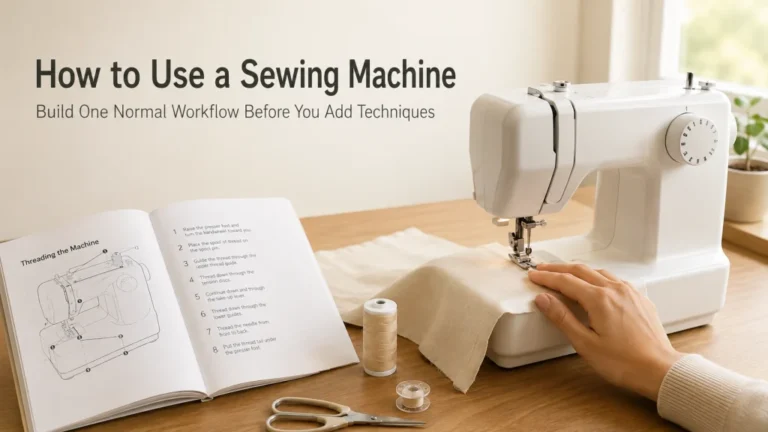
For a first-time owner, the easiest mistake is to read the sewing machine mechanism as if every visible part performs the same kind of job. A stitch selector is a command interface, a needle bar is a moving mechanism, and a bobbin is a removable thread supply. Keeping those roles separate makes the rest of the machine easier to read because a control can request a motion without being the part that physically performs it.
Read a machine as four coordinated systems
Group the machine by the work each subsystem performs. This four-system map stays broad enough to fit different domestic layouts without treating them as internally identical.
| System | Main job | What to look for in documentation |
|---|---|---|
| Drive and motion transfer | Turns user input and motor power into coordinated needle, hook, take-up, and feed motion. | Handwheel direction, speed control, needle position functions, and any model-specific operating notes. |
| Upper-thread control | Guides the upper thread, meters resistance, supplies thread to the forming loop, then recovers slack. | Thread path, tension control type, take-up lever, and threading diagrams. |
| Lower-thread supply and loop capture | Provides lower thread and captures the upper-thread loop so the two threads can interlace. | Bobbin loading direction, bobbin case or holder layout, hook type, and lower-area diagrams. |
| Fabric hold-down and feed | Controls the fabric at the needle and advances it by the commanded stitch distance. | Presser-foot operation, feed-dog description, drop-feed control, and stitch-length limits. |
The map gives each specification a job. That makes it easier to ask what a number or label actually changes instead of treating it as a general capability score.
Drive and motion transfer
The drive system supplies and coordinates motion. On a powered home machine, the motor turns the mechanism while shafts, linkages, cams, gears, belts, electronic actuators, or combinations of these translate that rotation into the movements needed for sewing. The handwheel gives the user a manual connection to part of that motion path, but its permitted direction and use should follow the exact model manual.
Synchronization matters. Needle, hook, take-up, and feed motion are coordinated so loop capture and fabric advance occur at the required points in the cycle. Read those mechanisms as a relationship, not as isolated parts.
Upper-thread control
The upper thread travels from the spool through guides and a tension system before reaching the take-up mechanism and needle. During the stitch cycle, the machine must make enough thread available for the needle to descend and for a loop to form below the fabric. After loop capture, the take-up movement recovers slack so the stitch can settle into the material.
The tension dial is not a stand-alone stitch maker. It changes resistance while other parts still create, capture, and recover the loop. The useful reference is the full thread-path diagram, not the dial number alone.
Lower-thread supply and loop capture
The bobbin stores lower thread, but the bobbin itself is not the hook. Depending on the machine, the bobbin may sit in a removable case or in a holder that remains in the machine, while a hook or shuttle mechanism moves around or beside that assembly to catch the upper-thread loop. Those distinctions matter when you are reading diagrams or trying to understand a specification such as vertical oscillating hook or horizontal rotary hook.
Calling the entire lower assembly the bobbin becomes confusing when a manual separates the bobbin, case, hook, and race. Learning each name by job makes the diagram easier to follow without disassembly.
Fabric hold-down and feed
The presser foot and feed system manage the fabric while the stitch-forming parts work around it. In a common bottom-feed arrangement, feed dogs rise through slots in the needle plate, grip the underside of the fabric against the presser foot, move it by a controlled distance, then return for the next cycle. The exact feed path and number or arrangement of feed-dog elements can vary.
Feed affects spacing and material movement, but it does not create the thread interlacing by itself. Different feed descriptions therefore belong to the fabric-transport part of the system, separate from the loop-capture mechanism.
Follow one complete stitch from input to fabric advance
The sequence below is a functional ledger, not a service-timing procedure. Exact geometry and timing remain model-specific and belong in manufacturer documentation.
- The needle descends through the fabric carrying the upper thread.
- As the needle begins to rise, a loop forms in the upper thread below the material.
- The hook or shuttle mechanism captures that loop.
- The upper-thread loop is carried around the lower-thread assembly so it can pass the bobbin thread.
- The take-up movement removes excess upper-thread slack and seats the interlacing into the material.
- After the needle clears the fabric sufficiently for the model’s feed sequence, the feed system advances the material for the next stitch.
That ledger answers the core question of how a sewing machine works. Hook motion can differ by model, but the upper thread still has to be looped, captured, passed around the lower-thread supply, tightened, and followed by controlled fabric advance.
Needle descends with upper thread
The needle carries the upper thread through the fabric into the lower mechanism area. Its motion is only useful because the thread path above it has already supplied the required amount of thread and the presser-foot system is holding the material in the intended sewing position. At this stage, no completed lockstitch exists yet.
Needle rise creates a loop
As the needle reverses direction and begins to rise, the relationship among needle shape, thread, fabric resistance, and machine geometry allows a loop to form on the required side of the needle. The loop has to appear where the capture mechanism expects it. This is a useful reminder that the needle is part of a timed system, not simply a punch that puts thread through fabric.
Hook or shuttle captures the loop
The hook or shuttle reaches the newly formed upper-thread loop and catches it. A rotary system and an oscillating system can achieve this with different motion paths, which is why hook type is a real mechanical distinction worth checking in the exact model documentation.
Upper thread passes around the lower-thread assembly
Once captured, the upper-thread loop must pass around the lower-thread supply so the two threads can interlace. The route depends on the hook, bobbin case or holder, race, and surrounding geometry. Visual similarity between lower-area parts is not compatibility evidence.
Take-up removes slack and seats the interlacing
After the loop travels around the lower-thread assembly, the take-up mechanism draws thread back through the path. That removes slack and helps the interlacing settle into the material. Tension affects the result, but the stitch still depends on the complete thread path and material condition.
Feed advances fabric after needle clearance
The fabric then has to move by the distance commanded for the next stitch. On common domestic bottom-feed machines, the feed dogs and presser foot provide that controlled advance while the needle is clear enough for the intended feed motion. The next needle penetration begins the same coordinated sequence again at a new point on the seam.

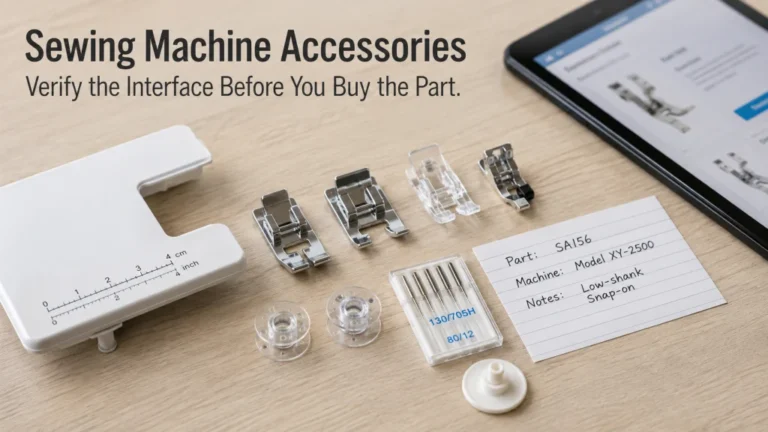
This 10-pack contains SINGER Universal sewing machine needles in size 90/14 for medium-weight knit and woven fabrics. The rounded tip and tapered end are designed to pass through common fabric weaves during general sewing. These needles provide a practical replacement option for the needle component that carries upper thread into the stitch-forming cycle.
Check On AmazonIf you click this link and buy, we earn a commission at no additional cost to you.
Separate the bobbin, case or holder, hook, shuttle, and race
Lower-thread terminology is one of the fastest places for a new owner to lose the thread, literally and figuratively. Manuals do not always use identical naming, but the following map gives each common term a distinct job so you can compare it with the labels used for your exact machine.
| Term | Functional meaning | What not to assume |
|---|---|---|
| Bobbin | The small spool that stores the lower thread. | That any bobbin with a similar diameter is compatible. |
| Bobbin case or holder | The structure that positions the bobbin and manages its thread path in the lower assembly. | That every machine has a removable case. |
| Hook | The moving capture element that catches the upper-thread loop. | That the hook label identifies every other part of the lower-thread layout. |
| Shuttle | A moving carrier or loop-capture arrangement used in particular designs and historical terminology. | That the word is interchangeable with every modern hook assembly. |
| Race | The guided path or surrounding structure in which a hook or shuttle assembly moves on designs that use that terminology. | That owner removal or adjustment is permitted without checking the manual. |
For example, Janome’s Toile Romance documentation separately identifies a removable bobbin case and describes the model as using a front-loading vertical oscillating hook. That is more precise than calling everything under the needle plate the bobbin area. When a manual uses different words, follow that manual’s diagram rather than forcing this terminology onto the machine.

This four-count pack contains SINGER Class 15 transparent plastic bobbins for compatible sewing machines. SINGER lists them for machines that use the Class 15 format across several brands, including SINGER, Brother, Elna, Kenmore, and Pfaff. The transparent construction makes the lower-thread supply visible while remaining a distinct bobbin format from Class 15J and metal variants.
Check On AmazonIf you click this link and buy, we earn a commission at no additional cost to you.
Understand tension without turning it into an adjustment guide
Thread tension is best understood here as controlled resistance within the thread paths. The machine needs enough freedom for thread to move through the cycle, but it also needs resistance so the take-up action can draw the interlacing into a stable position in the material. The exact balance depends on the machine, thread, needle, fabric, layer stack, stitch, and setup.
That does not mean every odd-looking stitch should send you directly to a tension control. Threading state, needle condition, bobbin insertion, material behavior, feed, and other factors can change the result, and those checks belong in model-specific setup or troubleshooting instructions. For this mechanism overview, the important point is that tension participates in thread control while the hook and take-up mechanisms perform different jobs.

This Gutermann Sew-All set includes 20 spools of 100-meter polyester thread in assorted basic colors. The thread is designed for machine and hand sewing, including closing seams, topstitching, and decorative stitches. Its general-purpose construction makes it a useful thread option for ordinary sewing where the upper-thread path and take-up system work together during stitch formation.
Check On AmazonIf you click this link and buy, we earn a commission at no additional cost to you.
What stitch length, width, and reverse actually command
Stitch length is fundamentally a command about how far the fabric advances between stitch-forming events, within the limits and implementation of the machine. A longer setting generally requests a greater feed distance per stitch, while a shorter setting requests less. That command is related to feed motion, not to the amount of thread stored on the bobbin or the type of hook installed.
Stitch width is different because it concerns lateral needle or stitch-forming movement on machines that support zigzag and other width-based patterns. Reverse changes the direction of fabric advance or invokes a model-specific reverse or locking behavior. A machine can therefore offer several control options while still relying on the same basic lockstitch relationship between upper thread, lower thread, loop capture, take-up, and feed.
Separate mechanical motion from computerized selection
A computerized control panel changes how the user selects and commands functions, but it does not eliminate the physical work required to form a stitch. The needle still has to move, an upper-thread loop still has to be captured, the lower-thread system still has to supply thread, and the fabric still has to be controlled and advanced. Electronics can choose, coordinate, limit, display, or automate functions while mechanical components perform the actual motions at the sewing point.
The Sewist 740DC is a useful documented example because Janome lists an LCD interface, direct stitch selection, needle up or down control, start or stop control, and a speed slider alongside a horizontal rotary hook and 7-piece feed dog. Those electronic controls tell you how the user can command the machine. They do not mean the machine forms a fundamentally different two-thread lockstitch from a mechanically selected home model.
Decode hook type and feed wording on current specification pages
The most useful way to read a specification is to translate it into a mechanical question. Hook type asks how the loop-capture system is arranged and moves. Feed wording asks how the fabric-transport system is described. Maximum stitch length and width define control ranges, while features such as drop feed, needle positioning, or start and stop controls describe additional operating choices.
- Find the exact model number, not just the brand or machine family.
- Identify whether the listed hook is rotary, oscillating, horizontal, vertical, top loading, front loading, or described with another model-specific term.
- Read the feed description separately from the hook description.
- Check maximum stitch length and width as control limits, not quality scores.
- Confirm whether a feature is a user command, a moving mechanism, or a removable component.
- Open the exact model manual when the product page wording is too brief to show how the parts relate.
Apply that checklist to the two Janome examples and the difference becomes concrete without becoming a ranking. Toile Romance is documented with a front-loading vertical oscillating hook, 3-piece feed dog, 5 mm maximum stitch width, and 4 mm maximum stitch length. Sewist 740DC is documented with a top-loading full rotary hook, 7-piece feed dog, 7 mm maximum stitch width, and 5 mm maximum stitch length. Those differences are enough to show why one universal internal diagram cannot accurately represent both machines.
Specifications do not prove stitch quality or material capacity
A larger stitch count, wider zigzag range, different hook label, more feed-dog elements, metal-frame wording, or a higher price cannot by itself prove better stitch formation, greater durability, or reliable performance on a difficult material stack. Those outcomes depend on the complete machine system and the conditions in which it is used. Published specifications describe features and limits, but performance claims need evidence under stated conditions.
Consider a buyer comparing two machines for a bulky seam intersection. A feed description may tell you how each machine transports fabric, but it does not establish how either model will behave with that exact fabric thickness, seam construction, needle, thread, presser foot, speed, and layer stack. The useful next question is what the manufacturer actually documents for the model and what independent evidence, if any, tests the relevant condition.
Use the exact model manual when the layout differs
Product pages are helpful for comparing published terms, but the manual is where the machine’s actual operating layout becomes clear. It can show the named parts, threading path, bobbin arrangement, control positions, safety limits, permitted cleaning steps, and model-specific instructions that a generic mechanism article cannot safely replace. If the diagram in your manual conflicts with a generic diagram online, the exact model documentation should control how you identify and operate that machine.
This matters especially around the needle, lower-thread area, covers, lubrication, and service boundaries. Do not remove covers, bypass guards, observe exposed mechanisms under power, adjust timing, perform electrical work, or continue operating after a hard collision, jam, smoke, sparks, burning odor, exposed wiring, or uncontrolled motion unless the exact manufacturer documentation explicitly places the action within normal owner service. Mechanism knowledge should help you read the manual, not encourage you to turn a home machine into a teardown project.
Final Thoughts: Trace the work, not just the labels
The clearest way to understand a domestic sewing machine is to follow the work in order: motion is supplied, upper thread is controlled, a loop is formed and captured, the upper thread passes around the lower-thread assembly, slack is recovered, and the fabric advances. Once that sequence is clear, terms such as rotary hook, oscillating hook, feed dog, take-up lever, stitch width, and reverse stop looking like unrelated vocabulary.
Use specifications to identify architecture and control limits, then use the exact model manual to see how that architecture is implemented. A good comparison starts by tracing what each mechanism actually does and then checking the evidence for any claim that goes beyond the published architecture or control range.
FAQs
🧵 Why does a sewing machine need two threads for a lockstitch?
The upper thread forms a loop below the fabric, and the lower thread from the bobbin is interlaced with that loop. The resulting stitch depends on both thread paths working with the hook, take-up, tension, and feed systems.
🪝 Is the hook the same part as the bobbin case?
No. The bobbin case or holder positions the bobbin and manages its thread path, while the hook is the moving element that captures the upper-thread loop. Exact names and layouts vary, so check the diagram for your model.
⚙️ Do the feed dogs actually make the stitch?
No. Feed dogs primarily control fabric advance in common domestic feed systems. Stitch formation also requires the needle, upper-thread path, lower-thread supply, loop-capture mechanism, take-up action, and coordinated timing.
🎛️ Does a computerized machine form a different basic lockstitch?
Not simply because it has computerized controls. Electronics can select and coordinate functions, but a domestic lockstitch still requires physical needle motion, loop capture, lower-thread supply, take-up, and fabric control.
📖 Why should I check the exact sewing machine manual?
Generic diagrams cannot show every hook layout, bobbin system, feed arrangement, control, or owner-service boundary. The exact manual tells you how your model names and arranges those parts and which actions the manufacturer permits.
These answers describe the system at a high level. When the question becomes model-specific, especially around operation, cleaning, service, or a symptom, use the exact manual and the documentation written for that machine.
References and Sources
The sources below were used for the current model-layout examples and the two-thread lockstitch mechanism described in this article.
- Janome Toile Romance specifications: verifies the front-loading vertical oscillating hook, 3-piece feed dog, and published stitch limits used in the first model example.
- Janome Sewist 740DC specifications: verifies the top-loading full rotary hook, 7-piece feed dog, computerized controls, and published stitch limits used in the second model example.
- Smithsonian Elias Howe patent model: supports the underlying lockstitch principle of needle-thread loops being locked by a second thread carried by a shuttle.
Machine designs and manufacturer terminology can change, so current product pages and the exact model manual should be checked again when a buying or operating decision depends on a specific specification.