A sewing-machine spec sheet becomes useful only when each line is translated into a job, measurement, control, included item, or claim that can be checked. Large stitch totals, high maximum speeds, and long feature lists are not automatically better because brands may count, label, and measure different things. The practical comparison starts by asking what a field proves, what the exact model manual adds, and what still requires a hands-on check. This approach lets you compare domestic machines without treating marketing language as evidence of stitch quality, material capacity, durability, or ease of use.
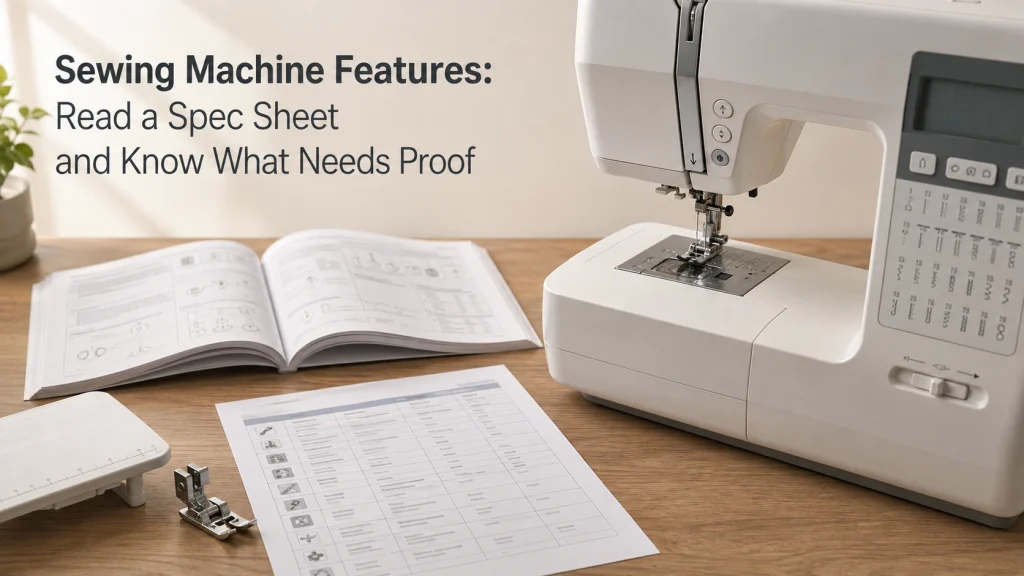
Two feature lists can look comparable when they are not
Sewing machine features often arrive as a wall of counts, measurements, and convenience labels, which makes a larger figure feel like the obvious winner. Current SINGER and bernette model pages show the problem clearly: one brand may separate stitch applications from built-in stitches, while another may emphasize stitch totals, right-of-needle space, speed, and speed limiting in a different vocabulary. The published fields are real, but they are not automatically comparable line by line.
The first useful move is therefore not to decide which list is longer. It is to normalize the field before comparing it. A buyer who first understands how a sewing machine works can separate the mechanism that forms and feeds a stitch from the controls, measurements, and conveniences wrapped around it. No hands-on ranking is being made here; the examples below are a documentation audit designed to show how to read claims before model comparison.
Treat the spec sheet as a pre-purchase evidence sheet
A specification list should answer a narrow question: what can be verified about this exact machine before you buy it? That is different from asking which machine is best or how to operate it. Mechanical and computerized machines may expose controls differently, but the same evidence rule applies: define the field, then check whether the manufacturer documents the behavior you care about.
This matters because labels can look more informative than they are. “Automatic,” “high speed,” “large workspace,” and “easy threading” can point to real features, but they do not tell you enough by themselves to compare two machines. The useful sewing machine specifications are the ones that can be tied to a defined action, a measurement, a known included item, or a manual instruction.
Sort every field before you compare it
Most spec-sheet lines fit into a small number of evidence types. Sorting them prevents a common mistake: comparing a measurable field on one machine with a marketing phrase on another as though both carry equal weight. It also keeps a convenience feature from being mistaken for a core sewing capability.
| Field type | Typical examples | What it can prove | What still needs checking |
|---|---|---|---|
| Measurement | Needle-to-tower space, machine dimensions, stitch width | A published physical dimension under the brand’s stated definition | Whether that dimension is the one that matters for your project |
| Control | Speed limiter, needle stop, reverse, start or stop button | That a specific user control exists | Its default state, operating limits, and interaction with other controls |
| Built-in capability | Stitch library, buttonhole program, lettering memory | That the machine contains the stated function or pattern set | How the brand counted it and which accessories or settings are required |
| Included item | Wide table, presser foot, hard cover | What the stated package includes | Whether the package varies by market, bundle, or seller |
| Convenience workflow | Needle threader, bobbin aid, thread cutter | That an assisted step is present | What the manual requires for correct use and where the assistance stops |
| Performance claim | Heavy-duty wording, smooth feeding, easy use, professional results | Only that the manufacturer makes the claim | Independent conditions or direct testing that can support the claim |
| Warranty or certification label | Warranty term, certification mark, country-of-origin wording | Only the exact term, mark, or origin statement that the manufacturer or responsible authority publishes | Coverage exclusions, registration requirements, regional applicability, and what the label does not prove about quality or durability |
Warranty terms and certification or origin labels belong in the same evidence discipline. Record the exact wording and applicable region, but do not treat a longer warranty, a certification mark, or a country-of-origin statement as automatic proof of better stitch quality, durability, or suitability for a particular project.
Part names also need to stay separate from feature claims. If a listing mentions a free arm, presser-foot lift, bobbin system, or feed control and you are not sure what component is being described, first identify the machine part and control. Once the physical reference is clear, the feature can be compared on its actual job instead of its label.
Verify the exact model page, then open the manual
The product page is useful for the manufacturer’s public feature list, but it should not be the last stop. The exact model manual is where control sequences, warnings, default behavior, accessory requirements, and model-specific limits are more likely to appear. A model family name is not enough when several machines share a casing or similar feature names.
One useful evidence anchor comes from the bernette b05 ACADEMY documentation: the manual index treats “Maximum sewing speed” and “Regulating the Speed” as separate entries. That distinction is small but important. A published top speed is a ceiling, while the way a user limits or regulates speed is a control behavior, so one number cannot stand in for the other.
| Source-labeled example | Published field | What the field proves | Next verification step |
|---|---|---|---|
| SINGER Quantum Stylist 9960 | 1,172 stitch applications, 600 built-in stitches, speed control, needle up/down | The brand distinguishes a counted application from a built-in stitch and lists separate controls | Use the exact manual for control behavior, defaults, and operating limits |
| bernette b05 ACADEMY | 30 stitches, space to the right of the needle, maximum speed, speed limit | The brand publishes measurements and speed-related fields separately | Resolve any wording or number discrepancy against the manual or brand support |
| Brother CS7000X | 70 built-in stitches, seven one-step auto-size buttonholes, adjustable sewing speed control, wide table | The page separates stitch count, buttonhole styles, a control, and an included item | Check the manual for how each control operates and what conditions apply |
The point of this ledger is not to reward the machine with the most filled cells. It is to keep unlike claims from collapsing into one score. If the product page and manual disagree, record the discrepancy instead of silently choosing the larger or more flattering figure.
Read workspace as geometry, not as one vague size
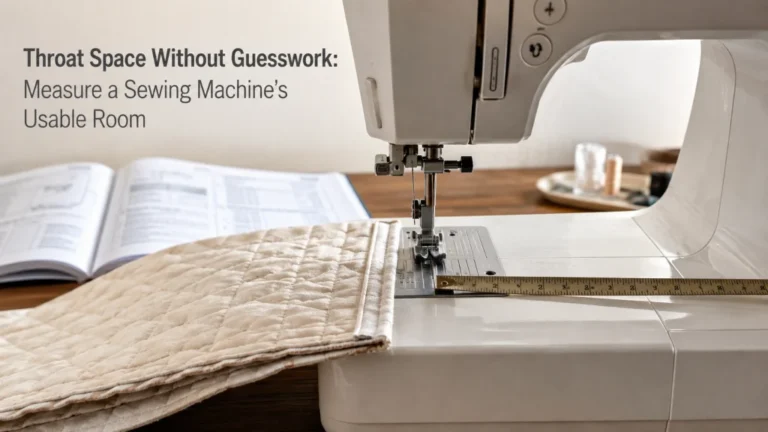
Workspace labels are a good example of why normalization matters. SINGER uses “sewing space (needle to tower)” on the 9960 page, while bernette uses “space to the right of the needle” for the b05 ACADEMY. Those phrases are close enough to invite comparison, but a buyer still needs to confirm the exact measurement direction and whether height, bed support, or an extension table matters for the intended work.
A first-time buyer can easily mistake overall machine width for usable room around the needle. The external case may be wide while the area to the right of the needle remains modest, or a machine may include a large table that supports fabric without increasing throat distance. For a deeper measurement breakdown, use the sewing machine throat space measurements rather than treating every “large workspace” label as the same specification.
Separate maximum speed from speed limiting and low-end control
Maximum stitches per minute describes a published upper rate, not how controllable a machine feels at the slow end. Both the SINGER and bernette examples in the verification ledger separate a maximum-speed field from a user-facing speed-control function. That separation is the evidence that matters here: top speed and speed limiting are different specifications.
This is one of the sewing machine features to look for when precision matters, but the useful question is not simply “Which number is higher?” Ask whether the machine offers a separate limiter, whether the foot control still governs speed within that limit, and what the manual says about the control. The difference between sewing speed and speed control deserves its own check because a maximum-rate figure cannot prove smooth low-speed behavior.
Reconcile stitch counts before treating them as capability
Stitch totals are especially easy to misread because manufacturers do not always count the same unit. SINGER’s 9960 documentation is a useful evidence anchor because it publishes built-in stitches and stitch applications as separate fields on the same model. The distinction itself is more important than repeating the totals: the two labels cannot be treated as interchangeable counts.
The same caution applies to alphabets, decorative patterns, utility stitches, functions, and buttonhole styles. A first-time owner may see a four-digit total and assume the machine contains four digits’ worth of unique selectable stitch patterns, when the brand may be counting applications or lettering outcomes differently. Before comparing totals, separate stitch applications from built-in stitches and write down exactly what each brand says it counted.

The SINGER Quantum Stylist 9960 is a computerized sewing and quilting machine with 600 built-in stitches and 1,172 stitch applications. It includes 13 presser feet, a large extension table, a hard cover, Class 15 bobbins, and additional sewing accessories. The machine also provides adjustable sewing speed, a start/stop button, an automatic needle threader, and 13 one-step buttonhole styles.
Check On AmazonIf you click this link and buy, we earn a commission at no additional cost to you.

The Brother XM2701 is a mechanical sewing machine with 27 built-in stitches and one automatic one-step auto-size buttonhole. It includes six sewing feet, including a buttonhole foot, plus a needle set, twin needle, bobbins, and other accessories. The machine also has an automatic needle threader, a drop-in top bobbin, a free arm, and dial-based stitch selection.
Check On AmazonIf you click this link and buy, we earn a commission at no additional cost to you.
Needle stop, start or stop, reverse, tie-off, and memory are separate controls
Computerized machines often place several buttons close together, which can make a feature list sound as though they are variations of one automation system. They are not. Needle up/down selects or changes the stopping position of the needle on models that support it, reverse commands backward sewing under the model’s defined conditions, and a start or stop button can provide motor control without relying on the foot control on machines designed for that use.
Tie-off or locking functions need their own manual check because the name does not guarantee the same stitch sequence across brands or stitch programs. Memory can mean something else again, such as remembering needle position, storing stitch sequences, or retaining a setting. When the feature list says only “memory” or “automatic lock,” treat it as an incomplete claim until the manual explains what is remembered or locked and under which stitch conditions.
Threaders, cutters, and bobbin aids describe workflows, not guarantees
A built-in needle threader can reduce a manual threading step, a thread cutter can trim threads, and a quick-set or drop-in bobbin system can change how the lower thread is prepared. None of those labels proves that every step is automatic or that the feature will work with every needle, thread, or setup. The manual should define the position, sequence, and restrictions for the exact model.
This is another place where first-time buyers can overread a short label. “Automatic needle threader” may sound like the machine threads the entire upper path, when the feature commonly assists only near the needle after the upper path has already been threaded correctly. Treat convenience wording as a workflow map: identify which step is assisted, which steps remain manual, and what setup the mechanism requires.

The Brother HC1850 is a computerized sewing and quilting machine with 185 built-in stitches, including 55 alphanumeric stitches and eight one-step auto-size buttonholes. Its Amazon listing includes an advanced needle threader, a jam-resistant drop-in top bobbin, and an LCD stitch-selection display. The package also includes a wide table, eight sewing feet, a manual, and additional sewing accessories.
Check On AmazonIf you click this link and buy, we earn a commission at no additional cost to you.
Separate built-in capability, included accessories, and optional compatibility
A feature can be built into the machine, supplied in the box, or available only through a compatible accessory. Those are three different ownership facts. Brother lists the CS7000X with a wide table and multiple accessory feet in the package, while its product specifications separately describe built-in stitches and machine functions.
Do not convert an included foot into proof that every similarly named foot will fit, and do not assume an optional accessory is included because a marketing image shows it. Compatibility must be verified for the exact machine and interface using the manufacturer accessory list, manual, or exact part reference. Visual similarity and generic accessory names are not evidence of fit.
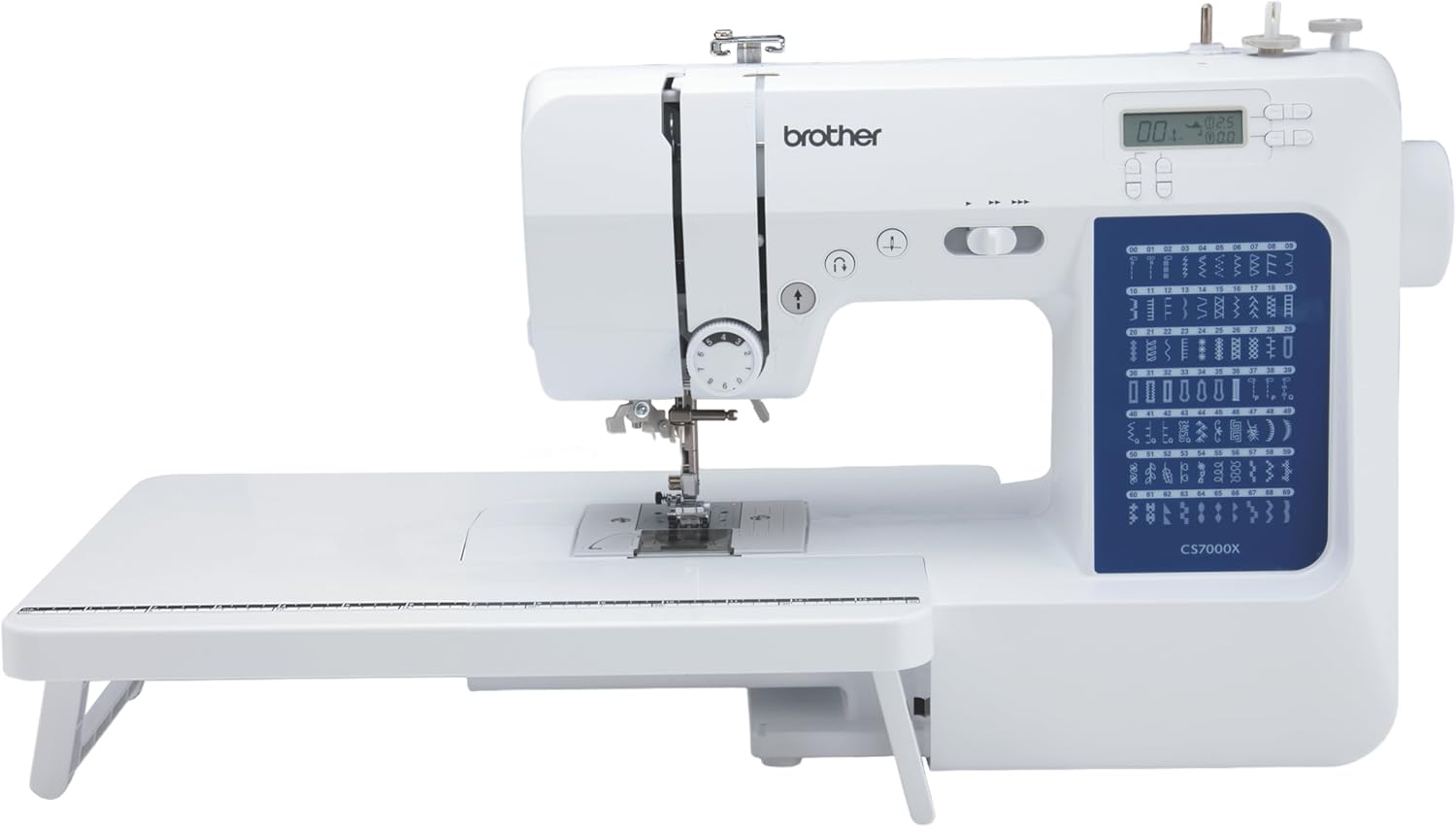
The Brother CS7000X is a computerized sewing and quilting machine with 70 built-in stitches and seven one-step auto-size buttonholes. The package includes a wide table, 10 sewing feet, a quilt guide, a protective hard case, and a trilingual user manual. Its Amazon listing also documents an automatic needle threader, a drop-in top bobbin, and an enlarged needle-to-arm workspace.
Check On AmazonIf you click this link and buy, we earn a commission at no additional cost to you.
Mark the claims a spec sheet cannot prove
A feature list can verify presence, count, dimensions, and certain control functions. It cannot by itself prove stitch quality on your fabric, heavy-material capacity, long-term durability, reliability, ease of use, or how smoothly the machine feeds a difficult layer transition. Even a metal-frame statement or a high maximum speed does not establish those outcomes without evidence under relevant conditions.
Independent testing can help when the machine, fabric, thread, needle, settings, and test conditions are disclosed, but one successful project still does not create a universal capability claim. Material performance also depends on the full sewing system, including needle, thread, presser foot, feed behavior, layer stack, and setup. If a seller page says “heavy duty” or “professional results,” record the wording as a claim until more specific evidence supports what it means.
Key point: A specification tells you what is documented. A performance claim needs evidence that matches the task you actually plan to sew.
This distinction protects both sides of the buying decision. It prevents a modest machine from being dismissed because it has a shorter feature list, and it prevents an expensive feature-rich machine from being credited with capability that its specifications never proved.
Build a project-to-evidence sheet before comparing models
Once the labels are normalized, connect them to the work you actually expect the machine to do. A garment sewer who regularly pivots at corners may care about needle-stop control; someone handling broad pieces may care more about right-of-needle space and fabric support; a beginner who wants deliberate pace control may care about a maximum-speed limiter. None of those needs requires the highest stitch count.
Use a short worksheet for every candidate so the same evidence question is asked each time. This keeps a heavily marketed field from taking over the comparison simply because one brand prints it more prominently.
- Project: name the real work, such as garment construction, mending, piecing, or another domestic machine-sewing task.
- Needed job: state what the machine must do, such as provide adequate right-of-needle room, sew a one-step buttonhole, or limit maximum speed.
- Published evidence: copy the exact field name, value, unit, and package statement from the exact model page.
- Manual check: record the control sequence, default state, limitation, required foot, or safety instruction that changes how the feature works.
- Still unknown: flag stitch quality, material behavior, control feel, noise, or another outcome that the documents do not establish.
- Decision status: mark the field verified, unresolved, irrelevant to the project, or requiring a hands-on check.
A useful comparison sheet will sometimes show that a field does not matter. Removing irrelevant numbers makes the later buying decision more specific and keeps attention on features that serve the projects, controls, workspace, or ownership setup you actually need.
Use a claim-to-evidence worksheet for ambiguous wording
When a term sounds impressive but remains fuzzy, rewrite it as a testable question. “Large workspace” becomes “What exact distance is measured from the needle to the machine body, and is an extension table included?” “High speed” becomes “What is the published maximum rate, and is there a separate maximum-speed control?” This conversion turns promotional language into something you can verify.
| Claim on the page | Evidence question | Acceptable proof | Do not infer |
|---|---|---|---|
| Large workspace | What dimension is being measured? | Exact model measurement with direction and unit | That overall machine size equals usable sewing room |
| High speed | What is the maximum rate, and can it be limited? | Published stitches-per-minute figure plus control documentation | Good low-speed control or stronger material handling |
| Hundreds of stitches | What exactly is counted? | Brand definition of built-in stitches, applications, alphabets, or styles | That every count is a unique selectable utility stitch |
| Automatic threading | Which threading step is assisted? | Exact manual sequence for the threading device | That the full upper thread path is automatic |
| Heavy duty | What tested material, stack, needle, thread, and settings support the claim? | Documented conditions from a suitable test or precise manufacturer limit | Universal thick-material capacity or durability |
The worksheet also exposes internal inconsistencies. If one page gives conflicting units, counts, or maximums, do not average them or pick the larger figure. Mark the field unresolved and use the exact manual or manufacturer support before carrying the number into a comparison.
Final Thoughts: Compare verified jobs, not the largest numbers
A useful spec sheet comparison is deliberately boring in the best way: each field has a definition, a source, a unit when needed, and a clear reason it matters to the project. Once stitch counts, workspace, speed, controls, and package contents have been normalized, many impressive-looking differences either become meaningful or disappear.
Carry only verified facts into the model-comparison stage, and keep unknown performance claims marked as unknown. If a control or accessory affects operation or safety, follow the exact model manual rather than a generic instruction. That gives you a cleaner buying decision without pretending that the machine with the longest feature list is automatically the better fit.
FAQs
Spec-sheet questions usually become easier once the reader separates counts, measurements, controls, and package contents. The answers below keep those categories separate so a short product-page label does not turn into a broader claim than the evidence supports.
🧵 How many stitches do I actually need on a sewing machine?
Start with the stitches required by your real projects, not the largest published total. Check whether the brand is counting built-in stitches, applications, alphabets, buttonhole styles, or another unit before comparing numbers.
📏 Is throat space the same as sewing-machine size?
No. Overall machine dimensions describe the outside footprint, while throat or right-of-needle space describes a working dimension around the needle area. Check the manufacturer’s measurement definition before comparing two figures.
🎚️ Does a higher maximum sewing speed mean better speed control?
No. Maximum stitches per minute is an upper-rate specification, while a speed limiter or slider is a user control. Low-speed behavior may still require a manual check or hands-on evaluation.
🪡 Does an automatic needle threader thread the whole machine?
Do not assume that from the label. On many domestic machines, the device assists the final step near the needle while the upper thread path is still prepared by the user. Follow the exact model manual for the sequence and restrictions.
🦶 Are all presser feet shown on a product page included?
Not necessarily. Separate the stated box contents from optional compatible accessories and from items shown in promotional photography. Verify the exact package and exact machine compatibility before treating a foot as included or usable.
⚙️ Can a spec sheet prove that a machine handles heavy fabric well?
Not by feature count, frame wording, speed, or price alone. Material behavior depends on the exact machine, layer stack, needle, thread, presser foot, feed conditions, settings, and test conditions, so look for evidence that matches the intended work.
If a feature still cannot be translated into a defined job, measurement, control, or included item after checking the manual, treat it as unresolved marketing language. That is safer than turning an attractive phrase into an unsupported capability claim.
References and Sources
This article uses official model documentation because the central question is how manufacturers label, count, and define their own specifications. The sources below support the model-specific examples used in the field register and control checks.
- SINGER Quantum Stylist 9960: verifies SINGER’s separate stitch-application and built-in-stitch counts, sewing-space label, speed figure, speed control, needle-stop control, and included items.
- bernette b05 ACADEMY: verifies the brand’s stitch count, right-of-needle space, maximum-speed field, speed-limiting feature, and included equipment.
- bernette b05 ACADEMY manual: verifies that maximum sewing speed and speed regulation are documented as separate manual topics.
- Brother CS7000X: verifies built-in stitch count, buttonhole styles, adjustable speed control, included accessory feet, and wide-table package information.
These sources establish what the manufacturers publish for the named models. They do not, by themselves, prove long-term durability, universal material capacity, stitch quality on every fabric, or how a control will feel to a particular user.
Explore more sewing machine feature topics
The broad spec sheet becomes easier to read when the most frequently confused fields are checked one at a time. These focused topics expand the measurement and terminology issues that are too detailed to settle with a single line on a product page.
| Topic | What you’ll find |
|---|---|
| Sewing Machine Throat Space | How to distinguish usable right-of-needle room from overall machine size and table support. |
| Sewing Machine Speed Control | How maximum sewing speed differs from a control that limits or regulates that speed. |
| Stitch Applications vs Built-In Stitches | How brand-specific counting language can make stitch totals look more comparable than they are. |
| One-Step vs Four-Step Buttonholes | How the step label describes workflow without proving identical automation across machines. |
Use those checks only when the field matters to your project. The goal is not to collect every available feature, but to remove ambiguity from the features that could actually change your decision.