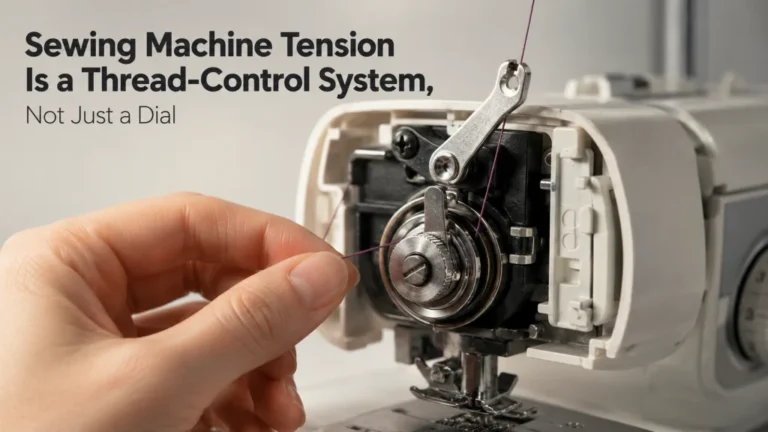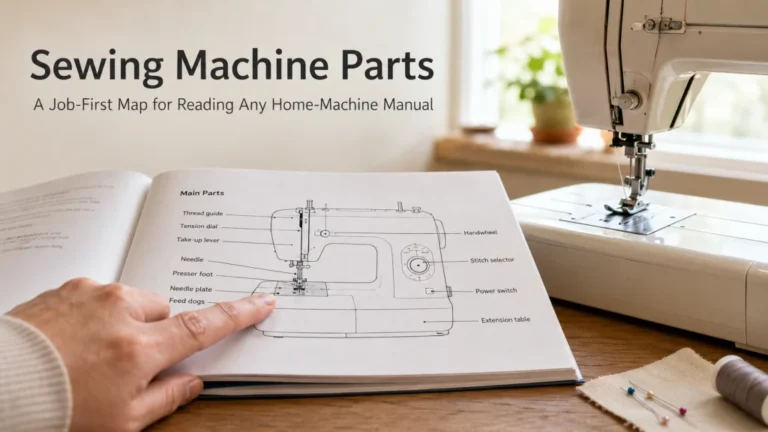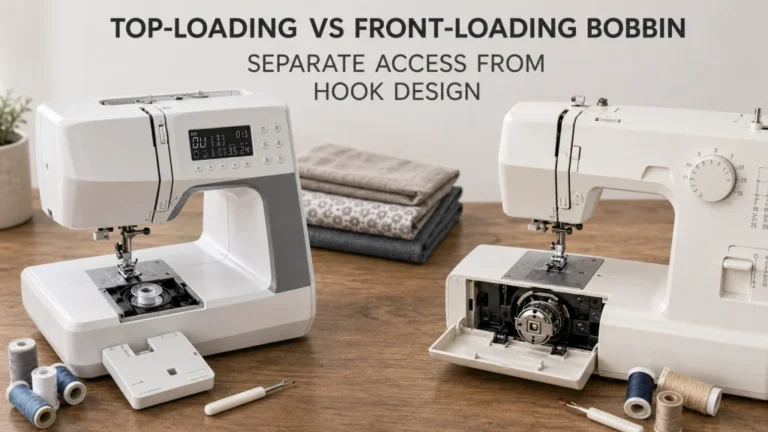
A 1-step buttonhole and a 4-step buttonhole can produce the same basic feature while assigning different parts of the sequence to the machine and the operator. The useful pre-purchase questions are who advances the stages, how the buttonhole length is established, which foot the exact model requires, and whether that foot is actually included. A 1-step label can describe automatic stage progression without proving automatic sizing, stored repetition, or better results on every fabric. Read the exact model documentation before treating either label as a complete description of the buttonhole system.
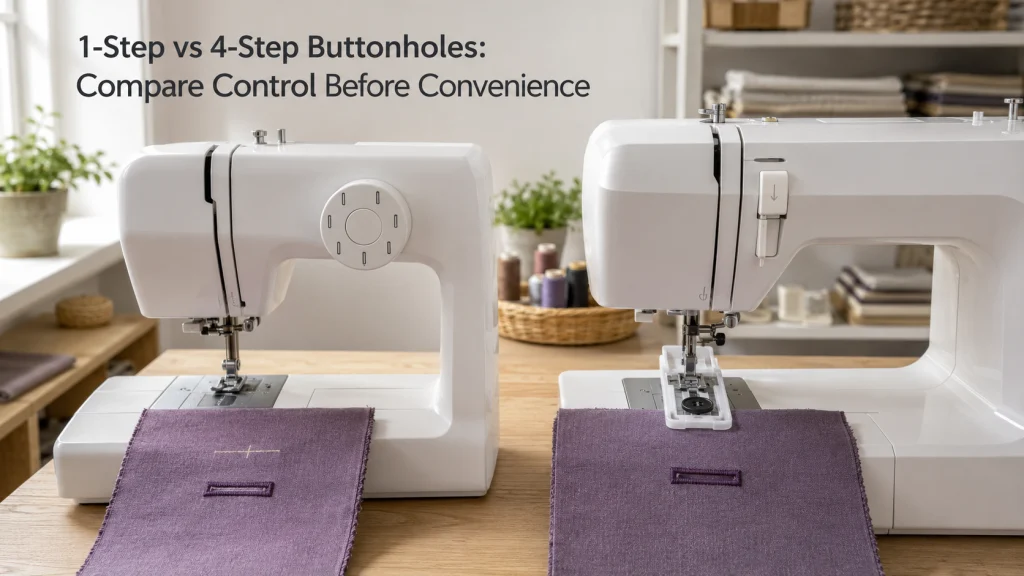
Same Buttonhole Task, Different Stage Responsibility
The 1-step vs 4-step buttonhole comparison is best understood as a division of responsibility, not a contest between good and bad systems. Singer’s M1500 documents four stages on the Stitch Selector Dial, while the Simple 3337 documents a one-step system that uses the button in the buttonhole foot as the size reference. Both specifications describe how the machine organizes the same basic task. What changes is how much stage advancement and size control the operator must handle.
That difference matters before purchase because labels such as “automatic,” “one-step,” and “four-step” can hide separate questions. One machine may advance the sequence automatically but still rely on a particular foot and lever, while another requires the operator to move a selector through marked stages. Neither label tells you how many styles exist, whether a size can be stored, or how a particular fabric will sew. For wider context, compare documented sewing machine features before using one convenience term as a buying shortcut.
Keep the Comparison at the Pre-Purchase Feature Level
This comparison is about what a specification requires from the operator before you choose a machine. It does not tell you which stitch length to use, how to position a specific fabric, how to stabilize a buttonhole, or what to change when the result looks poor. Those operating decisions belong to the machine manual and to a separate sewing procedure. Keeping that boundary clear makes the feature label more useful because you can compare workflow without pretending that one setting applies to every machine and material.
The purchase question is narrower: what will you have to control each time you make a buttonhole on this model? Look for stage progression, size reference, required foot, included accessories, number of buttonhole styles, and any repeat or memory behavior the manual actually names. Then separate those facts from marketing phrases about ease, consistency, or professional-looking results. A machine can offer a more automated sequence while still requiring careful setup after it is purchased.
Map Who Advances Each Stage in a Documented 4-Step System
Singer’s four-step support description tells the user to mark the intended buttonhole area and use the Stitch Selector Dial for the four stages. The M1500 page likewise shows four buttonhole steps on that dial. At the feature level, the operator moves through those stage selections instead of relying on one continuous automatic progression. The machine forms the selected stage, while the operator decides when to advance.
That architecture does not automatically mean the operator has more useful creative control. It means stage progression is more explicitly manual on the documented system. A buyer who dislikes switching stages may value a one-step workflow, while another may be comfortable with a four-position selector for occasional buttonholes. The specification shows the sequence burden, but personal preference still depends on the exact controls and manual.
When a page calls the feature easy, separate that adjective from the mechanism. The concrete fact is that four stages are selected separately. If the model page and manual disagree, review the current manufacturer documentation. Do not borrow another machine’s procedure just because the label matches.

The SINGER Heavy Duty 4411 is a mechanical sewing machine with 11 built-in stitches, 69 stitch applications, and a four-step buttonhole. It includes general purpose, zipper, buttonhole, and button sewing presser feet along with standard sewing accessories. The machine also provides adjustable stitch length and width, adjustable presser foot pressure, a top drop-in bobbin, and sewing speeds up to 1,100 stitches per minute.
Check On AmazonIf you click this link and buy, we earn a commission at no additional cost to you.
Map Who Advances Each Stage in a Documented 1-Step System
On the Singer Simple 3337, the documentation says the button goes in the buttonhole foot and the machine sizes the buttonhole to it. Singer’s one-step support page also describes a foot that measures the button. The operator therefore does not select four separate stages during the cycle. The machine coordinates progression after the model-specific setup establishes the mode and size reference.
That is a meaningful convenience difference, but the label still leaves several details open. One-step systems can use different foot geometry, lever arrangements, size references, or menu controls, even when the feature name looks identical. Mechanical and computerized machines may therefore reach the same broad workflow through different hardware. Use the feature name as a starting point, then check how that specific machine handles the foot, lever, screen, or selector.
The operator-versus-machine distinction makes the feature comparable without ranking models. A four-step system leaves more stage advancement with the operator, while this one-step example moves progression into the machine. That may matter for repeated buttonholes, but it does not predict final stitch quality. Real results still depend on the machine, material, foot, setup, and an actual test.

The Brother XM2701 is a mechanical sewing machine with 27 built-in stitches and an automatic one-step buttonhole. It includes six quick-change sewing feet, including a buttonhole foot, zipper foot, blind stitch foot, and button sewing foot. The machine also has an automatic needle threader, jam-resistant drop-in top bobbin, free arm, and automatic bobbin winding system.
Check On AmazonIf you click this link and buy, we earn a commission at no additional cost to you.
Verify How the Exact Model Establishes Buttonhole Length
Buttonhole length is easy to lose when a feature sheet compresses the system into a step-count label. Singer’s four-step support material tells the user to mark the intended buttonhole area before sewing. That puts the length reference in the operator’s marked work rather than in a button-measuring foot. On the Simple 3337, the product page says the button goes in the foot so the machine can size the buttonhole to that reference.
Do not assume the same split applies to every machine with the same step-count label. Another one-step system may use a different sensor, foot, screen value, or reference, and another four-step machine may handle the endpoint differently. Identify the method the manual describes for that machine. If a page says “automatic buttonhole” but never explains length, leave sizing unanswered rather than borrowing it from another model.
| Documentation field | Question to answer before purchase |
|---|---|
| Stage progression | Does the operator change stages, or does the machine advance them? |
| Length reference | Is length marked, measured from a button, entered, sensed, or established another documented way? |
| Required control | Does the system require a selector dial, buttonhole lever, menu, sensor, or another named control? |
| Required foot | Which exact foot does the manual name for the buttonhole system? |
This checklist keeps “automatic” from swallowing several separate mechanisms. Automatic stage progression and automatic length establishment can exist together, but one does not prove the other. A page that documents both gives you a clearer workflow than one that lists only a one-step badge. Record the fields separately so later comparisons use the same questions.

The Brother XR3774 is a sewing and quilting machine with 37 built-in stitches and a one-step buttonhole. Its built-in buttonholer is designed to create custom-sized buttonholes based on the button size. The package also includes a wide table, eight sewing feet, an automatic needle threader, a drop-in top bobbin, and free-arm capability.
Check On AmazonIf you click this link and buy, we earn a commission at no additional cost to you.
Verify the Required Foot and Whether It Is Included
A buttonhole specification is incomplete if you do not know which foot the system expects. Singer lists a Buttonhole Foot with both the M1500 and Simple 3337, so a buyer can verify that the named accessory is included with those machines. That does not make the two feet interchangeable, and it does not establish compatibility with any replacement sold under the same generic name. It only confirms that the required accessory type is part of each listed package.
The same check matters on any other model because neither step-count label guarantees the required foot is in the box or that a generic substitute will fit. Read the included-accessory list beside the buttonhole section and make sure the names line up. If a foot is optional, unavailable, or identified by a specific part number, that affects ownership even though the step count stays the same. Replacement-foot compatibility is a separate machine-interface question and should not be guessed from visual similarity.

The Brother HC1850 is a computerized sewing and quilting machine with 185 built-in stitches, including eight auto-size buttonhole styles and 55 alphanumeric stitches. Its accessory package includes eight sewing and quilting feet, including a dedicated buttonhole foot. The machine also includes an LCD display, wide table, advanced needle threader, and drop-in top bobbin.
Check On AmazonIf you click this link and buy, we earn a commission at no additional cost to you.
Separate Number of Steps From Number of Buttonhole Styles
Step count describes how the sequence advances, while style count describes how many distinct buttonhole patterns or programs the machine offers. A one-step system can have one style or several styles without changing what the progression label means. A four-step specification likewise leaves the number of available buttonhole styles unanswered. Keep the two fields separate in your notes.
Buttonhole entries can also appear inside a machine’s larger stitch count. A page may count one buttonhole as a built-in stitch, list several styles, or use a broader applications number. To reconcile those totals, use stitch applications and built-in stitch counts rather than treating step count as another stitch-library number. The number four in “4-step” means workflow stages, not four selectable styles.
Key point: “1-step,” “4-step,” and “four buttonhole styles” answer different questions. Step count describes progression through one buttonhole cycle, while style count describes the number of buttonhole patterns or programs the documentation makes available.
Keeping those numbers apart prevents a larger-looking specification from winning for the wrong reason. A buyer needing one ordinary buttonhole may care more about sizing and the included foot than about a long style list. Another buyer may need multiple styles, but that is a separate requirement. The feature sheet becomes easier to read once each number has one job.

The SINGER Quantum Stylist 9960 is a computerized sewing and quilting machine with 600 built-in stitches and 1,172 stitch applications. It provides 13 fully automatic one-step buttonhole styles, including keyhole designs, and includes a buttonhole foot among its 13 presser feet. The machine also features built-in lettering, speed control, a start and stop button, an extension table, and a top drop-in bobbin.
Check On AmazonIf you click this link and buy, we earn a commission at no additional cost to you.
Separate Automatic Progression, Automatic Sizing, and Memorized Repetition
“Automatic” is too broad to use as one comparison field. Automatic progression means the machine advances through the stages without separate operator selections. Automatic sizing means the machine establishes length from a documented reference such as a button, sensor, or entered value. Memorized repetition means it can retain a size or program for another buttonhole, and that capability needs explicit documentation.
The Simple 3337 shows why these fields should be split. Its page documents a one-step cycle and button-in-foot sizing, but that does not prove stored size memory. Singer also makes consistency claims for one-step systems, which remain manufacturer claims rather than independent tests. If repeat memory matters, look for that exact behavior instead of assuming it from the label.
| Feature term | What must be verified |
|---|---|
| Automatic progression | The machine advances through the documented buttonhole stages without four separate stage selections. |
| Automatic sizing | The documentation explains how the system establishes length from a button, sensor, entered value, or other reference. |
| Memorized repetition | The manual explicitly states that a size or buttonhole program can be retained or repeated. |
| Consistency claim | Identify whether it is manufacturer language or a controlled independent finding. |
Give each term its own line in your notes. That prevents “automatic” from receiving credit for three functions when only one is documented. It also gives you a place to write “not stated” instead of guessing. Unknown is better than an invented feature.
A 1-Step Label Does Not Prove Better Results on a Specific Fabric
One-step automation changes workflow, but the material remains part of the sewing system. Buttonhole formation can still depend on the machine, foot, fabric stack, support material, thread, needle, settings, and feed behavior. The step label says nothing about those conditions. A more automated sequence therefore cannot predict the same result on every fabric.
The same caution applies to four-step claims. Singer uses consistency language for both four-step and one-step buttonhole systems, which shows why the adjective cannot be treated as a result of step count alone. A manufacturer statement can describe the intended benefit of a feature, but it is not the same as a controlled comparison. Without a test that names the machine, foot, button, fabric stack, support material, thread, settings, repetitions, and results, compare workflow rather than declaring one architecture more precise.
A product page still tells you what the machine is designed to automate. Real sewing conditions are a different question and need a result test. Treat convenience language as purchase context, then reserve performance conclusions for evidence gathered under the conditions that matter to you. That keeps the feature comparison useful without asking the label to predict fabric behavior.
Build a Manual-Check List Before Accepting Automatic or Consistent Claims
A short evidence checklist is more useful than a feature badge when machines use different buttonhole language. Start with the exact model page, then confirm the mechanism in the instruction manual or current manufacturer support material. Record stage progression, length reference, required foot, included accessories, style count, and repeat behavior. Keep marketing claims separate so they do not quietly become mechanical facts.
- Exact machine model and full model suffix, if one is shown.
- Buttonhole label used by the manufacturer: 1-step, 4-step, automatic, or another term.
- Who advances the stages during the documented cycle.
- How buttonhole length is established.
- Exact foot or other accessory named for the system.
- Whether that required accessory is included with the machine.
- Number of buttonhole styles, recorded separately from step count.
- Any documented memory or repeat function, recorded separately from automatic progression.
- Any operating restriction that the manual says must be followed.
After filling those fields, the label becomes much less ambiguous. You can see whether one-step means progression only, progression plus button-referenced sizing, or a system with additional documented behavior. You can also see what a four-step system asks the operator to manage instead of reducing it to manual control. That level of detail is worth carrying into a later buying decision.
The checklist also exposes missing information before it becomes an assumption. If the page names a one-step buttonhole but omits the sizing method, write that omission down. If the manual names a foot that the package list does not show, verify the package before purchase. A blank field is a reason to check, not a reason to guess.
Used and discontinued machines need the same discipline when the current product page has disappeared. Search the manufacturer’s support archive for the full model number, look for an archived PDF manual from the brand, and contact manufacturer support if the buttonhole mechanism or required foot is still unclear. A reseller description or an unlabeled photo can help identify what to investigate, but neither should become the final proof of how the system advances or sizes a buttonhole. If the original documentation cannot be found, record the missing field as unknown rather than borrowing instructions from a similar-looking model.
Keep Buttonhole Workflow Separate From Stitch-Count Terminology
Buttonholes can create confusing numbers because one feature sheet may show built-in stitches, stitch applications, buttonhole styles, and buttonhole step count. Those numbers are not interchangeable units. A four-step buttonhole does not add four built-in stitches merely because the operator moves through four stages. A one-step label also does not reveal whether the buttonhole is counted as one pattern, one style, or part of a broader applications total.
Normalize the stitch library first, then record buttonhole workflow as its own feature. The article on reconciling stitch application counts explains why brand-defined totals need their own audit. Here, the question is how the buttonhole system advances and establishes size. Keeping those subjects separate prevents a count problem from distorting a control-and-convenience decision.
This separation is especially useful when a feature sheet mixes several numbers in one block. Copy each number into a field with its own definition before comparing machines. Do not let the largest visible number become the default winner. Buttonhole workflow belongs beside control features, not inside a raw stitch-total contest.
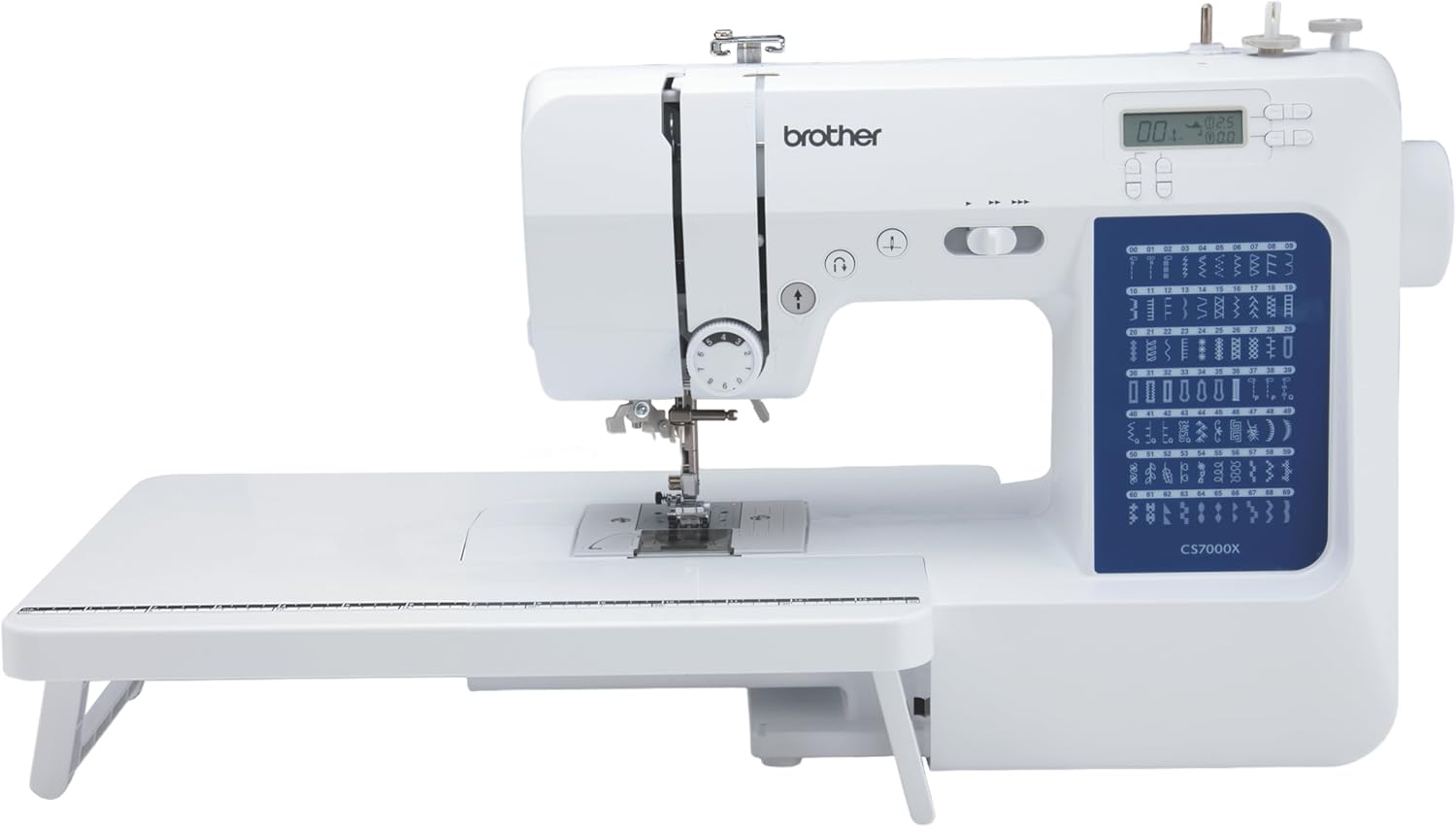
The Brother CS7000X is a computerized sewing and quilting machine with 70 built-in stitches and seven one-step auto-size buttonholes. Its stitch library includes utility, decorative, heirloom, and quilting functions as separate selectable options. The machine also includes a wide table, 10 sewing feet, a quilt guide, an automatic needle threader, a drop-in top bobbin, and a larger needle-to-arm workspace.
Check On AmazonIf you click this link and buy, we earn a commission at no additional cost to you.
Keep Setup and Test Sewing Out of the Feature Comparison
Once you own the machine, buttonhole success becomes a setup and test-sewing question rather than a specification-reading question. The manual may prescribe a particular foot position, lever movement, stitch setting, stabilizing method, or test procedure. Those instructions matter because machines with the same one-step or four-step label can still differ in controls and restrictions. Do not borrow an operating sequence from another machine simply because its feature sheet uses the same terminology.
The same boundary applies when something goes wrong. A skipped section, uneven density, jam, needle strike, or early stop does not establish that either architecture is inherently defective. It is a symptom that needs the machine, setup, material, foot, and manual context before diagnosis. Stop after a hard needle strike or abnormal contact, and never force a lever, foot, or selector that is not moving as described.
Use the Buttonhole Label as One Part of the Machine’s Control System
Buttonhole architecture makes more sense beside the rest of the machine’s controls. A mechanical model may use a selector dial and lever, while a computerized model can use a menu or sensor workflow even if both are labeled one-step. The label describes only one layer of the control system. For a broader mechanical frame, understand how sewing machine controls work before assuming the same words imply the same hardware.
This is also why beginner suitability cannot be reduced to step count. One person may value a one-step system because it removes manual stage changes, while another may prefer a simple four-position dial that keeps each stage visible. Screen layout, lever placement, labeling, foot handling, and manual clarity can change the learning curve without changing the step count. Compare the actual interface instead of treating one label as a universal proxy for ease.
For a first machine, clarity can matter as much as automation. One buyer may prefer a visible four-step dial, while another prefers fewer stage changes. The specification cannot settle that preference. It can only identify the controls worth checking before purchase.

The Janome JW8100 is a computerized sewing and quilting machine with 100 built-in stitches and seven one-step buttonholes. Its LCD screen and control buttons are used for stitch selection and adjustments, while a start and stop button and speed control slider provide additional operating controls. The package also includes an extension table, even feed foot, quarter-inch foot, hard cover, and standard sewing accessories.
Check On AmazonIf you click this link and buy, we earn a commission at no additional cost to you.
Final Thoughts: Verify Stages, Sizing, and Foot Before Trusting the Label
A 1-step buttonhole can reduce operator involvement in stage progression, while a 4-step system can require separate stage selections. That distinction is useful, but it is only the first comparison field. The exact model still needs to document length, required foot or control, included accessories, style count, and any repeat memory. Once those fields are separated, words such as “automatic” become easier to evaluate.
Do not use step count to predict stitch quality, fabric performance, precision, or beginner success. Use it to understand workflow, then leave settings and real results to the exact manual and a controlled test after purchase. If buttonhole entries confuse the machine’s stitch totals, normalize those counts separately. The useful purchase note is what the operator does and what the machine actually automates.
FAQs
🧵 What does a 1-step buttonhole mean?
It generally means the machine progresses through the buttonhole cycle without the operator selecting four separate stages. The exact sizing method, foot, lever, sensor, or menu still depends on the model documentation.
🎛️ What does a 4-step buttonhole mean?
It means the documented buttonhole workflow is divided into four stages that the operator advances through. On Singer examples such as the M1500 and 4411, those stages are shown on the Stitch Selector Dial.
📏 Does every 1-step buttonhole automatically size itself to a button?
No universal rule should be assumed from the label alone. Some documented systems use a button in the foot as the size reference, but the exact model manual must confirm how length is established.
🦶 Does a 1-step machine always include the required buttonhole foot?
Not necessarily. Check the exact model’s included-accessory list and manual rather than assuming the required foot is packaged with every machine that advertises a one-step buttonhole.
🔢 Is a 4-step buttonhole the same as four buttonhole styles?
No. Four-step describes stage progression through a buttonhole cycle, while four buttonhole styles would describe four distinct selectable patterns or programs.
💾 Does 1-step mean the machine remembers the buttonhole size?
No. Automatic stage progression, automatic sizing, and memorized repetition are separate features. Only count memory or repeat behavior when the exact manual explicitly documents it.
References and Sources
- Singer M1500 product specifications: Confirms the four-step label, dial stages, and included Buttonhole Foot.
- Singer Simple 3337 product specifications: Confirms the one-step system, button sizing, and included Buttonhole Foot.
- Singer four-step buttonhole support: Supports marked length and operator-controlled stage progression.
- Singer one-step buttonhole support: Supports button-measuring foot sizing and one-step progression.