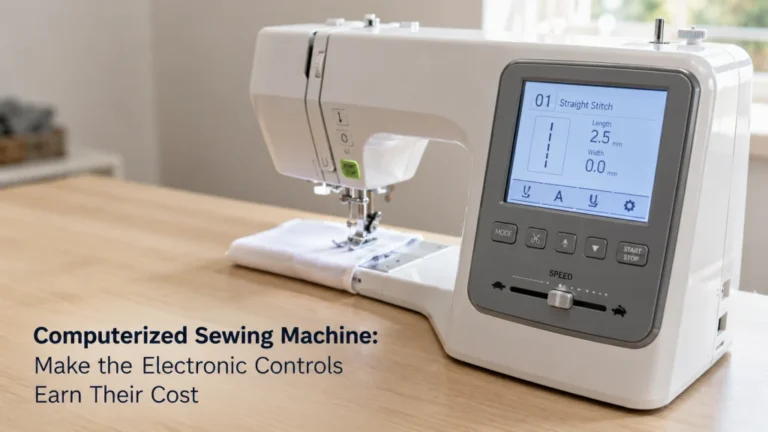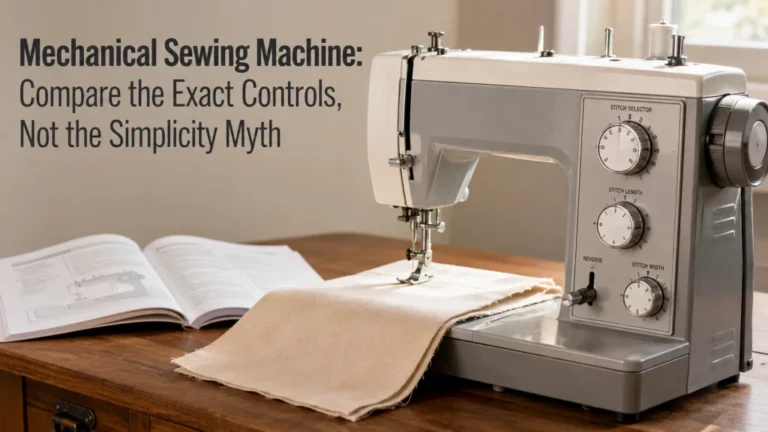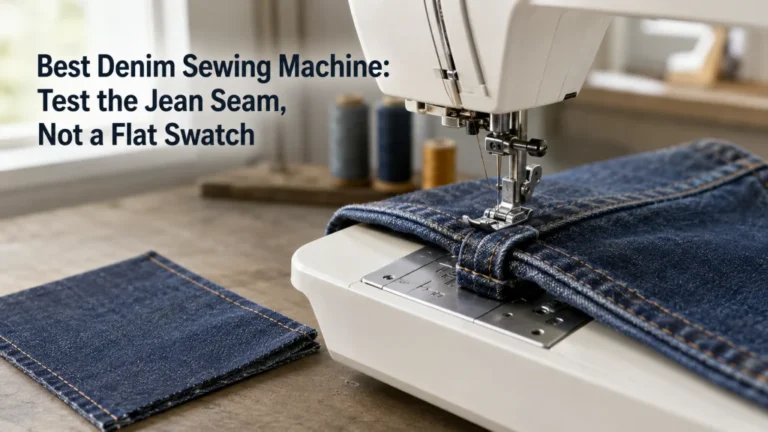
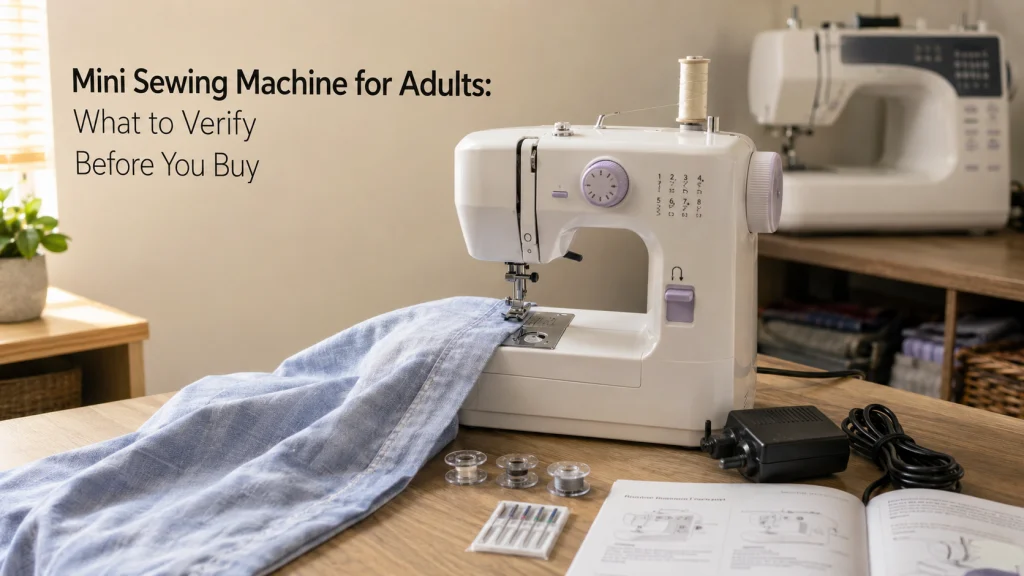
A mini sewing machine can make sense for an adult who needs a small tabletop machine for occasional light repairs, but size alone does not tell you whether the machine can form, control, and secure the stitch your task requires. The useful buying test is to identify the exact model, check its stitch system, controls, consumables, workspace, power setup, manual, and support path, then compare those limits with the repair you actually plan to do. A compact listing that cannot document those basics is not a safer bargain just because it is inexpensive or easy to store. For many buyers, the correct result will be a reduced tabletop machine for a narrow job, a normal portable domestic machine for broader sewing, or no purchase at all.
Mini is not one standardized machine class
Put a branded compact mending machine beside a tiny generic tabletop machine and a lightweight domestic machine and they can look like three sizes of the same idea. They are not. A mini sewing machine search can mix reduced tabletop machines, small mending-oriented models, child-oriented products, handheld stitchers, and ordinary portable domestic machines, even though those products may differ in stitch formation, controls, consumables, workspace, and support.
That is why a useful mini sewing machine recommendation should begin with the job you need done rather than a ranked list. Someone resewing one split pillowcase seam should not have to shop as if they are outfitting a full sewing room. That job is different from hemming jeans, making regular alterations, or starting complete projects. If the work needs normal domestic capability, compare it with portable sewing machine capability, not the smallest marketplace listing.
Define the repair or seam before shopping
Start with the exact work, not with the machine footprint. Write down the material, the seam or repair, whether the work is flat or tubular, how often you expect to sew, and whether you need to reverse, change stitch type, alter stitch settings, or guide a bulky area under the presser foot. That task description becomes the minimum capability test for every listing you consider.
A first-time buyer can easily misunderstand “basic repair” as one universal workload. Reseaming a light woven pillowcase is not the same job as crossing a thick jeans hem, sewing a bag strap intersection, or handling a stretchy knit edge. A small machine should only pass because its documented capabilities match the named job, not because the listing calls it suitable for beginners or mending.
- Name the exact repair or seam you expect to sew.
- Identify the fabric and any bulky seam intersections.
- Decide whether reverse or another documented securing method is required.
- Note whether cuffs, sleeves, pant hems, or other tubular areas matter.
- Decide how much setup, storage, and support you are willing to accept.
Once that list is specific, vague claims such as “perfect for quick fixes” become much less persuasive. The machine either documents the functions your task needs or it does not.
Separate a full portable machine, reduced tabletop mini, and handheld tool
These three formats solve different ownership problems. A normal portable domestic machine is still intended to provide a recognizable domestic sewing platform, even when it is light enough to store or carry. A reduced tabletop mini gives up some physical space or capability to stay smaller, while a handheld tool is operated against the work in a different geometry and may use a different stitch system entirely.
| Format | Best question to ask | Main qualification risk |
|---|---|---|
| Full portable domestic machine | Does it retain the controls and sewing functions I expect from a normal home machine? | Assuming lightweight means reduced capability without checking the actual model |
| Reduced tabletop mini or mending machine | Does the documented stitch and control envelope cover my narrow repair task? | Accepting size and price as proof that it is suitable |
| Handheld stitching tool | Does its stitch system and operating geometry fit this specific quick repair? | Treating it as a substitute for a tabletop domestic machine |
If your decision is specifically about a hand-operated stitcher, use the separate explanation of handheld sewing machine limits. Keeping the formats separate prevents a tiny tool, a reduced tabletop machine, and a normal lightweight domestic machine from being judged by the same standard.
Verify the exact model identity before trusting a listing
Model identity is the first evidence check because every later claim depends on it. A photo, shell shape, seller title, or generic phrase such as “portable mini machine” does not prove the stitch system, bobbin class, needle requirement, controls, included power equipment, or replacement support. Look for a manufacturer name, exact model designation, matching manual, and a product record that describes the same machine you are buying.
Generic marketplace products deserve extra caution when several sellers appear to use the same photos but provide different feature claims. Visual similarity is not enough to conclude that the machines have the same internals or consumables. If the listing cannot be tied to a stable model record, leave unsupported technical details in the unknown column rather than filling the gaps yourself.
- Exact manufacturer or responsible brand name
- Exact model designation
- Manual that matches that model
- Documented stitch types and controls
- Documented needle and bobbin information where applicable
- Clear power and start-control information
- Support, return, and replacement-consumable path
A listing that fails this identity check should normally fail before you begin comparing cosmetic features. The point is not to demand a famous brand, but to demand enough evidence to know what equipment you are actually buying.
Verify how the stitch is formed and secured from documentation
The stitch system matters more than the number printed beside a product image. Check what stitch or stitches the exact machine actually makes, how the seam is secured, and which controls are adjustable. If that information is missing, do not assume the machine behaves like a standard domestic lockstitch machine simply because it has a needle, presser foot, and tabletop shape.
One documented reduced mending machine provides a useful evidence example without serving as a product recommendation. The manufacturer’s product record for the SINGER M1000 lists four built-in stitches, Class 15 transparent bobbins, adjustable tension, a reverse lever, and a 4.25-inch needle-to-tower sewing space. Those specifics show the level of documentation a buyer can use to judge a task, while a visually similar generic listing may not establish any of the same facts.
Upper and lower thread where applicable
For a machine that documents a bobbin-based stitch system, verify the bobbin type and how the upper and lower threads are managed. Do not buy replacement bobbins because they look close enough in a product photo. Exact class, dimensions, and model compatibility matter because a near match can still interfere with stitch formation or feeding.
If a small machine uses a different stitch architecture, judge it by that architecture instead of forcing domestic lockstitch assumptions onto it. The buying question is whether the documented stitch is appropriate for the seam you need to make and whether you can obtain the correct consumables afterward.
Reverse or another securing method
A straight seam is only useful if you know how its ends are meant to be secured. Many adult buyers assume every tabletop machine includes a familiar reverse lever, but that function should be verified on the exact model. If reverse is absent, the documentation should make the intended securing method clear enough for your task.
This matters even for a short repair. A few inches of stitching on a side seam still needs a controlled beginning and end, so “it sews a straight line” is not a complete capability description.
Tension and stitch controls
Check which settings are genuinely adjustable and which are preset. Adjustable tension, stitch selection, stitch length, stitch width, and needle position are separate controls, and a machine may offer some while fixing others. A beginner does not automatically need every adjustment, but the required control should exist when the material or seam depends on it.
For example, a buyer doing occasional stable woven repairs may accept preset settings if the documented task range fits. Someone expecting to move among varied fabrics and seam types may reach the limit much sooner, which is a sign to compare mechanical and computerized machine controls within a normal domestic format instead.
| Evidence item | What to verify | Fail condition |
|---|---|---|
| Stitch formation | Exact documented stitch system | Listing gives only vague “sewing” language |
| Securing | Reverse or another documented method | No clear way to secure the seam ends |
| Tension | Whether tension is adjustable or preset | Control behavior cannot be verified |
| Stitch settings | Which length, width, or stitch options exist | Required setting is absent or unknown |
This ledger keeps the decision tied to the actual seam. A large stitch count is not a substitute for one required function that the machine cannot document.

Sew Mighty Mighty Multi is a compact sewing machine with 12 pre-programmed stitch patterns, including a four-step buttonhole. It provides forward and reverse sewing, dual-speed operation, thread tension control, automatic bobbin winding, and a built-in free arm. The machine includes a foot pedal and 110V AC adapter and can also operate on four AA batteries.
Check On AmazonIf you click this link and buy, we earn a commission at no additional cost to you.
Check needles, bobbins, feet, and replacement consumables
A small purchase can become unusable if routine consumables are unclear or difficult to replace. Check the exact needle system or manufacturer-specified needle, bobbin class where the machine uses bobbins, and the attachment method for any presser foot you expect to change. Generic product names and visual similarity do not prove fit.
This is also where ownership cost becomes more useful than purchase price alone. A low-cost machine with unclear bobbins, an unusual power component, or no stable support path may create more friction than a slightly larger machine that uses easy-to-identify consumables. Before buying, make sure the items you will actually wear, lose, or replace can be identified for the exact model.
Think one step beyond the checkout price. If ordinary needles and bobbins are easy to identify, routine upkeep stays predictable; if a proprietary cord, foot control, or obscure consumable cannot be replaced, a minor loss or failure can end the machine’s useful life. For an occasional-use mini, that replacement path can matter more than saving a small amount on the initial purchase.
- Needle system or exact manufacturer needle guidance
- Bobbin class and material where applicable
- Presser-foot or holder interface if feet are changeable
- Power cord, adapter, pedal, or other start-control replacement path
- Manual and support access for setup and routine maintenance
The checklist is intentionally plain because these are ordinary ownership items. If you cannot identify them before purchase, the machine is already asking you to accept avoidable uncertainty.
Audit power, pedal or start control, and speed options
Small machines can differ in how they are powered and started, so check the exact setup rather than assuming a conventional foot pedal is included. Check the manual or stable product record for the power source, included cord or adapter, pedal or push-button control, and any speed selection. These details affect both usability and replacement support.
A start button may suit a compact setup, while a foot control may feel more familiar. Neither is automatically better. What matters is whether the control method gives you manageable start, stop, and speed behavior for the repair.
Measure the usable workspace and the real storage benefit
A reduced machine is not useful merely because its outside dimensions are smaller. Measure storage space, but also consider the sewing area around the needle, room to guide fabric, control placement, and whether tubular work can be handled. A tiny shell can still be awkward if the project has nowhere to rest.
A person who only repairs a shirt seam or pillowcase may accept a narrow work area because the material remains easy to control. The same workspace can become restrictive when a larger garment, curtain panel, bag body, or bulky intersection has to move around the needle. Storage savings only count when the machine still leaves enough working geometry for the named task.
Read the manual before accepting beginner-friendly claims
“Beginner-friendly” is marketing language until the documentation shows what setup actually requires. Read the threading sequence, bobbin instructions where applicable, needle replacement procedure, control descriptions, troubleshooting section, and maintenance limits. If a machine looks simple but the manual is missing, unclear, or does not match the exact model, simplicity has not been established.
The manual also sets the owner-service boundary. Follow the exact instructions for unplugging the machine during needle, bobbin, cleaning, or other user-serviceable work when required. Stop using the machine and move to qualified service or replacement evaluation for damaged power parts, uncontrolled movement, excessive heat, smoke, a burning odor, a hard mechanical jam, or repeated hard needle strikes.
When the machine arrives, do a simple first-use check before trusting it with the actual repair. Confirm that the machine and included controls match the listing, thread it exactly as the manual shows, install only the specified needle and bobbin, and sew on a scrap of the same general fabric type before moving to the real seam. You are not trying to prove long-term durability from one sample; you are checking that the delivered machine matches its instructions and can complete the basic operation you bought it for.
If the machine will not form a stable stitch on that scrap after correct setup, or if the controls behave differently from the manual, use the seller or manufacturer support and return path rather than improvising internal adjustments. That keeps the first-use check at owner level and avoids turning a new-machine problem into an unsupported repair attempt.
Reject generic listings whose model or support cannot be verified
A generic product does not fail merely because it is generic. It fails when the seller cannot establish the facts needed for your decision. If you cannot verify the model, manual, stitch system, securing method, consumables, power arrangement, or return path, then the low price is being offered together with technical uncertainty.
Marketplace claims should be treated as seller claims unless a stable technical source supports them. Do not infer fabric thickness, layer capacity, durability, motor strength, or long-term repairability from photos, star ratings, or words such as “heavy duty.” For a narrow occasional task, documented modest capability is more useful than ambitious but unverified promises.
Set a task pass-fail requirement
Turn the purchase into a simple decision test. The machine must document the stitch, seam-securing method, controls, consumables, workspace, and power setup that your named task needs. If one required item is missing, the machine fails for that task even if it is attractive, inexpensive, or small enough to fit in a drawer.
| Outcome | Pass condition |
|---|---|
| Reduced tabletop mini | The exact narrow task fits the documented stitch, controls, workspace, consumables, and support limits. |
| Full portable domestic machine | The job needs broader domestic capability, more working room, or more flexible controls. |
| Handheld tool | The repair geometry and documented stitch system fit a genuinely narrow quick-fix use. |
| No purchase | The need is too occasional, the product cannot be verified, or borrowing, service, or another method is more sensible. |
This pass-fail method prevents feature creep in both directions. You do not need to buy a full-featured machine for one tiny repair, but you also do not need to accept an under-documented mini simply because your intended use sounds modest.
Check an unfamiliar listing before you trust it
When you find a mini machine you have never seen before, work backward from the listing instead of accepting the feature bullets at face value. Copy the exact brand and model name, look for a matching manual or support page, and compare the photos, controls, power setup, and stated stitch functions across those records. If the seller calls the machine by one model name but the manual, packaging, or control layout points to something else, stop there until the identity is clear.
Next, separate claims you can confirm from claims that are only promotional. A statement such as “two speed settings” should match the controls shown in the manual or product record, while phrases such as “great for all fabrics” or “heavy-duty performance” need stronger evidence before they influence the decision. This simple cross-check is especially useful with marketplace listings that reuse similar photos, because it lets you reject uncertainty without needing to know the product in advance.
Choose a full portable machine when the job needs normal domestic capability
Move away from the reduced tabletop format when your task list keeps expanding. Garment construction, varied materials, repeated alterations, larger pieces, multiple stitch requirements, or more demanding control needs are signs that compact storage should not be the dominant criterion. A normal portable domestic machine can still be easy to move and store without being defined mainly by reduced capability.
This is also the better direction when you are buying your first machine and expect sewing to grow beyond emergency repairs. The broader comparison of sewing machine choices for home use can help you judge controls, task fit, workspace, support, and ownership cost without treating “smallest” as the primary goal.
Choose handheld only when its narrow repair geometry fits
A handheld tool is not simply a tabletop mini with the base removed. The way it is held against the material, the stitch system it uses, how the stitch is secured, and how fabric is supported can all change the job it handles comfortably. It should therefore be judged as its own tool type.
If the repair is genuinely small, accessible, and compatible with the documented stitch method, the handheld format may solve a narrow problem. If you are expecting ordinary domestic-machine behavior, regular garment work, or stable control over longer seams, the format mismatch matters more than the storage advantage.

Janome Arctic Crystal is a mechanical sewing machine with 15 built-in stitches and a four-step buttonhole. It provides adjustable stitch length and zigzag width, a three-piece feed dog, free-arm sewing, and dial stitch selection. The package includes general-purpose, blind-hem, buttonhole, and zipper feet along with bobbins, needles, a seam ripper, and an instruction manual.
Check On AmazonIf you click this link and buy, we earn a commission at no additional cost to you.
Consider borrowing, repair service, or hand sewing instead
Sometimes the most sensible answer is not another machine in the closet. For one seam, one light alteration, or another one-off fix, borrowing a working machine or paying for service may cost less in money, storage, setup, and maintenance. Hand sewing can also be reasonable for a very small repair.
The ownership question remains simple: does buying a machine solve enough recurring work to justify it? A no-purchase result is especially sensible when the mini under consideration leaves its model, stitch behavior, consumables, or support unclear.

SINGER Stitch Quick+ is a portable mending machine with two-thread stitch capability for handheld or tabletop use. It runs on four AA batteries and has an ergonomic handle, on-off control, and built-in storage for sewing notions. This bundle includes bobbins, thread spools, machine needles, a needle threader, seam ripper, and drawstring storage bag.
Check On AmazonIf you click this link and buy, we earn a commission at no additional cost to you.
Final Thoughts: a no-purchase result is better than a false mini winner
A mini sewing machine for adults should be qualified by the job it can document, not by how little space it occupies or how inexpensive the listing appears. Start with the repair, then verify exact model identity, stitch formation, seam securing, controls, consumables, power setup, workspace, manual, and support. If those pieces line up with a narrow occasional task, a reduced tabletop machine can be a rational choice.
If the work needs broader domestic capability, choose the format that supports that work instead of forcing it into a mini-machine purchase. If the listing cannot prove what the machine is or how it is supported, reject it. The most useful buying decision is the one that matches the actual seam, even when that decision is to buy nothing.
FAQs
🧵 Is a mini sewing machine good enough for basic repairs?
It can be if the exact repair fits the machine’s documented stitch, securing method, controls, workspace, and material limits. Do not treat “basic repair” as proof that every mini model is suitable.
🪡 Can an adult use a mini sewing machine as a first machine?
Yes, but only when the buyer accepts the reduced format and the exact model can document the required functions. If you expect to move into regular garment sewing or varied projects, a normal domestic machine usually gives you a more appropriate capability baseline.
🔁 Does every mini sewing machine have reverse?
No assumption should be made from size or appearance. Verify reverse or another documented seam-securing method on the exact model before buying.
🧶 Do mini sewing machines use normal bobbins and needles?
Some use familiar domestic consumables, while others may not. Check the exact model manual or product documentation for the needle system and bobbin class instead of buying by appearance.
👖 Can a mini sewing machine hem jeans?
Do not assume it can. A jeans hem can create a bulky seam intersection, so the exact machine must document suitable material capability and the setup must match the fabric, needle, thread, and seam stack.
📦 Is a portable sewing machine the same as a mini sewing machine?
No. A portable domestic machine can retain normal home-machine functions while simply being light or compact, whereas a mini or mending-oriented tabletop machine may be deliberately reduced in workspace or capability.
References and Sources
An exact-model source is necessary here because the article uses a documented machine as an evidence example rather than relying on generic listing language.
- SINGER M1000 product record: Supports the exact-model evidence example for built-in stitches, Class 15 transparent bobbins, adjustable tension, reverse control, and sewing-space dimensions.
This source is included because the article uses exact model specifications as an example of the documentation a buyer should require. Marketplace descriptions and community opinions are not used here as technical proof.