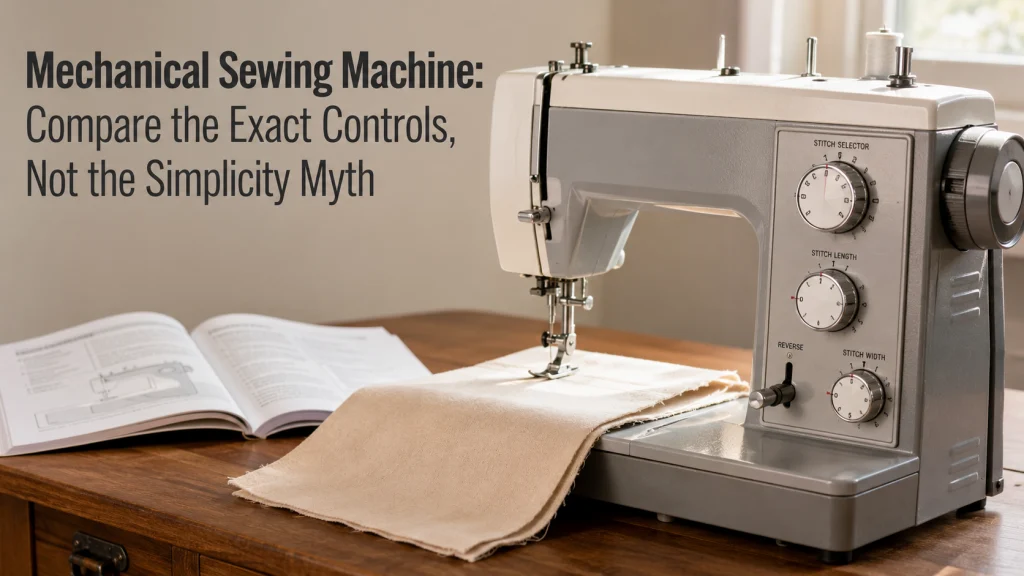
A mechanical sewing machine gives you direct physical controls, but that label does not tell you how many useful adjustments, feed controls, buttonhole steps, or support options a specific model provides. The practical way to choose is to write down the controls you actually need, verify them against the exact current model page and manual, then audition the finalists with your own fabric and normal sewing tasks. Current mechanical machines can differ sharply even when they look similar from the front. Treat durability, repairability, and material capacity as separate questions that need model-specific evidence.
Mechanical narrows the interface, not the buying decision
A mechanical sewing machine can be a sensible choice when you prefer direct dials, levers, and foot-pedal control instead of a screen and electronic selection buttons. What the word does not tell you is whether the machine has adjustable presser-foot pressure, drop feed, a built-in needle threader, a one-step buttonhole, a hard cover, or a control layout you actually like using.
That distinction matters because two current machines can both be called mechanical while asking very different things from the user. One may make a buttonhole in four manually selected stages, while another completes the sequence in one step; one may include a needle threader and another may not. Before comparing brands or stitch counts, decide which of those differences would change your everyday sewing.
Confirm that a mechanical control platform is actually wanted
If you have already compared mechanical and computerized machine controls, the next question is more specific: which direct controls do you want to operate by hand every time you sew? A preference for dials may be strong enough to settle the interface choice, but it should not automatically settle the exact machine.
Mechanical also should not be used as shorthand for all-metal construction, low service cost, easy repair, long life, or beginner-proof operation. Those claims require evidence for the exact model and service situation. Mechanical sewing machine recommendations are more useful when they name the actual controls and limitations instead of treating the entire family as one durability tier.
Write the minimum stitch and adjustment requirements
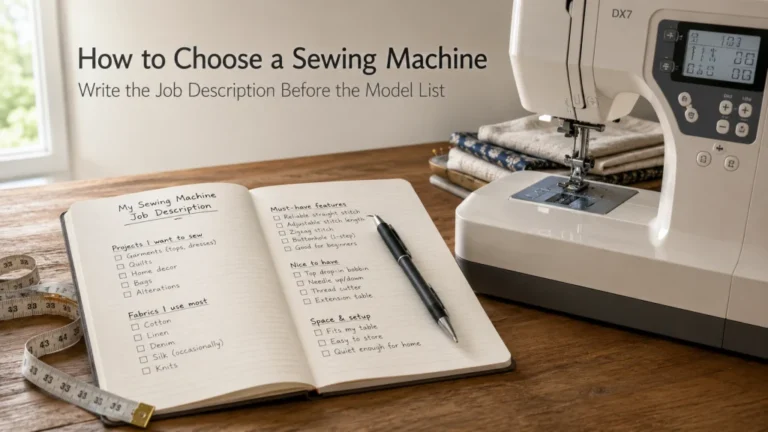
Start with a requirement sheet before looking at a model list. This prevents a long stitch menu or a familiar brand name from distracting you from the functions that affect your normal projects. The best mechanical sewing machine for one buyer can be a poor match for another because the useful controls depend on the fabric, buttonholes, portability, and adjustment habits involved.
- Required utility stitches, such as straight stitch, zigzag, stretch options, blind hem, or overcasting.
- Whether stitch length and width need independent adjustment.
- Whether a one-step buttonhole is worth prioritizing over a four-step process.
- Whether adjustable presser-foot pressure matters for the range of fabrics you actually sew.
- Whether you need drop feed for a specific technique rather than simply wanting the feature on a checklist.
- Whether a built-in needle threader, free arm, hard cover, or lower machine weight changes day-to-day use.
Keep this list short enough to be decisive. A first-time owner, for example, may assume more built-in stitches always means a more capable machine, when a smaller stitch set with the needed length, width, pressure, and buttonhole controls may fit the actual sewing better.
Compare the controls used every session
Controls deserve more weight than headline stitch totals because they shape repeated actions: selecting a stitch, changing its dimensions, reversing, winding a bobbin, and making a buttonhole. A machine can have a modest stitch library and still provide the adjustments you use constantly, while a larger library may include many stitches you rarely select.
Look at the exact front panel and the manual together. The panel tells you what is physically accessible; the manual tells you the sequence, control ranges, and any conditions attached to those settings.
Stitch selection and adjustment
Verify whether stitch selection uses one dial, multiple dials, push buttons, or another direct mechanism. Then check how stitch length and width are adjusted and whether straight-stitch needle position can be moved. A buyer who routinely topstitches close to an edge may care more about needle-position control than about twenty additional decorative patterns. The machine page should be treated as a starting point, not a substitute for the exact manual.
Reverse and bobbin winding
Reverse is usually simple, but its control position and behavior still affect how natural the machine feels in use. Bobbin winding deserves the same attention because the setup may require moving the handwheel, disengaging drive, routing thread through a separate tension path, or following another model-specific sequence. During an audition, wind one bobbin rather than only sewing on a pre-threaded demonstration machine. That small test exposes a control routine you will repeat for the life of the machine.
One-step versus four-step buttonhole
A four-step buttonhole asks the user to move through separate stages, while a one-step system automates more of the sequence with the appropriate foot and setup. Neither method proves better stitch quality by itself. If you sew shirts, dresses, bags, or other projects with repeated buttonholes, the difference may be worth testing because it changes the amount of manual sequencing. If buttonholes are rare, this feature may rank below pressure adjustment, feed control, or portability.
| Evidence example | Buttonhole control | Other adjustment evidence |
|---|---|---|
| Janome Sewist 709 | Four-step | Adjustable foot pressure and drop feed |
| Janome Sewist 721 | Four-step | Adjustable foot pressure, drop feed, built-in needle threader |
| Janome Sewist 725S | One-step | Adjustable foot pressure, drop feed, built-in needle threader |
| SINGER Elite ME457 | One-step | Adjustable presser-foot pressure, drop feed, built-in needle threader |
| PFAFF Select 4.2 | Buttonhole foot documented; verify exact sequence in the manual | Adjustable stitch width, adjustable needle positions, Original IDT feed system |
The comparison is useful because the buttonhole method and adjustment controls can eliminate a model before stitch count or brand reputation enters the decision. Where the current product page does not establish the exact buttonhole sequence, leave that field unresolved until the manual confirms it.
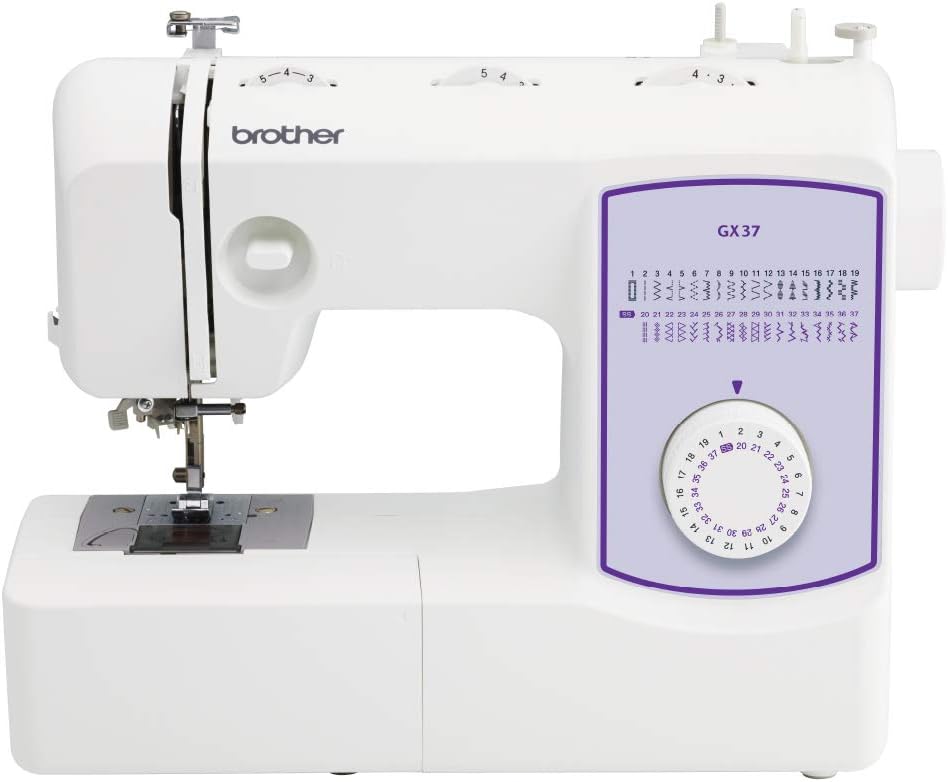
Brother GX37 is a mechanical sewing machine with 37 built-in utility and decorative stitches and an automatic one-step buttonhole. Stitch selection is controlled with a dial, and the machine includes an automatic needle threader and a jam-resistant drop-in top bobbin. It comes with six sewing feet, a needle set, bobbins, a foot controller, a soft dust cover, and operation guides.
Check On AmazonIf you click this link and buy, we earn a commission at no additional cost to you.
Verify fabric-control features without inferring capacity
Fabric-control features can help with specific situations, but they do not prove that a machine can sew every thick, slippery, fine, or layered material. The useful question is what the control changes and whether the exact manual supports using it for the sewing condition in front of you.
This is where marketing language causes trouble. Motor wording, frame material, an extra-high foot lift, or a mechanical control layout can describe a real feature without proving long-term performance on a particular material stack.
Presser-foot pressure
Adjustable presser-foot pressure changes how firmly the foot presses the fabric against the feed system. That can be relevant when moving between ordinary woven cotton and a substantially different fabric behavior, but the useful range and recommended settings are model-specific. If this control is on your requirement sheet, confirm that it exists and locate the manual instructions before buying. Do not treat its presence as proof that difficult fabric will automatically feed well.
Drop feed
Drop feed lets the feed dogs move out of their normal fabric-advancing role for techniques that require that configuration. The mechanism may be controlled by a lever in a location that is not obvious from product photographs. Check how the feed dogs are lowered and, just as important, how they are returned to normal sewing. A feature you cannot conveniently reach may matter more in practice than its appearance on a specification list.
Extra-high lift or leveling aids where documented
An extra-high presser-foot position can create more room to place a bulky area under the foot, but clearance is not the same as verified sewing capacity. A thick denim seam intersection, for example, changes the geometry under the foot and can affect feeding even when the fabric physically fits underneath. Leveling aids can help the foot approach a height change more evenly when the exact machine and accessory instructions support their use. Judge the complete needle, thread, presser-foot, feed, and material setup rather than one clearance feature.

Brother ST371HD is a mechanical sewing machine with 37 built-in stitches and a one-step auto-size buttonhole. It has an automatic needle threader, a Quick-Set drop-in top bobbin, drop feed, and a metal needle plate designed for smoother fabric feeding. The package includes six sewing feet, including nonstick, zipper, blind-stitch, buttonhole, and button-sewing feet.
Check On AmazonIf you click this link and buy, we earn a commission at no additional cost to you.
Compare bobbin access, workspace, weight, and cover
These details sound secondary until the machine has to live in a real room. A top-loading bobbin can change how you monitor and replace the bobbin, while free-arm access affects tubular areas such as cuffs and pant legs. Workspace measurements matter if you regularly manage larger fabric sections to the right of the needle.
Weight and cover type matter differently. A machine that is carried to classes or stored after every session creates a different ownership problem from one that stays permanently on a sewing table. Record the published machine weight and included cover, then test the actual lift, handle, and storage routine if portability is important.
Read the exact manual before accepting simple-to-use claims
Simple-looking controls can still hide model-specific sequences for threading, bobbin winding, buttonholes, feed changes, pressure settings, and presser-foot replacement. The manual is where those sequences become concrete. It also shows which maintenance tasks are owner-level and which warnings apply around the needle, power supply, foot control, and moving parts.
Current documentation can even expose inconsistencies that a quick comparison table would miss. At the time of this review, Janome’s Sewist 721 page describes one stitch total in its overview and a different total in its specification area, which is a reason to verify the manual instead of forcing a questionable number into a ranking. When the manufacturer documentation does not line up cleanly, mark the field for verification rather than guessing.
Separate construction facts from durability predictions
A manufacturer may document a metal frame, a particular feed system, a maximum speed, or another construction detail. Those are facts about the design when the source is current and specific. They are not, by themselves, evidence that the machine will last longer, cost less to repair, or tolerate every demanding project.
This distinction protects the buyer from one of the most persistent shortcuts in this market. A simple interface can be a genuine preference without needing an unsupported story about what will happen ten years later.
Check warranty, parts, and the actual service route
Warranty length is only one part of ownership support. Check who provides warranty service, whether proof of purchase is required, whether coverage depends on the seller or dealer channel, and how you would obtain model-specific parts or support where you live. A strong feature list is less reassuring if the service path is unclear before purchase.
Janome’s current US warranty information, for example, directs owners through authorized dealers for covered service and notes purchase and transfer conditions. Other manufacturers use different terms and support routes, so do not carry one brand’s process over to another. For any machine, stop using it and follow the exact manual or qualified service route for a damaged cord or pedal, uncontrolled motion, overheating, smoke, a burning odor, a hard jam, or repeated hard needle strikes.
Set the shortlist evidence threshold
A model should not survive the shortlist because a retailer description sounds confident. Keep a field ledger and mark each item as verified, unresolved, or not required for your sewing. This makes missing information visible instead of letting an assumption quietly become a buying reason.
| Field | Acceptable evidence | Do not substitute |
|---|---|---|
| Stitches and adjustment ranges | Exact current model page and manual | Family-level marketing copy |
| Buttonhole process | Exact manual sequence and included foot | A photo of a buttonhole symbol |
| Pressure or feed controls | Exact control listed and explained | A claim that the machine handles many fabrics |
| Weight, workspace, and cover | Current manufacturer specifications | Visual estimates from product photos |
| Warranty and service | Current US warranty and support terms | Brand reputation or old forum posts |
| Durability and repairability | Model-specific evidence with conditions | The word mechanical |
The same rule applies to availability and package contents because both can change. If a field matters to your decision and cannot be verified, leave it unresolved and ask the dealer or manufacturer before treating the machine as a finalist.
Current mechanical shortlist by buyer requirement
The table below is an evidence exercise, not a product ranking or a recommendation to buy a particular machine. It uses current manufacturer documentation to show how machines inside the same broad control family can differ enough to change a shortlist.
| Current evidence example | Documented differences worth noticing | Audition or verification still required | Exclude if |
|---|---|---|---|
| Janome Sewist 709 | 9 stitches, four-step buttonhole, adjustable foot pressure, drop feed, no built-in needle threader, 14.8 lb, no cover listed | Control feel, buttonhole workflow, low-speed response, normal project fabrics | A built-in needle threader or included cover is mandatory |
| Janome Sewist 721 | Four-step buttonhole, adjustable foot pressure, drop feed, built-in needle threader, 14.8 lb, hard cover | Resolve the current stitch-count discrepancy against the manual, then test the control sequence | A one-step buttonhole is mandatory |
| Janome Sewist 725S | 23 stitches, one-step buttonhole, adjustable foot pressure, drop feed, built-in needle threader, 14.8 lb, hard cover | Buttonhole setup, control feel, project fabrics, transport routine | Your requirements do not justify the extra functions you would be paying for |
| SINGER Elite ME457 | 32 built-in stitches, one-step buttonhole, adjustable presser-foot pressure, drop feed, built-in needle threader, top drop-in bobbin | Control feel, low-speed response, buttonhole workflow, current package, and local service route | A required control remains unverified or its interface does not suit your normal sewing |
| PFAFF Select 4.2 | 40 stitches, built-in needle threader, adjustable needle positions, mechanical speed control, Original IDT feed system, 24.25 lb, 6.8 in sewing space | Exact buttonhole process, any pressure or feed-lowering requirement, service route, handling at the machine’s higher weight | Portability is a priority or an unverified required control cannot be confirmed |
The useful pattern is not which row has the largest number. It is how quickly a requirement can eliminate a model. If you need a one-step buttonhole, a built-in threader, a lighter carry weight, or a particular feed control, the shortlist should shrink before any brand reputation enters the decision.
If two finalists still meet every mandatory requirement, use price only after comparing what the exact offer includes and what you would need to add immediately. When the remaining differences do not matter to your sewing, the lower verified purchase cost can break the tie without inventing a quality advantage for either brand. If one machine still has an unresolved control, service, or compatibility field, price should not erase that uncertainty.
List the audition still required for each finalist
Documentation can prove that a control exists, but it cannot tell you whether you like the force, spacing, sound, pedal response, or sequence of using it. An audition should therefore test the exact actions that remain uncertain after the specification review.
- Thread the machine from the beginning using the manual, not a pre-threaded floor sample.
- Wind and insert a bobbin, then confirm that the process is clear without improvising.
- Sew straight stitch and zigzag on your normal stable fabric with an appropriate needle and thread.
- Change stitch length and width, use reverse, and test the lowest controllable sewing speed.
- Make one complete buttonhole using the exact included foot and documented sequence.
- If pressure adjustment matters, locate the control and confirm the manual’s intended use.
- If portability matters, lift and carry the machine in the way you would at home or for class.
Bring the fabric that represents your ordinary sewing rather than an extreme sample chosen to make the machine prove a point. If you commonly cross a bulky seam intersection, include one realistic test piece with the needle and thread you would normally use, then judge the whole feed behavior rather than assuming an extra-high foot position answers the question.
Compare computerized models only when a specific electronic control remains valuable
Once the mechanical shortlist is built, there is no need to reopen the entire machine-type debate unless an electronic feature still solves a real problem. A programmable needle stop, electronic speed limiting, direct stitch selection, or another control may be valuable enough to justify reconsidering the interface choice for a particular buyer.
If that happens, compare the missing function rather than starting over with vague claims about simplicity or sophistication. The computerized sewing machine control checklist is the appropriate next comparison when a specific electronic function remains unresolved, while the broader sewing machine selection framework can reset the decision if the project, budget, or ownership priorities have changed.
Use the heavy-duty comparison when branding or capacity is the unresolved question
A buyer who mainly wants a mechanical interface is asking a different question from a buyer whose priority is a machine marketed for heavier work. The words heavy duty can introduce claims about motor strength, speed, frame construction, and fabric capacity that need their own evidence and should not be folded into a general mechanical shortlist.
If that label or material capacity is what will decide the purchase, move to the heavy-duty sewing machine comparison. Do not infer capacity from the mechanical label, a metal-frame claim, or the fact that thick fabric can physically fit under the presser foot.

SINGER Heavy Duty 4423 is a mechanical sewing machine with 23 built-in stitches, 97 stitch applications, and a one-step buttonhole. The listing specifies sewing speeds up to 1,100 stitches per minute, a metal frame, adjustable presser-foot pressure, and an automatic needle threader. Included accessories include all-purpose, zipper, buttonhole, and button-sewing feet, bobbins, needles, a quilting guide, and a soft dust cover.
Check On AmazonIf you click this link and buy, we earn a commission at no additional cost to you.
Final Thoughts: choose the exact mechanical model, not the family reputation
A mechanical machine is a control preference, not a quality certificate. The useful buying process is to define the stitches and adjustments you need, verify each field against the exact current documentation, remove any model that misses a requirement, and then audition the remaining controls with your own realistic sewing sample.
Keep unknowns visible. If durability, repairability, service cost, material capacity, or long-term parts support cannot be established for the exact machine, do not turn a general reputation into evidence. A shorter shortlist with clearly verified controls is more useful than a confident ranking built on assumptions.
FAQs
These questions reflect the decisions that tend to surface once a buyer has already chosen a mechanical control style. The answers stay focused on what can be verified before purchase and what still needs a model-specific audition.
Where a feature depends on the exact machine, use the model page and manual rather than assuming that all mechanical machines use the same control or sequence.
⚙️ Are mechanical sewing machines more durable than computerized machines?
Not as a universal rule. Mechanical describes the control platform, while durability depends on the exact design, components, use, maintenance, and service history. Require model-specific evidence before treating durability as a buying advantage.
🧵 How many stitches does a mechanical sewing machine really need?
Enough to cover the stitches your projects actually use, with the length, width, and needle-position adjustments that matter to you. A larger stitch count does not automatically improve fit for your sewing.
🔘 Is a one-step buttonhole worth choosing?
It can be valuable if you make buttonholes often because it reduces the manual sequencing required. If buttonholes are occasional, another control such as pressure adjustment or portability may matter more.
🦶 Do I need adjustable presser-foot pressure?
Only if it solves a real requirement in your fabric range and you are prepared to use it according to the exact manual. Its presence is useful evidence of adjustability, not proof that the machine will handle every difficult fabric.
📖 Should I read the manual before buying the machine?
Yes when the manual is available. It can confirm control sequences, maintenance boundaries, buttonhole setup, feed changes, threading, safety instructions, and details that a short product page may omit.
🧰 Does a mechanical machine cost less to repair?
Do not assume so from the control type alone. Repair cost depends on the fault, labor, parts, service availability, warranty status, and the exact model, so check the actual service route before purchase.
References and Sources
Current model details in this article were checked against manufacturer documentation because the comparison depends on exact controls, package details, weight, and support information. These sources are included only for claims that would be unsafe to generalize from the word mechanical alone.
- Janome Sewist 709 specifications: verifies the current control set, buttonhole method, pressure adjustment, drop feed, weight, and cover status used in the evidence table.
- Janome Sewist 721 specifications: supports the current feature comparison and shows the stitch-count inconsistency that requires manual verification.
- Janome Sewist 725S specifications: verifies the one-step buttonhole, built-in needle threader, pressure adjustment, drop feed, weight, workspace, and hard cover.
- SINGER Elite ME457 specifications: verifies the current stitch count, one-step buttonhole, presser-foot pressure adjustment, drop feed, built-in needle threader, and top drop-in bobbin used in the comparison.
- PFAFF Select 4.2 specifications: verifies its current stitch count, mechanical speed control, built-in needle threader, IDT feed system, weight, sewing space, and included accessories.
- Janome US warranty information: supports the discussion of authorized-dealer warranty service, proof of purchase, and warranty transfer conditions.
Availability, package contents, specifications, and warranty terms can change. Recheck the exact US model page, manual, and support terms before publication and before a purchase decision that depends on any one of these fields.