A mechanical machine can include conveniences that buyers often assume belong only to computerized models, while a computerized machine can omit controls that another computerized model provides. The useful comparison is therefore not “simple versus advanced,” but whether each exact machine gives you the stitch controls, speed behavior, buttonhole workflow, needle functions, documentation, and support route you will actually use. Current model documentation makes that difference visible before you buy. The goal is to choose the control platform only after the required operations are clear.
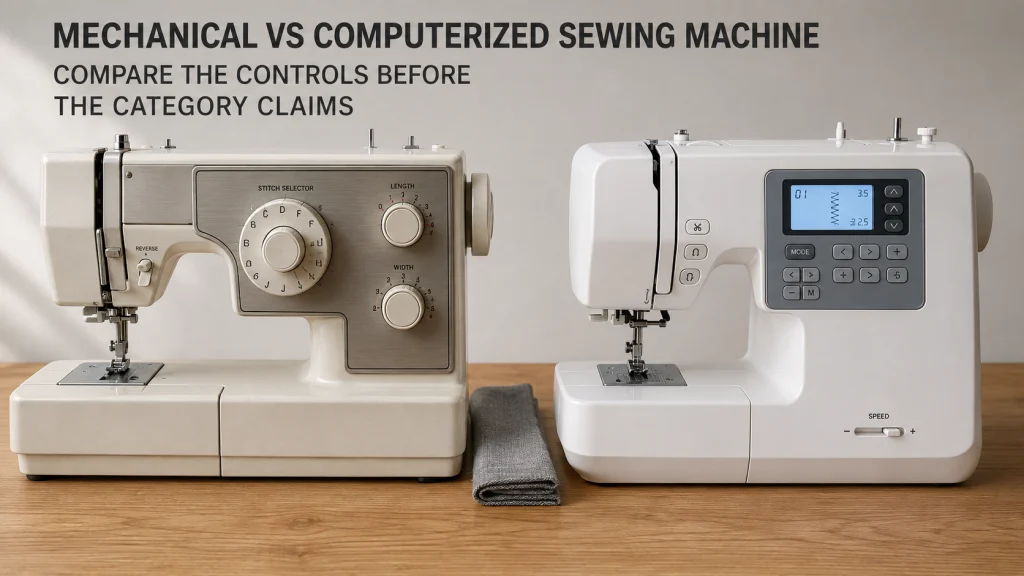
Two machine families do not tell you how two exact machines will feel to use
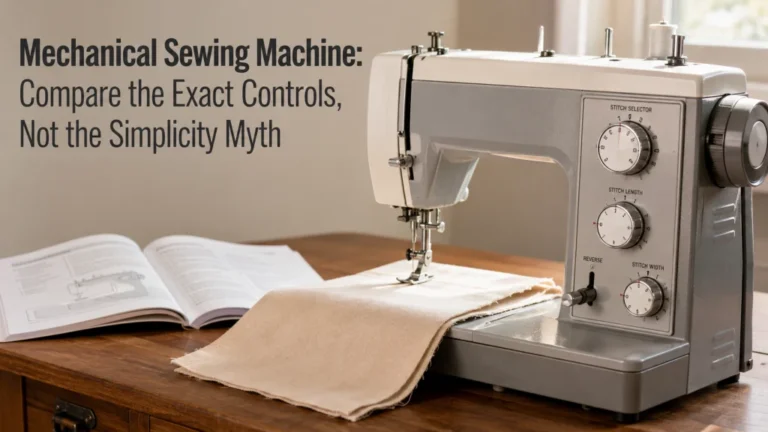
A mechanical vs computerized sewing machine decision becomes much easier when you stop treating the family name as the answer. For example, Janome currently lists the mechanical Sewist 725S with 23 stitches, a one-step buttonhole, a built-in needle threader, adjustable foot pressure, and drop feed. Those are real conveniences on a machine that still uses dials for stitch selection.
Brother’s current CS7000X shows the other side of the comparison. It uses an LCD and mode-and-shift-key stitch selection, adds adjustable sewing speed control, and provides seven one-step buttonhole styles, yet Brother lists no adjustable presser foot pressure. Neither machine proves its family is better. It proves that the useful question is which exact controls match the way you intend to sew.
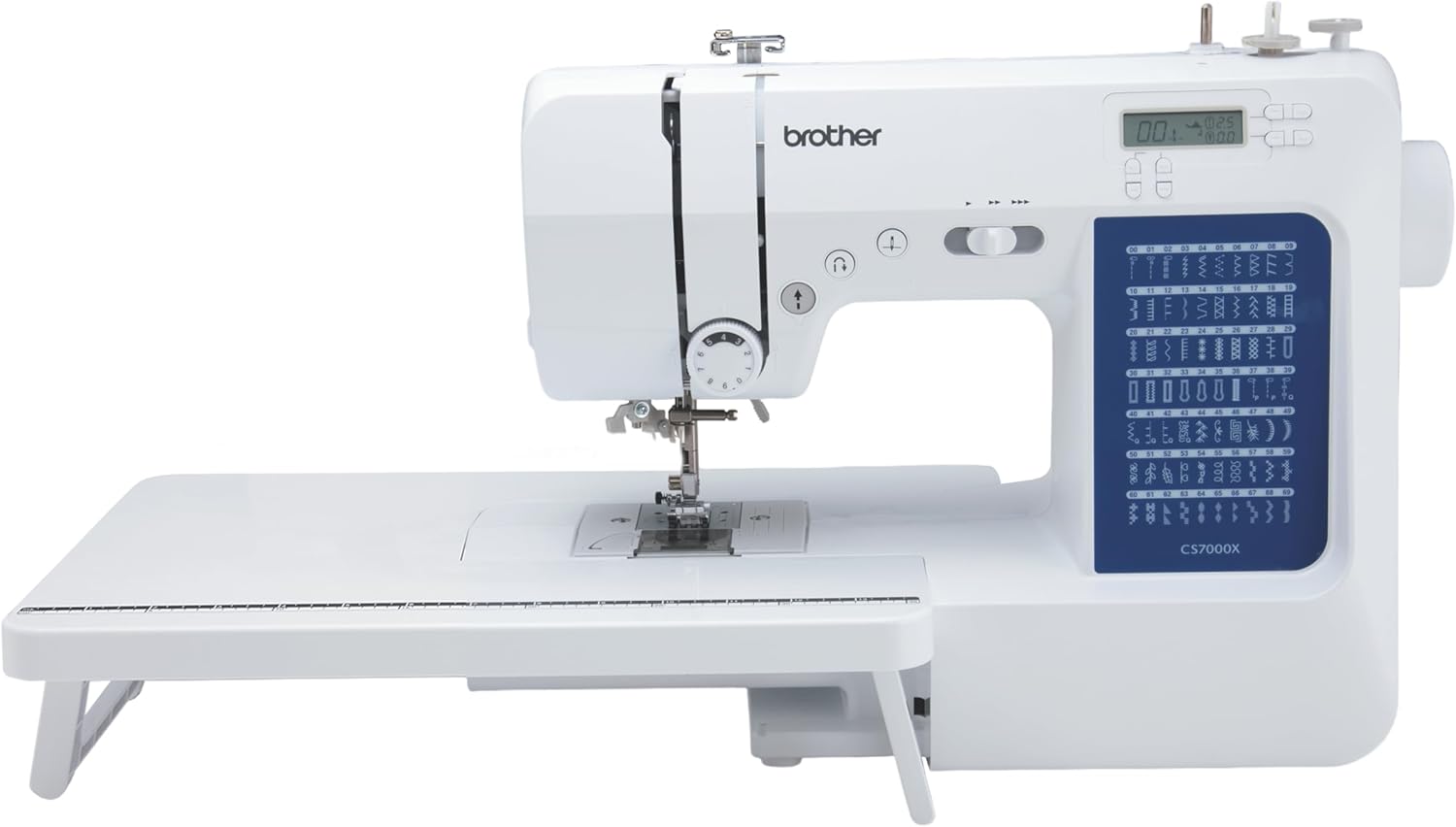
Brother CS7000X is a computerized sewing and quilting machine with 70 built-in stitches and seven one-step auto-size buttonholes. Its controls include an LCD screen, start-stop and reverse buttons, plus a variable speed slider. It also comes with an improved automatic needle threader, 10 sewing feet, a quilt guide, a wide table, and a hard protective case.
Check On AmazonIf you click this link and buy, we earn a commission at no additional cost to you.
Define mechanical, computerized, and the unstable electronic label
A mechanical domestic machine generally presents its main sewing adjustments through physical dials, levers, or sliders. A computerized machine uses electronic control logic for at least part of stitch selection or operation, commonly with buttons and a display. That distinction describes the control platform, not stitch quality, durability, power, material capacity, or beginner suitability.
The phrase electronic vs computerized sewing machine is less dependable because brands and retailers do not always use “electronic” in the same way. If a listing uses that term, ignore the label long enough to inspect the actual controls: how stitches are selected, whether speed can be limited independently of the foot control, whether needle stop position can be set, and what the manual says about operation. Model documentation is more useful than a loose product-family label.
Start from the completed buyer brief, not the family name
Before choosing a control platform, write down the operations that would change your normal sewing session. A buyer who mainly needs straight stitch, zigzag, a dependable buttonhole routine, easy reverse, and direct dials may reach a different conclusion from someone who repeatedly wants speed limiting, selectable needle stop position, multiple buttonhole styles, or push-button sewing.
If that list is still vague, first work through how to choose a sewing machine based on the work the machine must do. For the broader current domestic shortlist, use the sewing machine guide before narrowing to a control family. The family decision comes after that requirement list. Otherwise, “mechanical or computerized sewing machine” becomes a proxy for several separate decisions that should be checked one by one.
| Control task | What to write down before comparing | What counts as proof |
|---|---|---|
| Stitch selection | Which utility stitches you will actually use | Exact stitch chart and selector instructions |
| Speed control | Foot control only, or a separate speed limit | Manual and control-panel description |
| Needle stop | Whether repeatable needle-up or needle-down matters | Exact model specification or manual |
| Buttonholes | How often you make them and how many styles matter | Buttonhole workflow and included foot |
| Reverse or tie-off | Whether you want a lever, button, or programmed function | Control diagram and stitch instructions |
| Presser foot pressure | Whether manual pressure adjustment is important to your work | Exact model specification and manual |
This worksheet prevents feature count from taking over the decision. A feature earns weight only when you can name the task it changes.
Quick decision snapshot: Use the sewing situation to identify the first control worth checking, then verify that control on each exact finalist.
| Sewing situation | Control priority to verify first | What the check tells you |
|---|---|---|
| Occasional repairs and basic seams | Clear stitch selection, reverse, and a usable buttonhole routine | Whether a simple workflow already covers the work |
| Frequent garment sewing | Buttonhole workflow, needle position, and stitch adjustments | Whether repeated garment operations become easier |
| Repeated slow detail work and pivots | Speed limiting and selectable needle stop, where offered | Whether electronic control removes a repeated interruption |
| Projects where feed tuning matters | Presser foot pressure, feed controls, and exact accessory support | Whether the model provides the adjustment you actually need |
The snapshot does not choose a machine family for you. It narrows the audition to the controls most likely to matter in your own workflow.
List the controls used in a normal sewing session
Judge the difference between mechanical and computerized sewing machine controls as a sequence: load and thread the machine, select a straight stitch, change length or width, sew a corner, reverse, make a buttonhole, and stop. Note each point where you turn, press, hold, confirm, or read a display.
This reveals more than asking which family has “more features.” A control that removes a repeated interruption can matter more than dozens of unused decorative stitches.
Stitch selection, length, and width
Mechanical models commonly use a stitch dial plus separate length or width controls, but the number and arrangement vary. Computerized models may use buttons and a display, sometimes with preset values that can still be adjusted. A first-time buyer often assumes more built-in stitches mean more sewing capability. They do not prove better feeding, stronger penetration through thick seams, cleaner stitch formation, or compatibility with the materials you plan to sew.
Speed limiting, foot control, and start-stop where present
A foot controller changes speed through pedal input, while a separate speed limiter can cap the machine’s maximum sewing speed within the model’s available range. Some computerized models also provide start-stop sewing without continuous use of the foot controller, but this is not universal. If either function matters, verify it on the exact finalist rather than assuming the computerized label includes it. The Brother CS7000X product documentation, for example, specifically lists adjustable sewing speed control.
Needle position, reverse or tie-off, and thread cutting where present
These functions deserve separate checkboxes because they are not one package. A model may offer electronic stitch selection without an automatic thread cutter, or a mechanical model may provide a simple reverse lever that is exactly what you prefer. Needle up/down is especially useful to verify by model because the ability to choose a stop position can change how often you reach for the handwheel at corners or during repeated pivots. Do not infer one control from the presence of another.
Buttonhole setup and repeatability
Buttonholes are a good example of why family stereotypes fail. The mechanical Janome Sewist 725S has a one-step buttonhole and a dedicated automatic buttonhole foot, while the computerized Brother CS7000X lists seven one-step auto-size buttonhole styles. The relevant difference is not “mechanical cannot automate buttonholes.” It is whether one style and that workflow are enough for you, or whether multiple styles and electronic selection solve a repeated need.
Compare exact models inside each family
Once the task list is fixed, compare named finalists against the same rows. The table below is an evidence ledger, not a recommendation between these two models. It shows how quickly broad assumptions break when current official specifications are placed side by side.
One mechanical machine can have a one-step buttonhole and adjustable foot pressure. One computerized machine can offer speed control and multiple buttonhole styles while lacking adjustable presser foot pressure. The family name alone would not tell you either fact.
| Evidence item | Janome Sewist 725S | Brother CS7000X | Evidence status |
|---|---|---|---|
| Control family | Mechanical, dial stitch selection | Computerized, LCD with mode and shift keys | Official product documentation |
| Built-in stitches | 23 | 70 | Official product documentation |
| Buttonholes | 1 one-step style | 7 one-step styles | Official product documentation |
| Needle threader | Built-in | Automatic system | Official product documentation |
| Adjustable foot pressure | Yes | No | Official product documentation |
| Adjustable sewing speed control | Not established by the cited product page | Yes | Official product documentation where stated |
| Long-term durability advantage | Unknown from these specifications | Unknown from these specifications | Do not infer |
| Lower future repair cost | Unknown | Unknown | Requires local and model-specific evidence |
The useful habit is to keep “official fact,” “independent observation,” and “unknown” in separate columns. That prevents an attractive specification from quietly turning into a performance claim it does not support.
Separate useful automation from unused feature count
Automation deserves value when it removes a step you repeat. Speed limiting can matter to someone who frequently wants a lower ceiling without relying only on pedal pressure. A selectable needle-stop position can matter during repeated cornering. A one-step buttonhole can matter when garments or bags make that operation routine.
By contrast, a large decorative-stitch inventory has little decision value if you cannot name a project where you will use it. This is why a computerized model with fewer relevant functions can be a worse fit than a simpler machine with the controls you actually touch, and why a mechanical model with a thoughtful control set can be more capable for your workflow than its family stereotype suggests.

SINGER Quantum Stylist 9960 is a computerized sewing and quilting machine with 600 built-in stitches and 1,172 stitch applications. It includes 13 automatic one-step buttonhole styles, needle up/down, adjustable sewing speed, start-stop sewing, and a thread trimmer button. The package includes 13 presser feet, a large extension table, a hard dust cover, needles, bobbins, and other sewing accessories.
Check On AmazonIf you click this link and buy, we earn a commission at no additional cost to you.
Audit family claims that require evidence
Comparison pages often turn plausible engineering differences into universal rules. Fewer electronic controls may change diagnosis, but they do not establish lifespan or repair cost. Computer control can automate inputs without proving better stitch quality on every fabric.
Treat each broad claim as a model-level question. Use the rejection table when shopping language sounds more certain than the documentation.
| Broad claim | Why to reject it as a rule | What to verify instead |
|---|---|---|
| Mechanical machines always last longer | No universal lifespan follows from the control label alone | Model history, parts support, condition, maintenance, and service evidence |
| Mechanical machines are always cheaper to repair | Labor, parts, diagnosis, and local service vary | Local service route and model-specific parts availability |
| Computerized machines are more precise | Electronic selection does not prove stitch quality under your conditions | Matched testing on the relevant stitch, fabric, needle, and thread |
| Computerized machines are easier for beginners | Interface preference and task demands differ | Same-task audition and clarity of the exact manual |
| More stitches mean more capability | Stitch inventory does not prove material handling or feed behavior | Required utility stitches plus verified machine and material limits |
This does not mean durability or serviceability should be ignored. It means those decisions need better evidence than the word printed on the control panel.
Longevity and durability
Do not assign an expected life from the control family. Long-term outcome depends on design, usage, maintenance history, parts support, and damage. Current specifications cannot prove decades of future service, so mark a durability advantage as unknown when matched long-term evidence is unavailable.
Repair cost and local serviceability
Repairability is partly local. Check realistic travel distance to qualified service, the warranty route, and current model support. Janome directs US warranty repair through authorized dealers and requires proof of purchase if the machine is not registered. Brother lists phone and online support plus a 25-year limited warranty for the CS7000X, but the full warranty terms still matter.
Ease, precision, and fabric-handling claims
Ease, precision, and fabric handling are different questions. A speed slider may make pace control easier for one buyer, while direct dials may make settings clearer for another. Thick seam behavior still depends on the exact machine, needle, thread, presser foot, feed state, fabric stack, and setup.
Check manuals, warranty, and support before choosing the family
A product page is enough to build a shortlist, but the manual tells you how the controls actually behave. Check the buttonhole sequence, stitch-selection steps, reverse behavior, speed-control instructions, needle-stop options, presser foot requirements, cleaning instructions, and any model-specific warnings. A clear manual can also expose a feature that marketing shorthand described too loosely.
- Match the manual to the exact model number.
- Find the control diagram and normal sewing sequence.
- Check owner cleaning and maintenance boundaries.
- Confirm the warranty and qualified service route.
Support matters because ownership continues after the first successful seam. Confirm the warranty route, whether proof of purchase or registration affects service, how technical support is reached, and where authorized service is located. For any damaged power component, uncontrolled motion, overheating, smoke, burning odor, hard jam, or repeated hard needle strike, stop using the machine and follow the exact manual or qualified service route rather than treating the problem as a control-family issue.
Run the same control audition on both finalists
If you can inspect both finalists in person, perform the same sequence rather than casually trying random stitches. If you are comparing from documentation, use the same checklist against both manuals and product pages. The purpose is to expose extra steps, missing controls, unclear icons, or functions that matter only in marketing copy.
Use ordinary stable woven test fabric if a dealer permits sewing, then keep the needle, thread, stitch type, seam task, and operator sequence as similar as possible. That will not establish long-term reliability or every-material performance, but it can reveal whether the control workflow makes sense to you.
| Audition step | What to observe | Do not conclude |
|---|---|---|
| Select straight stitch and change length | Number of actions and clarity of feedback | That fewer actions prove better stitch quality |
| Sew slowly, then increase speed | How predictably you can control pace | That one test proves motor strength |
| Stop and pivot at a corner | Needle-stop behavior and hand movement required | That one preferred workflow fits everyone |
| Set up a buttonhole | Foot, selector steps, markings, and repeat process | That more styles guarantee better buttonholes |
| Find cleaning and service instructions | Whether owner maintenance boundaries are clear | That a shorter manual means simpler ownership |
Write down what slowed you, what felt clear, and which functions you would use weekly. That record is more useful than remembering that one machine looked more “advanced.”
Choose mechanical when its verified controls satisfy the brief
A mechanical machine is a strong fit when the exact model covers the utility stitches and adjustments you need, you prefer direct physical controls, and no missing electronic function solves a repeated problem. A one-step buttonhole, built-in needle threader, drop feed, or adjustable foot pressure may already provide the convenience you care about.
Choose on those verified controls, documentation, support, and the rest of the buying brief. Do not use an unsupported lifespan or repair-cost assumption as the reason.

Brother XM2701 is a mechanical sewing machine with 27 built-in stitches, an auto-size buttonhole, and dial-based stitch selection. It includes an automatic needle threader, a jam-resistant drop-in top bobbin, a free arm, and six sewing feet. The machine weighs 12.6 pounds and includes Brother support through online, live chat, or phone channels for the life of the machine.
Check On AmazonIf you click this link and buy, we earn a commission at no additional cost to you.
Choose computerized when specific electronic functions solve repeated tasks
A computerized machine earns its place when named functions reduce friction in work you expect to repeat. Speed limiting, selectable needle stop, multiple one-step buttonhole programs, or useful stitch presets can matter when they map to your sewing. The screen itself is not the benefit. The operation behind it is.
Verify those functions on the finalist and treat stitch count, precision, fabric handling, and longevity as separate questions that need their own evidence.
Keep both families open when the exact model matters more than the family
If one mechanical finalist and one computerized finalist both satisfy every high-priority control task, compare the remaining model-level factors: workspace, included accessories, compatibility, documentation, warranty route, service access, storage, and the controls you prefer using.
At that point, let a concrete difference break the tie. Pressure adjustment, included feet, buttonhole workflow, or support can matter more than the control label.
Route current mechanical shopping to exact mechanical-machine checks
Once direct controls are a meaningful preference, move from the family question to a current mechanical shortlist. The next step is to compare how specific models implement stitch selection, buttonholes, reverse, foot pressure, drop feed, needle threading, workspace, included feet, and maintenance instructions.
The mechanical sewing machine buying checks continue that model-level comparison without assuming every dial-controlled machine has the same feature set. Use it only after the control family has become a real selection factor.
Route current computerized shopping to exact electronic-control checks
If electronic functions have earned a place on your requirement list, compare computerized finalists by those exact functions rather than by screen size or total stitch count. Check speed limiting, needle-stop options, start-stop operation where present, buttonhole workflow, selector logic, included feet, documentation, and support.
The computerized sewing machine buying checks narrow that comparison to current model features. The aim is not to maximize automation, but to find the amount of electronic control that solves tasks you actually repeat.
Audit heavy-duty labeling before assuming material capacity
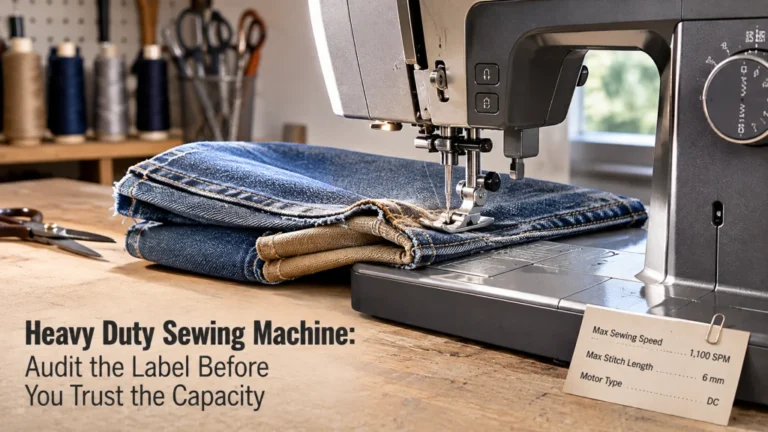
“Heavy duty” is a separate claim from mechanical or computerized control. A dial-controlled machine is not automatically better for denim, canvas, bulky seam intersections, or other demanding material stacks, and an electronic interface does not automatically make a machine weaker. Material capability must be evaluated on the exact model and conditions.
If that label is influencing your shortlist, use the heavy duty sewing machine audit before treating it as proof. Check the actual material task, seam thickness, needle and thread combination, presser foot and feed requirements, and any manufacturer limits or credible matched testing.
Separate full portable, mini, and handheld formats
Portability can also distort the mechanical-versus-computerized decision if the machine format has not been defined first. A full-size domestic machine that is light enough to carry is still a different purchase from a reduced tabletop mini machine, and both are different from a handheld mending tool. Those formats should not be treated as smaller versions of the same sewing system.
If repeated transport or storage drives the decision, compare full portable sewing machine options. If the question is specifically about reduced tabletop size, use the mini sewing machine format checks. For a hand-held tool intended for limited mending situations, use the handheld sewing machine limitations instead of mixing it into a full domestic-machine comparison.
Final Thoughts: Choose the controls, then verify the exact machine
Choose from the operations you will repeat, then verify them on the exact machine. Durability, repair cost, precision, and material capacity remain separate evidence questions.
Finish by checking the manual, warranty route, support, included accessories, and model-specific limits. If both finalists still meet the brief, either control family can remain a valid choice.
See More in This Section
The control family is only one part of a domestic-machine purchase. Once either approach can satisfy the brief, use the pages below for the remaining format decision. Each page starts from a different shopping reason.
| Topic | What you’ll find |
|---|---|
| Compare current mechanical machines | Model-level checks for direct controls, utility functions, documentation, and ownership fit. |
| Compare current computerized machines | Checks for electronic functions that matter beyond stitch-count marketing. |
| Audit heavy duty machine claims | A material-capacity check that separates labeling from verified conditions. |
| Compare full portable sewing machines | Transport and storage decisions without dropping to a reduced mini format. |
| Evaluate mini sewing machine limits | Checks for reduced tabletop machines and the capability tradeoffs that follow. |
| Understand handheld sewing machine limits | Separates hand-held mending tools from full domestic sewing machines. |
Use the page that matches the unresolved purchase question rather than reopening the entire machine search. That keeps the next comparison narrow enough to verify.
FAQs
🎛️ Is a mechanical sewing machine easier to use than a computerized one?
Not automatically. Direct dials may feel clearer to one sewist, while another may prefer electronic stitch presets or speed limiting. Compare the exact controls by running the same basic sewing sequence on both finalists.
💻 Are computerized sewing machines more precise?
Computerized controls can make some selections repeatable, but that does not by itself prove better stitch quality. Precision claims need matched evidence for the exact machine, stitch, fabric, needle, thread, settings, and test conditions.
🧰 Are mechanical sewing machines cheaper to repair?
Do not assume that from the control type alone. Repair cost depends on the fault, parts availability, labor, model design, warranty status, and local service options. Check the service route for the exact model before buying.
🧵 Do I need hundreds of built-in stitches?
Only if those stitches map to work you expect to do. For many general sewing tasks, the useful controls around straight stitch, zigzag, buttonholes, reverse, stitch dimensions, and speed can matter more than the total stitch number.
🪡 Can a mechanical machine have a one-step buttonhole?
Yes. Current mechanical models can include one-step buttonhole systems, so verify the exact model rather than assuming buttonhole automation requires a computerized machine. The Janome Sewist 725S is one current example.
⚙️ Does computerized mean the machine has a start-stop button?
No. Computerized describes the control platform, not a guaranteed bundle of features. Check the exact specification and manual for start-stop operation, needle-stop control, speed limiting, and thread cutting separately.
References and Sources
- Janome Sewist 725S product page: Verifies the current mechanical controls and specifications used in the model example.
- Brother CS7000X product page: Verifies the current computerized controls, documentation, support statement, and specifications.
- Brother CS7000X manual library: Confirms the current US operation-manual resource used to verify model-specific control instructions.
- Janome America warranty service: Verifies Janome’s current US warranty-service route through authorized dealers and its proof-of-purchase requirements.
These sources support the model-specific control and support facts used here. They do not establish universal durability, repair-cost, stitch-quality, or material-capacity advantages for either control family.