A home sewing business should choose equipment from the work it actually repeats, not from the label attached to the business. The useful evidence is a production brief that records products, operations, materials, changeovers, downtime tolerance, service access, and the machine’s documented intended use. A domestic machine can remain a sensible choice when its functions and use terms fit the work, while a specialist system becomes relevant when feed architecture, operation type, or continuity requirements change. The goal is to qualify the machine against paid work without inventing a duty cycle, productivity figure, or payback claim.
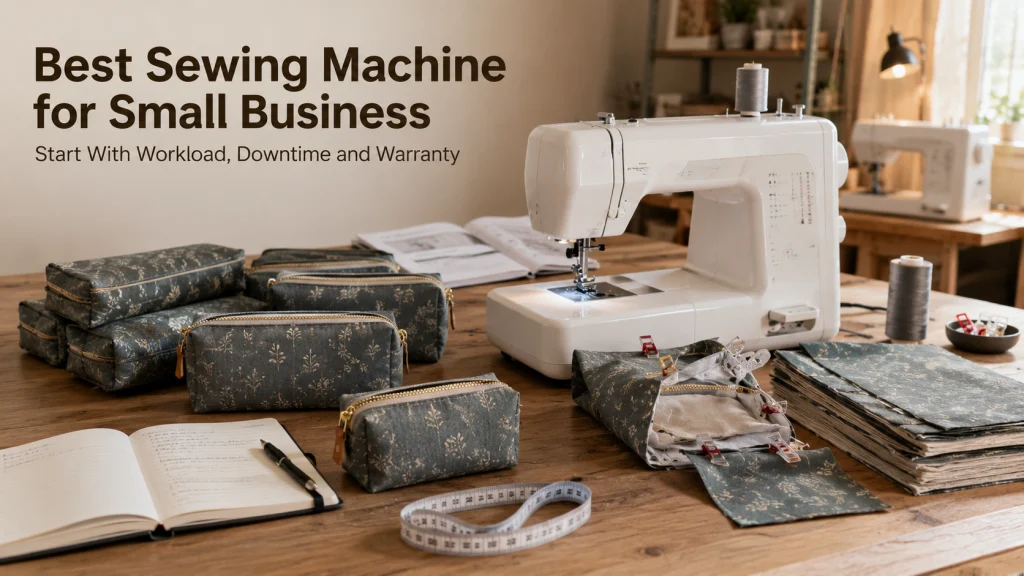
Small Business Is Not a Machine Specification
The best sewing machine for small business use cannot be identified from the phrase “small business” alone. One seller may make occasional cotton accessories, while another repeats long runs of structured seams, bindings, or garment operations. Those businesses can need the same basic stitch yet place very different demands on feeding, control, changeovers, and service continuity. Start by describing the paid operation before comparing machine classes.
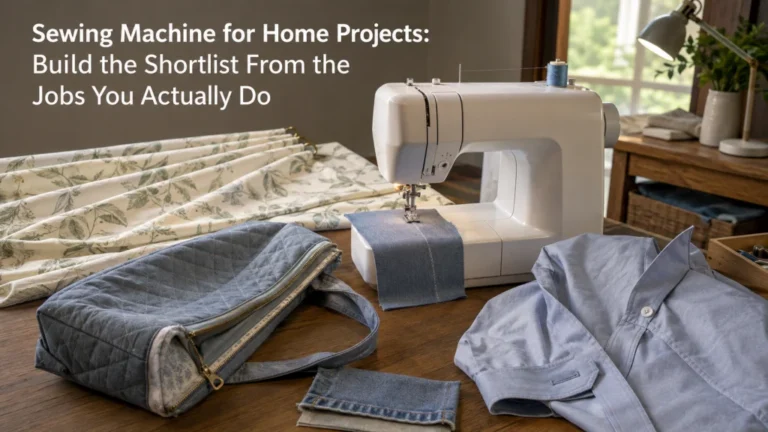
This keeps the decision connected to the same practical questions used when choosing a machine for home projects, but paid repetition adds another layer. A stitch that works once is not automatically evidence that the whole workflow is supported by the machine’s documented use. The machine also has to provide the controls, access, support route, and repeatability the actual product mix requires. That is a stronger starting point than assuming every business needs industrial equipment or every home machine is unsuitable.
List the Products and Required Machine Operations
Write down what the business sews before writing down what machine it wants. Break each product into operations such as straight seaming, edge finishing, topstitching, buttonholes, bar-style reinforcement, zipper insertion, or free-arm access where relevant. The list should describe work the machine must perform, not features that merely sound useful on a sales page. If an operation is rare, mark it separately from the operations repeated across nearly every order.
A product list also exposes when one general-purpose machine is being asked to cover unrelated jobs. A clothing business may need flexible utility stitches and garment access, while a structured accessory business may care more about feed behavior at bulky transitions. Neither case proves that a different machine class is necessary until the actual operations are compared with documentation and an audition. The worksheet keeps that comparison tied to real work.
| Production brief field | What to record | Why it changes the decision |
|---|---|---|
| Product family | Items made repeatedly | Keeps unusual projects from defining the purchase |
| Core operations | Repeated stitches and construction steps | Identifies required controls |
| Occasional operations | Steps used selectively | Separates needs from conveniences |
| Material condition | Normal stack and hardest junction | Creates a realistic audition target |
| Continuity need | Impact of machine unavailability | Frames service and backup needs |
Fill the worksheet from existing products, samples, or a defined range rather than imagined expansion. A concise production brief gives later comparisons a common reference. It also exposes missing evidence before purchase. Once the operations are fixed, material conditions become the next filter.
Record the Material and Hardest Junction
Material matters, but this decision should not collapse into a generic heavy-fabric comparison. Record the normal material family and then identify the operation where thickness, seam allowances, elastic layers, interfacing, binding, or reinforcement make the stack harder to feed. A flat sample may pass even when a finished junction changes presser-foot angle, clearance, or feeding behavior. The relevant test condition is therefore the operation that challenges the product, not the boldest fabric name on the supply list.
Keep the description specific enough to reproduce without inventing universal layer limits. Note the material combination, seam geometry, needle and thread system, foot type, stitch, and any preparation that affects the stack. If the business changes materials often, create more than one audition condition instead of pretending one sample represents everything. This keeps material evidence useful while leaving broader material-first machine selection to the appropriate topic.
Log Batch Size, Sewing Hours, and Changeovers From Real Work
Workload should be logged, not guessed from how serious the business feels. Record actual sewing time, batch size, repeated operations, and how often the setup changes between products or materials. Changeovers can matter because swapping thread, needle, foot, stitch settings, or machine configuration interrupts the production sequence even when each operation is easy. A short mixed batch can therefore stress workflow differently from a longer run of one repeated seam.
Do not turn the log into an invented safe duty cycle for a domestic machine. Its purpose is to reveal patterns that can be compared with intended-use language, service access, and the need for specialist operations. If the workload changes later, update the log and reassess rather than treating the original purchase decision as permanent. The same method also prevents a temporary busy period from becoming unsupported proof that a different class of machine is required.
| Workload log field | Record from actual work | Decision signal |
|---|---|---|
| Batch | Items in the run | Shows real repetition |
| Sewing time | Actual machine-use time | Separates sewing from other work |
| Operation repeats | Repeated seams or steps | Prioritizes audition targets |
| Changeovers | Needle, thread, foot, stitch, or setup changes | Reveals workflow friction |
| Interruptions | Corrections, jams, service, or unavailable equipment | Frames backup needs |
Keep the log descriptive rather than predictive. Record what happened without assigning a productivity promise to any machine. Repeated entries separate one awkward project from a recurring condition. That leads directly to the business’s tolerance for interruption.
Define Downtime Tolerance and Backup Needs
Downtime is an equipment decision even when the business does not calculate formal financial loss. Ask what happens when the primary machine is unavailable for cleaning, adjustment, warranty work, or service that cannot be completed immediately. A seller with flexible lead times may tolerate interruption differently from someone whose workflow depends on one repeated machine operation. The answer can change whether local service, a backup machine, or a more specialized setup deserves priority.
Backup planning should stay proportionate to the real operation. It can mean keeping an existing compatible machine, maintaining access to another suitable system, or choosing equipment with a practical service route rather than buying duplicate hardware immediately. Do not assume redundancy is mandatory simply because the sewing is paid. The production brief should show whether loss of one operation actually stops the work or merely changes the schedule.
Verify Required Utility Stitches and Controls
Machine class should follow the operations already listed, not the largest stitch count on a specification sheet. Confirm whether the work requires straight stitch, zigzag, stretch-capable utility stitches, buttonholes, adjustable needle position, speed control, reverse, free-arm access, or another documented function. A business that repeatedly uses only a narrow set of operations may gain little from decorative features. Conversely, one missing control can matter every time the product is sewn.
Use the exact manual or manufacturer specifications to verify each required function before ranking a candidate. The broader sewing machine selection framework can help place those controls in context, but the production brief decides which ones are mandatory here. Avoid treating a feature name as evidence of performance on a particular material stack. Function availability and proven operation under the business’s conditions are two separate checks.
Read the Manual, Intended-Use Wording, and Warranty
A domestic candidate should not be ranked for paid work until its intended-use language and warranty terms are checked. One current JUKI home-sewing warranty states that the covered product is warranted only for normal household non-commercial use and excludes damage from commercial use. That wording belongs to that warranty and must not be generalized to every manufacturer or every machine. The practical lesson is to verify the exact documentation attached to the machine being considered.
Manual wording can add another boundary because some home machines are explicitly described as intended for household use. Read the complete terms instead of relying on a retailer description, a product-family nickname, or a heavy-duty label. If the intended use conflicts with the production brief, do not solve the conflict by assuming occasional paid sewing is automatically accepted. The correct next step is to clarify the exact terms with the manufacturer or authorized support channel before treating the machine as a legitimate business candidate.
| Evidence item | What to capture | What it can establish |
|---|---|---|
| Owner’s manual | Intended use, setup, service boundaries, functions | Documented operating scope |
| Warranty | Coverage, exclusions, conditions, service path | Business-use treatment for that product |
| Support page | Service, dealer, parts, or contact information | Available support route |
| Product specification | Controls, stitches, interfaces, capabilities | Documented required functions |
This ledger prevents marketing language from replacing ownership evidence. Record the exact document and claim, then remove unsupported assumptions. Warranty and intended-use terms can differ from sewing performance. After that check, advertised speed has the right context.
Separate Maximum Speed From a Documented Production Workload
Maximum stitch speed is a specification, not a documented promise about continuous paid production. A fast machine can still be a poor fit if the required material junction, control range, intended-use terms, or service route does not match the business. Likewise, a slower candidate can be entirely adequate when the operation depends more on precision, frequent handling, or setup changes than sustained straight-line sewing. Compare speed only after the workload and operation sequence are known.
Do not convert a published maximum into a homemade duty-cycle estimate. Manufacturers may document speed, but that does not automatically establish how long a home machine should run in a business setting or how much repetitive work it will tolerate. The workload log should stay observational, while the manual and warranty control what is actually documented. If sustained production becomes the deciding issue, that is a signal to compare a different machine architecture rather than stretch a home specification beyond its meaning.
Check the Service Route Before You Need It
Service access matters because a machine that fits the sewing task can still be a poor business choice if support is impractical. Identify the authorized service path, local dealer availability where applicable, parts route, warranty procedure, and what the manual allows the owner to maintain. Do this before purchase rather than discovering the process after an interruption. The goal is not to predict failure but to know what happens when setup checks are no longer enough.
Keep owner maintenance inside the exact manual’s boundaries. Damaged electrical parts, uncontrolled motion, heat, smoke, burning odor, repeated hard jams, or repeated needle strikes are reasons to stop using the machine and move to qualified service. A business schedule does not justify forcing a machine through a fault or bypassing a safety instruction. The service and backup checklist below makes continuity part of the selection without turning the article into a repair guide.
- Confirm the manufacturer or authorized service contact for the machine under consideration.
- Check whether warranty service depends on a dealer, proof of purchase, registration, or another documented condition.
- Identify what normal cleaning, lubrication, adjustment, or replacement the manual assigns to the owner.
- Decide which products or operations can continue if the primary machine is unavailable.
- Record whether an existing machine can serve as a realistic backup for the required operation.
The checklist must reflect the actual machine and support network. Do not borrow dealer or parts assumptions from another brand. Mark unclear support as unresolved before ranking the candidate. Carry the same evidence discipline into the sewing audition.
Build an Operation-Level Audition
An audition should reproduce the business operation closely enough to answer a purchase question. Use the real material combination, prepared seam geometry, intended needle and thread system, appropriate presser foot, required stitch, and normal handling method. Test the difficult transition as well as the easy seam because one flat sample can hide the operation that actually limits the workflow. Record the setup and result instead of relying on memory or a showroom impression.
The audition is not permission to force a stack through a machine. Stop if the needle deflects into hardware or the needle plate, the machine repeatedly jams, motion becomes uncontrolled, or another condition indicates unsafe operation. If a candidate cannot complete a required operation under a supported setup, record that result and change the machine decision rather than escalating force. A successful audition proves only the disclosed condition, not universal durability or a safe production duty cycle.
Compare Domestic Candidates Only Inside Their Documented Use
Once the brief, evidence ledger, and audition conditions are complete, domestic candidates can be compared fairly. Rank them on required operations, control fit, documented intended use, service access, audition evidence, changeover burden, and the business’s tolerance for interruption. Do not reward a machine for features the product line never uses. More importantly, do not call a household machine commercial simply because it is fast, heavy, metal-framed, or marketed with durability language.
A domestic machine may still be the correct answer for a modest paid workflow when its documentation and operation fit are clear. The point is not to push every seller toward industrial equipment but to prevent business intent from overriding the machine’s actual boundaries. If two candidates both fit, the decision can then move to ownership considerations such as consumables, maintenance, service access, and purchase cost without mixing those questions into capability claims. If neither candidate fits, stop ranking domestic machines and change the machine class.
Paid Garment Work Needs a Garment Operation Check
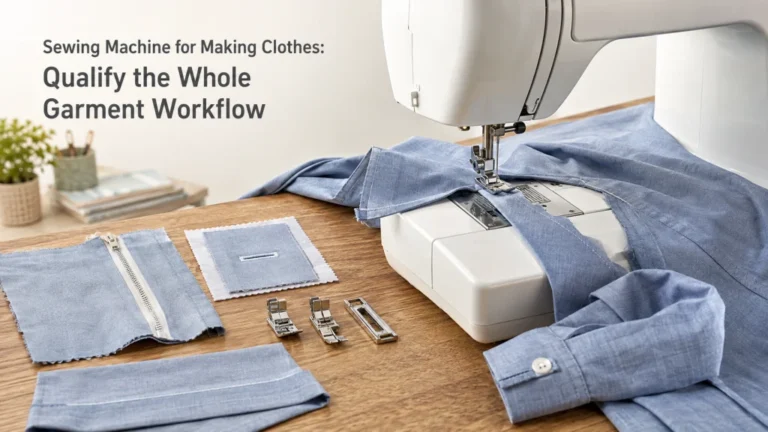
Garment production deserves a more specific operation check than the business label provides. Seams, hems, buttonholes, stretch handling, sleeve or cuff access, topstitching, and finishing can place different demands on a machine even within one clothing line. A seller making simple woven items should not automatically inherit requirements from a business producing stretch garments or detail-heavy construction. Keep the business workload log, then evaluate the actual garment operations separately.
For that branch, use the sewing machine for making clothes checklist to define the garment-specific work before returning to workload and continuity. The two decisions complement each other rather than compete. Garment fit tells you what the machine must do, while this article asks whether the paid repetition, intended use, downtime tolerance, and support route still make the machine a sensible business choice. That separation keeps the recommendation precise.
Paid Bag Work Needs a Completed-Stack Check
Bag work can look easy on flat exterior fabric and become a different machine problem at a finished junction. Binding, lining, stabilizer, foam, folded seam allowances, and reinforced attachment points can combine where clearance and feeding are less forgiving. A business workload log does not replace that construction test. It tells you how often the operation repeats after the bag itself has defined the real stack.
Use the completed bag machine checklist to identify the hardest construction point before treating any candidate as proven. Then bring that condition back into the operation-level audition and workload log. This avoids calling a machine suitable for paid bag production merely because it sews two flat layers cleanly. If the finished stack exposes a need for different feed or bed geometry, the machine-class decision changes.
Keep Ownership Cost Separate From Machine Fit
Purchase price should not decide whether a machine is mechanically or contractually appropriate for the work. First establish that the machine can perform the required operations within documented use and that service access is workable. Only then compare consumables, accessories, maintenance, service, replacement parts, and purchase cost as ownership factors. Mixing these stages encourages a cheaper machine to look attractive before its actual fit has been established.
This article does not calculate profit, payback, return on investment, pricing, taxes, or business formation decisions. Those questions require business data that a sewing-machine comparison cannot responsibly invent. The equipment decision here ends with a qualified machine class, a support plan, and a list of ownership costs that still need comparison. Keeping that boundary clear prevents financial assumptions from masquerading as sewing evidence.
Exit to Specialist Architecture When the Operation Demands It
A different machine class becomes relevant when the operation requires architecture a general-purpose domestic machine does not provide. Industrial manufacturers separate systems by production operation, including straight lockstitch, zigzag, overlock, programmable pattern sewing, and unison-feed configurations. That separation is useful because it shows why “industrial” is not simply a stronger version of one household machine. The required feed system, stitch formation, bed geometry, operation, and service environment determine the category.
Move to specialist comparison when the production brief repeatedly points to one of those architecture differences rather than a missing domestic feature. Do not make that jump from maximum speed, frame material, business status, or a heavy-duty label alone. A specialist system can solve a specific production requirement while giving up versatility that mattered on a general-purpose machine. The exit table keeps the change tied to an operation instead of prestige or assumption.
| Observed requirement | Stay with domestic comparison when | Consider specialist comparison when |
|---|---|---|
| General utility sewing | Required controls are documented and auditioned | A different stitch system is required |
| Difficult feeding | The disclosed stack feeds with supported setup | A different feed architecture is required |
| Restricted access | Required geometry remains workable | Specialized bed geometry is repeatedly needed |
| Repeated production step | Documented use fits the workload | A dedicated production system fits better |
| Business continuity | Service and backup plans are practical | One dedicated operation controls the workflow |
The table is a routing tool, not a claim that every repeated operation needs industrial equipment. A domestic machine can remain appropriate when the evidence supports it. The key is knowing when the production brief has changed the question from feature selection to machine architecture. At that point, compare specialist systems on their own terms rather than forcing them into one mixed ranking.
Final Thoughts: Buy for the Logged Operation, Not the Business Label
A small sewing business needs a machine decision built from recorded work. Define the products, repeated operations, difficult material conditions, changeovers, continuity needs, required controls, and service route before comparing equipment. Then check intended-use and warranty language for the exact candidate and audition the operation under disclosed conditions. This sequence can legitimately end with a domestic machine, a different domestic setup, or a move to specialist architecture.
Keep every conclusion narrow enough to match the evidence behind it. Maximum speed does not prove a duty cycle, a successful sample does not prove unlimited production capacity, and the word business does not automatically require industrial equipment. Revisit the production brief when products or workloads materially change. The best purchase is the one that remains defensible when the real operation, documentation, and support path are all placed beside the machine.
FAQs
These questions stay focused on equipment rather than business strategy. Each answer depends on the actual operation and documentation. No universal duty cycle applies across domestic machines. Check the exact manual and warranty when intended use matters.
Use the production brief to keep each answer specific. Occasional paid sewing and repeated specialist work are different conditions. Material, feed, controls, and service access can change the result. Compare a new machine class separately when those requirements change.
🧵 Can I use a domestic sewing machine for a home sewing business?
Possibly, but verify the required operations, actual workload, intended-use wording, warranty terms, and service route for the exact machine. Do not assume that paid sewing is accepted simply because the machine can complete a sample.
⚙️ Does a faster sewing machine automatically suit production better?
No. Maximum speed is only one specification and does not prove a safe duty cycle, material capability, service fit, or intended commercial use.
🪡 What should I test before buying a machine for paid sewing?
Test the repeated operation using the real material stack, needle and thread system, foot, stitch, and difficult geometry. Record the setup and result so the audition supports a specific claim instead of a general impression.
🛠️ How important is local sewing-machine service for a small business?
It matters when machine unavailability would interrupt a required operation. Verify the actual authorized service route and decide what work can continue if the primary machine is unavailable.
🏭 When should I consider an industrial or specialist sewing system?
Consider it when the repeated operation requires a different stitch system, feed architecture, bed geometry, or dedicated production function. Business status by itself is not enough reason to change machine class.
References and Sources
Only sources supporting material technical boundaries are included. The warranty source documents a home-machine use restriction. The industrial source documents distinct production machine architectures. Neither source recommends a particular product.
Warranty language and product organization can change, so check the exact candidate before purchase. Community discussions are not used as proof of capacity or duty cycle. Manufacturer documentation controls the technical claims here. That keeps the source list small and evidence-focused.
- JUKI Home product registration and warranty: supports the example showing household non-commercial-use language in a current home-machine warranty.
- Brother industrial sewing systems: supports the distinction between general-purpose domestic equipment and operation-specific industrial sewing architectures.