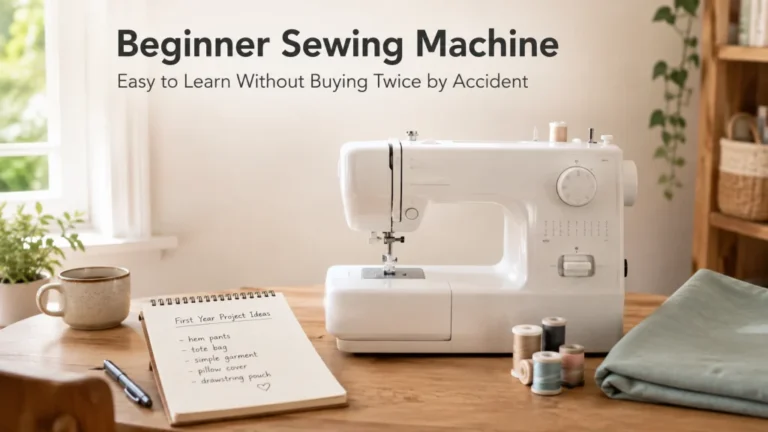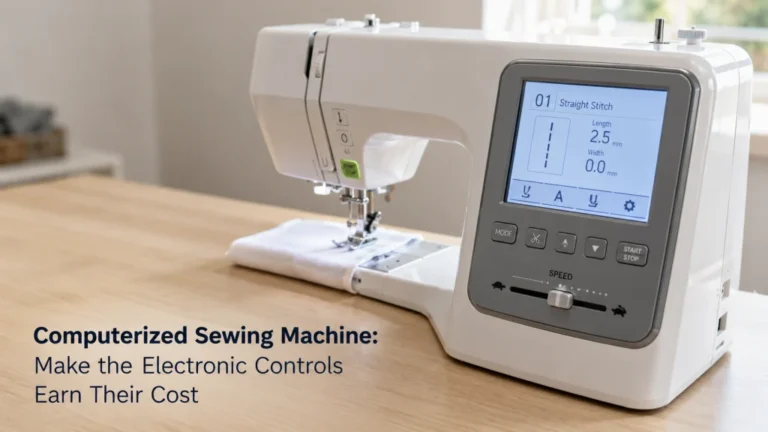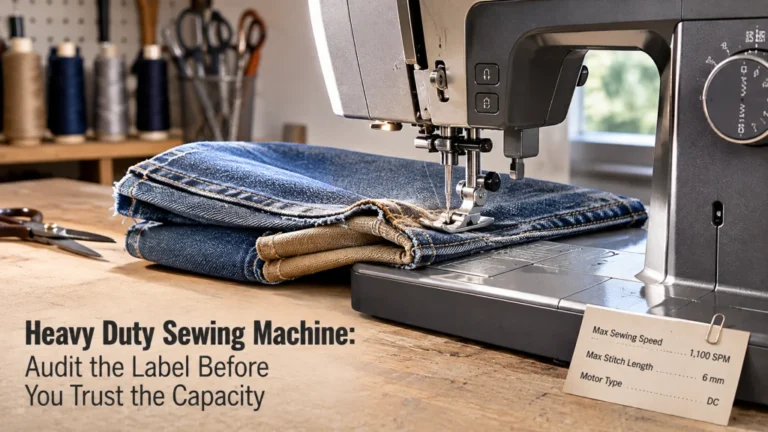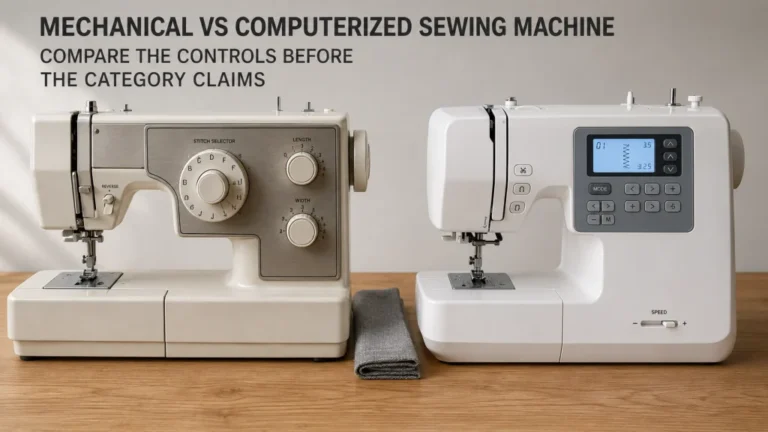
An intermediate sewing machine should solve a repeatable limitation in the machine you already use, not simply add more stitches, a higher price, or a more advanced label. Start by documenting the exact task that keeps failing or slowing you down, then separate machine capability from setup, accessories, maintenance, service, project demands, and specialist-system needs. The useful upgrade requirement may be more workspace, a specific control, a verified attachment option, better workflow control, or simply a reliable repair. By the end, you should have a short evidence-based test list and a clear choice among buying, testing, servicing, accessorizing, or keeping the current machine.
Name the current limit before naming the replacement
A more expensive machine is easy to justify when the current one feels frustrating, but frustration is not yet a buying requirement. Write down one repeatable sewing situation first: the long garment that keeps falling off a cramped work area, the buttonhole control that produces too much variation for repeated garments, the lack of a needle-position option you need for edge stitching, or the machine that repeatedly stops working even after normal setup checks. That gives you something a candidate machine can actually prove or fail to prove.
A search for the best intermediate sewing machine often produces long feature lists, but those lists do not establish which control solves your problem. Start with a documented bottleneck that remains after ordinary setup, compatibility, and maintenance checks.
Key point: Do not upgrade because your skill label changed. Upgrade only when a repeated limitation can be translated into a requirement that another machine, accessory, service action, or specialist system can be shown to address.
If you are still defining the basic machine type, controls, budget, and ownership needs rather than replacing an established setup, start with the broader process for choosing a sewing machine systematically. That decision starts earlier than the step-up question addressed here.
Define intermediate by sewing situation, not price
Intermediate is useful here only as a description of the reader’s situation. You already know normal threading, bobbin loading, basic stitch selection, presser-foot changes, and ordinary project handling well enough to notice patterns in what slows you down. You may also already own a machine that completes most of your work, which makes the missing capability easier to define.
Price does not create that stage. A beginner can buy a costly computerized model, while an experienced sewist can keep using a simple mechanical machine because it still fits the work. That is why the best sewing machine for intermediate sewers cannot be identified from a fixed dollar band, touchscreen, maximum speed, or stitch count alone.
A first-time owner can easily mistake retail skill labels for product tiers. The useful distinction is whether you can describe a repeated limitation from real sewing. If not, keeping the current machine while learning what matters may be the better choice.
Record the current machine, recurring work and repeated limitation
Build a small reproduced-limit ledger before comparing replacements. Record the exact machine model, the work you repeat, the fabric or layer condition when it matters, the needle and thread in use, the presser foot or attachment, the setting or control involved, and what actually happens. A complaint such as “I have outgrown this machine” is too broad to test. “I repeatedly need finer speed control when topstitching small curves” is testable.
| Record | What to capture | Why it matters |
|---|---|---|
| Current machine | Exact model and current service state | Prevents comparing a vague memory with a candidate spec sheet |
| Recurring work | Garment step, repeated seam, buttonhole run, quilting area, or other regular task | Shows whether the issue is frequent enough to justify a change |
| Material condition | Fabric type, number of layers, bulky crossing, stabilizer, or other relevant stack | Separates a general machine limitation from a narrow material condition |
| Observed limit | What fails, slows, restricts, or requires repeated workarounds | Creates the requirement the next option must answer |
| Frequency | Occasional, monthly, most projects, or nearly every session | Helps distinguish an annoyance from an ownership bottleneck |
A filled example could read: exact current model; topstitching tight garment curves; two woven layers; foot-pedal control jumps from stopped to faster than desired; problem appears on most garments with that detail. The requirement is a documented speed-control option tested on the same task.
The ledger prevents one bad session from becoming an expensive conclusion. A problem limited to one needle, fabric stack, or unfamiliar attachment is different from a limitation reproduced across normal projects. Keep the description narrow enough to recreate.
Separate machine limitation from setup, accessory, maintenance and service issues
A machine that cannot provide a required control is different from a machine that should provide normal operation but currently does not. Before shopping, confirm the threading path, bobbin type and insertion, needle condition and installation, presser-foot state, feed state, and the model-specific setup called for in the manual. If the symptom began recently on work the machine previously handled normally, maintenance or service deserves attention before capability is blamed.
- Repeat the problem with a fresh, appropriate needle and correctly installed thread path.
- Confirm the bobbin, presser foot, needle plate, and other machine-interface parts are documented for the exact model.
- Return unusual settings to a known normal starting point when the manual supports that step.
- Check whether cleaning or other owner maintenance is due and allowed by the exact manual.
- Separate a missing feature from a feature that exists but is not operating normally.
Replacement will not fix a setup mistake that follows you to the next machine, and a repair problem should not be disguised as a skill-level problem. After repeated hard needle strikes, jams, overheating, smoke, burning odor, exposed electrical damage, uncontrolled motion, or a hard mechanical lock, stop testing and follow the model’s service route.
Decide whether the real question belongs to a material, project or specialist-system route
Some limitations do not point to a different general-purpose domestic machine. If a problem occurs only with one material or layer stack, investigate the material, needle, thread, foot, feed behavior, and verified capability under that condition. For a project-specific need, define the operation rather than treating the whole machine as inadequate.
Specialist systems need an even cleaner boundary. A serger, coverstitch machine, embroidery system, or industrial-style machine changes the workflow and may solve a job that a domestic sewing machine is not designed to duplicate in the same way. A premium domestic machine should not be purchased on the assumption that a higher price turns it into every specialist machine at once.
For example, faster edge finishing across many knit garments may point toward a separate specialist system. Controlled low-speed sewing and repeatable needle-down behavior can remain a domestic-machine requirement. The route depends on the job, not the sewist’s label.

The Brother 1034D is a 3 or 4 thread serger with differential fabric feed for edge and hem finishing. It supports overlock, narrow hem, and rolled hem stitch options and can sew up to 1,300 stitches per minute. It is a relevant specialist-system option when the bottleneck is garment finishing rather than a missing control on a regular sewing machine.
Check On AmazonIf you click this link and buy, we earn a commission at no additional cost to you.
Translate the remaining bottleneck into a measurable requirement
Once setup, service, and specialist-system questions are separated, rewrite the surviving bottleneck as something you can verify. “I want a nicer machine” is not measurable. “I need a speed-control slider because repeated low-speed work is difficult to regulate with my current pedal” gives you a feature to verify and a test to perform.
When comparing a sewing machine for intermediate sewers, attach a reason to every desired feature. Use only the requirement groups below that map to your ledger.
Workspace and project support
Measure the space to the right of the needle and note whether project weight falls, bunches, or forces repositioning. An extension surface supports material but does not change the machine’s internal work area. Check both the documented workspace and what your sewing table can support.
Feed and presser-foot-pressure control
Do not treat a feeding claim as proof that a machine handles every difficult material. Check for documented presser-foot-pressure adjustment, a specific feed mechanism, compatible feed attachments, or another control that maps to the problem. Then test the material and layer transition that caused the bottleneck.
Needle position, plate and foot options
If precision placement is the issue, record the positions or adjustment range you actually use. Verify compatible presser feet, the shank or holder interface, needle plate options, and any required adapter on the exact model. Generic names and visual similarity do not prove compatibility.
Speed control, start-stop and repeated workflow
Speed sliders, start-stop controls, needle-position memory, locking stitches, and thread controls matter when they match repeated work. For frequent curves, pivots, or batch sewing, one useful control may matter more than dozens of decorative stitches. Test whether it actually changes the repeated action.
Buttonhole, memory and stitch-editing controls
Garment sewing can make repeatability more important than stitch count. For a buttonhole bottleneck, compare the documented method, supported foot, limits, and behavior on your stabilized sample. For memory or stitch editing, name the sequence you need to repeat before paying for it.
Separate useful automation from unused feature count
Feature abundance makes overbuying easy. Machines combine stitch libraries, buttonholes, speed control, needle-position controls, feet, screens, and automation in different mixes. Ask which repeated actions on your ledger become easier or more controllable.
Official documentation illustrates why the numbers can mislead. Brother currently lists the CS7000X with 70 built-in stitches, an adjustable sewing-speed control, a wide table, and included specialty feet, while its specification page lists adjustable presser-foot pressure as unavailable. Janome currently lists the New Home 2030DC with 30 stitches, a speed-control slider, memorized needle up or down, a seven-piece feed dog, and 15 needle positions. These are documentation examples, not recommendations: the smaller stitch count does not make one model less “intermediate,” and the larger count does not prove it solves a specific bottleneck.
Check whether an accessory or service action is enough
Do not replace the whole machine when a safe, compatible accessory can address the limitation. An extension table, presser foot, holder, plate, knee lift, spool support, or other documented part may solve a narrow workflow problem. Verify the exact part or compatibility list rather than a generic accessory name.
Consider service when the current machine already has the needed capabilities. If it previously handled ordinary work normally and now does not, resolve the service question before calling it an upgrade bottleneck. Compare the estimate, likely outcome, parts availability, and replacement cost.
Note: Owner cleaning, oiling, and adjustment boundaries vary by model. Follow the exact manual. Do not open the machine or attempt internal timing, electrical, gear, linkage, or motor work unless the manufacturer explicitly makes that work owner-serviceable.
The decision may end here. If one compatible accessory or ordinary service restores the workflow you wanted, buying nothing else is a valid result.
Set the evidence threshold for a step-up recommendation
Each candidate claim should be matched to the strongest available evidence. Official model pages and manuals can verify that a control exists, what accessories are included, what compatibility route applies, and what warranty or support information is published. They cannot by themselves prove stitch quality, feed behavior, durability, or performance on your exact fabric stack.
Independent testing is useful when its setup matches your bottleneck. Look for the exact machine, material, layer condition, needle and thread where disclosed, attachment state, and a relevant test method. Community discussion can identify recurring questions but cannot prove universal performance.
- Existence: Is the required control or specification documented on the exact current model?
- Compatibility: Is the required foot, plate, table, or other interface explicitly listed for that model?
- Performance: Is there a relevant independent test, or does the claim still require your own safe sample test?
- Ownership: Are manuals, service routes, warranty terms, and replacement parts reasonably accessible?
- Uncertainty: Which important question remains unresolved after the paperwork is checked?
Do not erase that last category. An unresolved question is not a reason to guess; it is a reason to test the candidate under controlled, ordinary sewing conditions or keep it off the shortlist.
Build a current shortlist by verified bottleneck
Start with requirements and let unsuitable machines eliminate themselves. Keep the shortlist small enough to read each exact manual, check accessories, understand service, and compare the same requirements. This article does not rank specific machines because the correct shortlist changes with the bottleneck.
| Verified bottleneck | Required evidence | Reject a candidate when |
|---|---|---|
| Low-speed control | Documented speed control plus a safe sample test | The control is absent or still does not give usable regulation |
| Workspace restriction | Published work-area dimensions plus table-space check | The project still cannot be supported without the same workaround |
| Needle-placement limitation | Documented needle positions and compatible foot or plate options | The required position or interface is not supported |
| Repeated garment workflow | Verified buttonhole, needle-stop, lock, memory, or other relevant control | The feature exists only as an unrelated extra |
| Reliability or support concern | Current warranty, service path, manual, and parts context | Ownership support does not fit your location or tolerance for downtime |
Once the rows are filled, machines with impressive but irrelevant features become easy to remove. This also keeps price in its proper role: a constraint to manage after the functional requirement is known, not a shortcut for deciding capability.
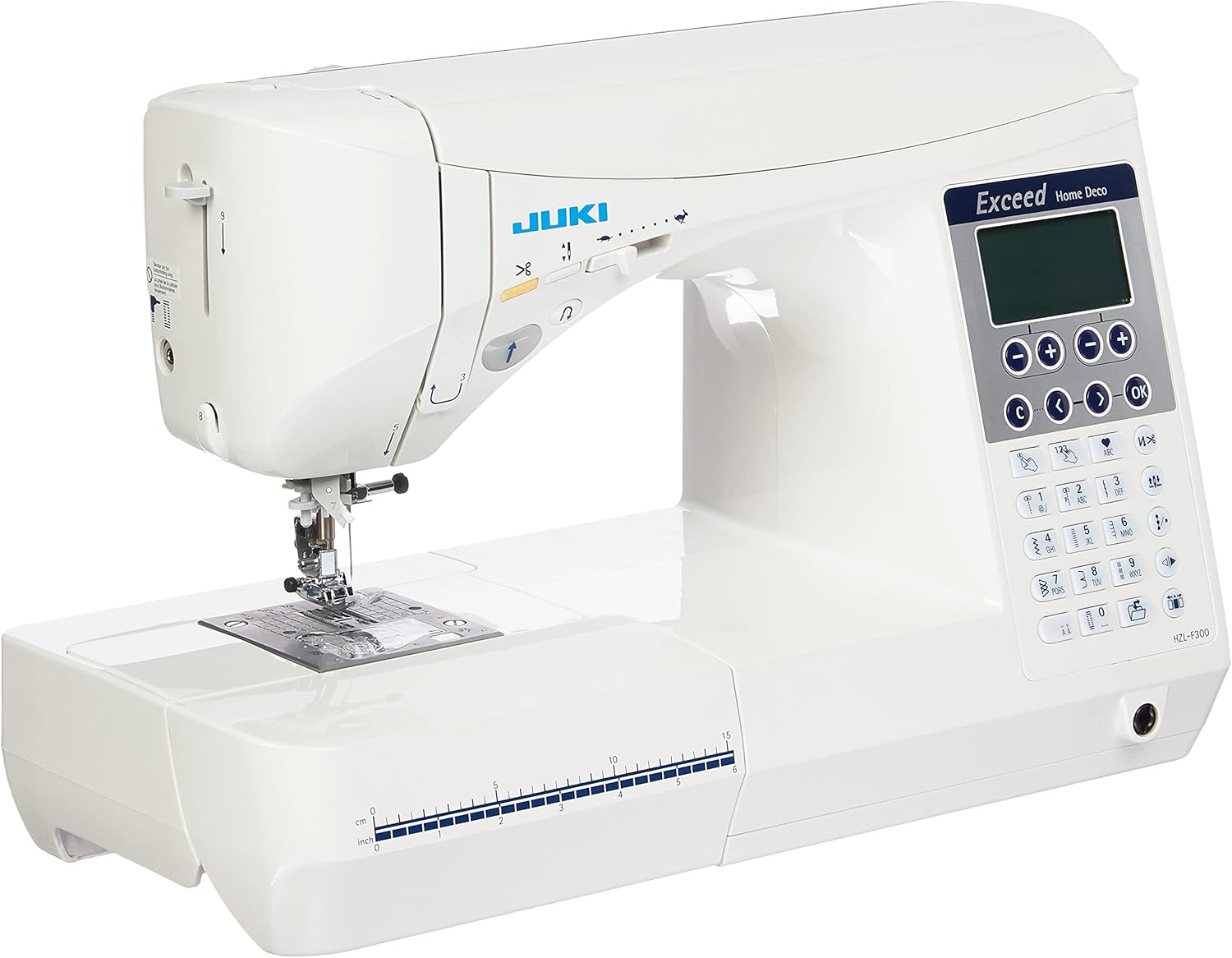
The JUKI HZL-F300 is a computerized sewing and quilting machine with 106 stitch patterns and 16 buttonholes. It includes needle up and down control, automatic thread trimming, an automatic needle threader, and adjustable presser-foot pressure. Those documented controls make it useful to compare against a specific workflow bottleneck instead of choosing a machine by stitch count alone.
Check On AmazonIf you click this link and buy, we earn a commission at no additional cost to you.
Compare each candidate against the current machine, not a marketing tier
A step-up comparison needs a baseline. Put the current machine in the first column, then compare only the requirements that survived your routing process. If the candidate wins only on stitch count, screen size, or included extras while the repeated bottleneck remains unchanged, it is not a meaningful upgrade for this decision.
| Requirement | Current machine | Candidate | Evidence status |
|---|---|---|---|
| Repeated bottleneck | Describe current workaround or failure | Describe the documented change | Verified, test needed, or unresolved |
| Required control | Present, absent, or inadequate | Present or absent | Manual or exact model page |
| Compatible equipment | Existing compatible parts | Required new parts and included items | Compatibility list or manual |
| Service and support | Known local or manufacturer route | Current support route | Verified current information |
| Ownership change | Current consumables and workflow | New consumables, accessories, or learning cost | Known or still to verify |
The comparison also exposes tradeoffs. Gaining one control while losing an attachment interface, service route, familiar bobbin system, or useful accessory may still be worthwhile, but it should be an explicit exchange.
Build an in-person test script for unresolved performance questions
A hands-on test is most useful when you arrive with a script instead of asking whether the machine is “good.” Bring ordinary sample materials that represent the bottleneck when allowed. Keep the needle, thread, foot, and setup consistent so the candidate is the main thing changing.
- Set up the machine according to its manual or the seller’s normal procedure.
- Recreate the same ordinary task that exposes the current bottleneck.
- Use the candidate control that is supposed to solve it.
- Repeat the same short task several times without changing the setup, and do not treat one successful pass as proof of consistent improvement.
- Record what changed, what did not, and any new drawback introduced.
- Stop immediately after a hard needle strike, repeated jam, abnormal electrical sign, smoke, burning odor, or other unsafe behavior.
Keep the script comparative. Test low-speed control if that is the bottleneck, or reproduce the workspace problem if support is the issue. No universal minimum repeat count is established here, so use repeated passes to see whether the result holds without changing the setup. Unrelated decorative stitches do not answer either question.
Decide buy, test, service, accessorize or keep
The decision should now be narrower than “Which machine is best?” Use the ledger, routing, verified requirement, and unresolved test questions. Buying is only one possible result.
| Decision | Use it when |
|---|---|
| Buy | A candidate verifies the required capability and the remaining tradeoffs are acceptable. |
| Test | The feature is documented but performance on your actual bottleneck is still unresolved. |
| Service | The current machine should meet the need but has developed an abnormal fault or reliability problem. |
| Accessorize | A verified compatible part solves the narrow limitation without replacing the machine. |
| Keep | The current machine still meets recurring needs and the proposed upgrade adds mostly unused features. |
- Can you reproduce the limitation?
- Have you ruled out setup, compatibility, maintenance, service, project, and specialist-system causes?
- Can you name and verify the required control, workspace change, interface, or workflow improvement?
- What still needs a controlled test?
- Does buy, test, service, accessorize, or keep best fit the evidence?
The decision can be postponed. If no candidate proves the requirement, keep collecting evidence. A clean “not yet” is better than replacing a known machine with the same bottleneck.

The SINGER Quantum Stylist 9960 is a computerized sewing machine with speed control, needle up and down, stitch sequencing memory, and an included extension table. It also provides 13 one-step buttonhole styles and a broad set of built-in stitches. Treat it as a candidate to verify against your actual bottleneck when controlled speed, repeatable garment steps, or added work support are the requirements.
Check On AmazonIf you click this link and buy, we earn a commission at no additional cost to you.
Return first-machine questions to the beginner decision
If you cannot yet name a repeated limitation, this upgrade framework is too late in the decision process. First-machine questions should begin with expected work, basic controls, machine type, support, workspace, compatible consumables, and budget. You do not need to predict every future feature.
The broader sewing machine comparison framework is the better place to orient that first purchase. Come back to the bottleneck method after enough normal sewing has produced evidence about what your setup repeatedly does well and where it repeatedly gets in the way.
Final Thoughts: Upgrade the bottleneck, not the label
The intermediate label becomes useful only after you stop treating it as a shopping tier. Your current machine, recurring projects, repeated limitation, setup state, compatible equipment, and service condition provide a stronger basis for comparison than price or feature count. Write the bottleneck down, rule out the wrong causes, and demand evidence for the specific capability that remains.
Then make the smallest decision that actually solves the problem. That may be a different domestic machine, but it may also be a test, a compatible accessory, ordinary service, a separate specialist system, or no purchase at all. The upgrade is justified when the evidence shows a meaningful change in the work you repeatedly do.
Frequently Asked Questions
These questions reflect the practical uncertainty that comes up when an established sewist starts comparing a step-up machine. The answer usually becomes clearer once the current bottleneck is named precisely.
🧵 What makes a sewing machine intermediate?
There is no universal feature or price that makes a machine intermediate. For this decision, the useful definition is a machine being evaluated by a sewist who can name a repeated limitation in an existing setup and verify which capability would address it.
💵 Does the best intermediate sewing machine have to cost more?
No. Price may change with controls, construction, support, included equipment, or market position, but it does not prove that the machine solves your specific bottleneck. Compare the required capability first, then evaluate the cost and ownership tradeoffs.
⚙️ Should I replace a machine that keeps having problems?
First separate an abnormal fault from a missing capability. If the machine previously handled the same normal work and now repeatedly jams, fails to feed, or behaves abnormally, follow the manual and appropriate service route before assuming replacement is the only answer.
🦶 Can a presser foot solve the problem instead of a new machine?
Sometimes, but only when the exact accessory is documented as compatible and the problem actually matches what that accessory changes. A generic foot name or similar appearance is not enough to prove fit.
📏 How do I know whether I need more workspace?
Record where the current project bunches, falls, or forces repeated repositioning, then compare the machine’s documented work area and the support available from your sewing table. An extension table can support material without increasing the machine’s internal space to the right of the needle.
🎛️ Are computerized controls necessary for intermediate sewing?
No. A computerized control is useful when it changes a repeated task you care about, such as speed regulation, needle stop position, buttonhole operation, or a saved stitch sequence. Buying automation without a defined use simply adds features to learn and pay for.
Notice that none of these answers depends on graduating into a predetermined machine class. They depend on the exact work, model, compatibility, control, service state, and evidence in front of you.
References and Sources
Current model details below are used as documentation examples, not product rankings. Community discussion is used only to show the kinds of upgrade questions sewists are actually asking.
- Brother CS7000X specifications: verifies the current published stitch count, included equipment, speed-control feature, support information, and absence of adjustable presser-foot pressure on this example model.
- Brother CS7000X support page: verifies that Brother provides model-specific manuals, warranty statements, support contact options, and repair routing for the CS7000X.
- Janome New Home 2030DC specifications: verifies the current published controls, feed features, needle positions, stitch range, workspace dimensions, and manual link for this example model.
- Intermediate machine owner discussion: documents current reader questions around replacement after recurring faults, garment sewing, budget, workspace, speed control, and whether a separate serger belongs in the decision.
Recheck these pages on publication day because model status, bundles, support routes, and published features can change.