A portable sewing machine should preserve the domestic sewing functions you actually need while making repeated storage or transport manageable. Weight matters, but so do unit dimensions, pedal and cord burden, required accessories, workspace, free arm, stitch controls, power requirements, documentation, warranty, and the time it takes to set the machine up again. Mini tabletop machines and handheld tools belong to different capability classes, so the smallest object is not automatically the best portable choice. Define the route first, lock the minimum sewing capability, then compare the complete move-and-sew burden.
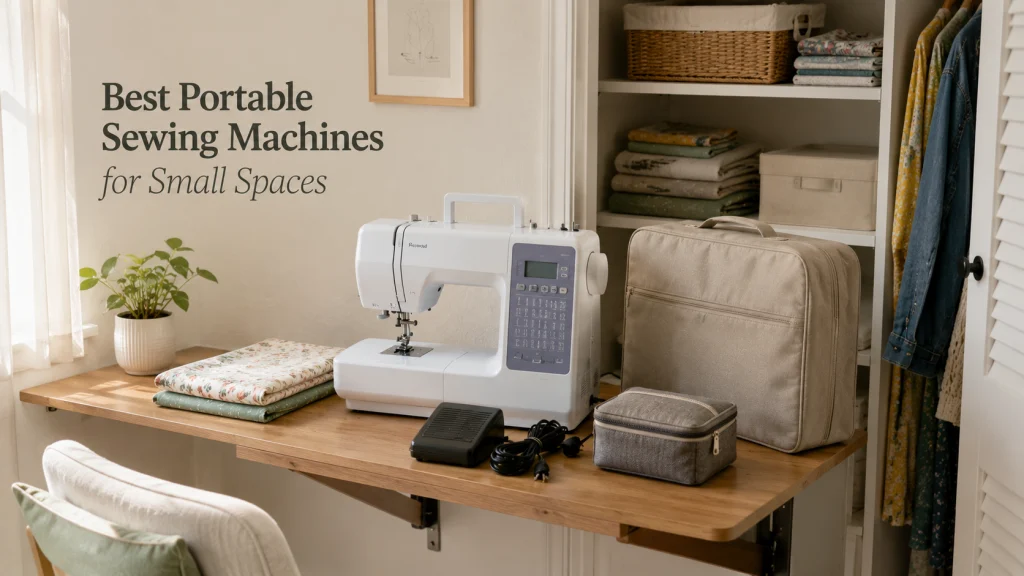
Portable describes a trip, not just a small machine
A portable sewing machine is useful only when it can make the trip you need without giving up the sewing functions that made you want a real domestic machine in the first place. A lightweight full-function machine, a tiny tabletop mending machine, and a handheld stitcher may all appear under portable search results, yet they solve different jobs. The smallest object can be the wrong answer if it cannot form the stitches, use the feet, or provide the workspace your normal sewing requires.
Start with the movement problem rather than the product label. A machine stored in a closet and moved six feet to a table has a different transport burden from one carried from a car into a class every week. If control type is still undecided, use the mechanical versus computerized machine comparison first so portability does not accidentally make the control decision for you.
Define the exact storage or transport route
Write the route as a sequence of physical steps. Where does the machine start, what has to be carried with it, how far does it move, are there stairs or tight doorways, what surface will receive it, and where do the pedal and power cord go? The useful measurement is the burden of the whole move, not just the weight printed on the machine page.
This route tells you which specifications matter before you compare machines. A closet-to-table move may be dominated by shelf fit and loose accessories, while repeated trips outside the house make protection, complete packing, setup surface, and power requirements more important.
| Route worksheet field | Your route | What to verify before buying |
|---|---|---|
| Start and destination | Closet to table, car to class, or another repeated route | Machine dimensions, storage opening, table footprint |
| Transfers | Doorways, stairs, vehicle, hallway, elevator, or other handoffs | Bare unit weight, documented handle or cover, loose-item count |
| Required carry package | Pedal, cord, feet, bobbins, needles, thread, project essentials | Which items must travel every time |
| Setup surface | Table size and available fabric-support area | Machine footprint and usable sewing workspace |
| Power at destination | Normal home outlet or a different travel environment | Exact electrical requirements from the machine documentation |
| Unknowns to measure yourself | Complete packed package | Packed weight and outside dimensions only after the actual package is assembled and measured |
Fill in the route before opening a shortlist. Once the path is concrete, you can eliminate machines that fail the storage opening, setup surface, required capability, or complete carry routine without treating a low unit weight as a universal advantage.
Closet to table
For repeated home storage, check whether the bare machine dimensions fit the shelf or closet opening and whether the machine can be lifted out without removing nearby items. Include the foot controller, power cord, and any presser feet you routinely need in the storage plan. A light machine that requires several separate trips for parts can be less convenient than the unit weight suggests.
Car to class, retreat, or convention
For repeated out-of-home movement, count every transition: storage to vehicle, vehicle to entrance, entrance to sewing table, then the reverse trip. A built-in handle or documented cover can reduce loose-item management, but neither proves comfort or impact protection. Decide whether the complete package works for your own route rather than relying on a universal carrying threshold.
Longer travel with power and packing constraints
Longer travel adds questions that ordinary room-to-room storage does not. Verify the machine’s exact electrical requirements from the rating information or manual, keep the foot controller and power cord matched to the machine, and protect protruding parts according to manufacturer instructions. Airline acceptance and packed size remain separate questions that must be checked against the actual packed package and the carrier’s rules.
Lock the minimum domestic sewing capability before comparing size
Portability should shrink the transport burden, not silently shrink the job. Write a minimum capability list before looking at weights. For a basic garment or mending workflow that may include straight stitch, zigzag, reverse, a usable buttonhole, free-arm access, compatible zipper and buttonhole feet, normal bobbin winding, and enough workspace to manage the projects you actually sew.
A portable sewing machine for beginners still needs the functions required for learning ordinary machine sewing. A beginner does not benefit from saving several pounds if the smaller product removes the stitch controls or accessory compatibility needed for the first projects. Capability first prevents size from becoming a false bargain.
| Required function | Keep if your sewing needs it | Do not trade it away merely for |
|---|---|---|
| Straight and zigzag stitches | Basic construction, finishing, and common mending | A smaller footprint |
| Reverse or reinforcement | Securing common seams where your process uses it | A lower advertised weight |
| Buttonhole capability | Garments or projects that need machine-made buttonholes | A simpler stitch selector |
| Free arm | Cuffs, sleeves, and other tubular work | A shorter machine body |
| Required presser-foot compatibility | Zippers, buttonholes, hems, or other repeated operations | A mini product label |
| Adequate sewing space | The project must still fit and move predictably | A compact storage claim |
Once this list is locked, use it as the entry gate for the shortlist. A missing required function matters more than a modest saving in size or weight.

Brother XR3774 is a full-size sewing and quilting machine with 37 built-in stitches and one automatic one-step buttonhole. It includes an automatic needle threader, free arm, Quick-Set top drop-in bobbin, and eight sewing feet. A detachable wide table, walking foot, quilting foot, and standard utility feet are included for garment sewing, mending, and quilting.
Check On AmazonIf you click this link and buy, we earn a commission at no additional cost to you.
Exclude mini and handheld substitutes when they fail the capability list
Portable, mini, and handheld are not interchangeable product classes. A full domestic machine can still be light enough for repeated movement while retaining a normal needle system, bobbin system, foot controller, utility stitches, presser feet, and free arm. A mini tabletop machine accepts a reduced capability envelope, while a handheld tool is built around a narrow quick-repair role rather than ordinary domestic-machine sewing.
Classify the object before comparing its size. That prevents a marketplace result from winning because it is dramatically smaller while solving a different problem.
| Product class | What it is trying to preserve | When it leaves this comparison |
|---|---|---|
| Portable full domestic machine | Normal home-sewing capability with a manageable move-and-store burden | Stays here when repeated transport or storage is the main constraint |
| Mini tabletop machine | Smaller size with a deliberately reduced capability set | Move to the mini-machine decision when reduced capability is acceptable |
| Handheld sewing tool | Very narrow on-the-spot repair or temporary stitching role | Move to the handheld decision when a full machine is unnecessary |
A travel sewing machine that must still make garments or perform ordinary mending belongs in the first row until the capability list says otherwise. “Travel” describes the route, not permission to downgrade the sewing system.
Compare the real machine burden
Once the product class is correct, compare the complete package. Official unit weight and dimensions are useful starting points, but they describe only the machine body. The carry package can also include a foot controller, power cord, required presser feet, bobbins, needles, thread, project materials, manual, and any protective cover or case you choose to use.
A useful carry-package inventory separates verified manufacturer data from items that still need your own measurement. Official unit specifications stay in one column; the assembled carry package stays unknown until it is actually measured.
Official unit dimensions and weight
SINGER lists the M1500 at 13 by 7 by 11.5 inches and 10 pounds. The M3330 is listed at 15 by 6.2 by 12 inches and 13.6 pounds. Janome lists the Jem Platinum 760 at 13.9 by 10 by 6.5 inches and 12 pounds. These numbers are directly comparable as bare-unit specifications, but they do not include an assumed bag, project, pedal, thread, or other travel load.
Handle and cover
A documented handle can simplify a short move, and a documented cover can help organize or protect the machine in the way the manufacturer intends. Janome lists a hard cover for the Jem Platinum 760. If a product page does not document a handle or cover, mark that field unknown or verify it in the exact manual rather than assuming one from product photos.
Pedal, cord, and required accessories
The machine does not sew after arrival if the pedal, power cord, correct foot, bobbin, or needle was left behind. Build a repeatable inventory for the sewing you plan to do away from the normal workspace. Keep optional extras out of the carry package unless they serve a specific task, because every added item becomes part of the transport burden.
| Carry item | Always verify | Record separately |
|---|---|---|
| Machine body | Official unit weight and dimensions | Any measured packed weight |
| Power system | Correct power cord, foot controller, and electrical requirement | Adapters or travel equipment only when manufacturer-approved |
| Sewing essentials | Required feet, bobbins, needles, thread, and small tools | Optional project accessories |
| Protection | Documented cover or compatible transport method | Actual bag or case weight and outside dimensions |
The inventory turns portability into something you can audit. It also makes it clear which numbers are manufacturer specifications and which require your own measurement.

Janome Arctic Crystal is a full-size mechanical sewing machine with 15 built-in stitches and a four-step buttonhole. It uses dial stitch selection, adjustable stitch length and width, a three-piece feed dog, and a free arm for tubular sewing. The machine weighs about 13 pounds and includes general-purpose, zipper, blind-hem, and buttonhole presser feet.
Check On AmazonIf you click this link and buy, we earn a commission at no additional cost to you.
Check the setup surface and workspace
A machine that fits in the closet still has to fit the table. Check the footprint against the actual setup surface and leave room for fabric to enter, exit, and move around the needle area. A narrow table can erase the advantage of a compact body if the project hangs off the edge and pulls against the feed.
Workspace beside the needle matters separately from overall dimensions. SINGER lists 5.6 inches of needle-to-tower sewing space on the M1500 and 5.7 inches on the M3330. Janome lists a 5.4-by-4-inch workspace on the Jem Platinum 760. These figures help describe the sewing area, but they should be matched to the projects you expect to carry rather than treated as a universal ranking.
Verify utility stitches, free arm, and required controls
SINGER lists six built-in stitches, a four-step buttonhole, preset stitch length and width, reverse, and a free arm on the M1500. The M3330 lists 23 built-in stitches, a one-step buttonhole, adjustable stitch length and width, reverse, built-in needle threading, and a free arm. Janome’s Jem Platinum 760 lists 60 stitches, five one-step buttonholes, a free arm, needle up/down, Start/Stop, speed control, locking stitch, and an automatic thread cutter.
Those differences show why weight alone is not enough. A lighter machine can be the right answer when its simpler controls cover the whole sewing brief. A slightly heavier machine can be the better transport fit when the additional control eliminates something you would otherwise have to give up every time the machine leaves its normal table.
Key point: Score only the functions you will actually use. Portability is not improved by carrying electronic features you do not need, but it is not improved by deleting a required function either.
If computerized functions are part of the minimum capability list, compare computerized sewing machine controls before assuming that the lightest computerized option has the interface you need.
Compare mechanical and computerized candidates only after transport fit
Transport does not make mechanical controls inherently better, and computerized controls do not make a machine inherently less portable. Once the route, unit burden, setup surface, and minimum capability have been fixed, compare control families on the tasks you repeat. Mechanical dials may keep setup simple, while a computerized machine may preserve speed limiting, needle-stop behavior, direct stitch selection, or other controls you already rely on.
The right order matters. If you start with a control preference and ignore the carry route, you can end up with a machine that is unpleasant to move. If you start with the lowest weight and ignore controls, you can end up carrying a machine that no longer supports your normal workflow.
Verify power requirements, manual, warranty, and service route
Repeated movement increases the importance of knowing exactly which power cord and foot controller belong with the machine. Check the rating information and manual for the electrical requirement instead of assuming that a machine sold in one market can be connected directly in another. Do not treat a plug adapter as proof of voltage compatibility.
Also confirm that the manual, warranty terms, parts information, and support route are available for the exact model. SINGER publishes warranty coverage and support access on the M1500 and M3330 pages, while Janome provides model-specific resources for the Jem Platinum 760. Support quality is not proven by the existence of a page, but a documented path is useful when the machine is repeatedly packed, unpacked, and set up away from its normal location.
Compare current portable candidates by transport situation
Build the shortlist around the route you wrote down, then use current model specifications only as evidence for that situation. The table below does not name a winner. It shows which facts deserve priority in three common transport patterns and where current full domestic machines illustrate different capability tradeoffs.
| Transport situation | Prioritize first | Current evidence examples | Reject or keep unknown when |
|---|---|---|---|
| Closet or shelf to home table | Storage opening, table footprint, loose-item count, minimum stitches and free arm | SINGER M1500: 10 lb, 13 x 7 x 11.5 in, 6 built-in stitches, free arm. SINGER M3330: 13.6 lb, 15 x 6.2 x 12 in, 23 built-in stitches, free arm. | The machine does not fit the storage route or drops a required sewing function |
| Car to class, retreat, or convention | Complete carry package, repeated transfers, setup completeness, controls used during class | Janome Jem Platinum 760: 12 lb, 13.9 x 10 x 6.5 in, hard cover, speed slider, Start/Stop, needle up/down. M3330 retains adjustable stitch length and width at a higher bare-unit weight than M1500. | Required accessories create an unacceptable carry routine or the control set does not match the work |
| Longer travel | Electrical requirements, actual packed package, protection, destination surface, required capability | Use the same verified bare-unit specifications as a starting point, then measure the complete package you will actually carry. | Packed burden, carrier acceptance, or power compatibility has not been verified |
Once one row matches your route, compare only machines that pass its first-column priorities and your capability checklist. That is the commercial decision point: remove candidates that fail a required function or transport condition, then compare the remaining choices on controls, support, current package contents, and total ownership fit.
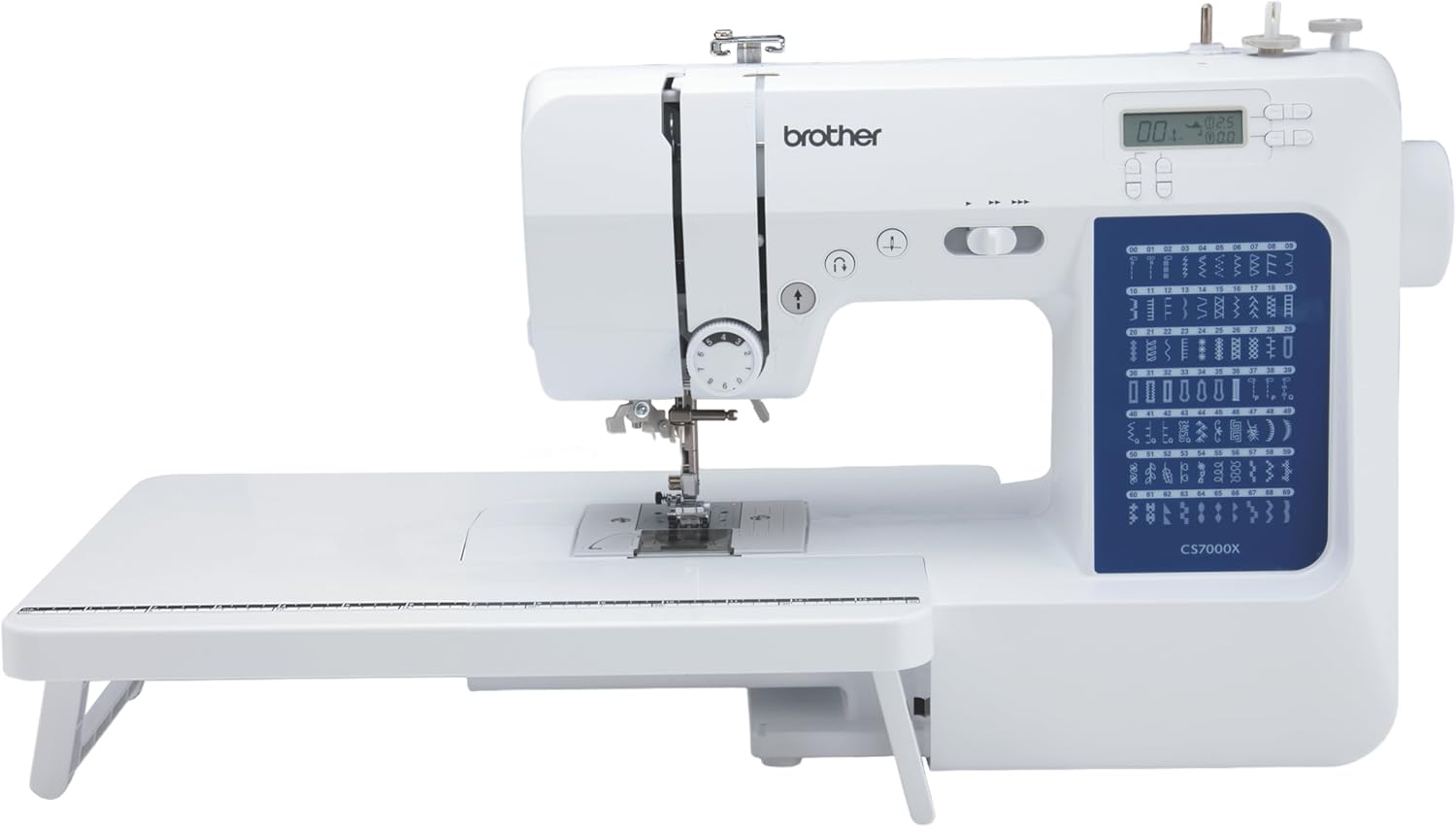
Brother CS7000X is a computerized sewing and quilting machine with 70 built-in stitches and seven one-step auto-size buttonholes. It has an LCD display, automatic needle threader, Quick-Set bobbin, adjustable sewing speed, free arm, and drop feed. The package includes 10 sewing feet, a detachable wide table, a quilt guide, and a hard protective cover.
Check On AmazonIf you click this link and buy, we earn a commission at no additional cost to you.
Build the lift, carry, setup, and stitch audition around your own handling limit
If you can evaluate the exact machine before purchase, test the whole workflow rather than only sewing on it. Pack the items you actually need, move the machine along a representative route, place it on the intended surface, connect the correct controller and power cord, install the needed foot, sew the required utility operations, then break the setup down again. Record the burden instead of relying on an impression formed from the bare machine in a store.
This is not a medical lifting test and there is no universal safe weight threshold here. The buyer defines their own handling limit. If the route feels awkward, unstable, or beyond that personal limit, reject the setup without needing a numerical rule.
| Audition stage | What to record |
|---|---|
| Lift | Where the machine is gripped and whether the complete package is manageable for you |
| Carry | Doors, stairs, vehicle transfers, loose items, and protection needed on your actual route |
| Setup | Surface fit, power connection, pedal position, accessory unpacking, and readiness to sew |
| Stitch | Whether every required utility function from the capability list remains available |
| Breakdown | How many items must be repacked and whether anything is easy to leave behind |
Without a documented audition, keep comfort, stability, packed burden, and setup speed untested. Official dimensions and weight are evidence for the bare machine, not for the complete experience of moving it.
Choose a mini machine only when reduced capability is acceptable
A mini tabletop machine can be a legitimate answer when the buyer intentionally accepts fewer functions in exchange for a smaller format. That is a different decision from preserving normal domestic sewing while making the machine easier to move. If the capability checklist is already short enough that a reduced machine satisfies every required task, the mini-machine comparison becomes relevant.
Use the mini sewing machine capability comparison at that point. Do not move into the smaller class merely because the word portable appears on both product pages.

KPCB Tech Mini Sewing Machine is a compact beginner machine with a double-thread system, dual-speed operation, and an extension table. It includes a foot controller, finger guard, built-in light, and a 42-piece sewing kit with fabric squares and basic sewing tools. The machine weighs about 3 pounds and is designed for small projects where compact size is prioritized over full domestic-machine capability.
Check On AmazonIf you click this link and buy, we earn a commission at no additional cost to you.
Choose a handheld tool only for a narrow quick-repair role
A handheld stitcher solves an even narrower problem. It can make sense when the job is a small temporary repair and carrying a domestic machine would defeat the purpose. It should not be scored against a full sewing machine on normal utility stitches, presser-foot options, free-arm work, buttonholes, or broad project capability.
If that narrow repair role is the actual requirement, use the handheld sewing machine decision criteria. If ordinary domestic sewing is still required after arrival, stay with the full-machine transport comparison.

SINGER Stitch Sew Quick is a cordless handheld single-thread mending machine designed for quick repairs and temporary stitching. It is intended primarily for lightweight fabrics and runs on four AA batteries, which are not included. The package includes thread, bobbins, needles, a thread spindle, and a needle threader.
Check On AmazonIf you click this link and buy, we earn a commission at no additional cost to you.
Keep portability inside the full sewing-machine decision
Repeated transport can become the decisive constraint without becoming the only ownership question. Workspace, compatible needles and bobbins, required feet, maintenance, warranty, service access, and project fit still matter once the machine reaches the table. A lighter machine that creates new compatibility or support problems may not reduce the total ownership burden.
Use the sewing machine buying framework when the portable finalists are close. That brings the transport audit back into the larger decision instead of letting one low weight number erase everything else the machine has to do.
Final Thoughts: Portable is the complete move-and-sew workflow
A portable machine has to pass two tests at the same time: the route must be workable and the sewing brief must remain intact. Verify unit size and weight, complete the carry-package inventory, check the setup surface and power requirements, then compare only the machines that retain the stitches, controls, free arm, workspace, and accessory fit you actually need. Mini and handheld products enter only when you deliberately accept their narrower jobs.
With those filters complete, the remaining shortlist is ready for a real purchase comparison on current package contents, support, warranty, and ownership fit. Portability is not a badge on the machine or a single weight number. It is whether the complete move, setup, sewing session, and pack-down routine works repeatedly without sacrificing the job you bought the machine to do.
Frequently Asked Questions
🧳 What makes a sewing machine portable?
Portability comes from the complete move-and-setup burden, not weight alone. Check dimensions, weight, required cord and pedal, accessories, protection, setup surface, and whether the machine still retains every sewing function you need.
⚖️ Is the lightest sewing machine always the best for classes?
No. A lower unit weight helps only if the machine still meets the stitch, control, workspace, and accessory requirements of the class or your normal sewing. Count the full carry package rather than the machine body alone.
🧵 Is a portable sewing machine the same as a mini machine?
No. A portable full domestic machine preserves a normal home-sewing capability set while reducing transport burden. A mini tabletop machine deliberately accepts a smaller capability envelope.
🖐️ Is a handheld sewing machine a good travel replacement?
Only for a narrow quick-repair role. If you need ordinary utility stitches, presser feet, buttonholes, free-arm work, or normal project sewing after arrival, a handheld tool is a different product class.
🔌 Can I plug a travel sewing machine into power anywhere?
Do not assume so. Verify the exact machine’s electrical requirement from its rating information or manual and use the correct power cord and foot controller. A plug adapter alone does not prove voltage compatibility.
📦 Does a hard cover make a sewing machine safe for airline travel?
No. A hard cover is a documented protection or storage feature, not proof of airline acceptance or carry-on eligibility. Check the carrier’s rules separately and do not invent packed dimensions from the bare machine size.
References and Sources
- SINGER M1500 specifications: Verifies unit size, weight, built-in stitches, buttonhole format, free arm, sewing space, included items, and warranty information used in the comparison.
- SINGER M3330 specifications: Verifies unit size, weight, stitch functions, adjustable controls, free arm, sewing space, included items, and warranty information used in the comparison.
- Janome Jem Platinum 760 specifications: Verifies unit footprint, weight, workspace, free arm, computerized controls, and hard-cover information used in the comparison.