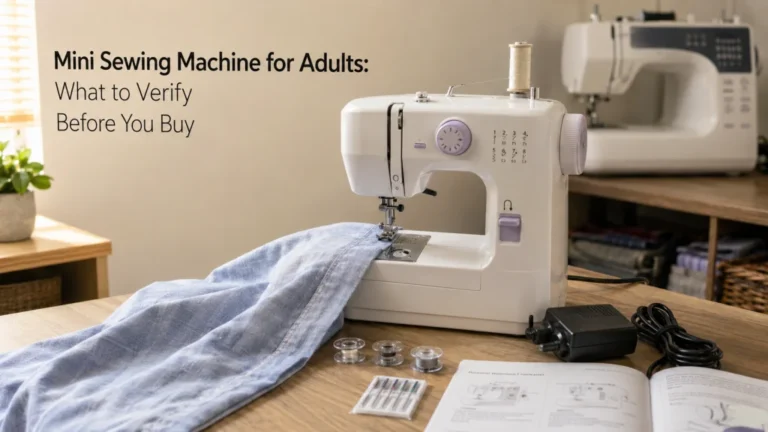
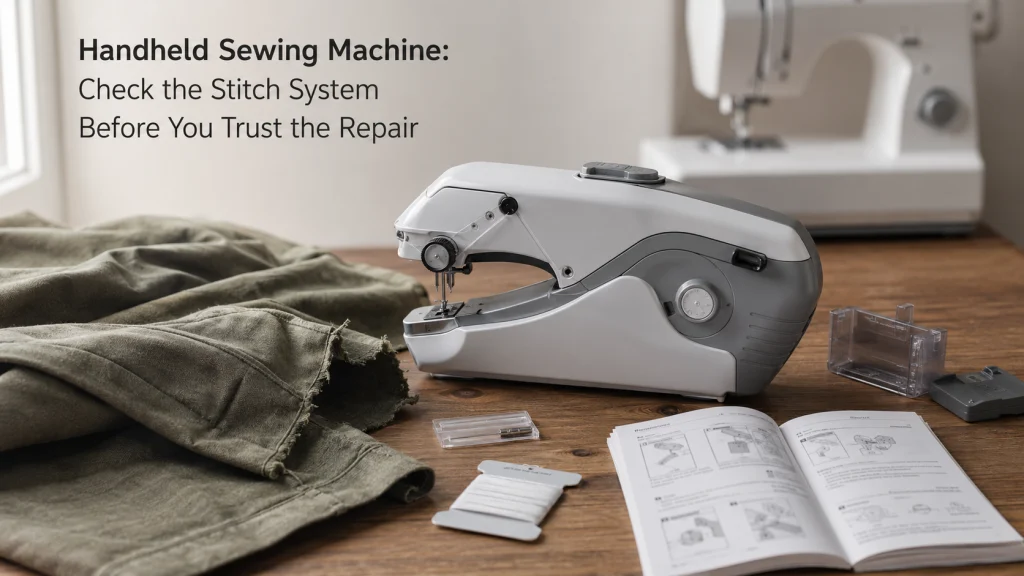
A handheld sewing machine is not one single tool category. Different models can use different stitch systems, thread paths, power setups, and repair methods, so the right buying question is not whether a handheld machine is convenient. It is whether the exact model can create and secure the type of repair you need. Verify the stitch system, seam start and finish, fabric access, controls, consumables, and documented limits before treating a handheld tool as a repair solution.
Define the repair before evaluating the tool
A handheld machine can look attractive because it promises a quick fix with less storage space than a full sewing machine. That convenience does not answer whether the resulting seam matches the job. A temporary hold, a simple fabric closure, and a seam that must remain secure under repeated use are different requirements. Start with the repair itself, not the size or price of the tool.
Describe the repair geometry before comparing machines: where the damaged area sits, whether both fabric faces are accessible, whether an edge can be supported, and whether the seam needs a secure beginning and ending. A loose hem near an open edge gives you very different access from a split seam inside a narrow sleeve or a tear beside a bulky intersection. If the fabric cannot be held flat or guided through the tool in the way the instructions require, portability does not solve the problem. That limitation should eliminate a candidate before convenience becomes the deciding factor.
Then define what success means. A temporary hold is not the same outcome as a seam expected to survive regular wear, washing, or repeated handling. Ask whether the exact model can form, finish, and physically reach the seam your repair requires. Once that is clear, the comparison becomes much easier.
Separate handheld, mini and portable sewing machines
Small sewing tools are often grouped together in search results, but their workflows can be very different. A handheld tool is operated directly against the fabric, so the user’s hand becomes part of the support and guiding system. A tabletop mini machine sits on a stable surface and moves fabric through a more machine-like work area. A portable domestic machine may still be compact enough to store easily while keeping broader controls, presser-foot support, and a conventional sewing position.
That distinction matters because these tools solve different ownership problems. Someone who wants an emergency mending device for an accessible hem is making a different decision from someone who wants a small machine for repeated garment repairs or regular sewing. Do not let the shared words “mini”, “portable”, or “compact” collapse those needs into one category. For the broader domestic architecture decision, the machine architecture guide separates the main machine formats before you compare compact repair tools. Compare the operating format first, then decide whether the footprint is actually an advantage for your use.
| Tool type | Main question | Common limitation to verify |
|---|---|---|
| Handheld | Can this exact tool create and secure the required seam? | Stitch system, access and seam finishing |
| Mini tabletop | Can the machine perform the needed work on a small footprint? | Workspace and machine capability |
| Portable domestic | Do you need broader sewing-machine functions? | Storage, controls and full workflow needs |
Use the table as a boundary check rather than a ranking. If you need conventional fabric support, repeatable control, or broader repair capability, compare the portable machine guide instead of forcing the handheld format to do that job. If reduced tabletop size is the real requirement, the mini machine guide covers that separate class. A handheld tool still makes sense for a narrow, accessible job when its seam system is documented for that use.
Identify the exact model and stitch system first
Do not assume every handheld sewing machine creates the same type of stitch. Singer’s current product information demonstrates why model-level checking matters: Stitch Sew Quick is identified as a single-thread handheld mending machine, while Stitch Quick+ is described as a handheld or tabletop machine with two-thread stitch capability. Those are not interchangeable descriptions. A general claim about what “handheld machines” can do can therefore hide a difference that directly affects thread path, seam formation, setup, and finishing.
Single-thread handheld example
A single-thread handheld system should be evaluated by how that stitch is formed and secured, not by the fact that the tool is compact. Singer describes Stitch Sew Quick as using a single-thread feed for quick repairs and basting, and says it works best on lightweight fabrics. That tells you something useful about intended use, but it does not prove that every single-thread handheld tool behaves the same way. The exact instructions still control how you start, finish, and handle the repair.
Two-thread handheld/tabletop example
A two-thread handheld or tabletop format can represent a different sewing approach from a single-thread tool. Singer describes Stitch Quick+ as having two-thread stitch capability and allowing either handheld or tabletop use, which changes the workflow you should evaluate. That does not automatically make it a substitute for a domestic machine, because capability still depends on the documented stitch formation, fabric handling, controls, and intended use. It simply means the model must be judged on its own system rather than by category shorthand.
| Evidence | What it tells you |
|---|---|
| Exact model page or manual | The actual stitch system and intended use |
| Thread path information | How the tool forms the seam |
| Included instructions | What the user is expected to do safely |
Model identity comes before feature comparison. If a listing gives only generic portable-sewing language, there is not enough evidence to compare its seam system with another tool. Confirm the model and documentation first, then move to seam security and repair access.

SINGER Stitch Sew Quick is a cordless handheld mending machine that uses a single-thread feed for quick repairs and temporary stitching. It is intended primarily for lightweight fabrics and runs on batteries for portable use. The package includes thread, bobbins, needles, a thread spindle, and a needle threader.
Check On AmazonIf you click this link and buy, we earn a commission at no additional cost to you.
Verify how the seam starts and ends
A repair seam is not only the visible line of stitches in the middle. The beginning and ending determine whether the repair method actually matches the job, especially when the fabric will be pulled, washed, flexed, or handled repeatedly. Check the exact instructions for how the stitch is started, how the last stitch is treated, and whether the thread must be secured manually after sewing. A neat-looking center section does not answer any of those questions.
This is where a first-time buyer can easily misread a product demonstration. A short sample may show that the tool can pierce fabric and create a line of stitches, but it may not show what happens at the ends of that line. If the model relies on a particular finishing step, that step is part of the repair workflow rather than an optional detail. If the documentation does not explain it clearly, treat the missing information as uncertainty instead of assuming the seam is permanent.
- How does the seam begin?
- How does the seam end or lock?
- Does the manual explain the finishing method?
- Does that method match the repair requirement?
Use those questions before judging stitch appearance. For a temporary hold, a simple securing method may be enough; for a repair expected to stay closed through normal use, you need stronger evidence that the documented start and finish match that expectation. The correct conclusion can be that the tool is suitable only for a narrower job.
Check what fabric faces and edges must be accessible
Repair geometry can decide whether a handheld tool is practical before stitch quality even enters the discussion. A seam near an open edge can often be positioned, supported, and reached more easily than damage buried inside a cuff, sleeve, pocket, bag, or layered construction. The relevant question is not simply whether the machine is small enough to approach the area. You also need enough room to hold the fabric in the orientation the tool requires while keeping the repair line controlled.
Think through the path the fabric must take during the repair. If the tool has to sit on one face while your other hand supports the opposite side, a narrow enclosed area can become harder to sew than it first appears. Bulky seam allowances, folded hems, elastic channels, and intersections can also change how flat the material can sit. Compact size helps only when the fabric can still be presented to the needle and feed area in a stable, repeatable way.
- Where is the damaged area located?
- Can both sides of the fabric be reached?
- Can the fabric stay stable while the tool operates?
- Does the repair need a visible seam, a temporary hold, or a more secure finish?
Run that access check on the actual item you want to repair, not on an imaginary flat fabric sample. If you cannot reproduce the needed orientation without twisting, bunching, or obscuring the repair line, a handheld format may create more handling difficulty than it removes. In that case, choose a method that gives the fabric better support.
Verify feed, pressure and orientation limits from the exact manual
Do not infer fabric capacity from appearance, weight, price, or marketing language. A handheld tool may depend on a specific way of presenting the fabric to the needle area, and that handling method can matter as much as the stitch itself. The exact instructions should show how the material is positioned, how the tool moves or feeds, and what the user is expected to control during sewing. If those details are missing, a claim that the machine is “easy” or “portable” does not fill the gap.
Material behavior also changes the decision. A light, stable woven fabric can lie flatter and be easier to control than a bulky seam intersection, a soft stretchy knit, or several compressed layers, even when all of them physically fit under the tool. That does not prove a handheld machine will or will not sew a particular material, but it explains why broad material claims need model-specific evidence. Verify what the manufacturer actually documents instead of extending one successful example to every fabric stack.
Follow the exact instructions for allowed use, orientation, and operating method. If the repair requires support or layer handling the handheld format does not document, choose another repair path. Compact size is not proof of capability.
Audit batteries, power options and controls
Power setup affects whether the tool fits the situation you are buying it for. A machine intended for a travel kit, emergency drawer, or occasional household repair needs a power source that will actually be available when the repair happens. Check whether batteries are required, whether they are included, whether corded operation is supported, and how the machine is switched on and off. Those details are part of usability, not background specifications.
The two Singer examples show why this check should stay model-specific. Singer lists Stitch Sew Quick as cordless and battery operated, with batteries not included, while Stitch Quick+ requires four AA batteries and is also described as having an option for cord power. Stitch Quick+ further uses an on/off safety switch in handheld mode and can be set for continuous stitching in tabletop mode. That is a different control workflow from simply assuming every handheld machine behaves the same way.
Before purchase, picture the actual use case. If the tool will sit in storage, plan for the batteries or supported power option it needs. If the controls are awkward in the expected repair position, compact size may not compensate. Power and controls should support the repair geometry you already defined.
Check replacement needles, thread path and consumables
A repair tool is only useful when the required consumables and setup information remain understandable after the included supplies are used up. Verify what the exact model documentation says about needles, thread, bobbins or other thread-holding parts, and the threading path. Do not assume that a familiar-looking needle or bobbin from a full sewing machine automatically fits a handheld device. Visual similarity is not compatibility evidence.
Included accessories can tell you what arrives in the box, but they do not answer the replacement question by themselves. Singer lists thread, bobbins, needles, and a thread spindle with Stitch Sew Quick, while Stitch Quick+ is listed with thread, bobbins, a needle, a threader, and a spindle. Those package details are useful for first setup, yet an owner still needs clear guidance for what to buy later and how to reinstall it correctly. A tool that becomes confusing as soon as the starter supplies run out is a weaker ownership choice.
Check support information before treating a handheld machine as an emergency repair option. You should be able to identify the threading route, the replacement item required, and any model-specific setup steps without guessing. If a listing is vague about basic consumables or the exact model cannot be matched to reliable documentation, that uncertainty belongs in the purchase decision.
Read the exact safety instructions
A handheld machine may look less intimidating than a full-size sewing machine, but it still places a moving needle close to the user’s hands. Read the exact instructions before operation, especially the sections covering switching, threading, needle handling, battery or power setup, and any required position for the tool. Keep fingers away from the needle path and do not improvise around guards, switches, or damaged parts. Small size does not reduce the need for normal needle and electrical caution.
Stop using the tool if it behaves in a way the documentation does not describe as normal. Uncontrolled motion, overheating, smoke, a burning odor, sparks, exposed wiring, a damaged cord where one is used, or repeated hard needle strikes are reasons to stop rather than continue testing. A jam that cannot be cleared by an owner-level step in the instructions should not become an excuse to force the mechanism. The safe boundary is the exact work the manufacturer documents for the user.
Safety also affects the buying decision before anything fails. Look for clear operating instructions and support information rather than treating a vague listing as good enough for a low-cost tool. If you cannot determine how the unit is powered, stopped, threaded, or handled safely, the missing documentation is itself a reason to reject that candidate.
Reject unsupported permanence and material claims
Handheld tools are easy to oversell because small size and convenience are immediately visible, while seam behavior is harder to judge from a product photo. Claims about denim, leather, upholstery, thick layers, permanent repairs, or universal fabric ability need evidence from the exact model or a test that clearly identifies the setup and material. A category label such as “handheld sewing machine” does not prove those capabilities. Neither does one short demonstration on an unspecified fabric.
Pay attention to the difference between intended-use wording and broader performance claims. Singer, for example, describes Stitch Sew Quick as a single-thread machine for quick repairs and basting and says it works best on lightweight fabrics. That is much narrower than claiming the tool is suitable for every household repair. When a manufacturer gives a bounded description, do not expand it into a stronger promise just because a retailer or marketplace listing uses more aggressive language.
Use the same standard for permanence. A line of stitches can look secure in a photo without showing how the seam was started, finished, loaded, washed, or repeatedly flexed. Unless the exact instructions or documented testing support a stronger conclusion, describe only what the evidence shows. A cautious rejection of an unsupported claim is more useful than pretending convenience proves durability.
Compare handheld options by evidence, not rankings
A useful comparison is not a list of the smallest, cheapest, or most popular tools. Start with exact model identity and build a short evidence record for each candidate: stitch system, intended use, power method, controls, fabric guidance, included consumables, seam-finishing instructions, and available support. If two listings cannot be compared on the same basic questions, the problem is missing evidence rather than a need for a more elaborate ranking formula.
This approach also prevents one visible feature from dominating the decision. A cordless model may be convenient, but that advantage does not answer whether the repair location is accessible or whether the seam can be secured properly. A two-thread format may differ from a single-thread one, but thread count alone does not prove broader material capacity or durability. Record what each model actually documents, then match those facts to the repair you defined at the beginning.
| Candidate evidence | What to record |
|---|---|
| Single-thread handheld format | Thread system, seam formation and documented limits |
| Two-thread handheld/tabletop format | Thread path, securing method and intended workflow |
| Any handheld listing | Exact model identity, manual availability and support information |
| No reliable documentation | Reject purchase until the missing evidence is available |
The last row is important. A low price does not make missing instructions less relevant, because the tool still has to be threaded, powered, controlled, and used safely. When documentation is too vague to answer the basic repair questions, reject the candidate until better evidence is available rather than filling the gaps with assumptions.

SINGER Stitch Quick+ is a portable mending machine with two-thread stitch capability for handheld or tabletop use. It can run on four AA batteries and uses an on-off safety switch in handheld mode or continuous stitching in tabletop mode. The machine includes thread, bobbins, a needle, needle threader, spindle, and built-in storage for sewing notions.
Check On AmazonIf you click this link and buy, we earn a commission at no additional cost to you.
Build a sample test only when real testing is available
If a real handheld test exists, document enough detail for the result to mean something. Record the exact model, power source, fabric identity, number and type of layers, repair geometry, stitch formation, seam start and finish, and any failure or handling problem that occurred. A statement such as “it worked on denim” is too vague if the fabric weight, layer count, seam position, and finishing method are unknown. The same applies to a successful repair on an easy flat edge that is later generalized to enclosed or bulky areas.
Repeatability matters too. One short line of stitches can show that a particular setup produced a stitch once, but it does not establish universal capacity, long-term durability, or suitability for every repair. If multiple samples are tested, keep the conditions comparable enough to explain what changed between them. If there is only one documented observation, present it as one bounded observation rather than turning it into a product-wide performance claim.
Without genuine testing records, keep the article’s conclusions based on manuals, official model information, and clearly labeled limits. Do not invent a sample test to make the review sound more experienced. A transparent evidence boundary is more useful to a buyer than an impressive-sounding test that never happened.
Choose another repair path when the geometry does not fit
A handheld tool is not always the correct answer, even when the repair looks small. Depending on the location and required seam, a compact domestic machine, a tabletop mini machine, a simple hand repair, or professional repair service may match the physical requirements better. The decision should follow the repair geometry and the level of seam security you need. Buying the smallest powered tool first can create another problem if the fabric cannot be positioned or supported correctly.
For example, a loose hem on an accessible edge gives you room to see the stitch line and control the fabric. A split inside a narrow sleeve, a damaged pocket corner, or a repair beside a thick seam intersection may restrict both access and support. Those jobs can demand a different workflow even when the damaged area is only a few inches long. The size of the tear is therefore a poor substitute for checking where the repair sits and how the material must move during stitching.
There is also no rule that a powered repair device has to be the answer. If the tool’s exact instructions do not support the material, seam finish, or access you need, reject it for that job rather than stretching its purpose. The correct purchase decision can be buying nothing new, using a machine you already own, or sending a difficult repair to someone with the equipment and access to handle it properly.
Final Thoughts: buy a narrow tool only for a repair it can document
A handheld sewing machine should be evaluated by the seam system it actually uses, not by its small size or convenience. Verify the model, stitch formation, seam security, fabric access, controls and support before treating it as a repair solution.
A narrow tool can be useful when its limits match the task. When the evidence does not support the repair you need and the decision returns to a conventional domestic machine, use the sewing machine guide to restart the purchase at the broader machine level. A different sewing method can still be the safer choice when no powered machine fits the repair geometry.
FAQs
🧵 Are all handheld sewing machines the same?
No. Different models can use different stitch systems, controls and repair methods.
🔍 Can a handheld machine replace a regular sewing machine?
Only for tasks that match the exact model’s documented capability and repair geometry.
🪡 Are handheld sewing machines permanent repair tools?
Do not assume permanence unless the exact model provides evidence for the seam method and use case.
References and Sources
- Singer Stitch Sew Quick information: supports model-specific single-thread documentation.
- Singer Stitch Quick information: supports model-specific two-thread handheld/tabletop documentation.