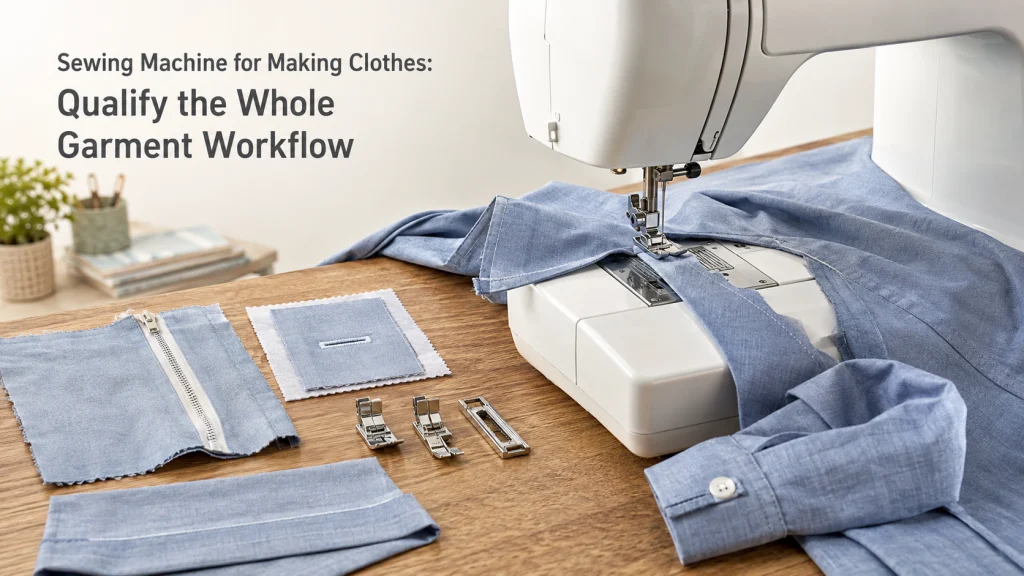
A sewing machine for making clothes should be qualified against the complete garment workflow, not stitch count or a broad beginner label. Start with the clothes you plan to sew, then check utility stitches, closures, hems, narrow areas, compatible feet, controls, and the fabrics that will pass under the presser foot. A feature list can prove that an operation is supported, but it cannot prove buttonhole quality, knit handling, or seam quality on every fabric. The goal is a repeatable way to reject incomplete candidates and audition the finalists on realistic garment operations.
A Finished Garment Is a Chain of Machine Operations
A sewing machine for making clothes earns its place by completing a sequence, not by looking impressive on a chart. A shirt can require seams, curves, a zipper or button placket, buttonholes, hems, and narrow cuff access. A machine can handle the first seam well and still be a poor match if a later operation is awkward or unsupported. The best sewing machine for making clothes is therefore the one that covers your real garment sequence with the fewest unresolved gaps.
Change the buying question from stitch quantity to garment completion. Decorative stitches do not replace a workable zipper setup, useful utility stitches, a documented buttonhole process, or practical cuff access. If you are still comparing broad machine types, first choose a machine for home projects and then narrow the decision to garment operations. Let the garment brief eliminate candidates before price or a long feature list distorts the shortlist.
List the Clothes You Actually Plan to Make
Start with five or six realistic garments instead of a vague goal to sew clothes. A woven shirt, pull-on skirt, fitted dress, casual pants, knit top, and light jacket reveal different needs without covering every textile. Note closures, hem types, narrow areas, topstitching, elastic use, and any unusually light, stretchy, dense, or bulky fabric. That list becomes the workload every candidate has to answer.
The exercise also separates present needs from imagined future needs. A beginner planning woven dresses may need utility stitches, zipper support, buttonholes, and a free arm before a large decorative-stitch library matters. Cuffed shirts and fitted pants create different priorities from pull-on knit garments. That is why the best sewing machine for garment making is easier to identify after the wardrobe defines what the machine must do.
- Garment type and typical fabric
- Primary seams and seam-finishing method
- Closures such as zippers, buttons, or buttonholes
- Hem style and any blind-hem requirement
- Narrow areas such as sleeves, cuffs, or pant legs
- Any stretch, bulky intersections, or repeated topstitching
Keep the list limited to projects you would genuinely sew, then translate those garments into operations that can be verified.
Convert the Wardrobe Into Required Operations
Garment names help with planning, but machine operations are what you can verify. Two dresses can use different closures, hems, fabrics, and amounts of narrow edge work, so “dressmaking” is not a machine specification. Break each garment into operations, then mark each one required, useful, or irrelevant to your wardrobe. This prevents a prominent feature from receiving weight it has not earned.
The matrix below turns a vague clothing goal into a pass-or-fail worksheet. It does not claim that a listed feature will produce a good result on your fabric, because setup, needle, thread, foot, material behavior, and the exact machine still matter. Instead, it shows what should be documented before a candidate survives the first cut. It also reveals when the intended work has moved beyond a normal domestic-machine decision.
| Wardrobe need | Machine operation to verify | Evidence to check |
|---|---|---|
| Woven shirts and dresses | Seams, curves, closures, hems | Utility stitches, feet, free arm, manual |
| Casual pants | Long seams, zipper, waistband, hems | Zipper setup, needle positions, clearance |
| Occasional knits | Zigzag or stretch utility | Stitch chart, manual, fabric audition |
| Button-front garments | Buttonholes and button sewing | Workflow, required foot, test procedure |
| Blind-hem garments | Blind hem | Stitch and compatible foot |
Use the matrix as a filter, not a scorecard that rewards the machine with the most rows. A candidate needs the operations your wardrobe requires, while unused features deserve little weight. That keeps a sewing machine for dressmaking focused on construction rather than decorative breadth.
Straight Seams and Seam-Finishing Support
Straight stitch is the baseline, but garment work also includes curves, bulky intersections, and raw edges. Verify stitch-length adjustment and the manual’s straight-seam procedure. If you plan domestic edge finishing, check the documented zigzag or overcasting option and required foot. A domestic overcast is useful, but it is not an overlock system.
Zigzag and Stretch Utility
Zigzag can support edge finishing, elastic application, and some stretch situations. Dedicated stretch stitches may also exist, but their names do not prove clean recovery on a knit. Check the stitch chart and manual, then test the intended fabric with the planned needle and thread. If knits dominate the wardrobe, fabric behavior should outweigh a feature checkbox.
Buttonholes and Button Sewing
Buttonholes are a workflow, not just a stitch icon. Verify the documented sequence and which foot or control it requires. Button sewing is separate and may use a different foot or feed setting. The goal is a process you can audition on garment fabric, not a promise of perfect buttonholes.
Zippers and Narrow Edge Work
A zipper foot is useful, but inclusion does not answer every zipper question. Check attachment, allowed needle positions, and whether your zipper types need another compatible foot. Narrow edge work also depends on visibility and controlled positioning. An invisible zipper should not be assumed to use the same setup as a conventional zipper.
Hems and Blind Hems
Most wardrobes require ordinary hems, while some also use blind hems. Confirm both the stitch and the compatible foot instead of assuming one proves the other. A blind-hem stitch is less useful if the required accessory is unavailable for the exact machine. For narrow rolled hems, verify a compatible foot or plan another method.
Sleeves, Cuffs, and Free-Arm Access
Sleeves, cuffs, and pant legs create a geometry problem that a flat sewing bed can make awkward. A free arm narrows the working surface after part of the machine bed is removed, which can make small tubular areas easier to position around the needle. The feature is still model-specific because the arm can differ in length, width, shape, and clearance, so a free-arm label alone does not prove that a particular cuff or sleeve will fit comfortably. If narrow garment openings are common in your wardrobe, include one realistic cuff, sleeve, or pant-leg sample in the audition and judge the actual access rather than the specification name.
Separate Garment Operations From Fabric Extremes
A machine can support the right garment operations and still be wrong for a wardrobe built around demanding fabric. Lightweight cotton, fluid rayon, stable ponte, thin jersey, coating wool, and dense denim behave differently under the same foot, needle, feed system, and settings. Do not translate a feature list into all-fabric capability. The more one fabric extreme dominates your wardrobe, the more the purchase should become fabric-led.
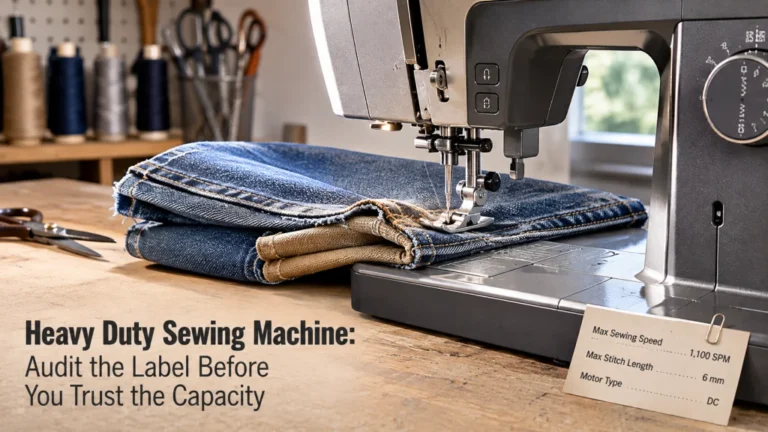
Keep the boundary practical. An occasional jeans hem is not the same workload as repeatedly crossing bulky denim seams. An occasional knit tee is also different from a wardrobe dominated by highly elastic knits. When one material controls the difficulty, evaluate feeding, compatible feet, needle and thread requirements, and real sample results around that material.
| Primary problem | Keep this article’s workflow | Use a different buying path when |
|---|---|---|
| General garment construction | Yes | No single fabric dominates |
| Stretch-heavy wardrobe | Partly | Knit behavior becomes the main constraint |
| Dense denim or bulky layers | Partly | Layer transitions control the shortlist |
| Specialist edge finishing | No | Overlock or coverstitch is required |
Garment operations define what the machine must do, while fabric behavior defines how demanding those operations will be.
Verify Utility Stitches Before Counting Decorative Stitches
Stitch count is easy to compare and easy to overweight. For clothing construction, a smaller set of useful operations can matter more than dozens of decorative patterns. Confirm straight stitch, zigzag, any stretch utility you need, buttonhole options, blind hem if relevant, reverse behavior, and the adjustment ranges described in the manual. Then check whether each operation requires a specific foot or setup.
A first-time buyer can see a large stitch number and assume it represents broader sewing capability. Many menus mix utility, decorative, heirloom, quilting, lettering, or repeated variations while garment construction still depends on a smaller core. Record only functions tied to your wardrobe and give unused decorative options no extra score. For a broader framework, you can compare sewing machines by real requirements before applying this garment filter.
- Straight stitch with usable length adjustment
- Zigzag with the adjustment needed for planned techniques
- Documented stretch utility if your wardrobe requires it
- Buttonhole process and required hardware
- Blind hem only if you expect to use it
- Reverse or reinforcement behavior described in the manual
- Compatible zipper, buttonhole, and general-purpose feet
Keep decorative stitches as preferences unless they serve a real garment operation.
Verify Included Feet Versus Optional Compatible Feet
Listings often mix standard accessories, compatible accessories, and optional purchases. For each finalist, separate what is in the box from what merely fits the machine. A zipper, buttonhole, button-sewing, blind-hem, overcasting, or narrow-hem foot may matter to your wardrobe, but inclusion varies by exact model. Budget and availability matter when a required foot must be purchased later.
Compatibility deserves more evidence than visual similarity. Two snap-on feet with the same generic name can still have different holder, shank, stitch-width, or model requirements. Use the manufacturer’s model list, accessory chart, manual, or support page to verify fit. If the evidence only says “low shank” or shows a similar-looking foot, treat compatibility as incomplete.
Choose a machine because a retailer photo shows many feet, then assume every pictured accessory is included and every generic replacement will fit.
Match each required garment operation to the exact included foot, then verify any optional foot against the manufacturer’s compatibility information for that machine.
Compare the cost of the garment setup you need, not the size of the accessory pile.
Check Speed, Needle Position, and Handling Controls Only Where They Change the Workflow
Controls deserve weight when they solve a real garment-handling problem. A speed limiter can help a user who wants more control around tight curves or detailed topstitching, while needle up or down can reduce handwheel use when pivoting at corners. Multiple needle positions can also matter for zipper work, edge stitching, or topstitching when the manual supports those adjustments. None of these features is automatically essential for every clothing sewist.
Mechanical machines can still complete substantial garment work without a screen, start or stop button, or electronic speed slider. The question is whether the missing control makes your intended operations harder enough to justify a different machine. If you audition a candidate, use the same curve, zipper sample, narrow edge, and seam intersection on each finalist so the comparison is about handling rather than novelty. A control should survive the shortlist because it changes your actual workflow, not because it looks modern.
Build a Complete-Garment Audition for Finalists
A few inches of straight stitching are not enough to qualify a garment machine. Build an audition around the operations most likely to expose a mismatch: a seam, curve, bulky intersection, zipper edge, hem, buttonhole, and narrow tubular area when relevant. Use representative fabrics with the needle and thread combination you would reasonably pair with them. Keep the test the same across finalists so the comparison remains meaningful.
Record the exact machine, fabric, layer stack, stitch, foot, settings, repeats, and observed result. If you cannot test before buying, mark performance items unknown and rely on documented features, return terms, support, and compatibility. Stop for damaged cords, overheating, smoke, burning odor, sparks, uncontrolled motion, a hard mechanical lock, or repeated hard needle strikes. Owner-level testing should stay within the instructions for the exact machine.
| Audition operation | Record | Decision question |
|---|---|---|
| Straight seam | Fabric, layers, stitch, needle, thread | Is feeding controlled? |
| Curve and edge | Speed, visibility, needle position, foot | Can you place the seam accurately? |
| Seam intersection | Layer stack and transition | Does it cross realistic bulk normally? |
| Zipper sample | Zipper type, foot, needle position | Is the setup controllable? |
| Buttonhole | Fabric, interfacing, button, repeats | Can you repeat the process? |
| Narrow tube | Cuff, sleeve, or pant leg | Does the geometry help? |
Keep the audition sheet so one attractive sample seam never stands in for the complete garment.
Build a Domestic Shortlist by Garment Requirement
A useful domestic shortlist does not have to begin with model names. Start with three requirement levels: basic woven construction, mixed woven plus occasional knit work, and control-heavy garment work where speed or needle-position features materially help. Every level should still verify closures, hems, compatible feet, and narrow-area access relevant to the wardrobe. This avoids recommending a specific product before the buyer’s garments and fabric constraints are known.
For basic woven work, prioritize documented straight and zigzag utility, reverse, a workable zipper setup, a buttonhole process if needed, and the necessary feet. For a mixed wardrobe, add the stretch utility and fabric audition your knits require rather than trusting a stitch name. For detail-heavy dressmaking, handling controls may gain value when they improve curves, topstitching, pivots, or repeated closures. In every tier, manual access, compatible accessories, maintenance, service, and support belong in the final comparison.
If no candidate covers every operation, rank the gaps by frequency and how hard they are to solve another way. Protect functions that affect many garments or depend on the machine itself, such as buttonholes, needed needle positions, or narrow-area access. A rare operation that can be handled with a compatible foot or alternate method deserves less weight. The goal is to avoid sacrificing functions that would repeatedly interrupt garment construction.
| Garment requirement | Shortlist baseline | Do not assume |
|---|---|---|
| Mostly stable woven garments | Straight and zigzag utility, closure support, needed feet, hems, usable access | More stitches mean better seams |
| Wovens plus occasional knits | Baseline plus documented stretch options and knit audition | A stretch-stitch label proves knit performance |
| Frequent detailed garment work | Baseline plus controls that improve your positioning and repeatability | Computerized controls are automatically superior |
After a candidate passes this screen, price is easier to judge against functions you will actually use.
Route Knit-Heavy or Denim-First Buying to a Fabric-Led Decision
Garment type should stop leading the decision when one fabric family creates most of the technical risk. A knit-heavy wardrobe raises specific questions about stretch, recovery, feed, needle and thread pairing, and seam construction. Denim-first buying centers on realistic layer stacks, bulky crossings, needle clearance, feeding, and domestic-machine limits. Those material conditions need their own qualification before a candidate is treated as suitable.
The practical boundary is frequency and severity. One lightweight denim skirt or stable knit top does not automatically require a fabric-specialized purchase. Repeated dense denim intersections or highly elastic knits can reshape the whole shortlist. Keep the garment-operation worksheet, then add fabric-specific tests and reject any candidate that cannot be verified for the dominant material.
Route Overlock and Coverstitch Needs to Specialist Systems
A domestic machine can construct garments and provide useful edge-finishing stitches, but it does not become an overlock or coverstitch system because a stitch icon looks similar. If the requirement is simultaneous trimming and overedge formation, or dedicated coverstitch-style hemming, the machine category has changed. Treat those needs as specialist-system questions rather than bonus points for a domestic machine. This keeps the comparison honest about what each system is designed to do.
Many home sewists can begin with a domestic machine and add a specialist system only when the workflow justifies it. That can be simpler than buying extra equipment before you know which finishing operations matter. A knit-heavy wardrobe or repeated specialist finishing can make that second system central rather than optional. Draw the boundary from the required operation, not from the idea that every serious garment maker needs more machines.
| Finishing need | Domestic machine role | Specialist boundary |
|---|---|---|
| Basic seam construction | Primary system | Usually not required |
| Domestic overcasting | Useful edge finish | Not overlock architecture |
| Trim and overedge | Not equivalent | Evaluate an overlock system |
| Coverstitch-style hems | Alternative hems possible | Evaluate coverstitch if required |
Add a specialist system only when a specialist operation is genuinely part of the workload.
Route Paid Garment Batches to a Small-Business Buying Decision
Making clothes for yourself and producing paid garment batches can use the same seams while creating different ownership priorities. Repetition increases the importance of throughput, downtime, service access, parts availability, maintenance, and the cost of an unavailable machine. A convenience feature can become operationally important when the same closure or seam is repeated across many paid items. That workload change deserves a separate buying framework.
If garment work becomes paid and repetitive, use this operation list as the starting specification, then choose a sewing machine for small business with downtime and repeated workload included. Do not assume a domestic machine becomes a business machine because it completes one sample garment. Do not assume paid work automatically requires industrial equipment when volume, materials, and operations remain within a suitable domestic setup. The business decision begins when repetition changes the economics of ownership.
Final Thoughts: Qualify the Machine Against the Finished Garment
The strongest shortlist begins with finished clothes, breaks them into operations, and rejects candidates that leave a required operation unresolved. Utility stitches, closures, hems, narrow-area access, compatible feet, controls, and fabric behavior should earn their place from the wardrobe. A manual can verify that a function exists, but only a disclosed audition can show how a particular setup behaves on your fabric. Keep documented capability and tested performance in separate columns.
You do not need every stitch, accessory, or specialist system to make clothes at home. You do need a machine that completes the operations you plan to repeat. When fabric extremes, specialist finishing, or paid production becomes the main constraint, change the buying path instead of forcing one domestic shortlist to answer every question. Qualify the machine at the garment level, and the decision becomes easier to defend.
FAQs
🧵 What stitches do I actually need to make clothes?
Most garment workflows start with straight stitch and zigzag, then add buttonhole, blind-hem, or stretch utility only when the planned garments require them. Check the exact machine’s stitch chart and manual rather than buying by total stitch count.
👗 Do I need a computerized sewing machine for dressmaking?
No. A mechanical machine can handle substantial garment construction if it supports the operations, adjustments, accessories, and fabrics you need. Computerized controls are useful only when their added positioning, speed, or workflow functions matter to your projects.
🪡 Is a one-step buttonhole always better than a multi-step buttonhole?
No. The systems organize the workflow differently, but the label does not prove finished buttonhole quality. Check the manual and audition the system on the garment fabric, interfacing, needle, and thread you intend to use.
🦶 Which presser feet matter most for making clothes?
A general-purpose foot, zipper foot, and buttonhole foot are common garment needs, while blind-hem, button-sewing, overcasting, or narrow-hem feet depend on your wardrobe. Verify both inclusion and exact model compatibility before counting a foot as part of the setup.
References and Sources
- Janome presser-foot compatibility resource: Supports model-specific presser-foot compatibility.
- Brother domestic-machine documentation: Verifies a documented four-step buttonhole workflow, free arm, and included feet.
- Janome domestic-machine documentation: Verifies a documented one-step buttonhole workflow, free arm, and handling controls.