An embroidery machine for small business work should be chosen against real order bottlenecks, not the ambition to bring every job in-house. The useful evidence is the actual or realistically validated mix of garments, hats, patches, colors, batch sizes, turnaround pressure, and downtime risk. That record may support continued outsourcing, a single-needle machine, a multi-needle system, or a more commercial setup. This article stays with equipment selection and ownership decisions, not service pricing, profit forecasts, tax questions, or business-plan promises.
The Best Embroidery Machine for Small Business Work Starts With an Order Ledger
An embroidery machine for small business use is easy to overspec when shopping starts with features instead of paid work. A shop already outsourcing polos and caps faces a different problem from a new seller who only hopes embroidery demand will appear. Write down completed jobs, credible requested jobs, and work that was delayed or declined because of the current process. That gives the purchase an operational base before price, needle count, or advertised speed enters the conversation.
The first decision is which part of the order flow creates a repeated constraint. Long outsourcing delays point toward schedule control, frequent color changes point toward operator attention, and recurring hats point toward item access. A single large order or one unusual request should not define the entire machine purchase. Repeated patterns matter more because they describe what the equipment will likely be asked to do again. That discipline also makes later model comparisons easier to defend.
Record the Last Real or Validated Embroidery Orders
Build the record from completed, outsourced, or credibly requested work, not from an imagined future catalog. For each job, capture item type, quantity, thread colors, design size, access difficulty, and promised turnaround. Record stitch count only when it already exists in a production-ready file because visible design size does not prove density or run time. Also note which jobs came back late, required repeated coordination, or could not be accepted because of equipment limits.
| Order field | What to record | Why it matters |
|---|---|---|
| Item | Polos, hoodies, caps, patches, bags, towels | Changes hooping and access needs |
| Quantity | Actual pieces in the validated order | Shows machine occupancy |
| Colors | Recurring thread-color count | Shows intervention burden |
| Turnaround | Required completion window | Exposes schedule pressure |
| Access | Flat, tubular, cap, pocket, or awkward area | Can eliminate unsuitable systems |
Use the ledger as a filter, not as a revenue forecast. For someone considering an embroidery machine for home business work, a modest but real order record is more useful than a broad list of popular machines. It shows whether the main problem is demand volume, manual intervention, item geometry, turnaround, or simply lack of validated work. Once those patterns are visible, equipment classes can be compared against evidence rather than ambition. Keep uncertain requests labeled as uncertain instead of treating them as orders.
Separate Flat Garments, Hats, Patches, and Difficult-Access Items
Embroidery area alone does not prove that a machine can handle a finished product efficiently. A flat patch and a finished cap may carry similarly sized logos while requiring very different framing, access, and machine geometry. Finished bags, pockets, sleeves, and narrow garment areas can create the same mismatch even when the design is small. Record the exact placement and item construction before comparing machine fields or hoop dimensions.
- Group flat work separately from tubular and difficult-access items.
- Flag recurring cap jobs and the required design position.
- Note any finished item that cannot be opened or laid flat.
- Record whether specialized frames or access are required.
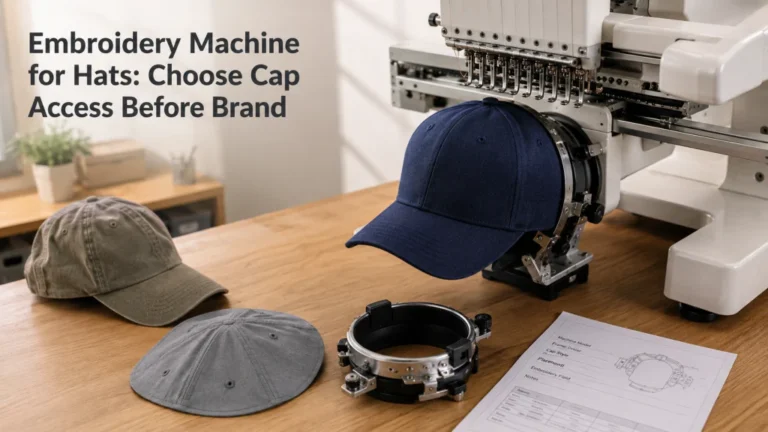
Hats deserve their own check because generic hoop size can hide the actual cap workflow. If they are a recurring part of the paid mix, verify embroidery machine requirements for hats before treating a flat-field specification as sufficient. If hats are occasional and easy to outsource, they may be a reason to keep that supplier relationship instead of redesigning the whole equipment plan. The machine should match the physical work that repeats, not the broadest possible product catalog. That distinction also prevents unnecessary equipment complexity.
Count Recurring Colors and Manual Thread Changes
Color count matters because it changes how much operator attention one job consumes. A single-needle machine can stitch multi-color designs, but each color change adds another intervention point that may interrupt other shop work. That can be acceptable for occasional names, monograms, or low-volume logos with few colors. It becomes more important when several colors recur across paid jobs and the operator also needs to prepare garments, pack orders, or run other equipment.
| Workload signal | What it suggests |
|---|---|
| Mostly one-color work | Manual changes may be a minor issue |
| Repeated multi-color logos | Operator returns may become a bottleneck |
| Many short runs with changing palettes | Needle count will not remove all setup work |
| Long designs with few colors | Machine occupancy may matter more than color changes |
Do not turn color count into a universal threshold for buying multi-needle equipment. Record how often changes occur, whether the operator must stay nearby, and whether those interventions repeatedly delay other work. A six-color logo on a short run creates a different burden from a one-color design repeated all day. If the architecture remains unclear, compare single-needle and multi-needle embroidery systems before looking at individual models. The recurring paid workload should be what moves the decision forward.
Measure Turnaround Pressure Without Inventing Profit
Turnaround pressure can be documented even when profit data is incomplete. Record when the design and blank goods are ready, when embroidery can actually begin, and when the customer expects completion. That sequence separates an embroidery bottleneck from delays caused by artwork approval, missing garments, or late customer decisions. A faster machine cannot solve a queue that forms somewhere else in the process.
- Write the promised completion window for each validated job.
- Mark when the design and goods were ready for embroidery.
- Record embroidery wait and machine occupancy when known.
- Identify the delay that repeats before changing equipment.
If completed files and garments repeatedly sit ready while outsourced work waits, in-house scheduling control has a clearer operational value. If an owned machine is occupied by long runs while other paid orders queue behind it, capacity deserves closer examination. Neither situation proves profit, payback, or business growth because those conclusions require primary financial records. The purpose here is to identify the repeated production constraint, not to manufacture a return-on-investment story. Keep the measured production delay clearly separate from any later financial ownership decision for the business.
Decide Whether Outsourcing Is Still Rational
Outsourcing is not automatically a temporary stage that should disappear when orders increase. It can remain useful for large batches, specialized cap work, overflow, unusual placements, or jobs that would monopolize one in-house machine. Compare the operational problems created by outsourcing with the ownership problems created by bringing work inside. Ownership adds setup, operator time, consumables, maintenance, service access, training, and downtime exposure.
- Keep outsourcing when demand is irregular or unvalidated.
- Consider partial in-house work when repeat small jobs miss acceptable turnaround.
- Keep rare specialist jobs outside when their access requirements are unusual.
- Reconsider ownership when a repeat workload consistently disrupts customer commitments.
A hybrid workflow can be more rational than an all-or-nothing switch. One shop may keep names, samples, and quick repeat logos in-house while sending large runs elsewhere, while another may outsource the occasional cap order and retain flat work. The order ledger should show which jobs are predictable enough to justify dedicated equipment. End this step with a workload statement, not a purchase command, so the next equipment decision stays tied to repeatable evidence. That final statement should describe repeatable paid shop operations, not projected future income.
Decide Whether a Single-Needle Machine Can Meet the Validated Workload
A single-needle embroidery machine can be a rational paid-work tool when the order mix is modest, mostly flat, and tolerant of manual color changes. Check whether its embroidery field, hooping options, file workflow, item access, and operator demands fit the jobs that actually recur. A small business does not become more capable merely because the machine has more needles. The useful test is whether a simpler system completes the validated work without creating a repeated access, attention, or scheduling problem.
First-time buyers often mistake single needle for hobby-only use, but machine class and business use are not the same question. A single-needle system may suit personalization, samples, and low-volume logos while becoming inefficient for repeated multi-color production or difficult finished items. Use the overview of machine types and their functions if the broader equipment roles are still unclear. Move beyond single needle only when the requirement sheet identifies a specific limit that another architecture can actually remove.
Move to Multi-Needle Only When Access or Operator Attention Is the Bottleneck
Multi-needle systems become more relevant when recurring jobs repeatedly expose limits that extra pre-threaded colors, different framing, or more production-oriented access can address. Strong signals include frequent manual color changes, recurring hats or tubular items, and an operator who must keep leaving other paid tasks to tend one design. Those are operational reasons to change architecture, not proof that every growing business needs multi needle. If those problems are absent, extra complexity may not remove the actual bottleneck.
Current manufacturer documentation also shows why needle count cannot stand alone as the decision rule. One current six-needle system separately lists cap-frame capability, free-arm embroidery, embroidery area, and speed ranges, while a current seven-needle system documents a different field, hoop set, file support, and speed ceiling. These are machine-specific capability fields, not guarantees of fit for a particular shop. If multi needle has clearly won the class decision, compare multi-needle embroidery machine requirements against the written workload before shortlisting models.
Record Downtime, Service, and Backup Requirements
Paid work changes the consequence of a machine being unavailable. A small shop may have customer garments, promised completion windows, and queued designs tied to one system, so service access belongs in the purchase decision. Record where the chosen class can be serviced, what the exact manual allows the owner to maintain, and what work stops during downtime. A lower purchase price is less attractive when the support route is unclear or impractical.
- Where can the machine be serviced?
- What maintenance does the exact manual assign to the owner?
- Which paid jobs stop if the machine is unavailable?
- Can overflow return to an outside supplier?
- Are required consumables, frames, bobbins, and needles readily obtainable?
Backup does not automatically mean buying a second identical machine. It may mean retaining outsourcing capacity, keeping another suitable machine for simple work, or knowing which jobs can be rescheduled safely. Stop owner troubleshooting and use qualified service for damaged cords, overheating, smoke, burning odor, sparks, exposed wiring, uncontrolled motion, a hard mechanical lock, or repeated hard needle strikes. The support plan should be written before a model is shortlisted because uptime is part of the paid-order workflow.
Set the Evidence Bar for Throughput Claims
Advertised maximum stitch speed is not the same as finished-order throughput. Completion time also depends on stitch count, density, trims, color sequence, speed settings, thread behavior, hoop changes, loading, placement checks, and rework. A machine can list a high maximum speed while a particular frame or cap workflow uses different documented conditions. Treat speed as one verified specification, not as a promise of pieces per hour.
The same caution applies to labels such as professional quality, production ready, or business grade. Ask for the exact manual, current specifications, compatible frame information, warranty terms, and service route for any system that survives the workload filter. Independent throughput observations are useful only when the machine, design, material, settings, hooping, and handling conditions are disclosed well enough to understand the measurement. Unsupported production math should never substitute for evidence from the exact system and the shop’s own repeated orders.
Note: Current manufacturer pages document differences in needle count, embroidery field, cap capability, frame support, file handling, and listed speed. Those facts support capability comparisons, but they do not prove profit, payback, durability, or a universal production rate.
Use that evidence standard to reject claims that sound precise but cannot be reproduced. A pieces-per-hour figure without the design and handling conditions is context, not a transferable benchmark. The shop’s own production log can eventually become stronger operational evidence because it reflects the work that actually repeats. Until then, verified capability and bottleneck fit are safer decision tools than optimistic throughput claims.
Choose the System Class Before Any Model
The order record should now be specific enough to choose among outsourcing, single-needle embroidery, multi-needle embroidery, or a more production-oriented commercial system. The class should win because it removes a repeated constraint while remaining supportable in the available workspace, budget, and service environment. Do not jump from one difficult job to the most capable system you can afford. The same constraint should appear often enough in validated work to justify changing architecture.
| System class | Use it when the record shows |
|---|---|
| Outsource | Demand is irregular, specialized, or easier to buy as a service |
| Single needle | Work is modest, mostly flat, and intervention is manageable |
| Multi needle | Repeated colors, access, or attention burden justify the architecture |
| Commercial class | Validated workload and support needs clearly exceed simpler systems |
When a small business reaches the point where a commercial embroidery machine becomes relevant, the reason should be operational rather than aspirational. The workload may require different access, repeated color handling, longer machine occupancy, or stronger service support, but the label commercial does not prove unlimited capacity. This table is a routing tool, not a hierarchy from beginner to professional. Once one class survives for documented reasons, model shopping becomes a narrower verification task. That makes unsupported feature comparisons much easier to discard.
Build a Current Shortlist Only Inside the Chosen Class
Do not compare a domestic single-needle machine, a multi-needle system, and a commercial machine as though they were interchangeable choices. Once the class is chosen, compare only models that can meet the same non-negotiable requirements from the order ledger. Verify embroidery field, supported frames, cap capability when required, tubular access, design transfer, file support, workspace footprint, warranty, and service route from current documentation. Remove any candidate that cannot prove a required capability instead of assuming an accessory or workaround will solve the gap.
- Required item access and embroidery area
- Required color-change workflow
- Supported hoops, frames, and cap equipment
- Design transfer and file support
- Workspace and operating clearance
- Warranty, service route, and consumable availability
Price should be read with the ownership system rather than by itself. A cheaper machine may require additional frames, stands, software, or service travel, while a more expensive option may still fail a critical access requirement. This article intentionally stops short of naming a machine to buy because the correct shortlist depends on the class that survives the user’s own workload filter. If that broader choice is still unsettled, choose an embroidery machine by task before comparing exact models.
Stop Before Pricing Services or Forecasting Income
Equipment selection can be grounded in orders without turning this decision into a profitability calculator. The ledger may record outsourced cost, operator time, or machine downtime when the owner already has those records, but none of those values should be invented or converted into guaranteed payback. Pricing embroidery services depends on labor, overhead, waste, taxes, licensing, market conditions, and other factors outside this equipment article. A machine that removes a production bottleneck can still be a poor financial purchase if the business records do not support ownership.
The same boundary applies to claims about business growth. Bringing embroidery in-house can change scheduling control, sample speed, and which jobs are practical to accept, but it does not guarantee customers or margins. A more capable system may also increase training, maintenance, space, consumable, and service demands. Keep the equipment question narrow: what work is validated, what bottleneck repeats, what class addresses it, and what evidence proves the chosen system can perform the required tasks.
Final Thoughts: Buy Against Paid Bottlenecks, Not Business Ambition
The strongest small-business embroidery purchase starts with the work that already exists and the constraint that keeps repeating. Record the garments, hats, patches, colors, batch sizes, turnaround pressure, operator interventions, service needs, and downtime exposure before building a model list. That record may show that outsourcing is still rational, that a single-needle machine is enough, or that a multi-needle or commercial class solves a specific problem. None of those outcomes is inherently more professional than the others.
Use the simplest system that can prove it meets the validated workload and can be supported when something goes wrong. If architecture remains unresolved, revisit the single-needle versus multi-needle decision factors; if multi needle has already won, move to multi-needle machine selection criteria. When hats dominate the order mix, verify cap embroidery machine requirements before treating a general specification as enough. The next purchase decision should be narrower and easier to defend because the workload has already done most of the filtering.
FAQs
🧵 Do I need a multi-needle embroidery machine for a small business?
Not automatically. It is easier to justify when recurring paid work creates a clear bottleneck around color changes, tubular or cap access, or operator attention that a single-needle setup cannot manage well.
🧢 Can I choose a machine mainly because I want to embroider hats?
Only if hats are a meaningful part of the validated order mix. Verify the exact machine’s cap-frame support, item access, operating limits, and required accessories instead of assuming any embroidery machine can handle finished caps well.
📦 Should I stop outsourcing before I buy a machine?
No. An outsourcing relationship can provide overflow capacity, specialist handling, and a backup path during downtime, so a hybrid workflow may be stronger than a complete switch.
🎨 How many thread colors justify moving beyond single needle?
There is no universal color-count threshold. Record how often changes occur, how much operator attention they require, and whether that intervention repeatedly delays other paid work before changing machine class.
🛠️ What service information should I check before buying?
Confirm the exact warranty, qualified service route, owner-maintenance instructions, parts and consumable availability, and what happens to paid orders during downtime. A technically capable machine can still be a poor fit if support is impractical.
References and Sources
- Brother six-needle specifications: Verifies cap capability, free-arm embroidery, embroidery area, included frames, and other machine-specific fields used as evidence examples.
- Janome seven-needle specifications: Verifies a different multi-needle configuration, embroidery field, hoop support, file formats, and listed maximum embroidery speed.
- Small-business outsourcing discussion: Provides community context around outsourcing delays, mixed garments, hats, and first-machine uncertainty, not technical proof.
- Entry-level business embroidery discussion: Provides community context around bringing outsourced embroidery in-house, mixed item types, maintenance concerns, and beginner equipment questions.