A sewing machine for bag making should be judged against the hardest completed part of the bag, not one easy piece of exterior fabric. The useful test includes the lining, structural layers, folded seam allowances, binding, webbing, and the geometry that must reach the needle together. A domestic machine can be a good fit when the real project stays within its documented stitch, accessory, needle, thread, and feeding limits. The goal is to define that real test, compare machines under equal conditions, and recognize when the work calls for a different machine class.
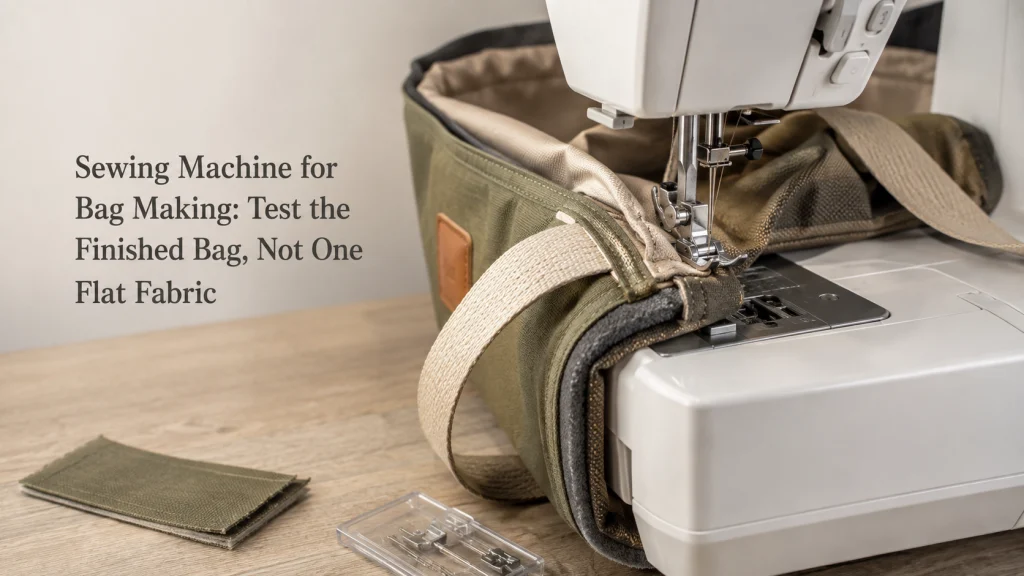
The Last Junction Is the Real Machine Test
A bag can sew easily for most of the project and become a different problem at the final bulky junction. Two flat exterior layers may feed cleanly, while the bound top edge adds lining, foam, folded allowances, and webbing. That is why the best sewing machine for bag making is not automatically the one that looks strongest on a flat sample. The useful question is whether it can complete the exact finished construction without forcing the stack or relying on an unsupported capacity claim.
This project-first test also keeps the buying decision in the right machine class. If your needs are still broad, start by choosing a machine for home projects and list the jobs you actually expect it to perform. You can also compare sewing machines by real use before narrowing the decision to bags. Bag making then becomes one defined qualification test, with the hardest completed operation setting the standard.
Define the Bags, Size Range, and Frequency
Start with a bag family rather than the vague idea that you want to make bags. A lightly structured pouch, lined tote, foam-supported organizer, and reinforced backpack can challenge the same machine in different ways. Note the project size range, narrow openings, boxed corners, bindings, and reinforced strap areas that appear in your plans. This turns a shopping phrase into operations that can actually be checked against the machine, manual, accessory list, and finished project.
- Bag types and approximate size range
- Most structured or bulky design in the group
- Whether webbing, binding, foam, or stabilizer enters a seam
- Required straight stitch, zigzag, edge stitching, or needle-position control
- How often the same demanding construction will be repeated
Frequency matters because an occasional difficult seam and repeated production are different ownership problems. A mixed home workload may favor versatility, while frequent repetition raises the value of predictable feeding, service access, and a focused stitch set. Do not assume that frequent use automatically requires industrial equipment, but do not ignore workload either. Record the expected project mix before comparing machines so every feature, limitation, maintenance need, and ownership cost is judged against real use.
Draw the Complete Bag Cross-Section
Draw the thickest completed seam as a cross-section before testing a machine. The needle sees materials, folds, stiffness, surface behavior, and height changes, not labels such as tote or handbag. Include every layer that will exist at the difficult point instead of testing only the exterior fabric. If a layer or fold is missing from the mock-up, the result applies only to that reduced stack.
The finished cross-section should match the seam after assembly, not just the easiest stage of construction. A top edge can double earlier layers and add reinforcement that was absent from the flat panel. The presser foot may then meet a sudden height change while the bag body limits how the work can be guided. Reproducing that condition gives the audition a clear and repeatable target.
Exterior and Lining
List exterior and lining separately even when both are woven fabrics. Different finishes and surface behavior can change how the layers feed together. A slick lining can shift against a stable exterior even when neither material is especially thick. Keep both in the sample whenever both exist at the difficult junction.
Foam, Stabilizer, or Interfacing
Structural layers can change thickness, stiffness, and compressibility at the same time. Foam may compress under the foot, while a firm stabilizer can resist bending around a curve. Those differences can affect feeding even when the visible exterior fabric stays unchanged. Test the actual structural material instead of substituting a thinner scrap.
Binding and Folded Seam Allowances
Binding and folded allowances often create abrupt height changes instead of one uniform stack. The presser foot may tilt as it climbs onto or leaves that bulk. A short overlap can therefore be harder than a longer seam made from the same materials at a constant height. Reproduce the real fold rather than stacking loose rectangles that do not match the seam geometry.
Webbing and Reinforced Attachment Points
Webbing attachments combine dense material with extra reinforcement in a short area where control matters. A strap anchor can also cross seam allowances or structure that is absent elsewhere. The relevant sample is the reinforced attachment exactly where those layers intersect, not a separate strip of webbing sewn on its own. Stop if the machine shows repeated hard needle contact, a mechanical lock, or another condition the manual treats as unsafe.
| Cross-section layer | What to record | Why it matters |
|---|---|---|
| Exterior | Material, finish, direction | Affects feeding and piercing |
| Lining | Material and surface behavior | May shift against the exterior |
| Structure | Foam, stabilizer, or interfacing | Changes stiffness and compression |
| Folded allowances | Number and direction of folds | Changes seam height |
| Binding or webbing | Exact position at the junction | Adds dense material at the junction |
The cross-section becomes the reference sample for every later comparison. Keep the layer order and folds unchanged when testing another machine. Record any necessary setup change instead of hiding it. Equal samples are what make the final comparison useful.
Note: Klum House describes a real bag-making failure pattern in which a home machine can sew ordinary layers but struggle where a hem crosses a side seam. That observation supports testing the completed junction rather than treating flat-layer success as proof of the whole bag. It remains practitioner evidence under the conditions they describe, not a universal capacity claim for another machine or stack.
Separate Flat Seams From Curved and Enclosed Geometry
Thickness is only one part of bag-machine fit because the project must also reach the needle in the correct orientation. An open flat panel can be easy to support, while the same materials become awkward around a gusset or inside a partly assembled bag. Free-arm access can help with some tubular areas when the exact machine provides it, but the usable shape still has to fit the project. A wide work surface supports large panels, yet it does not solve a tight enclosed curve by itself.
| Operation | Geometry question | What to verify |
|---|---|---|
| Flat panel | Can the work stay supported and straight? | Support, visibility, feeding |
| Gusset or curve | Can the project rotate without fighting the machine body? | Needle access and turning |
| Bound edge | Does the foot stay stable as height changes? | Clearance and stitching |
| Enclosed opening | Can the seam physically reach the needle? | Bed geometry and access |
Map flat, curved, bound, and enclosed operations before you audition the machine. Check where the bag body must rotate, where bulk sits beside the needle, and whether hardware blocks a normal approach. A bag making sewing machine must control this geometry as well as the material stack. If the completed bag cannot be positioned safely, a clean flat seam does not prove project fit.
Verify Required Stitches and Needle-Position Control
Start with the stitches required by the bag construction rather than a large decorative stitch count. Straight stitch may handle most assembly, but some projects also need zigzag or controlled needle position for a specific operation. Needle-position adjustment can help place edge stitching without moving bulky work farther under the machine head. Verify the available stitches, positions, maximum stitch conditions, and restrictions in the exact manual because controls can differ even within one brand or product family.
The needle and thread combination must also match the actual materials and the machine’s supported system. Manufacturer needle guidance treats needle choice as a relationship among fabric, thread, and needle size rather than one universal setting. Record the needle system and size, thread, stitch, and any setting that materially affects the audition. If the intended combination is outside documented support, treat that as a real compatibility limit instead of forcing the sample or improvising around the manual.
Treat the Presser Foot as a Tool, Not Proof of Feed Architecture
A walking-style or even-feed attachment can help control layer shift on a compatible domestic machine. It does not turn the underlying machine into a compound-feed industrial system with fundamentally different material transport behavior. The attachment may also have model, stitch, speed, installation, needle-threading, reverse-stitch, or operating restrictions of its own. Judge it by documented function on the exact machine, not by a generic product label, seller shorthand, or a photo that merely looks compatible.
Verify fit through the exact model manual, manufacturer accessory information, and the machine’s holder or shank system. Two feet with similar names can use different interfaces, and an accessory from the same brand may fit only listed models. The same caution applies to adapters and other feet used around bag construction. An accessory can improve control within a compatible system, but it does not prove universal piercing, feeding, clearance, thread handling, sustained workload, or stack capacity.
Build the Hardest-Junction Audition
Build the audition from scraps of the actual project materials and reproduce the most demanding completed junction. Include the real folds, structural layers, binding, webbing, and seam direction instead of making a convenient pile of flat squares. Set up the machine according to its manual with a compatible needle, thread, foot, and stitch. The goal is controlled completion of the real operation with repeatable stitch formation, not finding the maximum force the machine will tolerate.
| Audition field | Record before sewing | Record after sewing |
|---|---|---|
| Machine | Exact model and machine state | Sound, stall, strike, or heat |
| Bag stack | Full material and fold stack | Whether the junction passed unchanged |
| Needle and thread | Needle system, size, and thread | Stitch formation and deflection |
| Foot and stitch | Foot, stitch, position, and speed control | Layer shift and height changes |
| Geometry | Flat, curved, bound, or enclosed | Whether positioning stayed safe |
Record more than whether the needle passed through the stack. Watch feeding, stitch formation, foot control, usable pace, and whether the work can be guided without pulling from behind the needle. Stop for a hard lock, repeated hard strikes, uncontrolled motion, overheating, smoke, burning odor, sparks, or damaged electrical parts. A failed audition is still useful because it identifies the exact condition that the current setup did not handle and gives you a specific next question.
| Repeat-audition log | What to compare across projects |
|---|---|
| Project condition | Bag type, hardest junction, stack, and geometry |
| Machine setup | Needle, thread, foot, stitch, and machine state |
| Result pattern | Completion, shifting, skipped stitches, deflection, stalls, or access |
| Change before retest | Needle, setup, maintenance, or construction change |
Keep this log across several bag projects if the machine remains in regular use. A single difficult seam may reflect one needle, one construction, or one maintenance state, while the same failure under multiple disclosed conditions is a stronger ownership signal. Compare only like-for-like tests before calling a pattern meaningful, and replace a worn or damaged needle rather than treating deterioration as a machine-capacity verdict. The log is most useful when it separates a changing consumable or setup from a repeated limit in feeding, access, or workload.
Compare Domestic Candidates Against the Same Disclosed Bag Stack
Compare domestic candidates against the same hardest sample rather than giving each machine a different test. Keep the materials, folds, seam geometry, and stitch purpose consistent while respecting each machine’s documented setup. If one candidate needs a different compatible needle, thread, or foot, record that difference clearly. The comparison should show what each machine proved, what setup it required, and which material, geometry, accessory, service, or workload conditions remain unresolved.
| Claim | Acceptable evidence | Status |
|---|---|---|
| Required stitch is available | Exact manual or specification | Verified or unknown |
| Accessory fits | Exact model compatibility documentation | Verified or unknown |
| Hardest junction is manageable | Disclosed audition using the real stack | Tested or untested |
| Enclosed geometry is accessible | Physical audition plus machine geometry | Tested or untested |
| Machine class fits workload | Workload, service, feed needs | Supported or unresolved |
Do not rank a candidate from a heavy-duty badge, frame wording, stitch count, motor language, or price alone. Those details can describe a machine without proving that your finished junction will feed and stitch correctly. A versatile domestic machine may fit a mixed workload better than a specialized system that gives up functions you still need. Give each machine credit only for capabilities supported by documentation or the disclosed audition, and keep broad marketing language separate from demonstrated project fit.
Mark Every Untested Stack as Unknown
A clean result on one bag does not prove capacity for every future material combination. Changing the exterior, webbing, stabilizer, folded allowance, thread, stitch, needle, or geometry creates a new condition that may behave differently at the needle. Treat that condition as unknown until it is documented or auditioned. This is more accurate than calling a machine good for canvas, vinyl, foam, or webbing without stating the construction, layer order, seam shape, and setup behind the claim.
Owner reports are useful for identifying where people encounter feeding, clearance, and geometry problems. They do not automatically reproduce your machine, materials, maintenance state, needle, thread, or seam design. Use community reports to decide what deserves testing, which failure language to watch for, and which machine-class boundary may need closer verification rather than as universal proof. When the evidence stops, mark the result unknown instead of stretching one success into a broad promise.
Keep Material-First Questions Separate
Some buying questions begin with one material rather than one finished bag. A sewist may mainly want to know whether an owned machine can handle denim, canvas, vinyl, or another difficult material across several projects. That question should be evaluated around the material, actual layer stack, needle and thread relationship, stitch purpose, presser-foot setup, and documented machine limits. Bag making overlaps with it, but the finished-project decision is broader because shape, access, reinforcement, and sequence can become the limiting factors.
This article stays focused on the complete bag because the limiting operation can combine several materials with difficult geometry. A machine may handle two flat exterior layers and still struggle at a bound gusset with structure and webbing. The reverse is also possible when a difficult material appears only in a low-bulk area. Keep the question framed correctly so a material label does not replace the complete construction test or push this page into a material-only buying decision.
Paid Repetition Changes the Buying Decision
A machine that is reasonable for occasional hobby bags may not be the best ownership choice for repeated paid work. Repetition raises the importance of feeding consistency, downtime, maintenance access, parts, service availability, and time spent crossing difficult junctions. It can also make a more focused machine attractive when most work uses the same stitch, material system, demanding junction, and operating rhythm repeatedly. None of those ownership factors are proven by one successful sample or one short demonstration.
If you sew bags for regular sales, include the broader tradeoffs in choosing a machine for small business. The hardest-junction test still matters, but service interruption, consumables, repetition, and time now carry more weight. A domestic machine may remain appropriate for a modest mixed workload, while greater repetition can justify dedicated equipment. Let workload change the evaluation criteria instead of treating paid work as an automatic reason to buy a different machine class.
Know When Specialist Feed or Bed Geometry Takes Over
A specialist-machine decision begins when the limiting requirement is no longer an occasional difficult seam on a general-purpose domestic machine. Repeated resistant stacks, a need for different feed architecture, a thread range outside documented support, or awkward enclosed geometry can change the equipment class under consideration. Straight-stitch specialization can also remove zigzag and other general-purpose functions. Moving to specialist equipment is therefore a system change with tradeoffs, not an automatic upgrade in every direction.
| Decision signal | Domestic path may still fit | Specialist evaluation becomes relevant |
|---|---|---|
| Project mix | Mixed home sewing with bags among other projects | Mostly repeated bag operations with narrow stitch needs |
| Feed problem | Control improves with verified setup or compatible accessory | Required feed behavior exceeds the domestic system |
| Geometry | Bag reaches the needle safely with available bed geometry | Enclosed work repeatedly calls for a different bed shape |
| Needle and thread | Required combination is documented for the machine | Project needs a system outside the documented range |
| Workload | Occasional or varied use | High repetition makes dedicated equipment practical |
By this point, the question is no longer whether another domestic accessory might make one junction easier. The stronger signal is repeated evidence that the project depends on material transport, bed shape, thread range, or workload characteristics the domestic system does not provide. A specialist system can address a narrower mechanical requirement, but it also changes footprint, maintenance, service, and general-purpose capability. Evaluate that class separately and let the exact bag, documentation, workload, service access, and repeated audition results control the decision.
Final Thoughts: Qualify the Machine at the Finished Bag’s Hardest Point
The strongest bag-machine decision starts with a junction that represents the completed project. Define the bag family, draw the cross-section, map the geometry, verify required stitches and accessory fit, and audition the hardest operation without simplifying it. Record what the machine actually proved and mark every untested variation as unknown. That process can just as legitimately show that your current machine is sufficient for the planned bag family as it can reveal a real limit.
If the audition fails, identify the cause before changing machine class. A needle or thread mismatch, incompatible foot, poor access, layer shift, insufficient clearance, and feed-system limit are different problems. Stop rather than forcing the work when the machine shows a hard mechanical or electrical warning sign during testing. Let the finished bag, not the easiest scrap on the table, decide what capability, control, access, service support, and machine class you actually need next for the project.
FAQs
Bag-machine questions become clearer once the stack and geometry are stated. The answers below keep the decision tied to the exact project instead of a generic machine label. Use the exact manual whenever setup or accessory requirements vary by model. Treat a substantially different bag stack as a new test.
The next useful check may be the hardest seam, required stitch, accessory interface, needle and thread combination, or enclosed geometry. A purchase should follow that evidence rather than come before it. The same method works for an owned machine and a possible replacement. It also prevents one easy test from becoming a universal capacity claim.
👜 What is the best sewing machine for making bags?
The best choice is the machine that completes your hardest finished-bag junction with the required stitches, compatible setup, usable geometry, and controlled feeding. A flat exterior sample alone does not prove that fit.
🧵 Can a regular domestic sewing machine make bags?
Yes, many bag constructions fit a domestic machine. The answer depends on the exact stack, geometry, stitch needs, and documented machine limits.
🪡 Which needle should I use for bag making?
Choose a needle type and size that match the fabric, thread, and supported needle system. There is no single needle that fits every exterior, structural layer, webbing, and thread combination.
🦶 Does a walking foot make a domestic machine industrial?
No. A compatible even-feed or walking-style attachment can help control layers, but it does not replace the machine’s underlying feed architecture.
📐 Does free-arm sewing matter for bags?
It can help with some tubular or enclosed areas. Its usefulness depends on the exact bag geometry and the usable free-arm shape of the machine.
⚙️ When should I consider a specialist machine?
Consider a specialist evaluation when repeated tests point to feed architecture, bed geometry, supported thread range, or sustained workload rather than ordinary setup. Compare that system separately because specialization can also remove functions you still need.
References and Sources
These sources support technical distinctions that should not rest on generic bag-making claims. The bag-specific source supports project testing rather than broad labels. Manufacturer documentation supports the needle and accessory boundaries used here. Community reports shape framing, not universal performance claims.
- Klum House bag-machine article: Supports project-first testing and the importance of checking machine features and attachment fit.
- SINGER machine needle guidance: Supports choosing needle type and size in relation to fabric and thread.
- Brother shank identification support: Shows that presser-foot attachment geometry is model-dependent and should be verified.
- Brother walking-foot instructions: Shows that an optional walking foot has specific installation, stitch, speed, and model conditions.
No source above proves universal material capacity for every machine. Manufacturer information applies only to documented products and interfaces. Practitioner observations apply to the conditions they describe. Untested bag stacks therefore remain unknown rather than being converted into broad capacity claims.