Sewing machine speed control is not the same thing as a machine’s maximum stitches-per-minute rating. A useful pre-purchase check separates four things: the rated ceiling, any selectable speed limit, the command method, and the machine’s actual response at low speed. Manufacturer documentation can usually establish the first three, while smooth starts, gradual acceleration, and predictable stopping often require a model-specific demonstration or documented test. The goal is to know what the controls can prove before buying, without treating a high maximum speed or a slider as evidence of torque, feeding ability, or stitch quality.
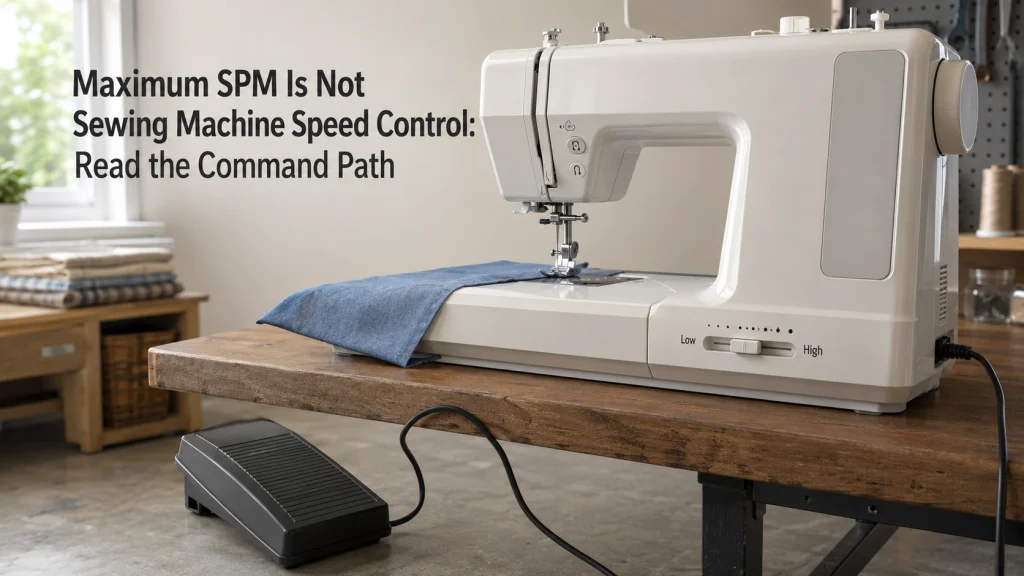
Maximum Speed and Speed Control Are Different Specifications
Sewing machine speed control answers a different question from maximum sewing speed. A machine can be rated for 1,100 stitches per minute while a sewist using another model complains that the pedal seems to move from no motion to far too much motion with very little usable range between them. Those facts are not contradictory. One describes a ceiling, while the other describes how the machine responds to a command near the bottom of its operating range.
That distinction matters before purchase because a high ceiling says almost nothing about how easy the machine will feel when approaching a corner, crossing a seam intersection, or taking the first few stitches after positioning fabric. It also prevents a common beginner misunderstanding: a lower published SPM number does not automatically mean better control, and a higher number does not automatically mean the machine will be difficult to manage. The useful question is how the exact model lets the operator command speed and what evidence exists for its response.

The Brother PQ1600S is a high-speed straight-stitch sewing and quilting machine that sews up to 1,500 stitches per minute. Amazon lists four color-coded feed-dog adjustment levels with presser-foot pressure control, plus a push-button thread cutter and programmable needle stop position. It also includes an expanded 11.1 by 23.3 inch wide table and a 5.7 by 8.7 inch needle-to-arm space.
Check On AmazonIf you click this link and buy, we earn a commission at no additional cost to you.
Separate the Rated Ceiling, Selected Ceiling, Commanded Speed, and Actual Response
Speed specifications become much easier to read when they are split into four fields instead of being treated as one feature. This same method fits naturally into a broader check of how to compare sewing machine features, because it keeps a published number from carrying more meaning than the documentation supports. Record each field separately even when the product page uses one broad phrase such as variable speed or speed control.
| Field | What it means | Best evidence | What it does not prove |
|---|---|---|---|
| Rated ceiling | The maximum stitches per minute the manufacturer publishes for the model. | Exact product specification or manual. | Low-speed response, torque, feeding, or stitch quality. |
| Selected ceiling | A lower maximum chosen with a slider, limiter, or fixed speed mode. | Exact control description in the manual. | How gradually the machine accelerates below that ceiling. |
| Commanded speed | The operator’s request through a foot control, start/stop control, or another documented input. | Operating instructions for the exact model. | The machine’s measured response under a particular load. |
| Actual response | How the machine starts, changes speed, holds low speed, and stops in a defined test. | Repeatable test with the machine, controls, material, needle, thread, and settings identified. | Performance on a different machine or material stack. |
This four-field map also explains why two machines with similar maximum SPM ratings can feel different in use. Their ceilings may be close while their control paths are not. Once the fields are separated, the missing evidence becomes obvious instead of being filled with assumptions.
Map Foot-Control Modulation Before Comparing Machines
A foot control is a command device, but the useful pre-purchase question is not simply whether one is included. Check the manual for what pressing farther is documented to do, whether the machine has a separate upper speed limit, and whether any operating mode changes the available range. A first-time owner can easily assume that every pedal provides the same smooth progression because the physical action looks familiar, but the exact machine and controller determine the behavior.
Documentation example: bernette lists the b05 ACADEMY with a maximum sewing speed of 1,100 stitches per minute and describes foot-control operation as continuously increasing speed as the pedal is pressed farther. The same model also has a separate speed-limit switch with two maximum-speed modes. That documentation establishes the command path and published ceilings, but it is not an independent measurement of startup smoothness on a particular fabric, needle, and thread combination.
What a Sewing Machine Speed Limiter or Slider Actually Does
A sewing machine speed limiter changes the maximum speed available within a documented operating mode. A sewing machine speed slider usually serves the same broad purpose when the manufacturer describes it as setting the machine’s maximum sewing speed. The important word is maximum: reducing the ceiling may make the machine easier to keep within a comfortable range, but it does not by itself prove how finely the machine responds between stopped and moving.
Documentation example: Singer lists the Quantum Stylist 9960 at 850 stitches per minute and describes its speed control as setting the maximum sewing speed. That is useful evidence for a pre-purchase feature audit because it tells the buyer what the control is intended to limit. It should not be stretched into a claim that the machine starts more smoothly, penetrates thick seams better, or maintains a particular low stitch rate unless those behaviors are separately documented under defined conditions.

The SINGER Quantum Stylist 9960 is a computerized sewing and quilting machine with 600 stitches, five fonts, and 13 one-step buttonholes. Its Speed Control lets the operator set the machine's maximum sewing speed for different types of work. The machine also includes an extension table, 13 presser feet, needle up and down control, LED lighting, and a hard case.
Check On AmazonIf you click this link and buy, we earn a commission at no additional cost to you.
Fixed Slow Modes Are Not the Same as a Continuous Slider
Some machines offer a few discrete maximum-speed modes rather than a continuously adjustable slider. That difference belongs in the buying notes because the controls may solve the same broad problem in different ways. A fixed lower mode gives the operator a known ceiling selected from the available modes, while a slider may allow the ceiling to be placed across a wider range described by the manufacturer.
The bernette example makes the distinction concrete: its documentation identifies a full-speed maximum and a lower fixed maximum. That is not the same control layout as a machine with a continuous speed slider, even though both can reduce the available top speed. For a beginner, the practical check is not which label sounds better, but whether the available control positions match the amount of adjustment they expect to use.

The Janome JW8100 is a computerized sewing and quilting machine with 100 built-in stitches and seven buttonholes. Its speed control slider lets the operator adjust the machine's speed range for slower detailed work or faster straight seams. It also includes an LCD screen, start and stop control, needle up and down positioning, and an extra-wide extension table.
Check On AmazonIf you click this link and buy, we earn a commission at no additional cost to you.
Separate Start/Stop Operation From Foot-Pedal Control
A start/stop button answers whether the machine can begin and end sewing through a control on the machine rather than through the pedal. It does not automatically tell you how fast the machine will run after it starts. The manual needs to show whether speed is governed by a slider, a preset mode, another control, or a fixed behavior when the start/stop function is used.
This matters because buyers sometimes treat pedal-free operation as proof of better slow-speed control. It is better to record two separate facts: how sewing is started and stopped, and how the maximum or commanded speed is selected in that mode. If the manual does not explain the relationship clearly, mark it as a question to verify rather than filling the gap with a general rule from another computerized machine.

The Brother HC1850 is a computerized sewing and quilting machine with 185 built-in stitches and an LCD interface. It provides variable speed control together with start, stop, and reverse sewing buttons, and it also includes a detachable foot controller. The machine comes with eight presser feet and a detachable wide table for quilting and larger projects.
Check On AmazonIf you click this link and buy, we earn a commission at no additional cost to you.
Check Whether the Speed Limit Applies to Every Command Method
A limiter is most useful when you know exactly where it sits in the command path. On one model it may cap the speed available from the foot control. On another, the manual may describe how the same setting affects start/stop operation as well. Do not assume that a slider, pedal, and button interact the same way across brands or even across models from the same brand.
The cleanest pre-purchase note is a simple sentence copied into your own words from the exact manual: limiter affects pedal, limiter affects start/stop, or interaction not documented. If the machine uses multiple control methods, this is also a good point to understand how sewing machines work at the system level, so the controls are read as separate inputs rather than decorative feature labels.
Treat Low-Speed Response, Startup Jump, and Stopping Behavior as Test-Dependent
Manufacturer documentation can tell you that a pedal varies speed or that a slider limits the maximum, but those statements are not the same as a measured low-speed response. Startup jump, the smallest sustainable stitch rate, acceleration through the pedal’s travel, and stopping behavior depend on the exact machine and control state. Material, needle, thread, stitch selection, and load can also change what a test reveals.
| Question | Usually readable from documentation? | Needs a defined test? |
|---|---|---|
| What is the published maximum SPM? | Yes | No, unless independently verifying the claim. |
| Does the model have a speed limiter or slider? | Usually | No for feature presence. |
| Does pressing the pedal farther command more speed? | Often | Testing is still needed to characterize response. |
| How slowly can it sew a defined material stack? | Rarely | Yes |
| Does it start gradually without a noticeable jump? | Rarely | Yes |
Test-method example: Sailrite publishes speed tests for named machines using a defined dense canvas stack, needle size, and thread size. Those results should stay attached to that equipment and setup. Their value here is methodological: a low-speed claim becomes meaningful only when the machine and test conditions are identified, not because one measured value can be transferred to a domestic model.
Maximum SPM Does Not Prove Torque, Penetration, Feeding, or Stitch Quality
Maximum stitches per minute is a speed rating, not a general performance score. It does not prove that the machine will cross a bulky seam without slowing, feed a slippery layer stack evenly, form cleaner stitches at low speed, or drive a particular needle and thread combination through a demanding material. Those outcomes involve other parts of the sewing system and need their own evidence.
For example, a machine that reaches a high rated speed on ordinary fabric can still behave differently when the presser foot climbs onto a thick seam intersection. That does not make the SPM specification false; it means the specification was never a complete material-capability test. Keep speed evidence separate from feed-system, needle, thread, presser-foot, and material evidence so one attractive number does not become a substitute for the rest of the evaluation.
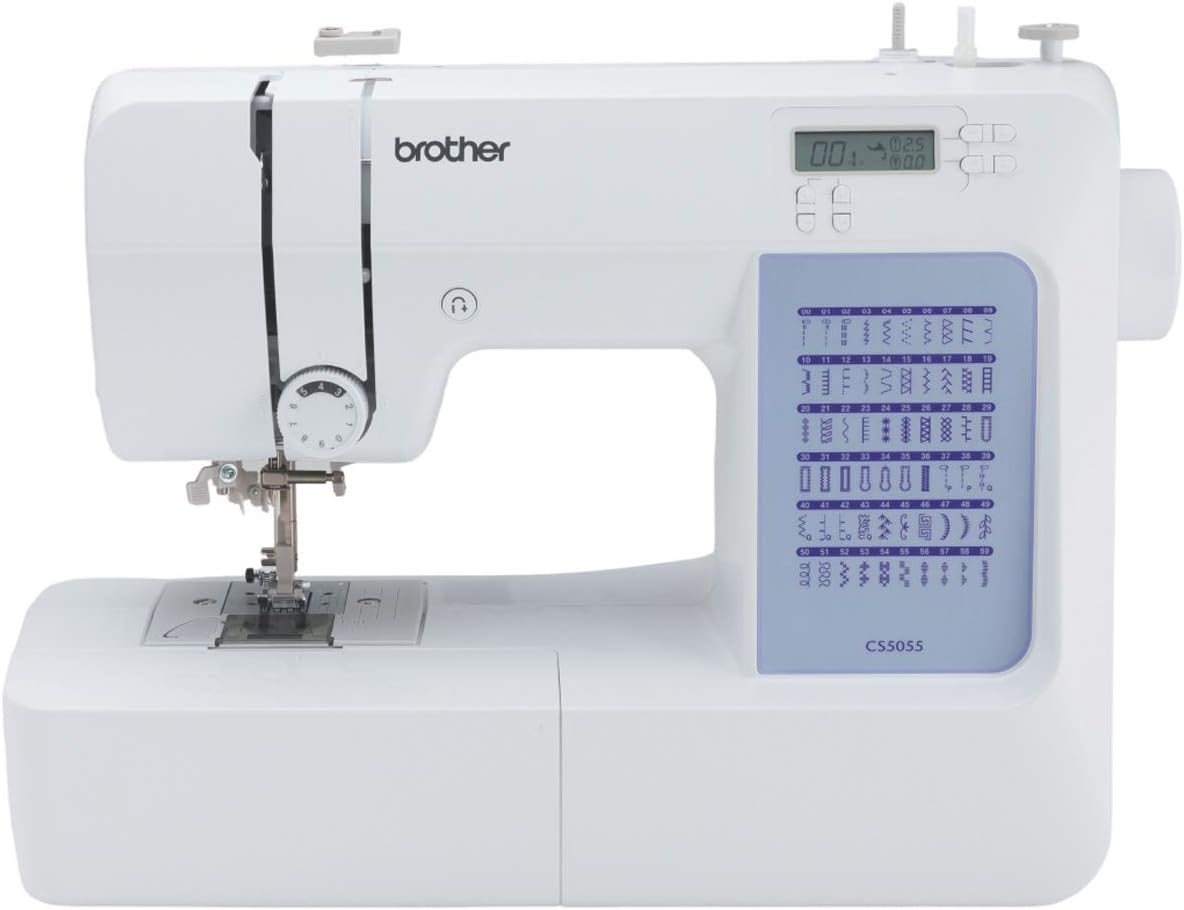
The Brother CS5055 is a computerized sewing machine with 60 built-in stitches and seven one-step auto-size buttonholes. Its fixed needle bar is designed to reduce side-to-side needle movement while sewing, and the listing describes an enhanced feed system for materials including denim and tweed. It also includes an LCD display, automatic needle threader, seven sewing feet, and a drop-in top bobbin.
Check On AmazonIf you click this link and buy, we earn a commission at no additional cost to you.
Use a Safe Dealer Demo to Check the Missing Evidence
If low-speed controllability matters, a short dealer demonstration can answer questions that a specification sheet cannot. Use the exact machine in its normal documented configuration, follow the manual, and ask before using any material sample. The purpose is to observe the controls, not to stress the machine or imitate a repair test.
- Confirm the exact model number and the control description in its manual.
- Set any speed limiter or mode according to the manual and note the selected position.
- Use a simple permitted material sample with an appropriate needle, thread, presser foot, and normal stitch.
- Start from stopped and observe whether the first movement is easy to command gradually.
- Try a few different limiter positions, if the model provides them, and note how the usable range changes.
- Release the command normally and observe whether stopping feels predictable.
Do not turn the demo into a contest for the slowest possible stitch rate. A useful result is simpler: you should know whether the machine’s documented controls give you a comfortable, repeatable range for the kind of handling you expect to do. If the response feels abrupt, record that observation for that exact setup instead of assuming the cause.
Keep Feature Research Separate From Jumpy-Pedal Troubleshooting
A pre-purchase article can explain what to verify when a community post describes a machine that does not move under light pedal pressure and then starts too quickly. It should not convert that complaint into an internal repair procedure. The same symptom can involve different machines, controllers, service histories, setup states, or faults, so the correct next step for an owned machine begins with its manual and model-specific troubleshooting path.
Do not open a pedal, alter wiring, adjust internal electrical components, bypass a safety device, or install an unverified controller based on general speed advice. Stop using a machine that shows uncontrolled motion, overheating, smoke, sparks, exposed wiring, or a damaged cord, and use qualified service when the manual places the work outside normal owner maintenance. That boundary keeps a buying decision from drifting into repair instructions that require different evidence.
Pair Control Evidence With Workspace Evidence for Handling-Intensive Sewing
Speed control is only one part of handling a large or awkward project. A sewist may be comfortable with the machine’s control range but still struggle if the work area forces the fabric to bunch, drag, or push against the machine body. For projects where fabric management matters, it is useful to evaluate sewing machine throat space separately from the speed-control system.
This is another place where independent fields prevent bad buying logic. A wider work area does not prove smoother control, and a good limiter does not create more physical room for the project. Record workspace and control behavior separately, then judge whether the combination matches the material size, seam path, and amount of repositioning the project actually requires.
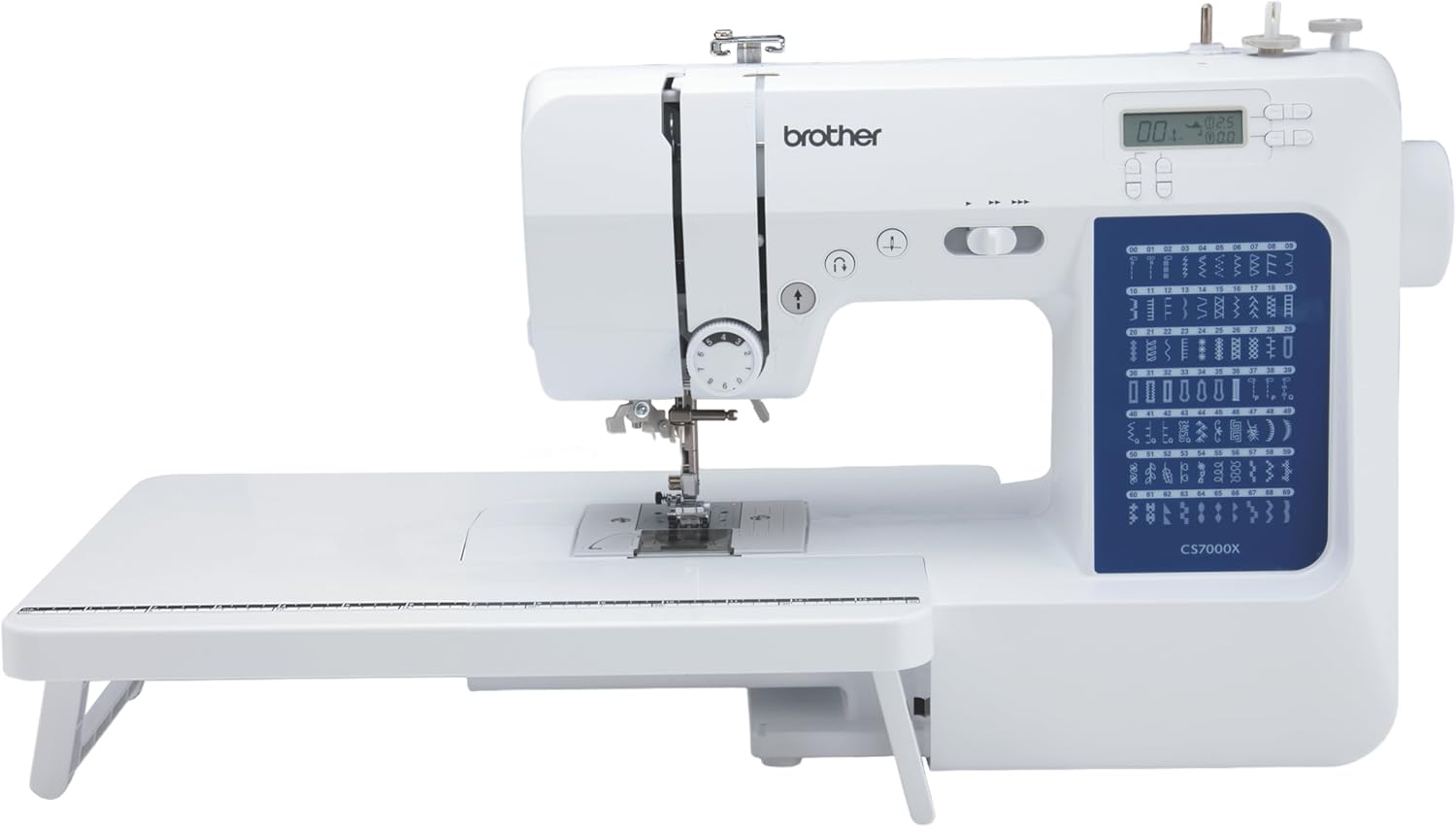
The Brother CS7000X is a computerized sewing and quilting machine with 70 built-in utility, decorative, and quilting stitches plus seven one-step buttonholes. It includes a wide table and an enlarged needle-to-arm workspace for handling larger projects such as quilts. The package also includes 10 sewing feet, a quilt guide, a protective hard case, and an automatic needle threader.
Check On AmazonIf you click this link and buy, we earn a commission at no additional cost to you.
Final Thoughts: Record Ceiling, Command, and Response Separately
The most useful speed-control note is not simply fast, slow, or variable. Write down the published maximum, the available limiter or mode, the way speed is commanded, and what remains untested. That small separation prevents a maximum SPM figure from being mistaken for controllability and prevents a slider icon from being treated as proof of smooth low-speed behavior.
For a purchase decision, documentation should establish what the controls are designed to do, while a model-specific demonstration should answer how the machine actually feels when starting, slowing, and stopping under a defined setup. If those two forms of evidence agree, the buyer has something much more useful than a marketing label: a control path they can understand and verify.
FAQs
🧵 Is a higher maximum SPM better for a sewing machine?
Not by itself. Maximum SPM tells you the published speed ceiling, not how smoothly the machine starts, feeds a particular material, or responds at low speed.
🎚️ What does a sewing machine speed slider do?
When the manual describes it as a speed limiter, the slider sets or reduces the maximum available sewing speed. Check the exact model manual to see how that setting interacts with the foot control or start/stop operation.
🦶 Does a foot pedal always give smooth low-speed control?
No universal rule proves that. A manual may describe variable pedal control, but startup response and the smallest usable speed are model-specific behaviors that are better verified with a defined demonstration or test.
⏯️ Is a start/stop button the same as speed control?
No. The button controls whether sewing starts or stops, while another control may determine the available speed. Read the manual for the exact interaction on that model.
📏 Can maximum sewing speed tell me how a machine handles thick fabric?
No. Thick-material performance also depends on the machine, feed system, presser foot, needle, thread, material stack, settings, and test conditions.
⚠️ What should I do if a machine suddenly surges or moves unpredictably?
Stop using it and follow the exact model’s troubleshooting and service guidance. Uncontrolled motion, overheating, smoke, sparks, exposed wiring, or damaged cords belong in a service or fault-diagnosis path, not a pre-purchase speed-control adjustment.
References and Sources
- bernette b05 ACADEMY specifications: Verifies the published maximum sewing speed, foot-control description, and two speed-limit modes used as a documentation example.
- Singer Quantum Stylist 9960 specifications: Verifies the published 850-stitch-per-minute maximum and the speed control’s role in setting the maximum sewing speed.
- Sailrite speed-control test: Provides a model-specific example of reporting low-speed behavior with the machine and material test conditions identified.
- SewingForBeginners pedal discussion: Documents the real owner question of a pedal that seems difficult to modulate from stopped to moving without being used as proof of the fault’s cause.