A sewing machine for knits should be chosen by the domestic jobs it must perform, not by stitch count alone. Verify the exact machine’s utility stitches, stitch control, feeding options, low-speed behavior, buttonhole system, and compatibility before judging it for stretch fabrics. A serger or coverstitch machine can add specialist seam or hemming functions, but neither replaces the full range of domestic sewing jobs. The final choice should be confirmed with a sample made from the knit fabrics you actually expect to sew.
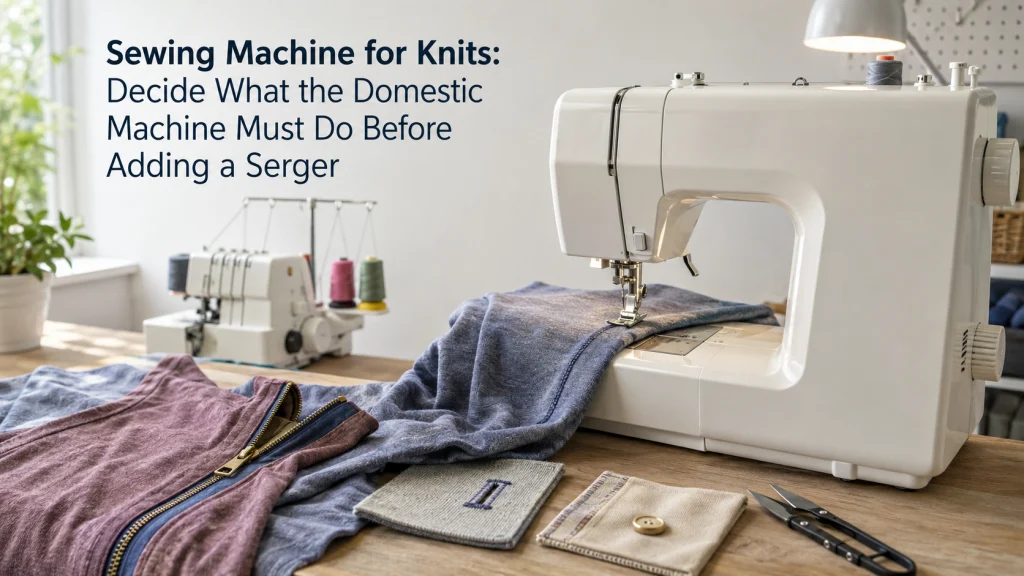
Define the Knit Jobs That Must Stay on the Domestic Machine
A sewing machine for knits still needs to work as a general domestic machine. You may need a stretch-capable construction seam, then a zipper, buttonhole, straight seam, or woven-fabric detail. Those jobs are not automatically covered by specialist knit equipment. Write down the operations that must remain on one machine before comparing features.
This is why a search for the best sewing machine for knits can become misleading. A large stitch menu may look impressive while missing a control or garment function you use often. A simpler machine may suit the work better if its utility stitches, feeding, buttonholes, and speed control are well matched. Build the shortlist from required jobs rather than from the largest feature count.
Construction Seams That Need Stretch
For buying purposes, verify a zigzag and any documented stretch-oriented utility stitches you expect to use. Check whether relevant stitch length and width settings can be adjusted. A stitch icon proves that the stitch exists, not that it will feed every knit well. Performance still needs a sample using the intended fabric and compatible setup.
Buttonholes, Zippers, and General Garment Operations
Knit garments still include jobs that belong naturally on a domestic machine. Zippers, buttonholes, edge stitching, and controlled topstitching may matter as much as the main construction seam. Verify the buttonhole system, compatible foot, and any model-specific restrictions if those operations matter. Do not choose a specialist seam system and assume it covers ordinary garment sewing.
Woven-Fabric Work the Same Machine Must Still Perform
Many knit-focused sewists also use cottons, linings, denim details, or other woven fabrics. The same machine should therefore be judged across the broader material mix when that reflects your work. Straight-stitch control, buttonholes, zipper work, needle position, and workspace may become just as important as stretch stitches. A knit requirement should not erase the other jobs the machine must perform.
Separate Domestic Sewing, Serging, and Coverstitch Jobs
A domestic sewing machine, a serger, and a coverstitch machine overlap around garment construction, but they serve different roles. A domestic machine handles general straight stitching, zigzag work, buttonholes, zippers, and many other operations. A serger is built around overlock seams and edge finishing, often with trimming and differential feed on supported models. A coverstitch machine is more specialized around cover hems, chain stitching, and related finishing.
The useful question is how to divide the workflow before comparing hardware. Occasional knit sewing may not justify another system, while frequent overlocking or cover hemming may make specialist equipment worthwhile. That second purchase should be evaluated on the seams it would take over rather than hidden inside a mixed list of machine types. This job-based split prevents one machine class from being mistaken for another.
| Job | Domestic machine | Serger | Coverstitch |
|---|---|---|---|
| General seams, zippers, buttonholes | Core role | Not a general replacement | Not a general replacement |
| Overlock seam and edge finishing | May overcast without trimming | Specialist role | Not the primary role |
| Cover hems and chain stitching | Alternative methods may exist | Not the primary role | Specialist role |
Use this as a job map rather than a performance ranking. Exact stitch formation, feed controls, accessories, and restrictions still depend on the model. A specialist machine can improve one stage of garment construction while the domestic machine continues to handle general sewing and detail work. That distinction gives the later shortlist a clear purpose instead of repeating the same buying argument.
Verify the Domestic Stitch Functions That Actually Matter
The phrase sewing machine for knit fabric becomes useful only when it is translated into features you can verify. Check the utility stitches you expect to use and the controls available for them. A printed stitch icon does not prove that length, width, needle position, or another setting can be changed as expected. Those details can differ even between machines from the same brand.
Do not count every decorative pattern as evidence of better knit performance. A smaller set of useful stitches with clear controls may be more valuable than a large menu. Stable ponte, lightweight jersey, and woven cotton can require different behavior from the same machine. Look for documented flexibility in the controls, then verify the result on fabric.
Zigzag and Documented Stretch Stitches
A regular zigzag is worth verifying because it can provide lateral movement in a domestic seam. Some machines also include utility stitches identified for stretch, elastic, or overcasting work. Treat those labels as proof that the stitches are available, not as proof of ideal performance on every knit. The final judgment still depends on a relevant sample.
Stitch Length and Width Control
Two machines with similar stitch icons may offer different adjustment options. Verify which utility stitches allow length changes, width changes, or needle-position changes. Those controls affect seam tuning and accurate placement. The manual is stronger evidence than a retailer summary that simply says the machine has adjustable stitches.
Twin-Needle Capability Only When the Exact Machine Supports It
Twin-needle sewing should never be assumed from a wide needle plate or a second spool position. Manufacturer instructions may restrict the needle, stitch, width, presser foot, threading method, or machine mode. An incompatible combination can cause a needle strike or breakage. If twin-needle work matters, verify the exact manual before treating it as supported.
Audit Feed and Presser-Foot Control at Model Level
Knit fabric can stretch, curl, shift, or feed unevenly, so feeding deserves more attention than a marketing label. Check the documented feed system, adjustable presser-foot pressure if present, and compatible specialty feet. Adjustable pressure matters only when the exact machine provides it and the manual explains its use. It is not a universal requirement for every capable domestic machine.
Official support guidance also shows why one pressure setting cannot be prescribed for every knit. On supported machines, changes may depend on thickness, stretching, slipping, or uneven feeding. A machine without adjustable pressure may still pass a relevant fabric test. The buying question is whether the control exists, what it is meant to address, and whether your sample needs it.
| Evidence | What it proves | What it does not prove |
|---|---|---|
| Feed description | Documented feed design | Result on your knit |
| Adjustable foot pressure | Control exists on that model | One setting fits all knits |
| Compatible specialty foot | Documented attachment support | The foot is always necessary |
This keeps one desirable feature from becoming a universal rule. Feeding depends on the machine, foot, fabric, stitch, needle, thread, and handling. Specifications show which controls are available, while a sample shows how those controls behave in your use. Both pieces of evidence belong in the decision.
Check Low-Speed Control, Visibility, and Fabric Support
Knit garments often include curves, necklines, short seams, and intersections where control matters more than headline speed. Check how smoothly the machine starts and how easily you can maintain a slow pace. A speed limiter can help when a model includes one, but a predictable foot controller may be enough for another buyer. Test that control while approaching a seam intersection or curve, not only while sewing a long straight sample. The goal is accurate movement without an abrupt jump from stopped to uncomfortable speed.
Visibility and support matter for the same reason. Good lighting, clear seam references, accessible controls, and enough flat support can reduce unnecessary handling near the needle. Free-arm access may help with cuffs or other tubular areas when those are common in your work. Notice whether the fabric can rest naturally instead of hanging from the table and pulling against the feed path. These features do not prove knit performance, but they can make a capable machine easier to control.
Separate Needle Compatibility From Machine Capability
A machine can have suitable stitches and controls while still requiring the correct needle system and size. That is a compatibility question, not proof that the machine is unsuitable for knits. Verify the needle system accepted by the exact machine before choosing a needle type for the fabric and thread. The machine manual or manufacturer compatibility information should establish that interface before the sample is sewn. Do not assume every package labeled for stretch fabric fits every domestic machine.
This distinction also prevents a buying article from becoming a needle-settings tutorial. If a sample skips stitches, do not immediately reject the machine or change tension. First confirm needle compatibility, condition, insertion, and suitability for the test. A bent, damaged, or incorrectly installed needle can create a misleading result that says little about the machine itself. Detailed needle selection belongs to its own compatibility decision, while this purchase check confirms that the machine supports the options you need.
Reject Stitch Count, Motor Power, and Serger Inclusion as Shortcuts
A high stitch count is easy to compare, but it is weak evidence of knit suitability. Many stitches may be decorative, duplicated, or irrelevant to your normal seams. A smaller set of useful stitches with clear adjustment can be more valuable. Ask whether the machine covers the construction, finishing, buttonhole, and detail work on your own job list. Count the operations the machine supports, not the icons on the panel.
Motor wording and mixed machine lists create similar problems. Claims about power or strength do not independently prove smooth feeding, stitch quality, or control on stretch fabric. A motor description also says little about buttonhole behavior, stitch adjustment, slow control, or the compatibility of a needed presser foot. Likewise, adding a serger to a recommendation list does not tell you whether a particular domestic model covers your garment workflow. Judge each candidate by documented functions and a relevant fabric sample, not by a shortcut label.
Set the Evidence Threshold for a Knit-Machine Recommendation
A useful recommendation needs more than a product title or a review saying a machine handles stretch. Start with the exact manufacturer page and manual. Verify the stitches, controls, buttonhole system, feed features, compatible feet, needle restrictions, and operating limits that matter to your job list. Independent testing adds value only when the machine, fabric, setup, and conditions are clear enough to interpret.
Community discussions are useful for identifying real buyer confusion, not for proving technical capability. They can show that buyers want one regular machine for knits and wovens or are unsure whether a serger is required. Those questions should guide what you investigate. The evidence threshold is met when documentation establishes capability and a relevant sample confirms acceptable behavior.
- Verify the exact machine manual.
- Confirm the needed utility stitches and controls.
- Confirm presser-foot and needle compatibility.
- Separate feature claims from observed results.
- Require a representative knit sample before the final choice.
If one layer is missing, mark it unresolved instead of filling the gap with an assumption. This matters when two machines look nearly identical on a comparison page. Small differences in controls or supported modes can change the practical choice. A buyer should know what is documented and what still needs testing.
Current Domestic Shortlist by Knit Workflow
A current shortlist is useful only when each model is tied to a workflow rather than presented as a universal winner. The machines below have manufacturer-documented controls relevant to knit sewing, garment details, and mixed-fabric work. Their inclusion does not prove that they will feed every jersey cleanly. Each finalist still needs a representative fabric test with the intended needle, thread, foot, and seam.
Brother lists the CS7000X with speed control, seven one-step buttonholes, ten included feet, a ballpoint needle, and a twin needle, but no adjustable presser-foot pressure. The ST150HDH adds seven-point box feeding, five one-step buttonholes, knit-oriented ballpoint needles, and start-stop control, while pressure remains fixed. Janome documents the 4120QDC-G with foot-pressure adjustment, a speed slider, seven one-step buttonholes, a seven-piece feed dog, and a twin-needle guard. JUKI documents the HZL-F300 with adjustable foot pressure, box feeding, stitch adjustment, sixteen buttonhole styles, and twin-needle support.
| Named workflow | Current domestic candidate | Documented reason to shortlist | What still needs testing |
|---|---|---|---|
| Occasional knits plus wovens | Brother CS7000X | Speed control, seven one-step buttonholes, ten feet, ballpoint and twin needles; fixed foot pressure. | Jersey feeding, curves, and your buttonhole fabric. |
| Frequent knit garment sewing | Brother ST150HDH | Seven-point box feed, five one-step buttonholes, start-stop control, walking foot, and ballpoint needles; fixed foot pressure. | Light and medium knits, bulky intersections, and slow starts. |
| Knits where pressure control matters | Janome 4120QDC-G | Foot-pressure adjustment, speed slider, seven one-step buttonholes, seven-piece feed dog, and twin-needle guard. | Pressure changes, zipper work, buttonholes, and twin-needle samples. |
| Control-heavy mixed-fabric work | JUKI HZL-F300 | Adjustable foot pressure, box feed, stitch adjustment, sixteen buttonholes, and documented twin-needle support. | Difficult knits, low-speed control, buttonholes, and twin-needle setup. |
These models represent different control packages, not a ranking. One buyer may value a speed slider, while another may want adjustable foot pressure for fabrics that prove difficult in testing. Buttonhole count matters only when the available styles fit the garments, and an included walking foot does not guarantee better knit feeding. Use the named machines as starting points, then remove any candidate that fails a required job or the sample test.
List the Knit Sample Test Still Required for Each Finalist
Documentation can establish capability, but it cannot predict exactly how your knit will behave under the presser foot. The final buying step is a controlled sample using fabric and a seam that resemble your normal work. Keep the important variables recorded so the comparison stays fair. The goal is to judge feeding, control, and seam formation rather than invent a laboratory score.
Use the same fabric orientation, seam purpose, thread category, compatible needle, and comparable stitch purpose for each finalist when possible. Record any foot or control change instead of quietly correcting one setup more than another. Watch for stretching, skipped stitches, bunching, poor feeding, hard starts, needle strikes, and loss of control. Stop if the machine shows repeated hard strikes, a jam, abnormal motion, heat, smoke, or a burning odor.
- Record the fabric and direction of greatest stretch.
- Record the seam or operation.
- Use a compatible needle and note its type and size.
- Record thread, presser foot, stitch, and relevant controls.
- Repeat an important sample if setup error may have affected it.
Write the result as an observation rather than a universal claim. Passing one stable knit sample does not prove performance on every stretch fabric. A poor result may also need a setup check before the machine is rejected. This keeps the test useful without overstating what one sample can prove.
Return to the All-Fabrics Decision When Knits Are Only Part of the Work
If knits are only one part of what you sew, do not let the hardest stretch fabric control the entire purchase. The machine may also need to handle stable wovens, linings, buttonholes, hems, and occasional heavier intersections within its documented limits. Those jobs introduce other priorities such as straight-stitch control, workspace, presser-foot options, and needle position. Rank those needs by frequency so an occasional knit challenge does not outweigh everyday sewing. The right balance depends on how often each job appears.
That broader choice is covered in choosing one machine across fabric types. Use it when the knit requirement matters but does not dominate your sewing. You can also compare broader sewing machine choices when you need to step back from a fabric-specific shortlist. Compare the broad requirements first, then return to the knit sample only for finalists that satisfy the rest of the workload. The knit checks here then become one evidence layer inside the larger decision.
Treat Serger and Coverstitch Decisions as Separate Purchases
A serger becomes relevant when overlock construction, edge finishing, trimming, or differential-feed behavior is important enough to justify specialist equipment. A coverstitch machine becomes relevant when cover hems, chain stitching, or related finishing operations justify their own system. Those capabilities can complement a domestic machine without replacing its buttonholes, zippers, general straight stitching, and other garment operations. Before buying, list the exact seams or hems that would move to the second machine and how often they occur. That frequency is more useful than assuming that knit sewing automatically requires another machine.
The ownership calculation is broader than purchase price. A second machine adds threading, consumables, maintenance, workspace, accessories, storage, service access, and another operating routine to learn. If the domestic machine already handles the knit workload acceptably, those extra costs may solve no urgent problem. If overlocking or cover hemming becomes a repeated bottleneck, compare the specialist system on the exact jobs it would take over. That comparison keeps the second purchase tied to measurable workflow value instead of turning it into an automatic upgrade.
Move to Settings and Technique Only After the Machine Is Chosen
Machine selection and knit sewing technique answer different questions. This article is about whether the domestic machine has the documented functions and controls needed for your workflow. It should not prescribe one stitch length, pressure setting, or tension value for every stretch fabric. The useful buying evidence is that the required controls exist and are supported for the intended operation. After purchase, settings should follow the exact manual and be tested with the actual fabric, needle, thread, foot, and seam.
This boundary also keeps troubleshooting cleaner. If a functioning machine skips stitches or distorts fabric, treat that first as a setup or sewing-condition problem rather than proof that the purchase was wrong. Verify threading, needle condition and compatibility, stitch selection, foot, feed state, and model-specific controls. Keep technique changes separate from claims about what the machine can or cannot do. Stop and use qualified service for a hard lock, repeated hard needle strikes, overheating, smoke, burning odor, exposed wiring, or uncontrolled motion.
Final Thoughts: Choose the Domestic Jobs First, Then Add Specialist Capability Only if Needed
The strongest knit-focused purchase is the domestic machine that matches the complete garment workflow and then proves itself on representative fabric. Check construction stitches, buttonholes, zipper work, woven sewing, slow control, feeding features, and the compatible accessories or needles you expect to use. Use the exact manual to confirm those functions rather than relying on stitch count, power language, or a generic stretch-fabric claim. Where documentation stops, a controlled sample should decide whether the machine stays on the shortlist.
Only then decide whether overlocking, differential feeding, or cover hemming creates enough repeated work to justify another system. The current domestic candidates in this article show why there is no single feature package that automatically wins for every knit sewer. One buyer may value adjustable foot pressure, another may care more about speed control, buttonholes, or a simpler mixed-fabric setup. Choose the machine whose documented controls fit the work, verify the fabric result, and add specialist equipment only when a separate job clearly earns it.
FAQs
🧵 Do I need a special sewing machine for knit fabric?
Not necessarily. A domestic machine can work when its documented stitches, controls, compatibility, and sample behavior match the knit work you plan to do.
⚙️ Are more stretch stitches always better for knits?
No. Stitch count does not prove feeding or seam quality, so focus on the utility stitches you need and the controls available for them.
🦶 Do I need adjustable presser-foot pressure for stretch fabric?
It can help on machines that provide it when fabric stretches, slips, or feeds unevenly. Verify the exact model and test whether your fabric actually benefits from the control.
🪡 Can every domestic sewing machine use a twin needle?
No. Twin-needle compatibility, permitted stitches, width, threading, foot choice, and machine mode can be model-specific, so follow the exact manual.
✂️ Is a serger better than a regular sewing machine for knits?
They serve different roles. A serger can handle specialist overlock work, while the domestic machine remains the general tool for buttonholes, zippers, straight stitching, and zigzag sewing.
👕 What should I test before buying a sewing machine for stretch fabric?
Use a representative knit, compatible needle, suitable thread, and the intended seam. Watch feeding, skipped stitches, distortion, starting behavior, and low-speed control.
References and Sources
- Brother CS7000X product page: Verifies speed control, buttonholes, included feet, needles, and fixed presser-foot pressure.
- Brother ST150HDH product page: Verifies feed design, buttonholes, included feet and needles, start-stop control, and fixed foot pressure.
- Janome 4120QDC-G product page: Verifies foot-pressure adjustment, speed control, feed system, buttonholes, and twin-needle guard.
- JUKI HZL-F300 product page: Verifies box feed, adjustable foot pressure, buttonholes, stitch controls, and twin-needle support.
- Brother presser-foot pressure support: Documents model-supported pressure adjustment and fabric-dependent behavior.
- Brother twin-needle instructions: Documents model-specific stitch, width, foot, and threading restrictions for twin-needle use.
- Brother serger and coverstitch overview: Supports the distinction between domestic, overlock, and coverstitch systems.