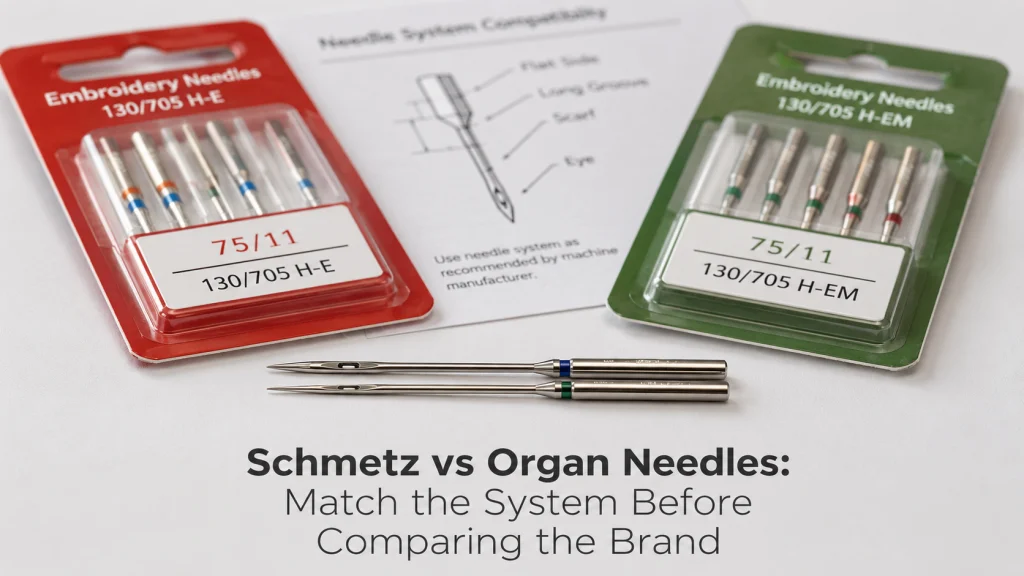
Schmetz vs Organ needles is not a meaningful comparison until the needle system, type, and size are already matched to the exact machine and sewing task. A machine manufacturer may name one product as factory-recommended, document another as an approved substitute, or permit more than one needle system on a specific model. Those statements prove compatibility within their stated scope; they do not prove that one brand is universally sharper, stronger, longer-lasting, or better at forming stitches. Compare brand only after the needle itself is equivalent.
Same system, same type, same size, one remaining question
A buyer can hold three packages marked for the same household system and still wonder whether Schmetz vs Organ needles is a real compatibility choice or simply a brand preference. That question becomes more important when online discussions mix Singer, SCHMETZ, Organ, and machine-brand needles as though matching size alone makes every package interchangeable. The useful comparison starts only after system, needle type, and size are fixed.
Brother gives a clear example of why the machine documentation comes first. For the PR1000E, Brother identifies HAX 130 EBBR from Organ as the factory-recommended embroidery needle and states that SCHMETZ 130/705 H-E may be used as a substitute. That is stronger evidence than a general brand reputation because it names both products within one exact machine scope.
Confirm system, type, and size before comparing brands
Brand is the last variable, not the first. Start with the exact needle system required by the machine, then choose the needle type for the fabric and thread, then choose an allowed size. Only after those three fields match does a brand comparison become useful.
For example, two packages can both say size 90/14 while belonging to different systems or different point families. That is not a fair brand comparison because the products are not equivalent yet. If the underlying system is still uncertain, verify whether sewing machine needles are universal before comparing labels on the package.
| Variable | What must match first | Why brand cannot override it |
|---|---|---|
| Needle system | The system named by the exact machine documentation | A different shank, scarf, or length relationship can make the needle incompatible |
| Needle type | The point and eye family appropriate for the material and task | Universal, embroidery, jersey, denim, and other types are not interchangeable merely because the size matches |
| Needle size | A size permitted for the machine, thread, and material combination | A preferred brand does not make an unsuitable size correct |
| Brand | Compared only after the first three variables are equivalent | Brand preference is not compatibility evidence |
This order also keeps the purchase decision small. Instead of asking which sewing machine needle brands are best in general, you are asking which documented product fits one known machine and one known needle requirement.
Check the exact machine manual or support page for named recommendations
A named manufacturer recommendation can narrow the choice beyond a generic household system. Brother’s PR1000E support information does exactly that: the machine is designed for household embroidery needles, Organ HAX 130 EBBR is factory-recommended, and SCHMETZ 130/705 H-E is documented as a substitute. That wording gives the buyer a hierarchy of evidence without declaring either brand universally superior.
Other machines can use a different structure. JUKI lists the TL-2010Q with HA x 1 (130/705H) or HL x 5 needles in sizes #9 through #18. The important detail is that the exact model allows more than one needle system. A generic statement such as “all home machines use 130/705 H” would erase that model-specific allowance and could push the buyer toward the wrong comparison.
Key point: If the machine maker names a specific needle, approved substitute, or alternate system, that instruction outranks a broad SCHMETZ-versus-Organ preference.
Use the exact model number whenever you search support material. A recommendation attached to one embroidery machine, serger, straight-stitch machine, or domestic sewing machine should not be carried over to another model simply because the brand name on the machine is the same.

SCHMETZ Embroidery needles use the 130/705 H-E household embroidery needle system and come in size 90/14. The listing specifies a medium ball point and identifies the product for domestic sewing machines. This bulk package contains 100 needles and is designed specifically for machine embroidery applications.
Check On AmazonIf you click this link and buy, we earn a commission at no additional cost to you.
Distinguish factory-recommended, approved substitute, and merely same-system products
Compatibility evidence has levels. A factory-recommended needle is the product the machine maker explicitly names. An approved substitute is another product the machine maker explicitly allows. A same-system needle may appear dimensionally relevant, but it still needs the correct type, size, and any model-specific approval or limitation before it can be treated as equivalent.
The distinction prevents a subtle buying mistake. If Brother names Organ HAX 130 EBBR first and SCHMETZ 130/705 H-E as a substitute for the PR1000E, the correct reading is not “Organ is better than SCHMETZ.” The correct reading is that both have documented status for that machine, but the status is not identical.
| Status | Evidence required | What you may conclude |
|---|---|---|
| Factory-recommended | Exact machine manual or manufacturer support names the product | The product is the maker’s stated first recommendation for the covered model and use |
| Approved substitute | Exact machine documentation explicitly permits the alternative | The alternative is documented as usable within that stated scope |
| Same system | Package or brand documentation matches the required system | System fit may match, but type, size, and model restrictions still need verification |
| Community favorite | Owner preference or anecdotal report | It shows preference, not technical superiority or universal fit |
Once the status is recorded, the remaining purchase question becomes easier. You can compare two documented options without pretending that a preference reported on another machine proves performance on yours.
Compare package system and type nomenclature
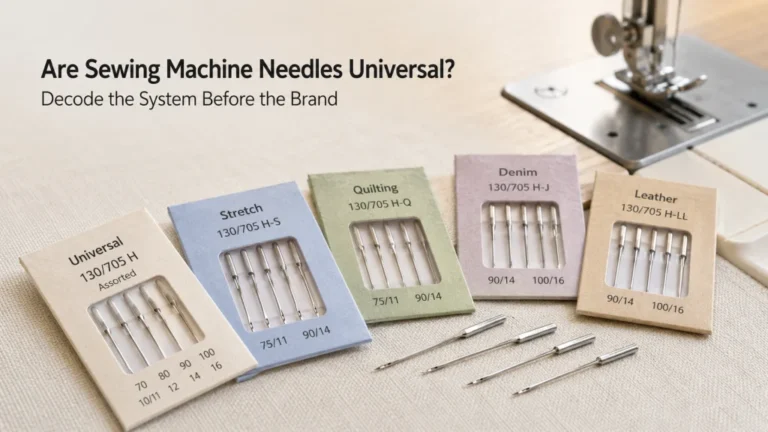
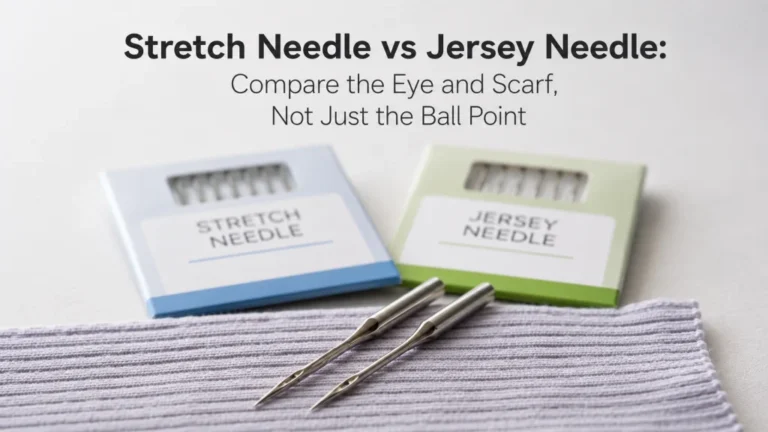
SCHMETZ identifies 130/705 H as the common household needle system and tells users to verify the system recommended by the machine manufacturer. Its product families then add type identifiers for applications such as embroidery, jersey, Microtex, denim, and other sewing conditions. Organ likewise sells household needle families under system designations such as 130/705H and HA x 1 variants.
The naming does not always look identical across brands. That means the buyer should translate the package into four fields: system, type, size, and any special suffix. Do not compare package color, marketing name, or the large size number alone.
- Write down the exact system from the machine documentation.
- Match the point or application type needed for the material.
- Match the allowed needle size.
- Record any suffix that changes the needle family or intended use.
- Check whether the machine maker names a specific product or substitute.
That checklist is especially useful when one brand uses a familiar retail name and the other uses a more technical designation. The words on the front of the package matter less than whether the underlying specification matches the machine requirement.

These SCHMETZ universal sewing machine needles in size 90/14 provide a practical replacement for regular-point household needles used with many woven fabrics and general garment projects. The set contains five needles, rather than the original Organ ten-needle assortment, so the quantity and brand change even though the nominal needle size remains the same. Match the needle system to the sewing machine manual and choose a different point for stretch knits, leather, or other specialty fabrics. Replace bent or blunt needles promptly and always test a new needle on a fabric scrap.
Check On AmazonIf you click this link and buy, we earn a commission at no additional cost to you.
Compare available sizes and specialty families without assuming equal performance
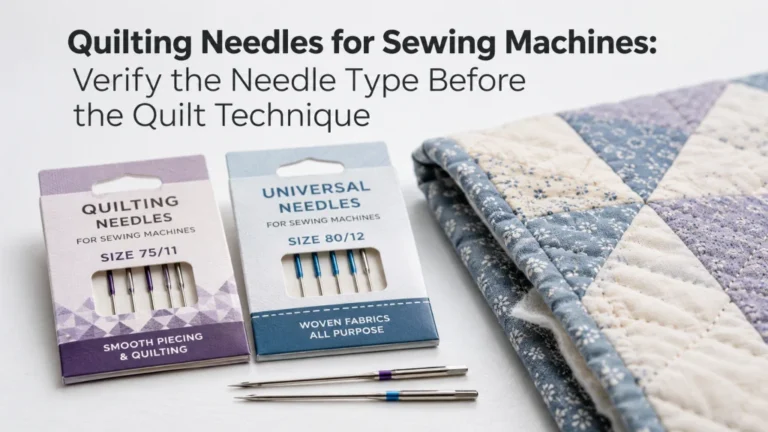
Once system and type are fixed, look at whether each brand actually offers the size and specialty family you need. SCHMETZ publishes household families across multiple types and sizes, while Organ also publishes household lines for general sewing, quilting, embroidery, knits, denim, leather, and other applications. Availability within a family can therefore matter even when both brands participate in the same broad household system.
Do not turn similar category names into a performance conclusion. Two embroidery needles with compatible systems and the same nominal size may both be candidates, but that alone does not prove identical eye geometry, finish, bending behavior, stitch quality, or service life. Those details require product specifications or controlled comparison data, not assumption.
| Comparison field | Safe to compare from documentation | Keep unknown without controlled evidence |
|---|---|---|
| System designation | Yes | None if clearly documented |
| Needle type or application family | Yes | Relative stitch quality |
| Available sizes | Yes | Which brand lasts longer |
| Package quantity | Yes | Which brand bends or breaks less often |
| Manufacturer-approved status for a machine | Yes, from the machine maker | Universal superiority outside that machine scope |
If one brand does not offer the exact documented combination you need, the decision can end there. There is no reason to reward brand loyalty by moving to the wrong type or size.

SCHMETZ Universal needles use the 130/705 H household needle system and come as a 10-needle assortment. The listing describes a slightly rounded point intended for general sewing with woven and knit fabrics. The assortment provides multiple needle sizes within the same Universal product family.
Check On AmazonIf you click this link and buy, we earn a commission at no additional cost to you.
Record price and availability only when you are ready to buy
Price and stock can separate two otherwise acceptable choices, but neither belongs in an evergreen technical conclusion. Compare the exact package count, system, type, and size at the retailer you are actually considering. A lower package price can disappear once pack quantity or specialty type is normalized.
Availability can matter more than a small price difference if you use the same needle family repeatedly. Still, do not turn temporary stock into a brand-quality statement. The useful record is simply which equivalent product is available to you at the point of purchase and what the normalized cost per needle is.
Separate compatibility evidence from community preference
Community discussions are useful because they reveal the questions buyers actually ask. Sewists frequently compare SCHMETZ, Organ, Singer-branded, and other needles after noticing that packages appear to share a system, type, or size. The replies often include strong personal preferences, reports of breakage or skipped stitches, and claims that one machine “likes” one brand better.
Those reports can help you decide what to test, but they cannot establish a universal winner. The machine, needle system, type, size, thread, fabric, stitch, installation, and maintenance state may all differ between two owners. A brand preference becomes stronger evidence only when those variables are controlled.
“Several owners prefer this brand, so it must be the safer or better needle for my machine.”
“My exact machine documentation permits this product, and any performance preference still needs a controlled comparison on an equivalent needle setup.”
That boundary lets owner experience remain useful without letting anecdotes override the machine maker’s compatibility requirements.
Mark sharpness, longevity, and stitch-quality claims unknown without controlled tests
Claims that one brand is sharper, bends less, breaks less, lasts longer, or makes cleaner stitches are tempting because they sound like direct buying answers. Unless the source controls the machine, needle system, needle type, size, thread, fabric, stitch, installation, conditions, and sample count, the comparison is not strong enough to support a universal recommendation.
This is also why country-of-origin stories or assumed manufacturer relationships should not be used as shortcuts. A real manufacturing relationship needs a primary source. A quality conclusion needs a reproducible comparison. Without that evidence, mark the performance claim unknown rather than filling the gap with brand reputation.
| Claim | Evidence status | Decision treatment |
|---|---|---|
| “This brand fits my machine” | Strong only when exact machine documentation or system evidence supports it | Verify before purchase |
| “This brand is sharper” | Unknown without a defined measurement or controlled test | Do not score |
| “This brand lasts longer” | Unknown without matched use and sample count | Do not score |
| “This brand gives better stitches” | Unknown without controlled machine, material, thread, stitch, and needle variables | Do not score |
The restraint is useful for both brands. It prevents a familiar name from receiving unearned credit and prevents a less familiar package from being dismissed without evidence.
Use Brother and JUKI examples only within their exact model scope
Brother’s PR1000E is a narrow but valuable example because the support page names Organ HAX 130 EBBR as factory-recommended and SCHMETZ 130/705 H-E as an allowed substitute. That proves a documented brand substitution for that machine. It does not prove that every Brother machine has the same recommendation or that every Organ and SCHMETZ embroidery needle can be exchanged.
JUKI shows two different kinds of documentation. The TL-2010Q specification permits HA x 1 (130/705H) or HL x 5 within its listed size range, while the MO-1000 overlocker specification names SCHMETZ 130/705 H or JLx2 and lists a SCHMETZ 130/705H needle set among the accessories. Those examples show that even within one manufacturer, needle-system and brand wording can change with machine architecture.
| Machine example | Documented needle wording | What the evidence proves |
|---|---|---|
| Brother PR1000E | Organ HAX 130 EBBR factory-recommended; SCHMETZ 130/705 H-E permitted as substitute | Both named products have documented status for this embroidery machine |
| JUKI TL-2010Q | HA x 1 (130/705H) or HL x 5, within the listed size range | The exact machine permits more than one needle system |
| JUKI MO-1000 | SCHMETZ 130/705 H or JLx2 | The overlocker has its own documented needle options |
These are evidence examples, not product endorsements. Their purpose is to show why the exact model page can settle a compatibility question more reliably than a broad brand comparison.
Stop the brand comparison if a needle change produces a symptom
If a machine that was forming stitches normally begins skipping, shredding thread, breaking needles, striking a plate or foot, or failing to pick up the bobbin thread after a needle change, stop treating the problem as a shopping comparison. First verify that the replacement needle matches the documented system, type, size, orientation, and seating. Do not continue after repeated strikes or breakage.
If the correct needle setup is confirmed and the symptom persists, move into fault diagnosis rather than declaring that one brand is bad. The sewing machine accessory compatibility framework can help when the component fit itself is uncertain, while stitch or thread failures belong in the site’s troubleshooting path rather than in a brand ranking.
Use a controlled checklist before choosing between the brands
Once the exact machine and needle requirement are known, a controlled brand comparison is short. The point is to hold everything except brand constant so you do not accidentally compare two different needles and call the result a brand difference.
- Verify the exact machine requirement. Record the permitted system, type, size, and any named recommended product.
- Match system exactly. Do not compare a 130/705 H product with a different system unless the machine explicitly permits both.
- Match type exactly. Compare embroidery with embroidery, jersey with jersey, or the other exact family required.
- Match size exactly. Keep the same metric and Singer size pair where applicable.
- Record recommendation status. Note whether each product is factory-recommended, an approved substitute, or simply a same-system candidate.
- Compare package facts. Check quantity, current availability, and current normalized cost without turning them into permanent brand claims.
- Keep performance unknown unless tested. Do not score sharpness, life, breakage, or stitch quality without controlled evidence.
If you need to choose another needle family rather than another brand, return to sewing machine needle selection. That keeps the decision centered on the part of the needle specification that actually changed.
Final Thoughts: Compare brands only after the needle itself is equivalent
SCHMETZ or Organ needles can both be valid choices when the exact machine documentation and needle specification support them, but the brand name should never outrank system, type, size, or a model-specific recommendation. Brother’s documented Organ recommendation and SCHMETZ substitute for one embroidery model shows how precise the evidence can be. JUKI’s model pages show that the permitted system itself can vary with machine architecture.
Hold the needle specification constant, record the recommendation status, and compare current package facts only after compatibility is settled. If no controlled evidence supports claims about sharpness, longevity, breakage, or stitch quality, leave those claims unknown. A defensible brand choice is narrower than a winner label, and that is exactly what makes it useful.
Frequently Asked Questions
🪡 Are SCHMETZ and Organ needles interchangeable?
Only when the exact machine permits the needle system and the compared products also match the required type and size. A manufacturer may explicitly approve one brand as a substitute on a specific model, which is stronger evidence than a general same-system assumption.
📖 What if my machine manual names Organ needles?
Use the named Organ product unless the manufacturer also documents an approved alternative. Do not replace an exact recommendation with a generic brand preference from another machine.
🧵 Does 130/705 H mean SCHMETZ and Organ are the same?
No. The shared system can establish an important compatibility field, but needle type, size, product suffix, and exact-machine restrictions still matter. Equal system notation does not prove equal performance.
🏷️ Which sewing machine needle brand lasts longer?
Do not assume a universal winner without controlled test data. Machine, system, type, size, fabric, thread, stitch, installation, conditions, and sample count all need to be held constant for a useful longevity comparison.
💵 Should I choose the cheaper equivalent needle?
Price can separate two fully compatible choices, but compare the same system, type, size, and package quantity first. Treat price and stock as current shopping facts rather than permanent brand characteristics.
⚠️ What if stitches get worse after changing needle brands?
Verify the replacement system, type, size, orientation, and seating before blaming the brand. Stop after repeated strikes or breakage, and move to symptom-led troubleshooting if the correct needle setup still produces a fault.
References and Sources
- Brother PR1000E needle support: Verifies Organ HAX 130 EBBR as factory-recommended and SCHMETZ 130/705 H-E as a documented substitute for the covered machine.
- JUKI TL-2010Q specifications: Verifies the model’s permitted HA x 1 (130/705H) and HL x 5 needle systems and listed size range.
- JUKI MO-1000 specifications: Verifies SCHMETZ 130/705 H or JLx2 as documented needle options and a SCHMETZ 130/705H needle set among the accessories.
- SCHMETZ household compatibility information: Supports SCHMETZ’s 130/705 H household-system claims and its instruction to follow the needle system recommended by the machine manufacturer.