Choosing quilting needles for sewing machines starts with compatibility, not the project word on the package. A dedicated Quilting needle can be a sensible candidate, but the word Quilting does not prove that it will fit the machine or outperform every other needle family. The useful decision starts with the machine’s permitted needle system, then separates needle type from needle size, thread needs, fabric construction, and the actual quilt workflow. SCHMETZ currently documents its household Quilting needle with a special taper and slightly rounded point, which distinguishes its geometry from the general-purpose Universal type. The goal is to verify that difference, decide whether it addresses the job in front of you, and test the result without treating the product label as a guarantee.
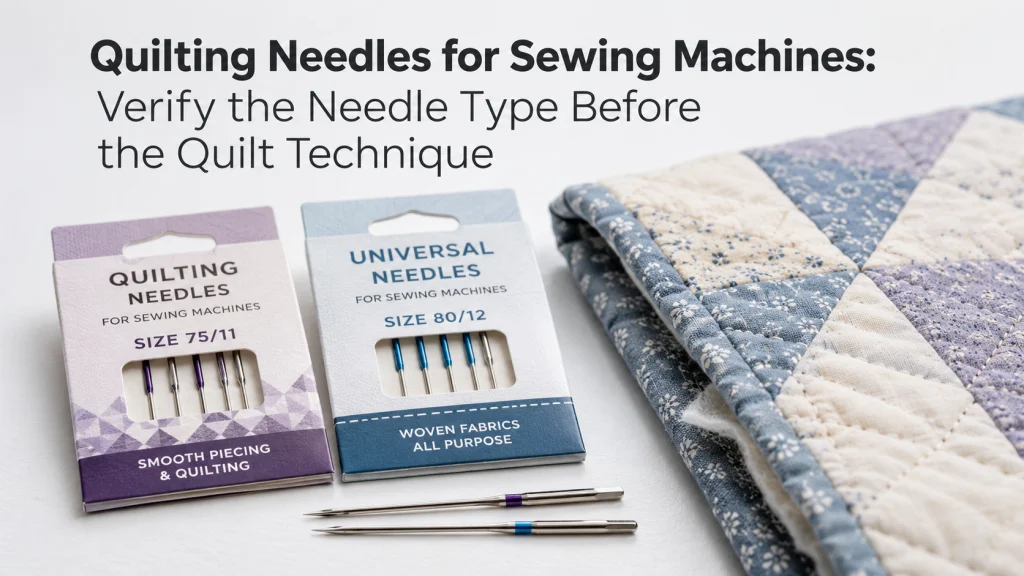
Same size, different needle geometry
Put a Quilting 90/14 package beside a Universal 90/14 package and the shared number can make the two look interchangeable. That is the first trap when shopping for quilting needles for sewing machines. The 90/14 size identifies needle size, not the complete point, taper, eye, groove, scarf, or application design. Two needles can therefore share the same size while belonging to different needle types.
SCHMETZ documents its Quilting needle with a slightly rounded point and a special taper, while its Universal needle is documented as a general-purpose type with a slightly rounded point. The overlap in size does not erase that geometry difference. It also does not prove that the dedicated type will create a better result on every quilt, because stitch behavior still depends on the machine, thread, fabric, layer stack, foot, and technique.
Same-size, different-geometry check: Treat the size number as one axis and Quilting versus Universal as another. Match the machine system first, choose a size that suits the thread and material conditions, then decide whether the needle type’s documented geometry is relevant to the work.
This distinction keeps the purchase question small. You are not trying to find one needle that wins every quilting task. You are checking whether a dedicated geometry is a reasonable candidate for a specific machine and workflow.
Confirm household needle-system fit before comparing types
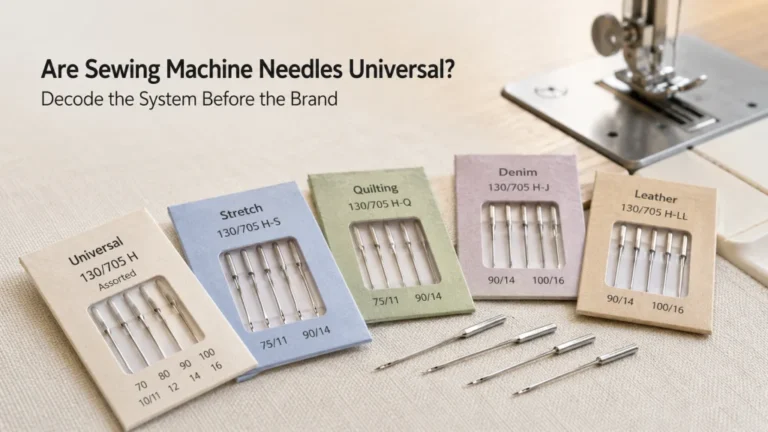
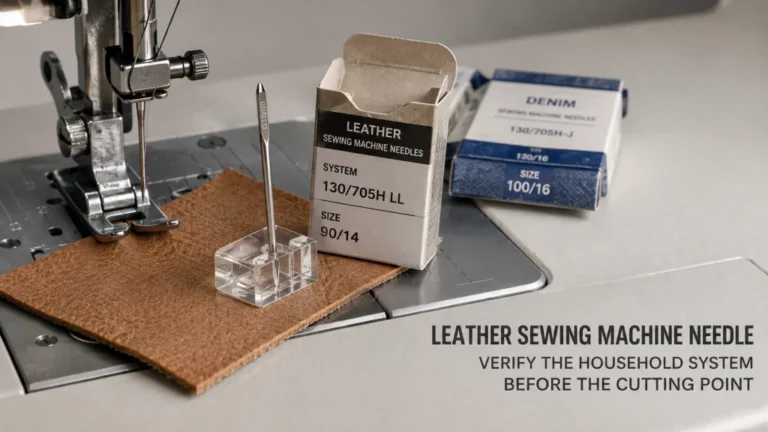
Needle selection begins with fit, not with the project word printed on the package. Check the exact machine manual for the permitted needle system and any stated size limits. SCHMETZ describes 130/705 H as the household needle system used by home sewing machines, while its current Quilting product is marked 130/705 H-Q. The added type designation does not give permission to ignore the machine manual.
This matters because machine categories do not all use the same needle architecture. A domestic sewing machine, serger, coverstitch machine, longarm, or specialist system may call for a different system even when the needles look similar from a distance. If the manual specifies a different system, stop there and buy within that system rather than trying to force a household Quilting needle into the decision.
Read the package in three parts: On a current SCHMETZ Quilting card or product listing, identify the type name, the system code 130/705 H-Q, and the size such as 75/11 or 90/14. Then compare the system and size with the exact machine manual. Packaging layout can change, so use those identifiers rather than relying on where a number is printed or on the package color.
The broader sewing machine needle selection process is useful when the machine manual leaves you choosing among several household needle types. For accessory fit beyond needles, use the same evidence-first approach described in sewing machine accessory compatibility.
Define what makes a dedicated Quilting needle a separate product
A dedicated Quilting needle is not simply a Universal needle placed in quilting-themed packaging. Packaging and search results can make quilting sewing machine needles look like one uniform category, but the type designation still needs to be read alongside the system and size. SCHMETZ currently describes its Quilting type as having a special taper to a slightly rounded point and lists piecing, machine quilting, and topstitching among its suggested applications. That documentation establishes a design difference and an intended-use range, not superiority over every alternative.
The useful buying question is therefore narrow: does that documented geometry give you a reason to test this needle type for the job you actually perform? If the answer is yes, the dedicated type becomes a reasonable candidate. If the machine already produces the required result with a compatible alternative, the Quilting label alone does not create a need to replace what is working.
- Verify the machine’s permitted needle system.
- Identify the needle type, not just the size number.
- Check the documented geometry or thread-handling feature that distinguishes that type.
- Match the size to the thread and material conditions within the machine’s limits.
- Test on the actual or representative quilt stack before treating the choice as settled.
This sequence prevents a product name from becoming a shortcut for the entire machine, thread, material, and technique decision.
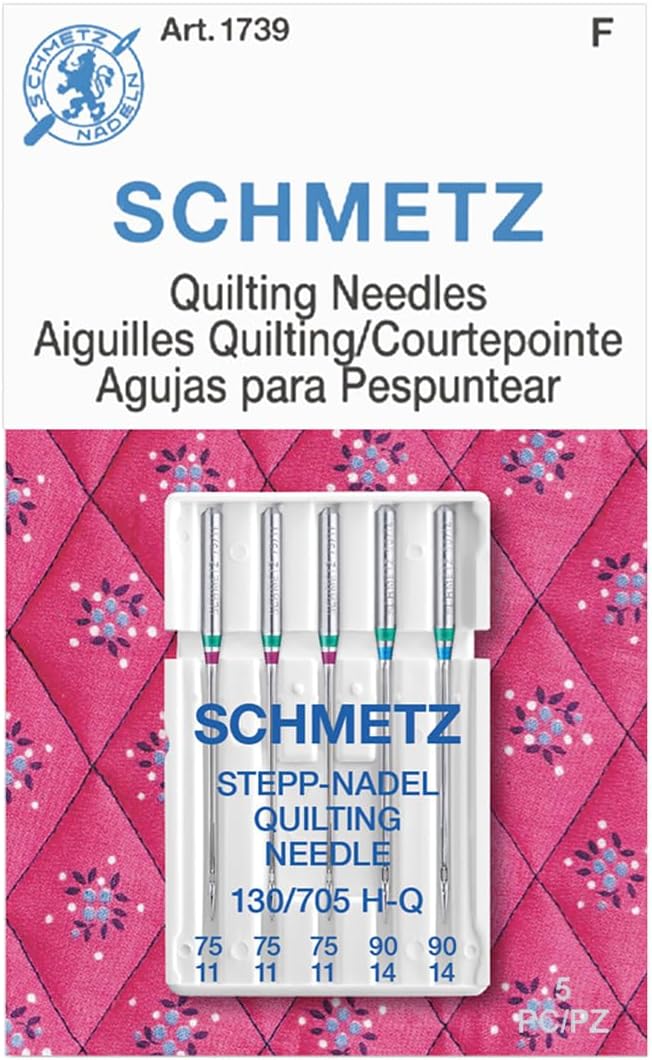
This SCHMETZ Quilting assortment includes 75/11 and 90/14 machine needles. SCHMETZ identifies its Quilting type as system 130/705 H-Q with a slightly rounded point and special taper. The manufacturer lists piecing, machine quilting, and topstitching among its applications, but the machine manual should still confirm the permitted needle system and size.
Check On AmazonIf you click this link and buy, we earn a commission at no additional cost to you.
Compare the documented point and taper with a Universal needle
The most useful comparison is not “specialized versus ordinary.” It is geometry versus geometry. SCHMETZ documents both its Universal and Quilting types with a slightly rounded point, but the Quilting type adds a special taper. Its Universal type is positioned for general sewing across woven and knit fabrics and is available across a much broader size range.
A shared nominal size can therefore identify two different products. The dedicated taper is real manufacturer-documented evidence. A claim that the Quilting needle will always penetrate a particular quilt more cleanly, make straighter stitches, or last longer would require a relevant test under disclosed conditions, not the package name alone.
| What you can verify | Quilting type | Universal type |
|---|---|---|
| Needle type | Dedicated Quilting geometry | General-purpose geometry |
| Point description | Slightly rounded | Slightly rounded |
| Distinctive documented feature | Special taper | General-purpose design |
| Shared example size | 90/14 | 90/14 |
| What the comparison proves | Equal size does not mean equal needle type or equal geometry. | |
The table is a label-reading tool, not a performance ranking. It tells you what differs before a test begins, which is exactly what a buyer needs to know before spending money on another pack of needles.

These SCHMETZ Universal needles are size 90/14 in household system 130/705 H. SCHMETZ documents the Universal type with a slightly rounded point and regular eye for general-purpose sewing with woven and knit fabrics. A shared 90/14 size does not make this the same needle type as a Quilting 90/14, so verify both system and type before choosing.
Check On AmazonIf you click this link and buy, we earn a commission at no additional cost to you.
Keep needle size as a separate axis
Needle size answers a different question from needle type. SCHMETZ explains size through blade diameter and currently lists its standard Quilting needle in 75/11 and 90/14, plus an assorted package. Universal needles span a wider range. A larger number therefore should not be read as “more suitable for quilting,” and a matching number should not be read as “same needle.”
Thread is part of this decision because the thread must pass through the eye without being pinched or excessively abraded. Fabric and layer stack matter too, but there is no responsible universal table that can convert “three quilt layers” into one mandatory needle size without considering the actual materials, thread, machine limits, and stitch conditions.
Warning: Stay within the exact machine manual’s permitted needle system and size range. Do not force a larger needle through dense layers as a substitute for diagnosing the setup, and stop after a hard needle strike, repeated breakage, or a jam rather than continuing the test.
The clean mental model is simple: system controls fit, type describes geometry or another design feature, and size describes the needle’s scale. Keep those three labels separate when reading a package.
Separate piecing, quilting through layers, and decorative top work only as purchase contexts
“Quilting” can describe several different machine tasks, which is one reason needle recommendations appear inconsistent. Piecing a quilt top asks the needle to make repeated seams through fabric layers. Quilting the assembled sandwich adds batting and backing. Decorative top work can add thicker, more visible, or specialty thread requirements.
Those distinctions are useful here only because they change what feature you are shopping for. They are not an invitation to turn needle selection into a quilting-technique lesson. Stitch length, free-motion setup, presser-foot selection, feed settings, sandwich handling, and quilting method belong with the exact workflow rather than with the product label.
| Purchase context | Question to carry into needle selection | What not to assume |
|---|---|---|
| Piecing | Which compatible type and size suit the fabric, thread, and precision requirement? | A needle named Quilting is mandatory. |
| Quilting through layers | Does the documented needle geometry make it a sensible candidate for the actual sandwich? | Layer count alone determines size. |
| Decorative top work | Does the thread require a different eye, groove, or type? | The same needle used for piecing is automatically the best match. |
Once the purchase question is defined, the actual setup should be checked against the machine and quilt workflow rather than inferred from a package label.

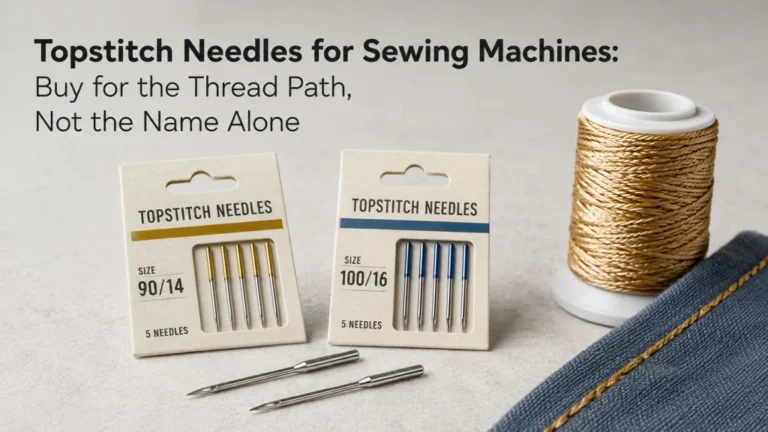
These SCHMETZ Topstitch needles are size 90/14 and belong to the 130/705 H-N needle system. SCHMETZ documents a slightly rounded point and a particularly long eye designed to handle thicker or multiple threads with less stress on the thread. That geometry makes Topstitch a separate candidate when decorative or visible top work changes the thread-handling requirement.
Check On AmazonIf you click this link and buy, we earn a commission at no additional cost to you.
Why Universal, Microtex, and Topstitch can still appear in quilting recommendations
Different needle families solve different parts of the sewing problem, so several can legitimately appear in machine quilting discussions. SCHMETZ describes Microtex with a very slim acute point and identifies precision piecing among its uses. Its Topstitch needle is documented with an elongated eye and is positioned for topstitching and heavier or difficult threads. Universal remains the general-purpose option.
Those differences explain the overlap without producing a winner. A sewist focused on precise piecing may be investigating point geometry. Another using a larger decorative thread may care more about the eye and groove. Someone sewing ordinary woven cotton successfully with a compatible Universal may not have a problem that requires a dedicated Quilting needle at all.
| Needle family | Documented feature to investigate | Reason it may enter a quilting decision |
|---|---|---|
| Quilting | Special taper, slightly rounded point | Dedicated piecing and machine-quilting context |
| Universal | Slightly rounded general-purpose point | Broad household sewing use, including cases where current results are already acceptable |
| Microtex | Very slim acute point | Precision-focused work and certain fabric conditions |
| Topstitch | Elongated eye | Thread-handling needs in visible top work |
This alternatives card is deliberately not a ranking. If Topstitch geometry is the real question, continue with Topstitch needle compatibility and geometry. If the sharper Microtex profile is the competing option, the Microtex needle selection article keeps that decision separate.
Verify thread and fabric relationships instead of inventing a universal chart
A needle can fit the machine and still be a poor match for the thread or material conditions. That is why choosing one fixed size for every quilt is incomplete advice. A useful selection has to account for thread diameter, fabric structure, density, coatings or finishes when relevant, and the complete material stack that the needle will penetrate.
When comparing sewing machine needles for quilting, start with the thread and fabric relationship, not layer count alone. Stay within the machine’s permitted needle range, and treat manufacturer application guidance as a starting point rather than a universal performance promise.
Note: If the machine sews one quilt fabric normally but struggles only on a different material, thread, or dense seam intersection, do not assume the needle label alone explains the change. Keep the material and thread conditions attached to the observation.
This is also why a useful comparison record names the machine, needle system, needle type and size, thread, fabric or quilt sandwich, presser foot, stitch, and observed result. Without those conditions, “this needle works better” is too vague to support a purchase decision.
Verify the actual quilt workflow after choosing a compatible candidate
Needle buying ends where technique testing begins. Once a compatible candidate has been chosen, test it on a representative sample that matches the fabric, batting, backing, thread, foot, and stitch conditions that matter to the project. Record what happens instead of relying on the product family name.
A simple test record is enough: machine model, needle system, type and size, thread, material stack, foot, stitch, date, and observed result. If you change more than one variable at once, the result becomes harder to interpret. Keeping the conditions stable lets you compare a Quilting needle with a compatible alternative without pretending the result applies to every machine or quilt.
- Install only a needle system and size allowed by the machine documentation.
- Use a fresh, undamaged needle for the comparison.
- Keep thread, material stack, foot, and stitch conditions consistent where possible.
- Record skipped stitches, thread damage, fabric damage, abnormal sound, or other observable differences.
- Stop after a strike, breakage, repeated jam, or other unsafe behavior.
The purpose is not to crown a permanent winner. It is to answer whether the chosen needle type works acceptably in the workflow that justified the purchase.

These SCHMETZ Microtex needles are size 80/12 and use the household 130/705 H-M system. SCHMETZ documents the Microtex type with a slim acute point and regular eye, with applications including cotton, batik, woven fabrics, piecing, and quilting. It provides a distinct geometry to test against another compatible needle while keeping the rest of the quilt setup consistent.
Check On AmazonIf you click this link and buy, we earn a commission at no additional cost to you.
Reject the idea that the Quilting label alone proves better results
A specialty label can tell you what the manufacturer designed a needle to do. It cannot tell you how that needle will behave in every compatible machine with every thread, fabric, batting, foot, and stitch setup. That boundary matters because machine quilting needles are often discussed as though the project name on the package settles the choice.
The stronger evidence chain is more modest: verify fit, document geometry, choose a suitable size, identify the workflow, and test the candidate under relevant conditions. If a compatible Universal already gives clean, stable results, there is no rule that requires changing it simply because a Quilting product exists. If the dedicated geometry addresses a real need, then testing it is justified.
That approach protects both sides of the decision. It prevents unnecessary purchases when the current setup is already working, and it gives a clear reason to try a dedicated product when its documented design actually matches the problem.
Final Thoughts: Choose the product geometry, then test the quilt workflow
The useful question is not whether a sewist has reached the point where they “should” buy a Quilting needle. Start with the machine’s approved system, keep size separate from type, and identify the geometry or thread-handling feature that matters to the job. Two needles can share a size while using different geometry, without either one becoming the automatic answer.
If the dedicated taper is relevant, test it under the quilt conditions that matter. If Universal, Microtex, or Topstitch better matches the verified requirement, that can be a valid result too. The wider needle-family decision remains available in the home sewing machine needle overview, while the exact quilt setup should remain tied to the machine and project rather than inferred from the label.
Frequently Asked Questions
🪡 Are Quilting needles different from Universal needles?
Yes, within the SCHMETZ household range they are documented as different needle types. Both have a slightly rounded point, but the Quilting type adds a special taper, so sharing a size does not make their geometry identical.
📏 Does 90/14 mean two sewing machine needles are the same?
No. The size identifies needle size, while type describes other design features such as point, taper, eye, groove, or scarf. Check both the system and type before treating two needles with the same size as equivalent.
🧵 Do I need a Quilting needle for every quilt?
No. A dedicated Quilting needle is one candidate, not a mandatory choice for every quilt. A compatible Universal, Microtex, Topstitch, or another valid type may suit a particular thread, fabric, and workflow, but the result should be verified rather than assumed.
🧶 How do I choose the needle size for machine quilting?
Start with the sizes allowed by the exact machine, then consider the thread and material conditions. Do not choose a larger size only because the project has multiple layers, and do not use one fixed quilting-size rule for every thread and quilt sandwich.
⚙️ How do I know whether a Quilting needle fits my machine?
Check the machine manual for its required needle system and size range, then compare that requirement with the package. Similar appearance, a familiar size number, or the word Quilting is not enough to prove compatibility.
References and Sources
The technical distinctions in this article use current manufacturer documentation for household needle anatomy, type, size, system, and Quilting geometry.
- SCHMETZ Needle Guide: Documents household needle-system basics, needle size, and the current feature descriptions for Universal, Quilting, Microtex, and Topstitch needle types.
- SCHMETZ Quilting Needles: Confirms the current Quilting needle system, available sizes, special taper, slightly rounded point, and listed applications.
These sources establish product geometry and labeling. They do not prove that one needle type will outperform the alternatives in every compatible machine or quilt setup.