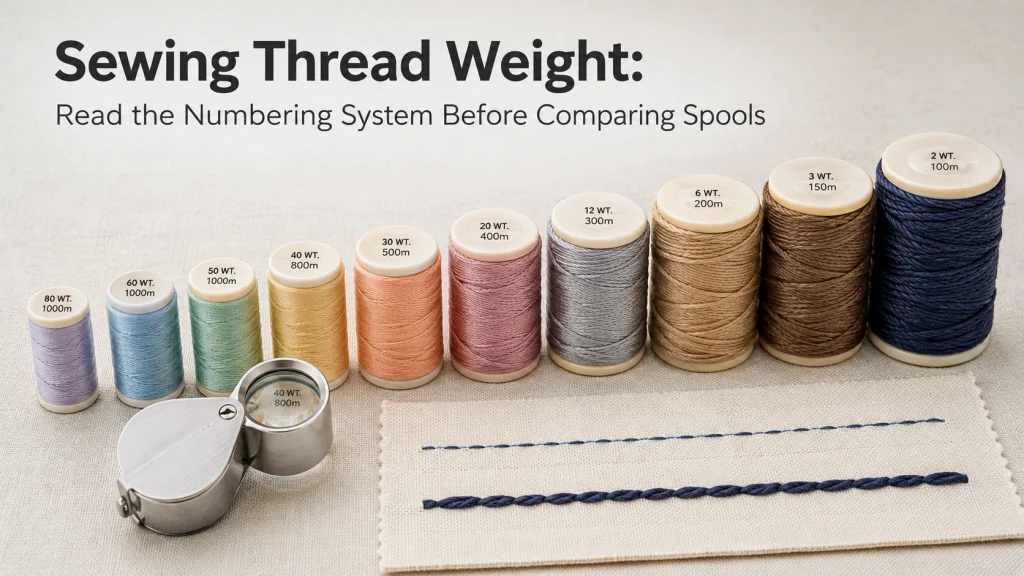
Thread-size labels are useful only after you know which numbering system they belong to. A 40 wt label, No. 40 label, and Tex 40 label do not describe thread size in the same way, even though the printed number is identical. The practical comparison is to identify the system, note fiber and ply construction, then decide whether the finished stitching should recede, remain moderate, or stand out. Needle sizing and machine tension are separate compatibility and setup decisions, so this article stops before prescribing either one.
The same number can belong to different systems
Three spools can each show the number 40 and still tell you three different things. Sewing thread weight only becomes useful after you identify whether the label says 40 wt, No. 40, Tex 40, or another notation. Treating those numbers as interchangeable can make a finer thread look equivalent to a heavier one on paper when the labels are actually using different rules.
This is a common first-time buyer mistake because larger numbers often feel as though they should mean larger physical size. That intuition works for Tex and denier, where a larger number represents more mass over a fixed length, but common count-style systems run in the opposite direction. The useful habit is simple: read the letters and symbols around the number before comparing the number itself.
Do not equate: 40 wt, No. 40, and Tex 40 are not three spellings of one universal thread size. The numbering system is part of the measurement.
If a spool label gives too little information to identify its system, do not invent a conversion from the number alone. Compare the manufacturer’s own specifications, fiber, construction, and intended use, or treat the exact cross-brand size relationship as unknown.
Identify wt, Tex, denier, No. and ply notation
The label audit starts with the notation, not with a chart. Consumer sewing and quilting thread can be described with weight labels, Tex, denier, number systems, and construction markings that include ply count. These systems are related to length and mass in different ways, and a construction mark such as 50/2 contains more information than the first number by itself.
Superior Threads describes Tex as the mass in grams of 1,000 meters and denier as the mass in grams of 9,000 meters. Its thread-measurement material also explains that common U.S. weight labels are not as cleanly standardized as Tex and that the trailing number in notations such as 50/2 or 50/3 can identify the number of plies. The same technical material separates the direction of these labels clearly: Tex rises as thread mass per fixed length rises, while common wt-style counts move the other way.
| Label style | What the number is doing | Direction to remember | What to check before comparing |
|---|---|---|---|
| wt | A common consumer weight convention based on length for a given mass | Higher number generally means finer thread | Fiber, ply, and how the manufacturer defines the label |
| Tex | Grams per 1,000 meters | Higher number means heavier thread by mass per length | Fiber and finished construction when judging physical diameter |
| Denier | Grams per 9,000 meters | Higher number means heavier thread by mass per length | Whether the label describes a component yarn or the finished thread |
| No. or # | A count-style designation whose meaning depends on the stated system | Do not infer direction from the number alone unless the system is known | The manufacturer’s naming convention and any construction notation |
| 50/2, 50/3 and similar | The slash can indicate ply construction in a stated count system | The first number is not the whole description | Both the count and the number of plies |
A practical example is 50/2 versus 50/3 within the same stated construction system. The two labels share the number 50, but the second part tells you the finished thread is built from a different number of plies, so ignoring everything after the slash throws away information that can matter to the final size and seam bulk.
For a wider look at fiber, construction, and intended use beyond size labels, compare common sewing thread types before treating the number as the deciding factor. Size is one part of a thread choice, not a substitute for identifying what the thread actually is.

Aurifil Cotton 50wt is a 2-ply cotton thread, so its label provides both a weight designation and construction information. The large spool contains 1,422 yards of thread. It is a useful real-world example of why the full thread notation should be read before comparing one printed number with another.
Check On AmazonIf you click this link and buy, we earn a commission at no additional cost to you.
Thread Tex size: separate direct from inverse numbering systems
The fastest way to avoid a backwards comparison is to sort the label into a direct or inverse relationship. In a direct system such as Tex, more mass over the fixed length produces a larger number, so Tex 40 is heavier by that measurement than Tex 25. Denier behaves in the same direction because its number also reports mass over a fixed length.
Common count-style labels behave differently. With the U.S. weight convention described by Superior Threads, a 30 wt thread is treated as heavier than a 50 wt thread because fewer units of length make up the specified mass. The same source cautions that commercial weight labeling can be inconsistent, especially when ply construction is hidden or simplified, which is why a familiar 30, 40, or 50 should not be treated as laboratory-grade proof of diameter.
Key point: Do not memorize whether “bigger means thicker” without naming the system. For Tex and denier, the number rises with mass per fixed length. For common wt-style counts, the number generally rises as the thread becomes finer.
Suppose one shelf tag says 30 wt and another says Tex 30. The shared number is visually persuasive but technically unhelpful because the labels are moving in opposite directions. The first question is therefore not “Which 30 is thicker?” but “Which measurement system is each label using, and do I have enough information to compare them responsibly?”
Compare only within a compatible measurement context
A conversion formula can be mathematically valid without proving that two finished sewing threads will have the same diameter, feel, or behavior. Fiber density, ply construction, twist, finish, and the way a manufacturer applies a consumer label can all affect what you are actually holding. Superior Threads specifically advises comparing like fibers when precision matters because equal Tex values do not force cotton, polyester, and silk to have identical physical diameters.
That is why a universal thread weight chart becomes risky when it presents every system as a one-to-one lookup table. A chart is useful for learning the direction and definition of a system. It is much less reliable when it claims that a consumer wt label, a No. label, a Tex value, and a finished thread from another fiber or ply construction are exact substitutes.
- Read the complete size notation, including wt, Tex, denier, No., slash notation, or any ticket designation.
- Check the fiber before making a physical-size comparison across products.
- Record ply information when the manufacturer provides it.
- Prefer comparisons within the same measurement system and similar construction.
- If the labels use different systems, use conversion only as orientation, then verify the finished thread specification instead of declaring an exact match.
Consider two threads both marked Tex 30, one cotton and one polyester. The Tex labels tell you that the same length has the same mass under that system, but they do not by themselves prove identical diameter because the materials need not occupy the same volume. That distinction matters when the buyer’s real question is whether the thread will look equally prominent or create the same amount of bulk in a seam.
Note: The useful label-audit sequence is system, fiber, construction, then project goal. Reversing that order encourages false precision because the number is being asked to prove more than its measurement system actually states.
An older spool with a faded, partial, or unfamiliar label should be handled the same way. If you cannot identify whether the number is wt, Tex, denier, No., or a manufacturer-specific product code, do not reverse-engineer a size from the number alone. Look for the original product documentation or a clearly defined current equivalent; if neither is available, keep the exact size relationship unknown instead of forcing the spool into a conversion chart.

Gütermann Top Stitch is a 100 percent polyester three-ply thread identified by the manufacturer as No. 30. It is designed for decorative seams and topstitching rather than serving as a universal size reference. The product is a practical example of why a No. designation should be read together with fiber, construction, and the manufacturer's stated sizing system.
Check On AmazonIf you click this link and buy, we earn a commission at no additional cost to you.
Thread weight for sewing: use visual prominence and seam bulk as project criteria
After the label is interpreted correctly, the buying question changes from “What number is best?” to “What do I want the thread to do in this project?” A finer thread can recede visually and occupy less space where stitches are dense. A more substantial thread can make the stitch line more visible, but the amount of bulk also depends on construction, stitch density, fabric, seam structure, and how many passes of thread accumulate in one area.
A safer approach is to use the number to understand relative size within a valid context, then choose for the desired visual and structural role. Do not turn “fine,” “medium,” and “heavy” into universal numerical bands across all systems. Those are project-facing descriptions, not substitute measurement standards.
| Relative appearance role | Desired result | What to look for | What not to assume |
|---|---|---|---|
| Fine | Stitching should visually recede | A finer option within the same known system and suitable construction | That the largest printed number is always finest across every labeling system |
| Medium | Stitching should remain noticeable but not dominant | A middle choice among genuinely comparable threads, checked on the actual fabric | That a “medium” marketing label has one universal diameter |
| Heavy or prominent | Stitching is intended as a visible design line | A more prominent thread whose size and construction suit the intended machine-sewn task | That a lower wt number, higher Tex number, or heavier appearance automatically fits every machine path |
| Bulk-sensitive | Multiple stitch passes or compact seams create bulk | Consider whether a finer comparable thread reduces accumulated thread volume | That thread size alone determines seam quality or strength |
A topstitched pocket is a simple example. If the design goal is a clearly visible stitch line, the useful next question is not whether “40” beats “50,” but whether the two candidates use the same sizing system and which finished thread gives the intended prominence. The separate decision about choosing thread for visible topstitching can then address the task itself rather than re-solving the numbering problem.
Machine quilting creates a similar distinction because a sewist may want the quilting line to blend into the fabric or become part of the visual design. If that is the actual job, compare thread for machine quilting after decoding the label. The size notation tells you what the manufacturer is saying about thread size; it does not decide how visible you want the quilting to be.
Compatibility boundary: This article does not assign a needle size or tension setting from a thread label. Before using a materially different thread size, verify the machine’s thread path and the needle system and size allowed for the exact machine and application.
That boundary matters because a Tex value, wt label, or another size designation can describe the thread without proving that it will pass correctly through every needle eye, guide, tension assembly, or bobbin setup. For the broader purchase context around thread, needles, bobbins, stabilizers, and other consumables, choose machine sewing supplies by system rather than treating one size number as the whole compatibility decision.
Final Thoughts: Read the system before the number
The most useful improvement you can make to a sewing thread size comparison is to stop reading the number in isolation. Identify the measurement system, check fiber and ply construction, and compare within a compatible context before deciding whether one thread is finer or heavier than another.
From there, return to the project. Decide whether the stitch should disappear into the work, remain moderate, or become a visible design line, and whether seam bulk matters in that construction. If the label does not provide enough information to make the comparison cleanly, keeping the relationship unknown is more accurate than forcing a universal conversion.

Coats & Clark Extra Strong Thread for Jeans is made for seams and hems on denim and comes in a golden color intended to resemble ready-to-wear jeans stitching. The spool contains 70 yards of thread. It fits a project where the stitch line is intentionally visible, making the finished appearance more relevant than comparing an isolated thread-size number.
Check On AmazonIf you click this link and buy, we earn a commission at no additional cost to you.
FAQs
🧵 Is 40 wt thread thicker than 50 wt thread?
Within the same clearly stated wt convention and comparable construction, 40 wt is generally treated as heavier than 50 wt. Do not carry that rule over to Tex, where the larger number represents more mass per fixed length.
📏 Does a higher Tex number mean thicker thread?
A higher Tex number means the thread has more mass per 1,000 meters. That makes it a heavier thread by the Tex measurement, but equal Tex values across different fibers do not by themselves prove identical physical diameter.
🔢 Is No. 40 the same as 40 wt?
Do not assume so from the shared number. Identify the exact No. system and the manufacturer’s construction notation before comparing it with a wt label.
🪢 What does the 2 or 3 mean in 50/2 or 50/3 thread?
In construction notation where the slash value identifies ply, it records how many component strands are combined in the finished thread. Read both parts of the notation because 50/2 and 50/3 do not describe identical construction.
🧶 Can I convert wt directly to Tex before buying thread?
A mathematical conversion can be useful for orientation, but do not treat it as proof that two finished products have identical diameter or are interchangeable. Check fiber, ply, and the manufacturer’s stated sizing system before making the purchase comparison.
References and Sources
Two technical references are enough for this article because the claims that need external verification are the definitions, direction, and limitations of the thread-numbering systems.
- Superior Threads thread measurement: Explains U.S. weight-label caveats, Tex, ply notation, and why fiber matters when comparing finished thread size.
- Superior Threads thread weight: Defines wt, denier, Tex, number notation, and composition or ply conventions used in thread-size comparisons.
These sources support the numbering-system definitions and comparison boundaries above. They do not establish one universal conversion that makes differently labeled consumer threads interchangeable.