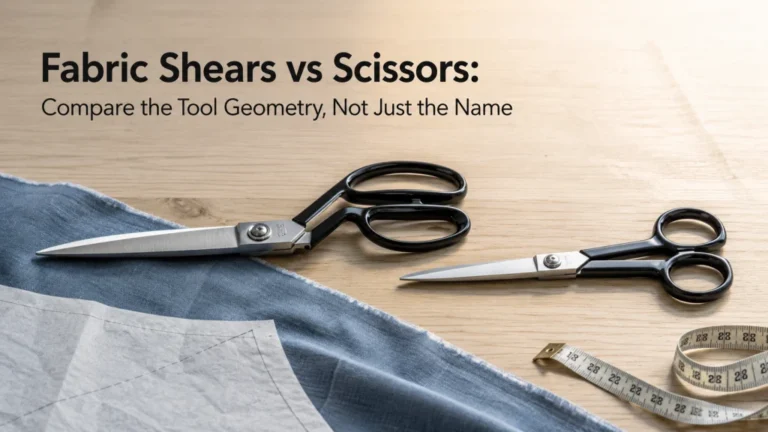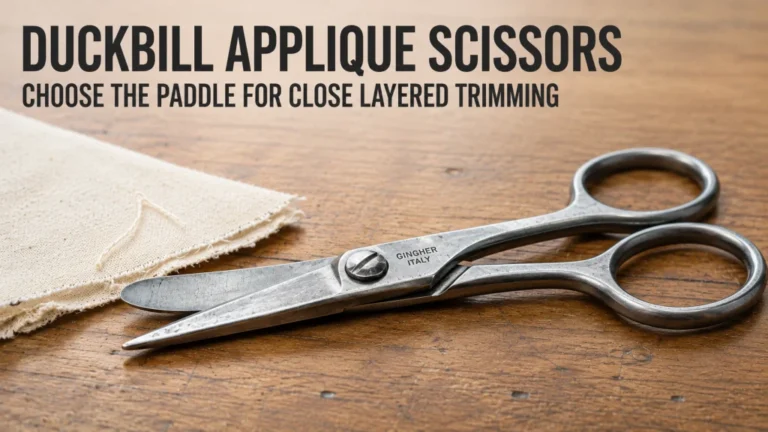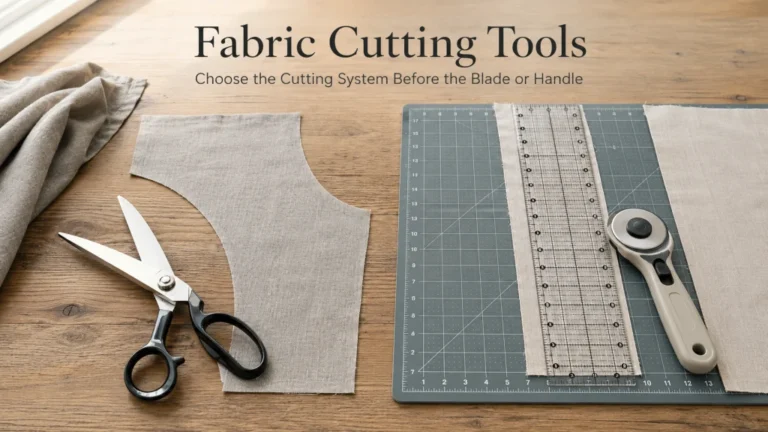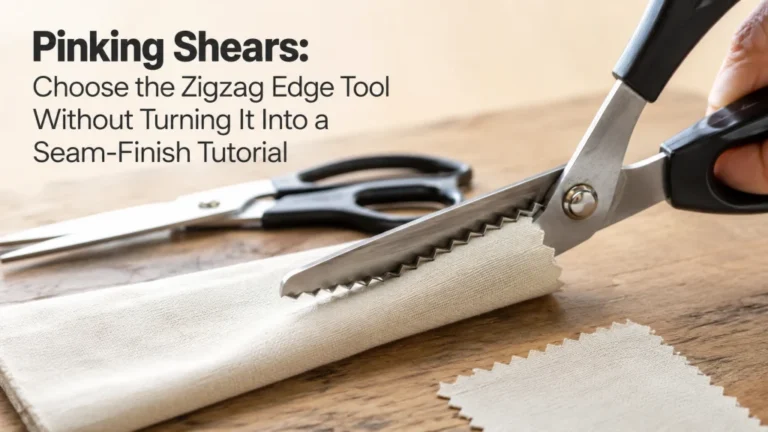
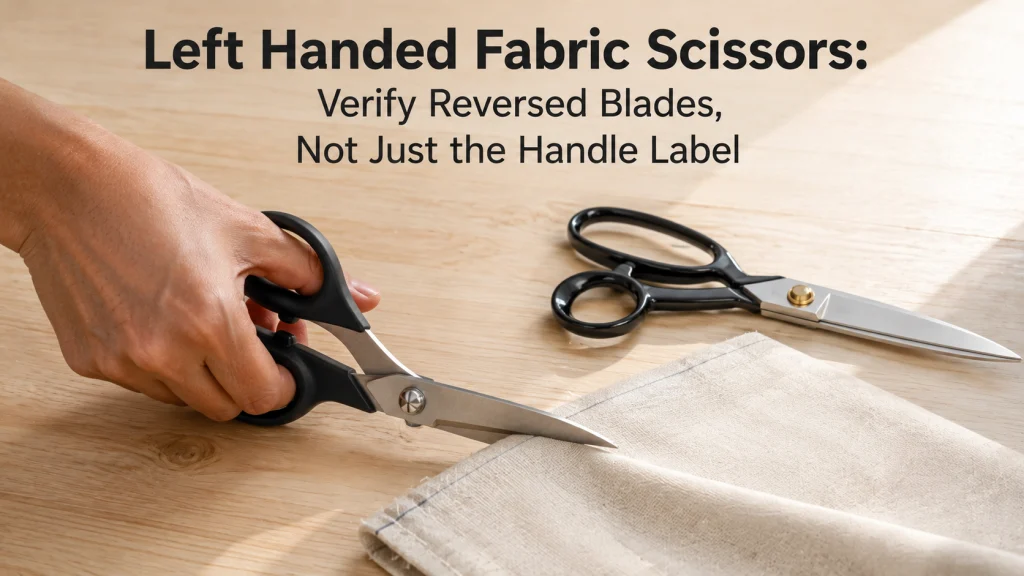
Left handed fabric scissors are not all built the same way. A handle that accepts the left hand does not automatically mean the blades are reversed, and that difference changes what the product can legitimately claim about left-handed cutting geometry. Before buying, verify the blade arrangement, handle shape, size, and stated fabric-cutting role on the exact listing. The goal is to identify what has actually been configured for left-handed use before comparing the remaining buying factors.
Left handed can describe the handle or the whole cutting geometry
Listings for left handed fabric scissors can describe two pairs with different construction. One design may use a symmetric or double-loop handle that can be held from either side while retaining a standard blade stack. Another may reverse the blade arrangement and shape the handle for the left hand.
That is why the first buying check should be anatomical rather than promotional. Read the listing as separate fields for the handle, blades, size, and cutting role. A broad label can help you find candidates, but it should not be treated as proof of a mirrored cutting setup.
| Anatomy point | Ambidextrous or handle-only design | True-left design |
|---|---|---|
| Handle | May be symmetric, double-loop, or shaped to accept the left hand | Configured specifically for the left hand |
| Blade stack | May retain the standard right-handed orientation | Blades are reversed for left-handed cutting |
| Cut-line view | Cannot be inferred from the handle label alone | Blade reversal changes which cutting edge is presented to the left-handed user |
| Listing evidence | Look for handle wording plus a separate blade statement | Look for explicit wording such as reversed blades or true left-handed blades |
This anatomy check narrows the broader process of choosing fabric cutting tools. Once the geometry is clear, the ordinary questions about size, task, edge type, care, and storage can be evaluated without letting the handedness label answer questions it does not actually prove.
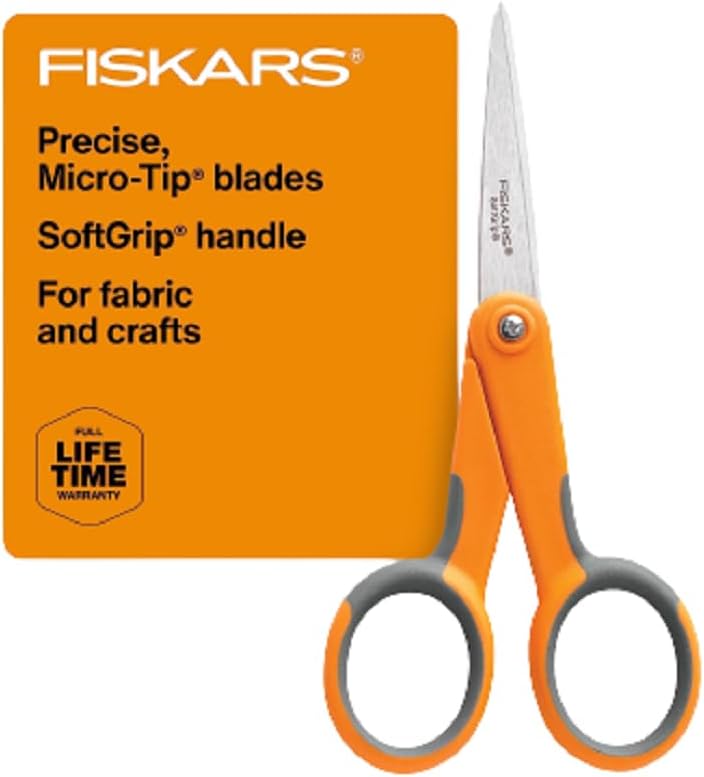
These Fiskars Micro-Tip scissors use a double-loop handle that accommodates both right-handed and left-handed users. The 4.9-inch scissors are designed for detailed fabric cutting, tight patterns, and quick thread snips. Their handle configuration makes them a useful example of why left-hand usability should be checked separately from true-left blade geometry.
Check On AmazonIf you click this link and buy, we earn a commission at no additional cost to you.
Check whether the blades are actually reversed
True-left construction is identified by the blade arrangement, not by color or handle wording. Current manufacturer pages use phrases such as reversed blades, true left-handed blades, or a statement that the scissors are made as a left-handed pattern. When the product page says only that the handle accommodates the left hand, blade orientation remains an open question.
Three current examples show why the distinction is worth checking. Fiskars sells double-loop fabric-detail scissors whose handle accommodates either hand. KAI lists the N5220L with a left-hand grip but states that its blades are not reversed. Ernest Wright describes its true left-handed dressmaker and tailor shears as separate left-handed patterns with the blades arranged for the left hand. These examples establish that more than one construction is intentionally sold under left-hand-oriented wording.
Key point: Treat the handle and blade stack as separate specification fields. A listing does not establish true-left geometry until it confirms the blade arrangement.
A product photo can support the check, especially when the overlapping blades are clearly visible, but a written specification is stronger evidence than an image shot from an uncertain angle. If the photo and description appear to conflict, the sensible next step is to verify the exact variant rather than guess from the thumbnail.

The KAI 7250L is a 10-inch professional shear built specifically for left-handed use. KAI states that the model combines a left-handed grip with blades reversed from the right-handed configuration. It is intended for sewing projects, making it a direct example of the true-left construction discussed in this section.
Check On AmazonIf you click this link and buy, we earn a commission at no additional cost to you.
Check handle shape and finger-loop fit separately
After blade orientation is known, inspect the handle on its own terms. A symmetric double-loop handle may allow the tool to be held from either side. A left-specific grip may change the finger and thumb openings while leaving the blade stack in the standard orientation. Those are legitimate construction choices, but they serve different preferences.
KAI’s N5220L is a useful example because the maker identifies it as a left-hand-grip shear while explicitly distinguishing it from the company’s true-left configuration. That one listing prevents a common category error: a left-specific handle does not automatically mean every part of the scissors has been mirrored.
Finger-loop size, bent-handle geometry, grip material, and overall handle shape can still matter to the individual buyer. They should be checked as physical product details rather than converted into medical or treatment claims. When shopping for left-handed sewing scissors, compare the stated dimensions and handle construction with the way the tool will actually be held at the cutting table.
If spring assistance is the feature controlling the purchase instead of blade handedness, move that decision to the separate discussion of spring loaded fabric scissors. Mixing the two mechanisms makes it harder to see which feature is actually solving the buyer’s problem.
Confirm blade length and the stated fabric-cutting role
Correct handedness does not make every size interchangeable. A compact detail scissor, a general fabric scissor, and a long dressmaking shear can all be suitable for sewing work while serving different cutting jobs. The product still needs to match the scale and material of the task.
Current manufacturer listings illustrate that range without requiring a performance ranking. Fiskars lists fabric-detail scissors at about 4.9 inches, KAI lists the N5220L dressmaking shear at 8.5 inches, and Ernest Wright offers true-left dressmaker shears in a longer pattern. The point of those dimensions is not that one is better. They show why a buyer who verifies handedness must still verify size and intended use.
The same rule applies to left-handed fabric shears and to listings that use the words scissors and shears loosely. Check overall length, blade form, handle position, and whether the maker actually identifies fabric, sewing, dressmaking, quilting, or another relevant role. The broader terminology question is covered in fabric shears versus scissors.
For someone who has not yet chosen the basic tool type, choosing fabric scissors is the earlier decision. This page starts after handedness has become a controlling requirement.

These Gingher shears are an 8-inch left-handed dressmaking tool with long knife-edge blades and a bent handle design. The stated cutting role includes pattern cutting, seam trimming, and longer cuts through fabric. They fit this section because handedness still needs to be evaluated together with tool length and the specific cutting job.
Check On AmazonIf you click this link and buy, we earn a commission at no additional cost to you.
Compare true-left and ambidextrous designs without medical claims
Once the construction is verified, compare only what the evidence supports. A double-loop handle can establish two-hand usability. A reversed blade stack can establish true-left blade orientation. Neither specification proves lower fatigue, better joint comfort, faster cutting, or suitability for a disability for every buyer.
This distinction keeps objective product details separate from personal preference. Someone who learned to cut for years with a standard blade stack may deliberately prefer a left-hand grip with that familiar orientation. Another buyer may specifically want mirrored blades and a different cut-line view. Both can be rational choices without turning either preference into a universal rule.
The product listing can tell you how the tool is built. It cannot establish a medical outcome or decide which familiar cutting motion every individual should prefer. Keeping that boundary clear makes the buying comparison more useful, not less.
Verify product photos and specifications before ordering
Product titles are useful for discovery, but the detailed listing should control the purchase decision. Search pages and marketplace filters can collapse ambidextrous handles, left-hand grips, and true-left blades into one broad label. Open the exact product page and confirm that the selected size or variant matches the specification you are reading.
Use photos as a cross-check rather than the only proof. A clear close-up may show the blade overlap, but a side angle or mirrored image can be misleading. If the written specification does not state the blade orientation, check the manufacturer’s support material or ask the seller a precise product question instead of relying on a general review.
- Does the maker explicitly say the blades are reversed or true left-handed?
- Is the handle left-specific, symmetric, double-loop, bent, or otherwise described?
- What is the exact overall length or blade length?
- Is fabric, sewing, dressmaking, quilting, or another relevant cutting role stated?
- Does the selected size or variant match the model or article number in the specification?
- Do the written details and product photos agree on the configuration?
- If the listing is unclear, can the manufacturer or seller confirm the blade orientation for that exact variant?
Warning: Scissors and shears are sharp cutting tools. Follow the maker’s instructions for use, storage, maintenance, and any sharpening service. Do not disassemble or modify a cutting tool merely to change its handedness.
A useful Q&A answer should resolve a factual point such as whether the blades are reversed, which variant is being sold, or what the stated length is. It should not substitute another buyer’s comfort preference for the construction evidence you still need from the exact product.
Decide when true-left blade orientation changes the buying decision
True-left blade orientation becomes decisive when the buyer specifically wants the mirrored blade arrangement. In that case, a product described only as ambidextrous, left-hand friendly, or left-grip is incomplete evidence. The listing needs to confirm the blades as well.
If mirrored blades are not a requirement, the decision can remain open to other constructions. A buyer who is comfortable with a standard blade stack may reasonably compare left-grip and ambidextrous options on size, fabric role, maintenance, and other verified specifications. The important point is to make that choice knowingly rather than discover the geometry after delivery.
Handedness can also be outweighed by task mismatch. A compact detail scissor is not a substitute for a longer shear merely because the blade orientation is correct, and a long shear is not automatically suitable for small controlled snips. The buying decision is complete only when geometry and task fit point to the same type of tool.
At that point, the reader is ready to compare actual candidates rather than labels. Use the wider sewing tools selection framework for the rest of the setup, but keep this purchase gate simple: confirm the blade orientation, confirm the handle, confirm the size and fabric role, then compare the remaining options that genuinely meet those requirements.
Final Thoughts: Verify the blades before the label
A left-hand label is a starting point, not the final specification. The most reliable buying process is to identify the blade orientation first, then check the handle, dimensions, and stated fabric-cutting role on the exact variant being sold.
Once those fields are confirmed, comparison becomes straightforward. Remove listings that do not meet the required geometry or task, then compare the remaining choices on the product details that actually matter to the buyer. That moves the decision from vague handedness wording to a short, verifiable set of requirements.
Frequently Asked Questions
✂️ What makes fabric scissors truly left handed?
A true-left design uses a blade arrangement made for left-handed cutting, commonly described by manufacturers as reversed or left-handed blades. Check the exact product specification rather than relying on the handle shape or title alone.
👈 Are ambidextrous scissors the same as left handed scissors?
Not necessarily. Ambidextrous may describe a handle that works in either hand, while a true-left design also changes the blade arrangement. Verify those features separately.
🔍 How can I tell if the blades are reversed online?
Look for explicit blade-orientation wording in the exact listing, then use clear product photos as a secondary check. If the specification is silent, ask the manufacturer or seller to confirm the exact variant rather than inferring from the title.
📏 Does scissor length still matter for a left handed pair?
Yes. Handedness does not replace the normal size and task check. Confirm the tool’s length and stated fabric role before deciding that a particular pair fits the work.
🧵 Can a left-hand grip still use standard blade orientation?
Yes. Current specialist listings show left-hand grips paired with non-reversed blades as an intentional construction. That is why the handle description alone does not establish true-left blade geometry.
References and Sources
These sources are included because the article depends on exact construction language that cannot be verified from a generic left-handed label alone.
- Fiskars Micro-Tip specifications: Confirms a fabric-detail scissor with a double-loop handle that accommodates right- and left-handed users.
- KAI N5220L specifications: Confirms the N5220L model name, 8.5-inch size, left-hand grip, and non-reversed blade arrangement.
- Ernest Wright left-handed scissors: Confirms that its true left-handed scissors and dressmaker shears use blade arrangements made specifically for the left hand.
Together, the sources show that current makers deliberately sell different left-hand configurations. They do not establish universal comfort, medical suitability, durability, or cutting-performance rankings.