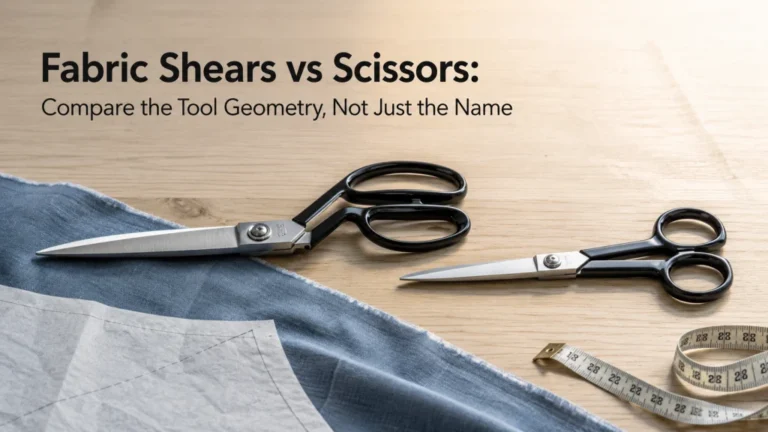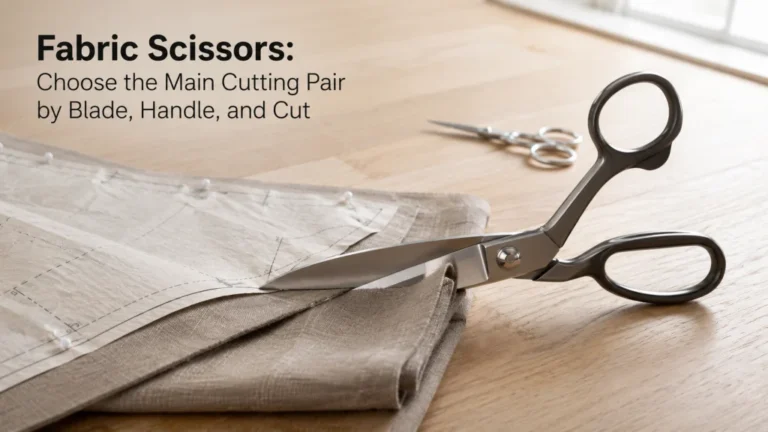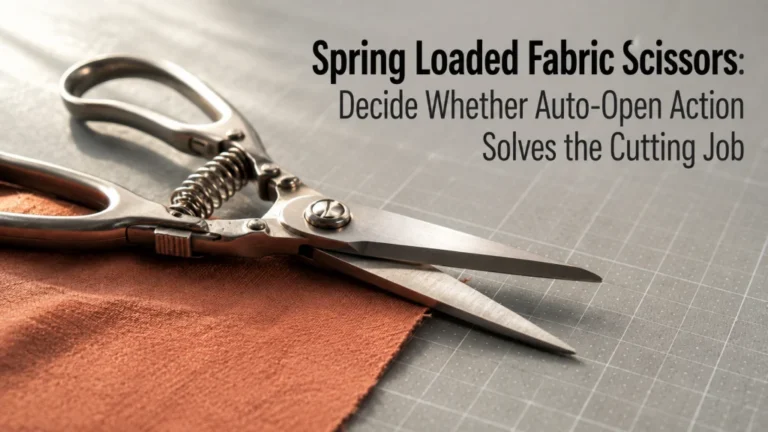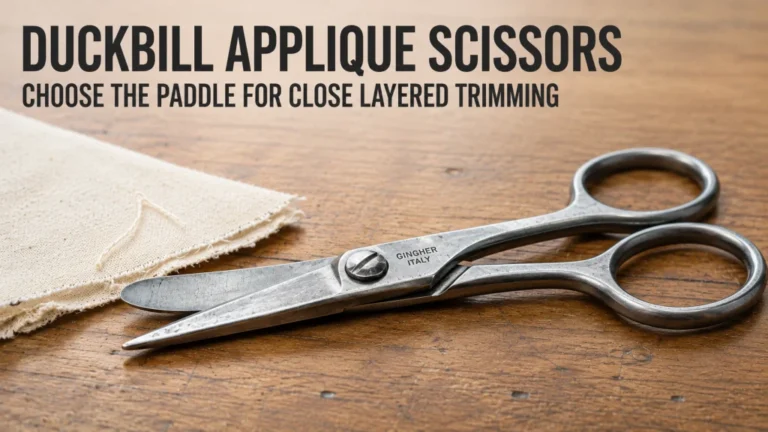
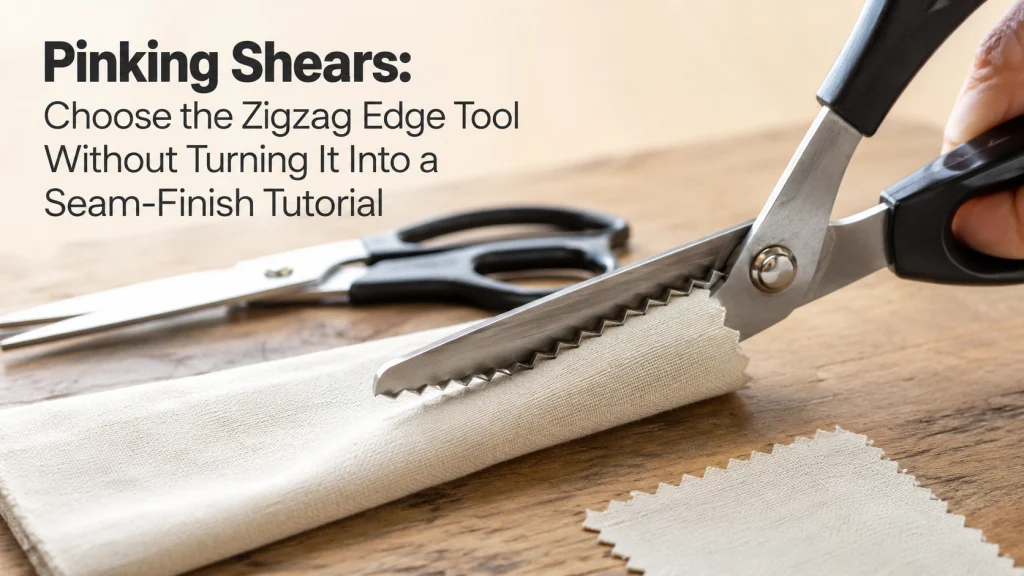
These fabric-cutting shears use saw-toothed blades that leave a zigzag edge, but buying the tool is not the same decision as choosing pinking as a seam finish. Start by confirming that you actually want that cut edge, then compare blade length, tooth pattern, fabric guidance, and maintenance requirements. Pinking can reduce fraying on suitable woven fabrics, but it does not guarantee a fray-free edge on every material. The useful purchase is a fabric tool whose geometry matches the job, not a pair chosen from a vague claim that zigzag edges solve every raw seam.
A zigzag blade is a tool, not a universal finishing rule
If you are shopping for pinking shears, the first question is simple: do you want the shears to create a repeated zigzag cut in fabric? That is the defining job of the tool. Current supplier guidance describes the tool as saw-toothed fabric scissors that cut a jagged or zigzag edge rather than the straight edge produced by ordinary fabric shears.
This article stays on the tool side of that decision. It covers what to verify before buying, how to distinguish true pinking teeth from other serrated edges, which material guidance matters, and what maintenance the tooth geometry requires.
Key point: Buy the tool because you need a controlled zigzag cut. Whether that edge is suitable as a final seam treatment depends on the fabric and project and is handled separately.
That narrower scope lets the buying decision focus on the information a product page can actually support: cutting geometry, dimensions, intended materials, and maintenance.
Confirm the cut edge is the reason for buying
This is a specialized cutting tool. If you mainly need long straight cuts through yardage, ordinary fabric shears are usually the more direct tool because their blades are designed to leave a straight edge. If you specifically need a repeated zigzag edge on fabric, the pinking mechanism becomes relevant.
That distinction matters when a sewing kit is still small. A new sewist who owns no dependable cutting shears may get more day-to-day use from a standard fabric-cutting tool first, while someone who already has straight cutting covered can evaluate pinking as a second edge option. Use the site’s overview of fabric cutting tools for sewing if the basic tool category is still undecided.
- Choose pinking shears when the required result is a repeated zigzag fabric edge.
- Choose ordinary fabric shears when the main job is long, straight cutting.
- Do not buy pinking shears merely because a seam-finishing article mentions them once.
- Do not assume the tool replaces every stitched, bound, overcast, or serged edge treatment.
If the choice is really between a normal cutting tool and a specialty edge tool, compare the roles before comparing handle shape or price. The separate page on choosing fabric scissors for sewing covers that straight-cut purchase decision in more detail.

These 8-inch scissors use precision-ground steel blades for clean cuts through fabric and other craft materials. The bent handle helps keep material flat on the work surface while cutting. The classic orange handle provides an ergonomic grip for everyday sewing and craft work.
Check On AmazonIf you click this link and buy, we earn a commission at no additional cost to you.
Read blade length and tooth pattern before comparing handles
Blade length affects how much fabric edge the shears can cover in one closing motion, but a longer pair is not automatically better for every job. Shorter shears can be easier to place around small samples or tight work areas, while longer blades can cover more edge per cut. The useful comparison is how much control and reach the intended task actually needs.
Tooth geometry deserves equal attention because it determines the shape of the cut. Pinking blades use repeated peaks and valleys to create the familiar zigzag. When two listings show different tooth spacing or depth, do not assume the more dramatic pattern cuts better. Confirm what the manufacturer or specialist supplier actually says the tool is designed to cut.
| Listing detail | What it changes | What it does not prove |
|---|---|---|
| Overall or blade length | Reach and length of cut per closing motion | Comfort, durability, or suitability for every fabric |
| Tooth spacing | Width and frequency of the zigzag pattern | That fraying will stop completely |
| Tooth depth | How pronounced the cut pattern appears | That deeper teeth are inherently better |
| Handle style | Grip shape and how the tool is held | A medical or ergonomic outcome |
This is the practical place to compare sewing pinking shears on a retailer page. Read the dimensions and cutting geometry first, then treat handle shape and marketing language as secondary information rather than proof of cutting performance.

The Fiskars Gingher 7.5 Inch Pinking Shears use sawtooth blades to leave a zigzag edge instead of a straight cut. The Amazon listing specifies a 7.5-inch length, a serrated blade edge, and a zigzag point style. It also describes a double-plated chrome-over-nickel blade finish and notes that the shears can be used for decorative project edges.
Check On AmazonIf you click this link and buy, we earn a commission at no additional cost to you.
Separate pinking teeth from micro-serration
Pinking teeth and micro-serrated edges solve different cutting problems. A pinking blade is intentionally shaped to leave a visible zigzag edge in the fabric. A micro-serrated blade uses much finer teeth along a cutting edge to help grip slippery or difficult material while still making a generally straight cut.
That difference is easy to miss when both tools are described with words such as “serrated,” “toothed,” or “gripping.” Look at the actual cut result. If the blade produces obvious triangular peaks and valleys, it is doing a pinking job. If the teeth are fine and the finished cut remains straight, it belongs to the serrated-shear category instead.
| Edge geometry | Visible blade job | Typical cut result |
|---|---|---|
| Pinking teeth | Repeated sawtooth peaks and valleys interlock as the blades close | Distinct zigzag fabric edge |
| Micro-serration | Very fine teeth grip material along one cutting edge | Mostly straight cut with added grip |
This is why serrated fabric scissors for slippery materials should not be treated as another name for pinking shears. If the goal is a zigzag edge, confirm the pinking geometry rather than buying a fine-tooth straight-cut shear by mistake.
Check fabric suitability from exact product guidance
Manufacturer and specialist guidance commonly positions pinking shears for woven fabrics, especially fabrics whose raw edges can fray. Madam Sew states that the sawtooth pattern does not prevent fraying completely but can limit the length of frayed threads. WAWAK similarly notes that pinking is generally more effective on tightly woven fabrics and can be less effective on open or loosely woven materials.
That is a useful purchase boundary because it stops the word “fabric” from becoming a universal claim. A tool intended for ordinary woven cloth may not give the same cut quality on knit jersey, loosely woven fabric, heavy multilayer stacks, coated material, or another specialty textile. Read the product’s stated material scope before assuming that every pair of zigzag fabric scissors is designed for every material in the sewing room.
A useful real-world example is a tightly woven cotton swatch versus a loose, open weave. Both are woven fabrics, but the second can still shed threads after pinking. That difference belongs in the material check, not in an unsupported conclusion that the shears are defective.
Separate owning pinking shears from choosing pinking as a seam finish
The tool-selection decision ends once you know that a pair fits the cutting job, material guidance, and maintenance expectations. The sewing-technique decision begins when you ask whether a pinked edge is appropriate for a specific seam, garment, wash cycle, fabric construction, or project requirement. Those questions should not be collapsed into one recommendation.
For example, someone may buy pinking shears because they routinely prepare tightly woven test swatches and want a quick zigzag edge. That does not mean the same person should use pinking as the final treatment on every garment seam. Another sewist may use pinking only for temporary samples or decorative craft edges while choosing a stitched finish elsewhere.
| Decision | Question to answer | Belongs here? |
|---|---|---|
| Tool selection | Do I need a zigzag-cutting shear intended for this fabric? | Yes |
| Geometry | Does the blade use true pinking teeth rather than micro-serration? | Yes |
| Maintenance | How should this tooth geometry be kept clean and sharpened? | Yes |
| Seam technique | Should this project use pinking instead of another finish? | No, that depends on the sewing method and fabric |
This boundary is what keeps the article useful for buying. A reusable tool can be worth owning for a defined job without being promoted as a one-step replacement for every other seam treatment.
Read the product page like a cutting-tool specification
Listings may call the tool pinking scissors for fabric, pinking shears, or zigzag shears. Once the shopping intent is clear, ignore vague words such as “professional,” “premium,” or “heavy duty” until the listing answers the basic tool questions. Confirm that the item is actually designed for fabric, that it produces a pinked zigzag edge, and that the dimensions and material scope are stated clearly enough to compare with your intended work.
Then look for maintenance and service information. If the seller or maker provides care instructions, sharpening guidance, or a service route, that is more useful than an unsupported durability claim. A listing that says little about edge geometry but spends most of its space on comfort, color, or generic quality language leaves important buying questions unanswered.
- Confirm the item is a fabric pinking shear, not decorative paper scissors.
- Check blade or overall length against the scale of the work.
- Verify the visible tooth pattern produces the edge you want.
- Read the stated fabric range and layer guidance.
- Look for cleaning, oiling, sharpening, or service instructions.
- Do not treat retailer reviews as proof of universal comfort or durability.
Once those fields are clear, the purchase comparison becomes much easier. Price can be compared among tools that already meet the cutting brief instead of being used to choose between products with different edge jobs.

The JISTL Green Pinking Shears are 9.5-inch zigzag cutting scissors with stainless-steel blades and ABS handle components. The Amazon listing identifies uses including fabric, linings, paper, leather, PU, and craft materials and describes the blades as producing zigzag cuts. Its care guidance says to wipe the oil on the blades before use and states that the oil helps prevent rust.
Check On AmazonIf you click this link and buy, we earn a commission at no additional cost to you.
Plan sharpening with the edge geometry in mind
The toothed blades are not sharpened like an ordinary pair of straight household scissors. Their interlocking teeth create a specialized geometry, and specialist suppliers commonly recommend professional scissor sharpening rather than improvised home methods. WAWAK specifically warns that tricks such as cutting aluminum foil or sandpaper do not truly sharpen the blade edges and can make matters worse.
That does not mean every dull pair is automatically beyond owner care. Cleaning lint from the blades, keeping the joint moving according to the maker’s instructions, and storing the shears so the teeth are protected are normal ownership tasks when the product guidance permits them. Sharpening is the point where the tooth profile deserves specialist attention.
Sharp-tool safety: Follow the exact manufacturer’s care, storage, and sharpening instructions. Keep fingers away from exposed cutting edges, do not bypass guards on powered sharpening equipment, and do not attempt a blade procedure that the tool maker reserves for service.
If sharpening is now the main question, use the site’s separate process for sharpening fabric scissors safely. The important point for this purchase is to know the maintenance path before buying, especially if local sharpening service is difficult to access.
Protect the teeth between cutting sessions
Fabric shears stay useful longer when they are kept for the material they were designed to cut. Specialist scissor-care guidance commonly recommends keeping sewing shears away from paper and other unnecessary abrasive materials, wiping away fibers and dust, and maintaining the pivot according to the maker’s instructions. The toothed blades deserve the same discipline because damage or misalignment can affect the entire zigzag cut.
Storage should also keep the cutting edges from knocking against loose metal tools in a drawer. Use any supplied sheath, case, closure, or storage method the manufacturer recommends. If the tool has no dedicated cover, store it closed in a protected location where the teeth will not be struck or handled casually.
A basic ownership example is simple: a pair kept closed in a sewing-tool drawer with the teeth protected has a different risk profile from one dropped loose among rulers, seam rippers, and metal hardware. The care decision is about protecting geometry, not inventing a universal blade-life number.
Final Thoughts: buy the edge tool for a defined job
The tool makes sense when the result you need is a controlled zigzag fabric edge. Compare the actual tooth pattern, blade length, stated material range, and maintenance path before paying attention to generic quality language. Keep micro-serrated straight-cut shears in a separate category, because fine gripping teeth and true pinking teeth do different jobs.
Pinking can reduce fraying on suitable fabrics, but the product decision should stay tied to what the shears are built to do: create a zigzag cut in the materials their guidance supports. If the broader cutting setup is still being assembled, return to the site’s sewing tools selection framework and choose each reusable tool around a defined task.
Frequently Asked Questions
✂️ What are pinking shears used for?
They are fabric-cutting shears with saw-toothed blades that leave a zigzag edge. That edge can reduce fraying on suitable woven fabrics, but it does not guarantee a fray-free finish on every material.
🧵 Are pinking shears the same as serrated fabric scissors?
No. Pinking teeth create a visible zigzag edge, while micro-serrated fabric scissors use much finer teeth to grip material while making a generally straight cut.
📏 Does blade length matter on pinking shears?
Yes, because it changes reach and the amount of edge covered in one cutting motion. Longer is not automatically better; match the length to the scale and control needs of the work.
🪡 Does a pinked edge stop fabric from fraying completely?
No. Current specialist guidance describes pinking as a way to reduce or limit fraying, especially on suitable woven fabrics. Loose weaves can still fray after the edge is pinked.
🧶 Can I use the zigzag shears on knit fabric?
Do not assume so from the word “fabric.” Check the exact product guidance; several current specialist sources position pinking shears mainly for woven materials and warn that some knits may snag or cut poorly.
🛠️ Can the toothed blades be sharpened at home?
The specialized tooth geometry makes professional scissor sharpening the safer default when the maker does not provide a specific home method. Do not rely on foil or sandpaper tricks as substitutes for actual sharpening.
References and Sources
External sources are limited to the technical claims that need current support: what pinking teeth do, which fabrics specialist guidance favors, and why sharpening requires attention to the tooth geometry.
- Madam Sew pinking shears manual: supports the sawtooth cutting action, woven-fabric use, and the boundary that pinking can limit fraying without eliminating it universally.
- WAWAK pinking shears overview: supports the distinction between zigzag pinking edges, woven-fabric suitability, limited fray control, and professional sharpening guidance.
- Mood Fabrics pinking shears guidance: supports current specialist retail descriptions of saw-toothed geometry, one-layer cutting guidance, and professional sharpening for complex zigzag edges.
These sources support the tool-family and maintenance claims only. They do not establish that pinking is the correct seam finish for every fabric or project.