The right cutting mat size is the one that supports the pieces you cut most often without forcing the fabric, ruler, or cutter off the usable surface. Start with the dimensions of your recurring cutting tasks, then compare that footprint with the flat support and storage space you actually have. A larger mat can reduce repositioning, but it becomes a poor choice if it overhangs the work surface, cannot be stored flat, or is too awkward to move when portability matters. This approach separates mat-size selection from buying a new table and helps you choose enough working area without treating one dimension as universal.
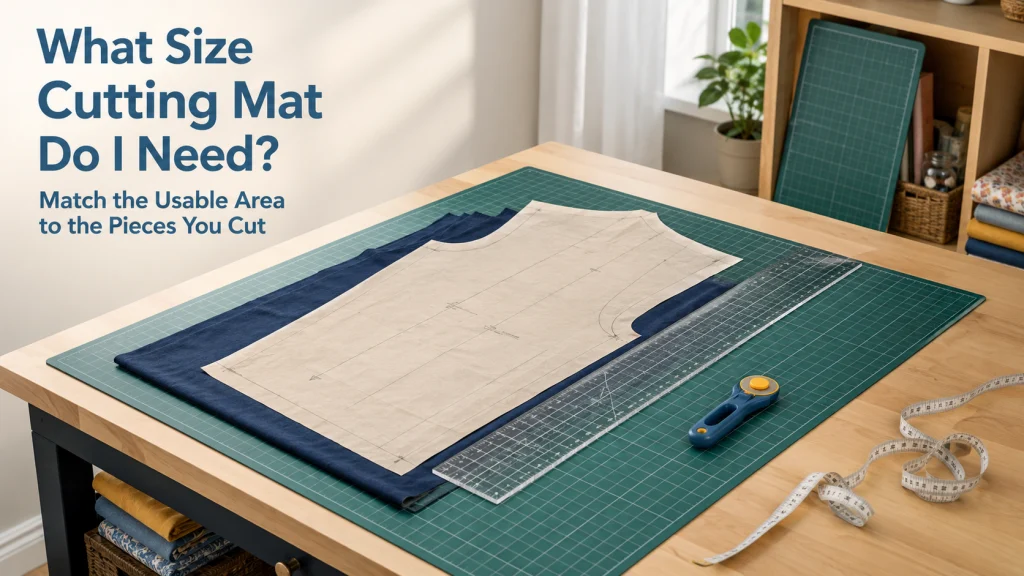
Start With the Largest Recurring Piece, Not the Biggest Mat Sold
If you are asking what size cutting mat do I need, start with the largest piece or cutting sequence that appears repeatedly in your sewing rather than the largest mat you can find. A sewist trimming small quilt blocks needs a different working footprint from someone cutting long garment pieces or wide sections of interfacing. The useful measurement is not simply the finished project size because fabric may be folded, aligned to a ruler, or shifted between cuts. Write down the dimensions of the area that must stay flat and supported during one normal cutting pass.
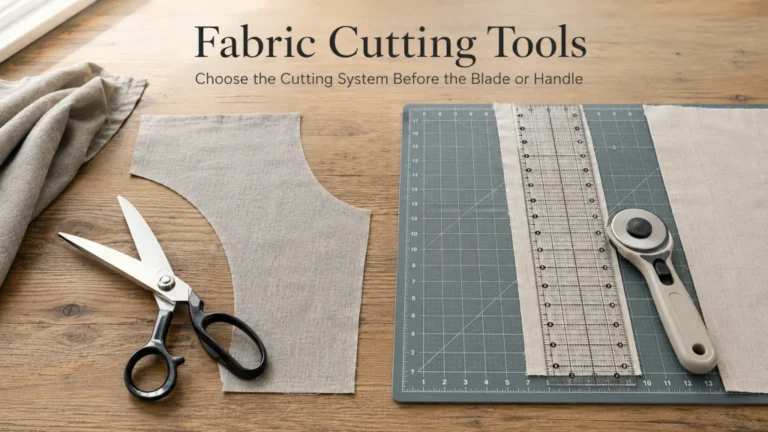
This keeps the decision tied to work you actually perform instead of an imagined future setup. For sewing, cutting mat size depends on how much material, ruler, and cutter travel must fit together at the same time. If your work varies, use the largest recurring task as the baseline and treat rare oversized jobs separately rather than buying around the exception. At the broader reusable-tool level, the sewing tools guide separates cutting equipment from the other tool families in the sewing room. That same task-first logic also helps when you choose fabric cutting tools, because the tool and the work surface have to function as one cutting setup.
Measure the Normal Cutting Task
Measure the material as it is positioned for the cut, not merely the pattern piece after it has been separated. A garment piece may need extra room around its edges for alignment and cutter access, while a quilt block can often be trimmed inside a much smaller footprint. Long strips create a different problem because the width may be modest even though the cut continues well beyond a compact mat. Recording these differences prevents a single project label such as quilting or garment sewing from hiding the dimensions that actually matter.
A simple worksheet makes the comparison more concrete and keeps sewing cutting mat sizes from turning into arbitrary small, medium, and large labels. Record several jobs you repeat, note the material footprint during the cut, and identify whether the piece must remain fully supported or can be repositioned between separate cuts. The goal is to find the largest normal footprint, not to make every possible project fit without moving anything. Once that baseline is visible, you can judge whether added mat area removes a recurring limitation or simply consumes more workroom and storage space.
| Recurring task | Footprint to record | What to notice |
|---|---|---|
| Block trimming | Block plus ruler clearance | Whether the full trim fits without shifting |
| Long fabric strips | Strip width plus ruler and cutter path | Whether length can advance in controlled stages |
| Garment pieces | Largest routinely cut piece as positioned | Whether edges and cutting lines stay supported |
| Small detail work | Material plus hand and ruler clearance | Whether a smaller dedicated area is sufficient |
Do not turn the worksheet into a demand for one mat that covers every row perfectly. If one unusually large piece appears once in a while, occasional repositioning may be more sensible than storing an oversized mat year-round. The useful pattern is the task that repeatedly makes you run out of supported cutting area. That is the task your mat size should solve first.
Account for Ruler Length and Cutter Travel
Fabric dimensions are only part of the footprint because the ruler and cutter also need room to work. A narrow strip can still require a long, stable ruler position, and a rotary cutter needs a continuous supported path where the blade meets the material. If the ruler regularly extends beyond the mat, you can lose the stable cutting reference even when the fabric itself appears to fit. Rotary cutting mat size therefore matters most when the cutting line, ruler position, and blade path are considered together rather than measured as separate objects.
Match the mat to the ruler lengths you actually use for recurring cuts instead of assuming a larger cutter automatically requires a larger mat. Cutter diameter affects other parts of tool selection, while mat dimensions answer the separate question of supported travel across the work surface. If you are still deciding among common cutter formats, choose the right rotary cutter size before treating the mat as a substitute for that decision. The mat should provide a stable route for the chosen cutting method, not compensate for a tool that is poorly matched to the material or task. Mat size also does not replace the cutter manufacturer’s instructions for blade guards, blade changes, handling, or storage.
Measure the Available Flat Support
A mat is only as useful as the surface supporting it, so measure the clear flat area where cutting actually happens. Do not count table space occupied by a machine, storage bin, lamp base, or other equipment that you are not willing to move for every cutting session. A mat that extends past the supporting surface can flex or leave part of the cutting area unsupported, which defeats the reason for choosing the larger size. Measure length and width separately because a long narrow surface may accommodate one mat orientation but not another.
Measure the area that remains continuously usable after those fixed obstacles are accounted for, then compare that rectangle with the project footprint you recorded earlier. A surface can look generous overall while leaving only a narrow cutting lane once the machine and other equipment stay in place. Check both possible mat orientations because turning a rectangular mat can change whether the long ruler path remains supported. The useful measurement is the uninterrupted cutting area, not the room’s total surface dimensions.
Use that supported-area measurement as a pass-or-fail check before comparing larger mat sizes. If a candidate mat would leave part of the active cutting zone unsupported, it is too large for that setup even when its outside dimensions technically fit nearby. If the full cutting path remains supported, extra uncovered surface around the mat is not a problem. This keeps the measurement step tied to cutting stability and prevents unused tabletop dimensions from distorting the size choice.
Plan Storage Without Bending or Heat Exposure
Storage can eliminate an otherwise sensible size before you buy it. Large flexible mats need a place where they can remain flat or otherwise be stored exactly as the manufacturer allows, without being folded or forced into a tight curved space. Heat exposure also matters because cutting-mat makers warn that excessive heat and direct sun can contribute to warping, and a cutting mat should not double as an ironing surface. Measure the actual shelf, under-table area, cabinet, or approved hanging space instead of assuming the mat will somehow fit after the room is arranged.
This is one place where manufacturer guidance deserves more weight than a generic storage trick. OLFA advises keeping rotary mats flat, away from direct sunlight and temperature extremes, while WAWAK likewise recommends flat storage away from high heat. Those instructions support a simple buying rule: if you cannot store a particular size without bending, heating, or crowding it, that size does not fit your workspace even if it fits the cutting task. A slightly smaller mat that can be stored correctly may remain more usable than a larger one that has no safe, stable home.
- Measure the storage length and width before choosing the mat.
- Confirm that the stored mat can stay flat or use a manufacturer-approved hanging method.
- Keep the storage location away from direct sun and high heat.
- Do not plan to place a hot iron or pressing equipment on the cutting mat.
- Leave enough clearance that the mat is not bent by doors, bins, or stacked equipment.
Storage belongs in the size decision because it affects the mat every day, not only when a large project appears. If two sizes both support the normal cutting footprint, the one you can store correctly has a practical advantage. That does not mean smaller is always better; it means usable size includes what happens before and after the cut. Measure storage with the same seriousness you use for the cutting surface.
Decide Whether Portability Matters
Portability changes the useful size when the mat moves between rooms, goes to classes, or has to be cleared from a shared table after each session. A mat that works beautifully when it stays in one place can become frustrating if it must pass through narrow storage spaces or be carried with rulers, fabric, and other tools. Measure the path the mat has to travel as well as the destination surface, especially if the workspace is temporary. The best portable size is therefore not automatically the smallest one, but the largest size that still moves and stores without becoming a recurring handling problem.
Separate portability from cutting technique so the decision stays clear. If a smaller mat requires you to reposition fabric during long cuts, decide whether that compromise is acceptable for the work you do most often rather than assuming every cut must happen in one pass. If you mostly work on small pieces away from a permanent sewing room, compact dimensions may provide more value than unused surface area. If the mat remains on a dedicated surface, portability may deserve almost no weight compared with ruler clearance and project footprint.
Choose One Large Mat or Several Specialized Mats
One large mat is convenient when most recurring work benefits from the same generous cutting area and the workspace can support and store it correctly. Several smaller mats can make more sense when tasks are genuinely different, such as a compact trimming station and a separate larger area for garment or strip cutting. The important distinction is specialization, not trying to tile loose mats into one supposedly seamless cutting surface. Separate mats can shift, create edges, and interrupt a ruler or blade path, so multiple pieces should not be treated as a substitute for one continuous supported surface when the cut requires continuity.
A second mat can also solve a different mechanism rather than a different size problem. For example, someone doing frequent small-piece trimming may want to decide whether a rotating mat helps instead of making the primary mat choice larger. Likewise, the material and surface construction question belongs in a separate comparison of self-healing cutting mat types. Keep those decisions distinct so size answers how much supported area you need, while mat type and mechanism answer how that surface behaves.
| Work pattern | Size strategy to consider | Reason |
|---|---|---|
| Most tasks need the same broad footprint | One larger primary mat | Reduces repeated repositioning on recurring work |
| Large cutting plus frequent compact trimming | Primary mat plus smaller dedicated mat | Keeps each station matched to its repeated task |
| Shared or temporary workspace | Portable primary mat sized to storage limits | Balances work area with repeated setup and removal |
| Continuous long cut across the full surface | One continuous supported mat | Avoids treating separate mat edges as one cutting plane |
The point is not to accumulate mats for every project type. Add another size only when it removes a recurring constraint that the primary mat cannot solve efficiently. If the second mat would sit unused most of the time, the extra specialization may not justify the storage it consumes. A small number of clearly assigned surfaces is easier to evaluate than a collection purchased without defined jobs.
Keep Mat Dimensions Separate From the Furniture Beneath It
The cutting mat and the table beneath it solve different problems. Mat dimensions determine the protected, marked surface available to support the cut, while the furniture determines whether that mat itself is fully and steadily supported. A mat that is too large for the existing surface does not prove that the table is wrong; it may simply mean that the proposed mat exceeds the workspace you chose to use. Likewise, a very large table does not require a table-covering mat if your recurring cutting footprint is much smaller.
This distinction prevents the scope of the decision from expanding every time a dimension feels inconvenient. First decide what mat area the normal cutting task needs, then verify whether your existing flat surface can support it, and stop there if the answer is yes. If the furniture itself creates a separate problem such as insufficient support or an unsuitable working arrangement, treat that as a different workspace decision rather than hiding it inside the mat purchase. Size the reusable cutting surface to the work you perform, not to an idealized room that may never exist.
Final Thoughts: Size the Mat to the Work Footprint
A useful cutting mat is large enough for the recurring piece, ruler position, and cutter travel that need continuous support, but no larger than your work and storage conditions can manage well. Measure those conditions before comparing labels or treating one popular dimension as the answer for every sewist. Rare oversized projects can often be handled as exceptions, while the mat should solve the task that repeatedly occupies your cutting space. That gives you a size decision based on evidence from your own workflow without inventing a universal minimum.
When two sizes both fit the normal task, use flat support, storage, and portability to break the tie. When neither fits the recurring task on the existing surface, identify whether the real limitation is mat area or the separate workspace beneath it before buying anything. Keep type, rotation, cutter format, and furniture as their own decisions so one purchase does not become a catch-all solution. The result should be a cutting surface that disappears into the workflow because it fits the work instead of forcing the work to fit the mat.
FAQs
Cutting-mat size questions usually become easier once the recurring task and the available flat support are measured separately. The answers below focus on dimensions, storage, and work footprint rather than prescribing one size for every sewing room. They also keep mat size separate from cutter selection, mat construction, and furniture choices. Use the exact dimensions of your own pieces and workspace when a general example does not match your setup.
Remember that a mat must support the cut you are making, not merely fit somewhere in the room. A larger surface can reduce repositioning, but only when it is fully supported and can be stored as its maker directs. A smaller surface can be sufficient for compact repeated work without being a compromise. The most useful answer is the one that matches the task you repeat, not the largest dimension available.
📏 What size cutting mat is best for sewing?
There is no single best size for all sewing. Measure the largest recurring cutting footprint, including the ruler position and cutter path, then choose a mat that supports that work on your available flat surface.
🧵 Is a small cutting mat enough for garment sewing?
It can be enough for small components and detail work, but larger pattern pieces may require repeated repositioning. Base the decision on the garment pieces you routinely cut rather than the finished garment size.
🔄 Can I put two cutting mats together to make a larger surface?
Two mats can serve separate tasks, but their meeting edges should not be assumed to create one continuous cutting plane. If a long cut requires uninterrupted ruler and blade travel, one continuously supported mat is the clearer choice.
🗄️ How should I store a large cutting mat?
Follow the exact maker’s storage instructions for your mat. Major cutting-mat guidance commonly emphasizes keeping mats flat or using an approved hanging method and protecting them from heat that can contribute to warping.
✂️ Does my rotary cutter size determine my mat size?
Not by itself. Mat dimensions should support the material, ruler, and cutter travel required by the task, while cutter size is a separate tool-selection decision tied to the material and cutting job.
References and Sources
Only two external sources are needed for the claims that require outside verification in this article. WAWAK documents multiple cutting-mat dimensions and explicitly frames mat size around available space and intended use. OLFA provides manufacturer maintenance guidance about keeping rotary mats flat and away from direct sunlight and damaging heat. The rest of the size-selection method is a measurement framework rather than a claim that one commercial size is universally correct.
- WAWAK sewing cutting mats: documents available mat dimensions and explains that size choice depends on workspace and the scale of the cutting task.
- OLFA rotary mat maintenance: supports the storage guidance about keeping mats flat and protecting them from heat and direct sunlight.
These sources do not establish a universal minimum mat size, and this article does not use them that way. Product assortments can vary, so listed dimensions serve only as evidence that sewing mats are sold across substantially different work footprints. Storage instructions should still be checked for the exact mat a reader owns because construction and approved storage methods can differ. That evidence boundary keeps the recommendation tied to measured work rather than turning a supplier catalog into a sizing rule.