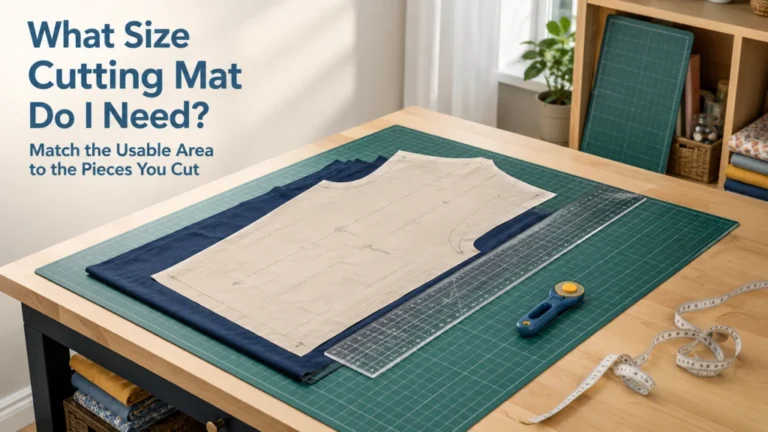
A self healing cutting mat is not just a disposable shield for the table beneath it. In a rotary cutting setup, the mat is the surface that supports the blade path, the ruler position, the fabric, and the repeated cuts that follow. The useful buying checks are whether the mat is intended for rotary cutting, how much usable area it provides, what its grid actually shows, whether both faces are usable, and how the manufacturer says it must be stored and protected from heat. Choose those specifications first, then decide separately whether you need a larger size, a rotating mechanism, or a different care routine.
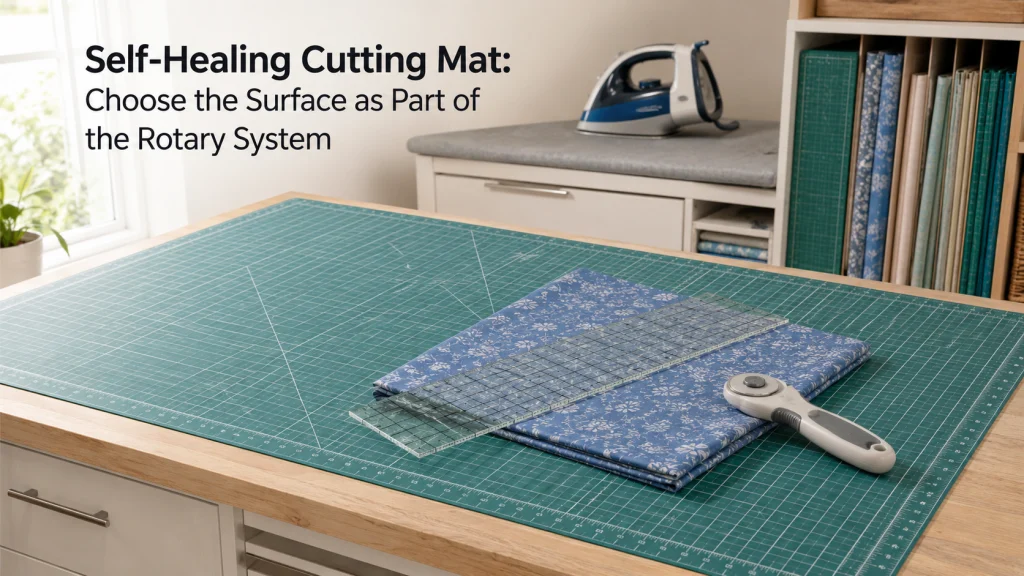
Treat the Mat as Part of the Rotary Cutting System
A self healing cutting mat belongs in the same decision as the rotary cutter and ruler because all three meet at the cut line. The cutter supplies the blade, the ruler controls the path, and the mat receives the blade after it passes through the fabric. An ordinary tabletop can protect nothing beyond its own surface, while a random craft board may not be intended to receive repeated rotary-blade contact. That makes the mat a working surface, not merely a layer placed under the real tools.
This matters most when a buyer starts comparing color, printed graphics, or package claims before checking what the surface is designed to do. A sewing cutting mat should first be identified as a rotary-cutting surface with manufacturer guidance that matches the tools being used. Utah State University Extension lists a rotary cutter, self-healing cutting mat, and grid ruler together among sewing supplies, which reflects the practical dependency between these tools rather than treating the mat as unrelated table protection. Once that relationship is clear, the rest of the purchase can be judged by specifications instead of decoration.
Rotary-system dependency: The cutter supplies the blade, the ruler establishes the cutting edge, and the mat receives the blade after it passes through the fabric. A mismatch in any one part can change the workflow, so the mat should be evaluated as part of the same system rather than as generic table protection.
The card is useful because it separates three jobs that are easy to blur together. A sharper or larger cutter does not prove that an unrelated surface is appropriate, and a detailed mat grid does not replace the ruler that guides the blade. Likewise, a good mat cannot correct unsafe cutter handling or poor ruler control. For the broader reusable-tool decision, the sewing tools guide keeps the cutting system in its proper tool family. The buying decision stays cleaner when each tool is judged for the role it actually performs.
Confirm the Surface Is Intended for Rotary Cutting
Start by checking the manufacturer’s stated use, because the phrase “cutting mat” covers surfaces made for different tools and materials. The important question is whether the surface is intended to work with rotary blades used for fabric cutting, not whether it looks similar to a sewing mat in a product photo. A mat designed around another cutting method may have a different surface construction, thickness, or care limit. If rotary use is not stated clearly, do not assume that the word “self-healing” proves compatibility.
The term self-healing also needs a realistic interpretation. OLFA describes its layered rotary mats as surfaces designed so the top layer closes after a cut, helping maintain the cutting surface and printed lines. That does not mean the material is indestructible or that repeated cuts in one track can never leave wear. The useful expectation is a surface designed to recover from normal rotary cuts within its stated use, while still requiring correct tool choice, clean cutting areas, and appropriate care.
- Confirm that the mat is explicitly intended for rotary cutting.
- Check the stated width and length against the cuts you make repeatedly.
- Read the grid units, edge numbering, subdivisions, and angle markings.
- Verify whether one or both faces are approved as cutting surfaces.
- Check the manufacturer’s blade or cutting-tool compatibility guidance.
- Read flat-storage, temperature, ironing, and other care restrictions before purchase.
Use that checklist before comparing cosmetic features or assuming that two mats with similar dimensions are functionally interchangeable. A mat can pass the size check and still fail because the grid is wrong for the workflow, the second face is not intended for cutting, or the storage instructions do not fit the room. Each item is a separate specification that can be verified without turning the choice into a product roundup. Once those fields are clear, the remaining sections explain how to judge them in context.
Keep Cutter Operation and Ruler Handling as a Separate Tool-Use Workflow
Choosing the mat does not replace learning how to operate the rotary cutter or control the ruler. Blade exposure, guard use, blade changes, hand placement, cutting direction, and ruler pressure belong to the cutter workflow and should follow the exact tool instructions. A better mat cannot make unsafe blade handling safe, and a clear grid cannot compensate for a ruler that shifts while the blade is moving. Keep the buying decision focused on the surface while treating sharp-tool technique as its own safety task.
If the broader cutting setup is still unresolved, start with the cutting tools guide before narrowing to the mat. If you are still choosing the cutting tool itself, first compare rotary cutters for fabric before trying to solve cutter questions through the mat purchase. If the cutter is already owned but the operating sequence is unclear, use the separate explanation of safe rotary cutter use rather than improvising around an exposed blade. This separation prevents a common mistake: expecting surface features to solve control problems that actually belong to the cutter, ruler, or cutting technique. The mat should support the workflow, not become a substitute for learning it.
Read Usable Dimensions, Not Just the Package Size
Mat dimensions matter because the fabric, ruler, and intended cut all need room inside a usable working area. Read the stated width and length, then look at how much of that surface is actually available once borders, hanging holes, unprinted edges, or other features are accounted for. A mat can physically fit on a table yet still feel restrictive if the common fabric piece extends beyond the cutting area. The better comparison starts with the cuts you repeat, not with the largest mat that can be squeezed into the room.
Also check the table beneath the mat before treating a larger footprint as automatically better. The mat should lie fully supported according to its storage and use instructions, without a corner hanging over an edge or a flexible tabletop forcing it out of plane. If the surface needs to be moved between a sewing table and another room, storage clearance becomes part of the usable-size decision as well. Exact size selection is a separate question, so use the dedicated cutting mat size decision when dimensions are the main problem.
Read the Grid Units and Markings Before You Rely on Them
A printed grid can help with alignment, but only when its units and markings match the way you cut. Check whether the mat uses inches, metric units, or both, then inspect the subdivision pattern, numbered edges, angle lines, and any zero point that affects how measurements are read. Do not assume that every sewing cutting mat uses the same numbering direction or spacing. A familiar-looking grid can still slow the workflow if the marks you rely on are faint, crowded, or arranged differently from your ruler.
The ruler should remain the measurement reference whenever the cutting method depends on the ruler edge, because the mat and ruler serve different jobs. For example, a sewist may use the mat grid to square the fabric roughly, then use a quilting ruler to establish the exact cut line. That approach keeps a printed surface from becoming a substitute for the straightedge controlling the blade. Grid quality matters, but it should be judged by visibility and compatibility with the way you measure rather than by how many lines are printed on the mat.
Check Whether One or Both Sides Are Intended for Cutting
Do not assume that the back of a mat is automatically a second cutting surface. Some rotary mats are designed for use on both faces, while another mat may provide printing on only one side or have manufacturer instructions that define how each surface should be used. The correct answer comes from the exact mat documentation, not from flipping the material over and deciding that both sides look similar. This is especially important when one side has a grid and the other is blank, because visual difference does not by itself prove a difference in cutting permission.
A verified second cutting face can be useful when a blank surface is preferable for visual contrast or when the manufacturer allows both sides to share normal cutting wear. It should not be treated as a license to ignore the printed side’s care instructions or to cut with tools outside the stated compatibility range. If the documentation is silent, count the usable side conservatively rather than inventing an extra feature. A simple specification check here can prevent the mat from being damaged by a tool or use that was never intended.
Check Storage, Temperature, and Ironing Restrictions
Heat and storage limits are purchase criteria because a rotary mat must remain flat enough to support the cutting plane. OLFA’s rotary-mat guidance tells users to avoid extreme temperatures, store mats flat, avoid rolling them, and not use them as an ironing surface. Those instructions show why “self-healing” should be understood as a cutting-surface property rather than resistance to every kind of damage. Before buying, compare the documented care limits with the room, table, and storage space where the mat will actually live.
Warning: Follow the exact mat manufacturer’s heat and storage instructions. Keep irons and other heated tools off the cutting surface unless the manufacturer explicitly approves that use.
A shared sewing table can still work well when pressing and rotary cutting are treated as separate surface jobs. The important question is whether the mat can be moved or stored flat without being bent, rolled, or exposed to heat outside its stated limits. If the only available storage slot forces the mat out of shape, a different size or storage location may be the better ownership choice. Protecting the flat cutting plane is the practical reason these restrictions belong in the buying decision.
Choose Mat Size as a Separate Decision
Once the standard self-healing mat family has been chosen, size becomes a geometry problem rather than a quality ranking. Measure the cutting area you can support, then compare that space with the fabric pieces, ruler lengths, strips, blocks, or garment sections you cut repeatedly. A small mat can be perfectly appropriate for small components and still be frustrating for long cuts that force repeated repositioning. A larger mat can reduce repositioning but create a storage problem that is worse than the cutting inconvenience it solves.
Keep those tradeoffs separate from surface type so the decision remains easy to audit. First confirm that the mat is appropriate for rotary fabric cutting and that its care limits fit the sewing space. Then choose dimensions around recurring work instead of assuming that bigger is always safer or more capable. If size is the unresolved variable, the cutting mat sizing framework can handle that comparison without turning this article into a size chart.
Choose a Rotating Mechanism Only When the Work Justifies It
A rotating cutting mat solves a different problem from choosing a standard self-healing surface. Its moving platform can make sense when the work repeatedly benefits from turning the piece while keeping the cutter and ruler position easier to manage. That mechanism also adds another layer to the tool decision, including the rotating base, its supported work area, and the stability of the assembly. It should not be treated as an automatic upgrade for every home sewing table.
If most cuts are long straight strips or larger garment sections, a rotating platform may offer little advantage compared with simply choosing an adequately sized standard mat. Small repeated pieces or work that changes cutting direction frequently can create a different case, but that judgment belongs to the recurring task. Use the separate rotating cutting mat comparison when rotation itself is the feature you are trying to justify. This article stays with the standard mat family so a specialized mechanism does not distort the basic surface decision.
Plan Cleaning and Flat Storage Before the Mat Arrives
A mat is easier to own when its storage place and basic cleaning routine are decided before it enters the sewing room. Keep the cutting surface clear of pins, needles, scraps, and hard objects that could meet the blade unexpectedly. Manufacturer care guidance may also specify how embedded fibers should be removed and which cleaners are acceptable. The exact method matters because aggressive scraping, strong chemicals, or heat-based fixes can create a new problem while trying to remove a small one.
Flat storage is equally important because the mat must return to the table without a bow or curl that interferes with the cutting plane. If the available storage forces the mat to bend, reconsider the size or storage location instead of planning to straighten it later. Detailed cleaning methods belong in the separate article on cleaning a self-healing cutting mat, where the care step can be matched to the manufacturer’s instructions. For the purchase itself, the key question is whether you can keep the surface clean, supported, and stored within its stated limits.
Final Thoughts: Choose the Surface for the Cutting System
The best standard mat is the one whose intended tool use, working area, grid, usable faces, and care limits match the rotary cutting setup already on the table. Start with evidence that the surface is made for rotary cutting, then read the dimensions and markings instead of buying by color or a vague self-healing label. Treat heat, ironing, and storage restrictions as ownership requirements because a warped surface changes the very job the mat is supposed to perform. Size and rotation can be decided afterward when those are the variables that actually change the workflow.
Keep the boundaries clear as you make that decision. Cutter safety and ruler control belong to the cutting technique, exact dimensions belong to the size choice, rotating platforms belong to a specialized mechanism decision, and detailed maintenance belongs to the care routine. The standard mat decision is simpler: verify the surface, verify the usable area, verify the markings, and verify that you can store it as instructed. That produces a cutting surface chosen as part of the system rather than as an afterthought under the fabric.
FAQs
These questions cover the specification checks that usually determine whether a standard self-healing mat fits a rotary fabric-cutting setup. They do not replace the exact instructions for the cutter, ruler, or mat being used. When a feature varies by product, the manufacturer’s documentation should control the answer rather than a generic rule. That is especially important for usable sides, compatible cutting tools, cleaning, storage, and heat exposure.
Use the answers as a final check after you have identified the mat’s intended use and measured the available cutting area. If a question turns into a size, rotating-mechanism, cutter-operation, or cleaning problem, follow that separate decision instead of forcing it into the basic mat purchase. A standard self-healing mat does not need every possible feature to be the correct surface. It needs to support the rotary system and the recurring cuts you actually make.
🌀 What does self-healing mean on a cutting mat?
It describes a surface designed so normal cut lines close back together rather than remaining as open grooves immediately after each pass. It does not mean the mat is immune to wear, repeated cuts in one track, heat, or incorrect tool use.
✂️ Can I use any cutting mat with a rotary cutter?
No. Verify that the exact mat is intended for rotary cutting and that the manufacturer allows the blade type you plan to use. A generic craft mat or self-healing label alone is not enough evidence.
📏 Should I measure fabric from the mat grid or the ruler?
Use the ruler as the controlling straightedge when the cut follows the ruler edge. The mat grid can help with alignment and orientation, but its markings should support the measurement workflow rather than replace the ruler.
🔄 Are self-healing cutting mats always double-sided?
No. Some are documented for cutting on both faces, while other products may define only one usable cutting surface or different functions for each side. Check the exact mat instructions before cutting on the back.
🔥 Can I iron on a self-healing cutting mat?
Do not assume so. Major rotary-mat guidance explicitly warns against ironing on heat-sensitive mats, so follow the exact manufacturer’s temperature and ironing restrictions and use a proper pressing surface instead.
🗄️ How should I store a rotary cutting mat?
Follow the manufacturer’s storage instructions, with flat storage commonly specified for standard rotary mats. Avoid forcing a mat into a bent or rolled space when its documentation requires it to remain flat.
References and Sources
This article needs a small source section because several purchase criteria are technical rather than matters of preference. Self-healing construction, rotary-tool intent, temperature exposure, ironing restrictions, and flat-storage guidance should be tied to documented instructions instead of generalized from product photos. The sources below are limited to one manufacturer reference and one university Extension reference that directly support those points. No retailer roundup or community thread is needed to establish the core decision.
The manufacturer source is used as exact evidence for its own rotary-mat guidance, not as proof that every mat from every maker has identical construction or restrictions. The Extension source supports the broader sewing context in which a rotary cutter, self-healing mat, and grid ruler function together as cutting supplies. Product-specific dimensions, usable sides, cleaning methods, and tool compatibility should still be checked on the exact mat being considered. That keeps the article useful without turning References into a collection of unnecessary external links.
- OLFA rotary mat FAQ: explains self-healing construction and documents storage, temperature, ironing, blade-life, and fiber-removal guidance for the manufacturer’s rotary mats.
- Utah State University Extension sewing supplies: places the rotary cutter, self-healing cutting mat, and grid ruler together within a practical sewing-tool setup.
Those sources are enough for the claims this article actually publishes. They support the surface-as-system framing and the warning that care limits matter to a flat cutting surface without supplying invented durability numbers or universal performance promises. Any future claim about a specific mat’s dimensions, grid, second cutting face, or compatible blade should be verified against that exact product’s documentation before publication. The evidence standard stays narrow because the buying decision is narrow.