Stretch fabric does not automatically require elastic shirring thread. Construction seams may use a general-purpose polyester thread or a specialty stretch seam thread, depending on how much the finished seam must extend and recover. The useful decision is to separate ordinary seam construction from high-movement seams and from shirring, then verify the exact thread maker’s machine-use instructions before loading the spool. This approach keeps fabric stretch, seam movement, and thread purpose from being treated as the same question.
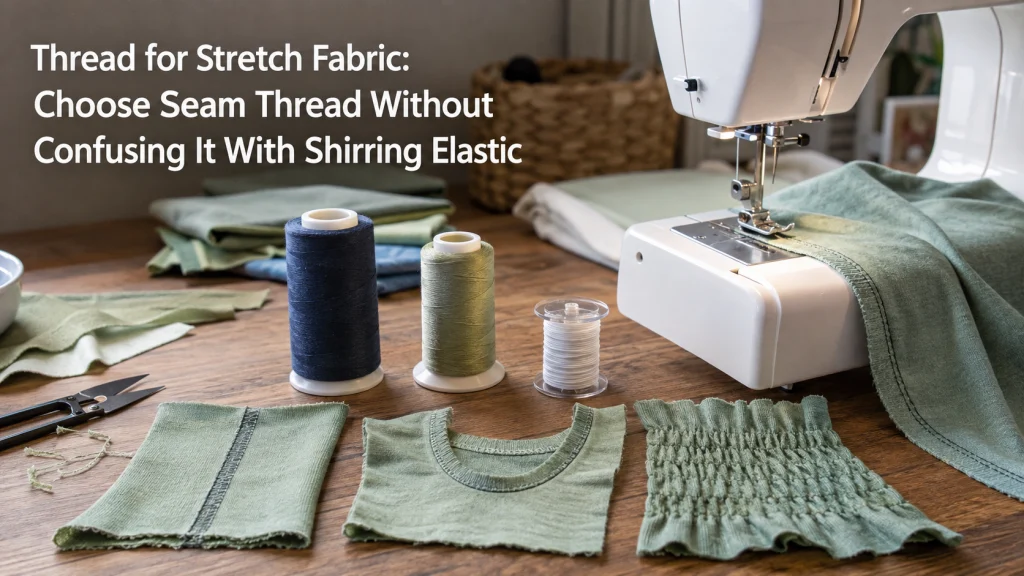
Stretch Fabric Does Not Automatically Need Elastic Shirring Thread
A knit top, a fitted stretch garment, and a shirred panel can all contain elastic material, but they do not ask the thread to do the same job. When choosing sewing thread for stretch fabric, start with the seam that has to survive movement after the garment or project is finished. An ordinary construction seam may need only modest give, while a close-fitting opening or high-extension area may demand more movement from the seam system. Shirring is different again because elastic thread is being used to gather or smock fabric rather than simply to construct a normal seam.
That distinction prevents a common beginner mistake: seeing the word elastic on the fabric and assuming the bobbin should be filled with elastic shirring thread. For normal construction, the better starting point is the broader sewing thread types and uses framework, then narrowing the choice by seam movement. If the main question is basic supply selection rather than one stretch-fabric seam, the core sewing supplies for machine work overview keeps thread choice in context with the rest of the machine setup. The rest of this article stays on construction thread for domestic-machine stretch seams and does not turn into stitch selection, needle compatibility, serger setup, or shirring technique.
| Route | What the thread is doing | What to verify next |
|---|---|---|
| General construction thread | Forms an ordinary seam where moderate movement is sufficient | Thread type, seam movement, fabric behavior, and the exact machine setup |
| Specialty stretch seam thread | Adds documented elongation for seams that need more extension | Intended fabric range, top-thread and bobbin instructions, and product-specific sewing guidance |
| Elastic shirring thread | Creates gathering or smocking rather than serving as ordinary construction thread | Whether the project is actually shirring and whether the product is intended for bobbin use |
The router is deliberately based on thread purpose rather than fabric name. Jersey, stretch woven fabric, and elastane blends can each appear in more than one route because the finished seam may have different movement requirements. A fabric label alone cannot tell you whether ordinary construction thread is sufficient or whether a specialty stretch thread adds useful capacity. Once the route is clear, the next step is to define what the seam itself must do.
Define the Seam’s Movement Requirement
The fabric can stretch much farther than a particular seam ever needs to move, so copying the fabric’s maximum stretch is not the goal. A loose side seam on a jersey top, for example, may experience less extension in wear than a narrow neckline, fitted cuff, or close body seam made from the same fabric. The right thread for jersey fabric therefore depends on the seam’s job as well as the fabric construction. Before comparing thread categories, identify whether the seam will stay mostly relaxed, open repeatedly during dressing, or remain under frequent extension while the item is worn or used.
Look at the finished object rather than stretching a scrap simply because it can stretch. A waistband opening that must pass over the hips, a fitted sleeve opening, and a loose hem do not impose the same movement requirement even when cut from one knit. Also separate seam extension from recovery: a seam that can be pulled once without breaking is not automatically a good match if it stays distorted afterward. This is why the decision belongs at the seam level, with the actual location and expected movement written down before thread claims are compared.
Seam-movement requirement card: Record the seam location and whether it must open during dressing or normal use. Note how often it will be extended and whether it needs to recover to its original shape. Separate ordinary construction from intentional gathering before narrowing the thread category. If those points are unknown, the thread choice is not ready to be narrowed.
A simple recovery check can make that requirement more concrete without turning it into a laboratory test. Mark a short reference length on the completed seam sample while it is relaxed, extend the sample only to the movement the finished project actually needs, and then release it. After the seam has relaxed, compare the marked length with its starting length and look for lingering distortion, puckering, or thread damage. The goal is not to assign a universal percentage, but to see whether that specific seam returns close enough to its original state for the project before you change thread categories.
That card also helps keep this article from drifting into a stitch prescription. Stitch type, stitch density, fabric handling, and needle choice can change seam behavior, but those are separate setup decisions that need their own verification. Here, the card answers only how much movement the construction thread must support and whether the project is actually asking for a specialty thread class. With that requirement defined, an ordinary construction thread deserves consideration before a more specialized option is assumed necessary.
Start With Documented General Construction Thread Where Appropriate
General-purpose polyester thread is a common baseline for domestic-machine stretch-fabric construction because current sewing guidance describes polyester as having useful flexibility and durability for these materials. That does not mean every polyester thread, every seam, or every stretch fabric will behave the same way. The thread still has to form a sound seam on the exact fabric and machine, and the completed seam has to tolerate the movement defined in the previous section. Treat polyester as a reasonable construction category to evaluate, not as proof that a seam will survive any amount of extension.
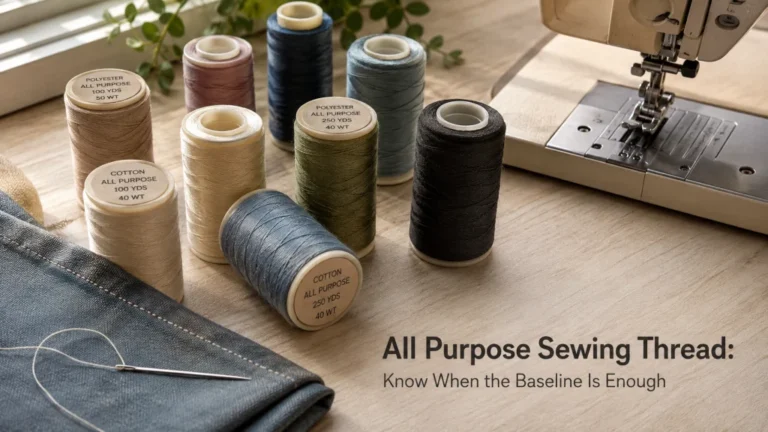
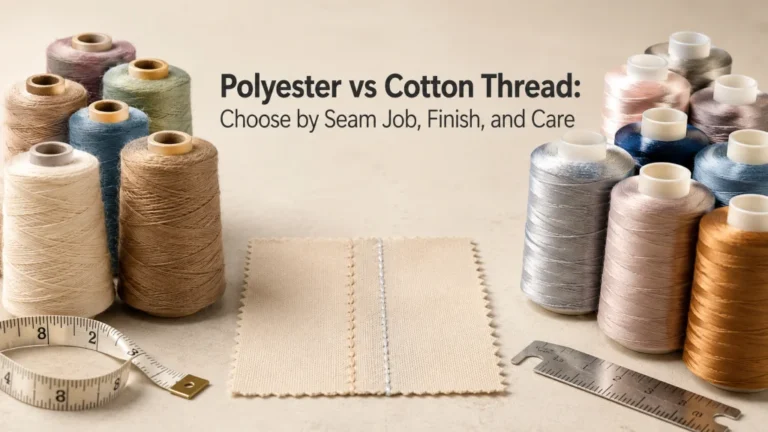
This baseline is especially useful when the project does not demand unusually high seam movement and the goal is ordinary construction rather than a specialized effect. It also connects to the broader choice between all-purpose sewing thread for regular construction and more specialized thread types. If fiber choice is the unresolved issue, the separate polyester versus cotton sewing thread comparison explains that decision without turning stretch-fabric selection into a universal fiber rule. The important point here is that a stretch fabric does not, by itself, disqualify general construction thread.
- Confirm that the thread is intended for domestic-machine construction rather than decorative, hand-sewing, serger, or shirring use.
- Test the planned seam on a representative fabric layer stack, not only on one flat scrap.
- Extend the completed test seam to the amount the finished project actually requires.
- Check for thread breakage, obvious seam restriction, distortion, or failure to recover before committing to the project.
A successful test is evidence for that thread, seam, fabric, and setup combination, not for every knit in the sewing room. If the seam passes the movement requirement cleanly, there may be no practical reason to move to a specialty stretch thread. If it fails specifically because the seam cannot extend enough, that result gives a clear reason to evaluate a thread designed for higher seam extension. This keeps the decision tied to observed need instead of buying a specialty spool merely because the fabric description includes stretch.
Identify When a Specialty Stretch Seam Thread Changes the Choice
A specialty stretch sewing thread becomes relevant when the seam needs more extension than the chosen general construction setup can provide and the thread maker documents that product for stretch seams. Current manufacturer documentation shows that this is a real construction-thread class, not another name for shirring elastic. Some specialty products are engineered for high-extension seams, while others are explicitly presented for household machines and flexible construction or topstitching. Those claims are product-specific, so they should be read as documented capabilities of the exact thread rather than as a blanket rule for anything sold with stretch in the name.
The buying question is therefore not simply whether a specialty thread stretches more. It is whether its documented application matches the seam movement, fabric type, machine use, and thread path required by the project. A close-fitting neckline or another seam that repeatedly opens during use may justify investigating this category when a tested general-purpose setup restricts movement or breaks. A loose seam that already passes its required movement test gives much less reason to change. Specialty thread should solve a defined seam requirement, not become the default purchase for every knit.
When comparing spools for purchase, look for evidence that answers the seam question rather than relying on the product name. Useful listing or package details include an explicit construction-seam purpose, the fabrics or applications the maker names, whether the thread is intended for a household sewing machine, and any directions about needle-thread or bobbin use. A vague elastic or stretch label without those details gives you less purchasing evidence than a clearly documented intended use. That lets two similar-looking threads be screened before checkout without pretending that either one has already been proven on your fabric.
The boundary with shirring elastic matters most here. A manufacturer can describe one thread as a construction thread for stretch seams while describing another elastic product as a bobbin thread for gathering and smocking. Those are different purposes even though both products may be elastic. If the project goal is intentional shirring, continue to elastic thread for shirring and smocking instead of treating that material as an ordinary seam-thread substitute.
Read the Exact Top, Bobbin, and Fabric-Use Instructions
Stretch-thread labels are not interchangeable instructions. One documented household-machine stretch thread specifies use as both needle thread and bobbin thread, while a documented elastic shirring thread is described for bobbin use when gathering or smocking. That difference is enough to make generic advice such as put elastic thread in the bobbin unsafe as a purchasing rule. Read the exact product page or package directions before deciding where the thread belongs in the machine.
Fabric-use wording matters for the same reason. A specialty thread may be documented for particular fabric weights, elastic woven fabrics, knitwear, garment areas, or high-extension seam applications, and those boundaries should control how broadly the claim is applied. Do not extend one maker’s instructions to a different thread simply because the spools look similar or use similar marketing language. If the exact product does not state the relevant application or thread-path use, leave that point unknown rather than inventing compatibility from the product category.
For shopping, treat those directions as part of the product specification rather than as fine print to read after purchase. A useful listing should make it possible to tell what kind of thread you are buying, what sewing purpose it serves, and where the maker expects it to run in the machine. If the package or listing leaves those points ambiguous, compare another documented option instead of filling the gaps from a generic product title. This is especially important when construction thread and shirring elastic appear beside each other under broad stretch-thread search terms.
- Confirm whether the product is construction thread, stretch seam thread, or elastic shirring thread.
- Check whether the maker specifies top-thread use, bobbin use, or both.
- Read the stated fabric or application range instead of relying on the word stretch alone.
- Keep product-specific setup instructions with that exact thread rather than transferring them to another brand or line.
- Follow the sewing-machine manual when thread size, winding, threading, or bobbin handling creates a model-specific restriction.
This verification step is also where thread selection should stop if the problem turns out to be elsewhere. A seam that fails because the machine is skipping stitches, damaging the fabric, or feeding it poorly is not automatically a thread-category problem. Likewise, this article does not prescribe a needle or stitch simply because a specialty thread maker lists one in its own product instructions. Use the documentation to verify the thread itself, then keep the rest of the machine setup within the exact machine and project guidance that applies.
Final Thoughts: Choose Thread for Seam Movement, Not the Fabric Label Alone
The practical sequence is short: define the movement the finished seam needs, start with a suitable construction-thread baseline, and move to a specialty stretch seam thread only when the requirement justifies it. This avoids treating jersey, elastane, or another stretch fabric as an automatic instruction to buy elastic thread. It also prevents shirring elastic from being confused with construction thread simply because both can stretch. A thread choice becomes much easier once the seam’s job is written down before the spool category is chosen.
Then verify the exact product rather than relying on a family name such as polyester, stretch, or elastic. Check whether the maker documents the intended application, whether the thread belongs on top, in the bobbin, or both, and whether the planned fabric and seam fall inside that guidance. Test the representative seam to the movement the finished project actually needs and keep any unverified claim out of the decision. The best result is not the most specialized thread, but the least complicated option that satisfies the documented seam requirement without crossing into a different thread purpose.
FAQs
🧵 Can I use regular polyester thread on stretch fabric?
Often, yes, if the completed seam can move as much as the finished project requires without breaking or becoming restrictive. Test the actual seam and representative layer stack rather than assuming every polyester thread and stretch fabric will behave the same way.
👕 Does jersey fabric always need stretch thread?
No. The decision depends on the movement required at the specific seam and on the performance of the tested construction setup. A loose jersey seam and a close-fitting opening can need different amounts of seam extension even in the same garment.
🌀 Is stretch seam thread the same as elastic shirring thread?
No. Specialty stretch seam thread can be designed for construction seams, while elastic shirring thread is used to create gathering or smocking. Check the exact product instructions because top-thread and bobbin use can differ.
🧶 Should stretch thread go in both the needle and bobbin?
Only when the exact thread maker instructs that use. Some documented stretch construction threads specify both positions, while documented shirring elastic may be intended for bobbin use, so the product directions control the answer.
📏 How do I know whether my seam needs more stretch?
Identify how far that seam must open or extend during normal use, then test a representative seam to that movement. If the thread breaks, the seam restricts the required movement, or recovery is poor, investigate the cause before deciding whether a specialty stretch thread is the appropriate change.
References and Sources
- Gütermann Maraflex documentation: Verifies a household-machine stretch construction thread, its documented fabric uses, and its needle-thread and bobbin-thread application.
- Coats Eloflex documentation: Verifies the existence and intended use of a high-extension construction thread for stretch seams.
- Gütermann Elastic Thread documentation: Verifies that elastic shirring thread is used for gathering and smocking and is specified as bobbin thread for machine sewing.
- WAWAK stretch-fabric guidance: Supports general-purpose polyester as a common construction-thread baseline for stretch fabrics.