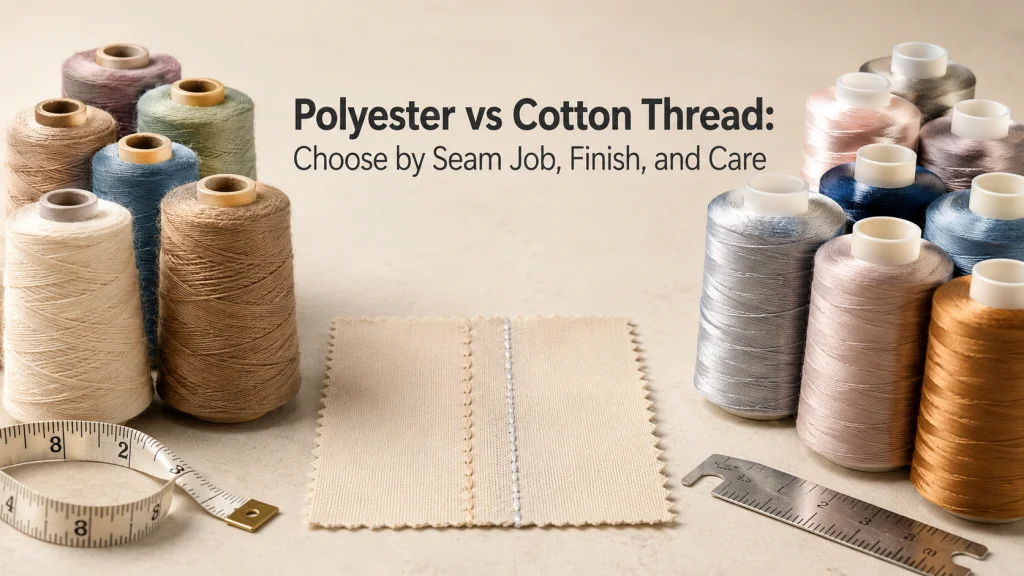
Choosing between cotton and polyester thread starts with the seam job, not a rule that thread fiber must always match fabric fiber. Fiber affects useful properties, but construction, size, finish, movement, appearance, care, and the way the finished item will be used can change the better choice. The practical comparison is therefore cotton thread versus polyester thread in a defined project, with the spool label and technical documentation checked before assuming how either thread will behave. By the end, you should be able to compare the two fibers without relying on one-line sewing folklore.
Fiber identity is not the whole seam decision
The usual polyester vs cotton thread comparison sounds simple until two spools are placed beside the same project. Picture a stable woven cotton bag with one candidate labeled cotton and another labeled polyester. If one label also identifies a spun construction or a particular finish while the other gives only fiber content, the two labels are already telling you different amounts about the thread. The seam job, not the fabric fiber by itself, decides which missing details matter next.
This is why the useful question is not simply, “What fiber is the fabric?” It is, “What does this particular seam need the thread to do?” Coats classifies sewing thread separately by substrate, construction, and finish, which is a useful reminder that fiber is only one variable. A cotton thread and a polyester thread can each be appropriate in machine sewing, but they should be compared as complete thread constructions rather than as two fiber names printed on a spool.
Key point: Start with the seam’s job, then verify the thread’s fiber, construction, size, finish, and care information. Do not turn a fiber preference into a universal rule.
That distinction also keeps this comparison in the right scope. For a broader explanation of the main families available to home sewists, the sewing thread types comparison provides the wider context. This page stays with the narrower cotton-versus-polyester decision.
Confirm the exact thread construction before comparing fibers
Fiber labels can hide meaningful construction differences. Coats distinguishes spun thread, corespun thread, and filament thread, and notes that construction changes properties such as strength, flexibility, surface behavior, and intended use. In plain terms, spun thread is made from short fibers twisted together, corespun thread wraps staple fibers around a continuous core, and filament thread uses continuous fibers. A spun polyester thread should not be treated as interchangeable with every other polyester construction merely because the fiber content matches. The same caution applies to cotton threads with different processing, ply, size, or finish.
Size labels need similar care. Superior Threads notes that a cotton thread and a polyester thread carrying the same composition-style number can be similar without being exactly the same size. That matters because a visual comparison can become misleading when one candidate is physically finer, heavier, smoother, or built differently from the other. A fair fiber comparison begins by checking whether the two threads are actually comparable in the dimensions that matter to the seam.
Use the following fiber comparison ledger as a label audit before weighing end use. It records what each spool actually documents, so later decisions about appearance, movement, and care are based on comparable information rather than fiber names alone.
| Label or documentation field | Why it matters before choosing | What not to assume |
|---|---|---|
| Fiber content | Identifies cotton, polyester, or another substrate | Fiber alone determines the best seam |
| Construction | Separates spun, corespun, filament, and other structures | All polyester or all cotton threads behave alike |
| Thread size | Changes bulk, visibility, and the amount of thread in the seam | Matching number systems always mean identical diameter |
| Finish or treatment | Can alter sewability, appearance, or a specialized function | The fiber name reveals every surface treatment |
| Care guidance | Shows what the maker documents for laundering or pressing conditions | A generic fiber rule overrides the stated product guidance |
This ledger prevents an easy comparison error: attributing every observed difference to cotton or polyester when the two samples also differ in size or construction. If you want the general baseline before making this narrower choice, all purpose sewing thread selection explains when a general-purpose thread category is sufficient. Here, the goal is to compare like with like as closely as the available labeling allows.

Gütermann Sew-All is a 100% polyester sewing thread made with Micro Core Technology. The manufacturer specifies a No. 100 thickness and recommends universal needles from NM 70 to 90. It is designed for machine and hand sewing, including closing seams, topstitching, and decorative stitches.
Check On AmazonIf you click this link and buy, we earn a commission at no additional cost to you.
Compare appearance and hand on the finished seam
Some seams are meant to disappear into the fabric, while others are part of the design. Coats lists color, lustre, and thread fineness among the factors that affect stitch aesthetics, so the visual decision should be made at the stitch line rather than from the spool alone. A thread that looks slightly different under shop lighting may blend well after stitching, while a nominal color match can still read differently because of surface sheen or thickness.
Cotton is often chosen when a softer or more matte visual character is wanted, while polyester constructions can range from subdued to visibly lustrous. Those are tendencies, not sufficient buying rules. The exact finish and construction still control what the seam looks and feels like. For visible topstitching, decorative machine work, or any seam where the thread itself is part of the surface, sewists should compare the actual documented thread characteristics and, when practical, inspect a small stitched sample on the project fabric before committing to the whole piece.
A third fiber can make the visual tradeoff even clearer. If the project is driven primarily by a specific surface effect rather than a cotton-or-polyester requirement, the silk sewing thread comparison is the more relevant branch. The important point is to keep appearance as its own decision factor instead of pretending fiber identity automatically settles it.

Aurifil Cotton 50wt is a fine 50-weight, 2-ply cotton thread designed to produce flat and crisp seams. Its relatively thin profile makes it useful when the stitching should remain subtle rather than visually dominate the fabric. It can be used for piecing, subtle quilting, topstitching, applique, and other machine-sewing applications.
Check On AmazonIf you click this link and buy, we earn a commission at no additional cost to you.
Compare movement and seam demand
A seam in a stable decorative panel is not doing the same job as a seam in a garment area that repeatedly bends, pulls, or recovers. Coats treats elasticity, abrasion resistance, seam strength, and elongation as separate performance considerations. It also documents spun polyester as stronger than cotton thread of a comparable size. That comparison is useful, but it still does not mean polyester wins every project, because strength is only one part of seam behavior.
For a first practical example, consider two seams made in the same stable woven cotton: an interior construction seam that sees ordinary use, and a line of visible decorative stitching where a low-sheen finish is the priority. The first seam may give movement and durability more weight, while the second can reasonably give appearance more weight. Neither decision can be reduced to “cotton fabric means cotton thread.” The seam function changes the weighting even before the thread label is examined closely.
| End-use question | If the answer is yes | What to verify next |
|---|---|---|
| Will the seam move or recover repeatedly? | Give elongation and recovery more weight | Documented construction and performance properties |
| Will the thread be highly visible? | Give finish, size, color, and lustre more weight | Actual stitched appearance and thread description |
| Is the item expected to see repeated wear or abrasion? | Give abrasion resistance and seam demand more weight | Technical documentation for the exact thread type |
| Is the seam part of a stretch-dominant project? | Do not decide from fiber alone | Seam construction and thread requirements for that application |
The decision card is intentionally conditional. A stretch-dominant project has more variables than this fiber comparison can resolve, so readers dealing with that situation should continue to thread choices for stretch fabric rather than force a cotton-versus-polyester answer. That keeps movement requirements tied to the actual seam instead of to a generic fiber hierarchy.
Compare care and pressing only from sourced guidance
Care claims are where broad internet rules become especially unreliable. Coats identifies shrinkage, color fastness, chemical resistance, washing, dry cleaning, bleaching, and wet or dry pressing as properties or exposures that can matter to thread performance. That does not establish one universal care limit for every cotton thread or every polyester thread. The responsible next step is to check the documentation for the exact thread being considered and compare it with the finished item’s intended care routine.
This also explains why “match thread fiber to fabric” can appear in advice for a particular finishing process without becoming a universal sewing rule. If a thread maker documents a fiber requirement for dyeing, finishing, or another defined treatment, that condition belongs to that process. A home-sewn item with a different care path is a different problem. A narrow technical requirement should not be copied into every ordinary machine-sewn seam.
Warning: Do not infer protective performance, high-heat suitability, flame behavior, or structural-load capacity from the words cotton or polyester alone. Those claims require exact product documentation for the intended use.
For a home sewist, the practical care audit is simple: identify how the finished item will actually be washed, dried, pressed, or otherwise maintained, then verify what the thread maker documents. If no reliable guidance exists for a demanding care condition, uncertainty is a reason to narrow the claim or choose a thread with clearer documentation, not a reason to invent a fiber rule.
Separate quilting preference from general construction
Cotton-versus-polyester arguments are especially persistent in quilting communities. One recurring claim is that polyester thread will eventually cut cotton fabric simply because polyester is stronger. Community discussions are useful evidence that this concern is real, but they are not technical proof. Superior Threads directly addresses the claim and states that fabric cutting is not determined by fiber type alone, using a comparison in which the cotton test thread was stronger than the polyester thread.
The lesson is broader than that single myth. “Polyester is stronger” and “cotton matches cotton” are both too coarse to decide every seam. Thread strength depends on more than the fiber name, and the finished quilt involves piecing, quilting, visible stitch character, laundering, fabric condition, thread size, and personal finish preferences. A sewist can reasonably prefer cotton for one quilting task and polyester for another without converting that preference into a general rule for garment or home-project construction.
Quilting also deserves its own application-specific decision path. If piecing or machine quilting is the actual job, machine quilting thread choices can weigh the variables that a general fiber comparison intentionally leaves out. This prevents a strong quilting tradition or preference from being presented as a universal machine-sewing requirement.

King Tut is a 40-weight, 3-ply cotton thread made from Egyptian-grown extra-long staple cotton. It is designed specifically for quilting and decorative stitching where the stitch line can remain visible. The manufacturer recommends it for both home sewing machines and longarm quilting machines and specifies a Topstitch 90/14 needle.
Check On AmazonIf you click this link and buy, we earn a commission at no additional cost to you.
Final Thoughts: choose the fiber for the seam’s real job
The best cotton-versus-polyester decision is not a permanent allegiance to one fiber. It is a repeatable process: define the seam, confirm the exact thread construction, compare appearance and movement, check the documented care environment, and separate application-specific tradition from technical evidence. Before paying for a different spool, turn those decisions into a short project check rather than starting over with the fiber label.
- Name the exact seam or stitch job.
- Decide whether the thread should blend in or remain visibly distinct.
- Account for the movement, wear, and abrasion that seam will actually see.
- Match the finished item’s care routine to documented thread guidance.
- Separate sourced properties from community preference or sewing folklore.
If the thread already on hand passes those checks and its construction is documented well enough for the job, replacing it solely because the fiber label differs is unnecessary. If it fails a real requirement for construction, finish, movement, or care, that failure gives a specific reason to choose a better-matched thread rather than buying on a cotton-versus-polyester rule alone.
If the choice is still too broad, move sideways to the application that actually controls it. Use the general machine sewing supplies overview when the thread decision is part of a larger supply setup, the quilting-specific comparison when the project is a quilt, or the stretch-thread discussion when seam movement dominates. The goal is not to crown one fiber. It is to choose a documented thread construction that fits what the seam really has to do.
FAQs
🧵 Is polyester thread always stronger than cotton thread?
No. Coats documents spun polyester as stronger than cotton of a comparable size, but fiber name alone does not determine every thread’s strength. Construction, size, and the exact thread being compared still matter.
🌿 Do I need cotton thread for cotton fabric?
Not as a universal rule. Match the thread to the seam job, desired finish, movement, and care requirements, then verify the exact thread construction. Same-fiber matching can matter in specialized processes, but that does not make it mandatory for every home-sewn cotton project.
🪡 Can polyester thread cut through cotton fabric?
Fiber identity alone does not prove that outcome. The commonly repeated claim should not replace a comparison of thread strength, size, construction, fabric condition, seam design, and use. Treat community reports as questions to investigate, not as universal technical evidence.
✨ Which thread looks more matte, cotton or polyester?
Cotton is often associated with a softer matte appearance, but the exact finish and construction can change the result. If appearance matters, compare the documented thread finish and inspect how the actual stitch line looks on the project fabric.
🧺 Which thread should I use for something washed frequently?
Start with the exact item’s care routine, then check the thread maker’s documented guidance for washing, drying, pressing, and other relevant exposures. Do not assume that fiber identity by itself proves suitability for every care condition.
References and Sources
The references below are the sources used for the technical distinctions and the documented community confusion discussed in this comparison. Manufacturer and technical material supports thread properties; community discussion is used only to show recurring buyer questions and claims.
- Coats thread selection bulletin: Supports the distinctions among fiber substrate, thread construction, finish, size, elasticity, abrasion, shrinkage, color fastness, and other selection factors.
- Superior thread weight reference: Supports the caution that cotton and polyester threads with the same composition-style numbering are not necessarily exactly the same size.
- Superior thread characteristics: Supports construction-level distinctions among cotton, corespun polyester, and filament polyester threads.
- Superior cotton and polyester discussion: Supports the evidence boundary around the claim that polyester fiber inherently cuts cotton fabric.
- Quiltingboard cotton versus polyester discussion: Documents the recurring community confusion and preferences around fiber matching and the fabric-cutting claim; it is not used as technical proof.
These sources support the comparison framework and the evidence boundaries used above. Exact thread properties and care suitability still depend on the specific thread construction and current manufacturer documentation.