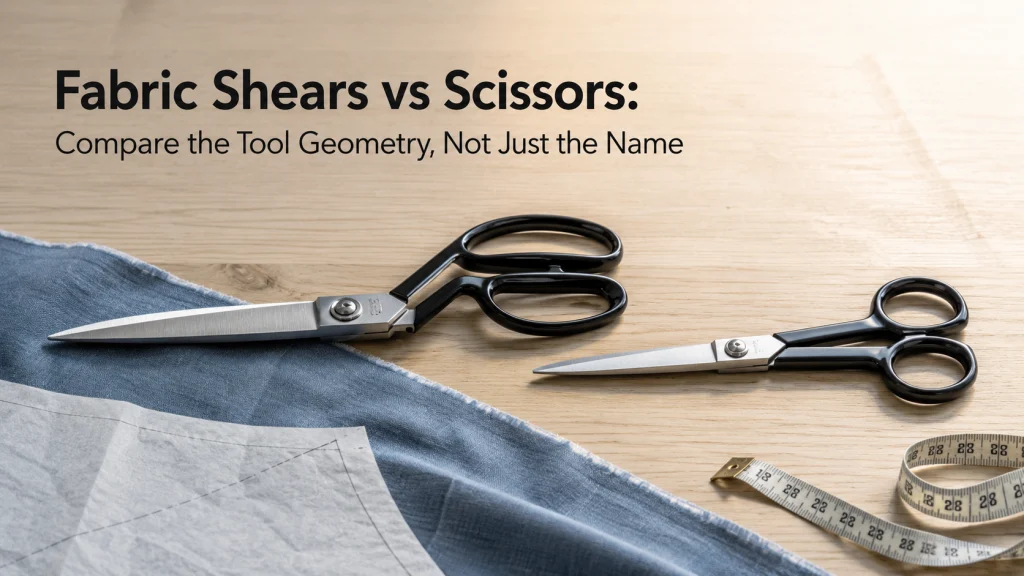
Fabric shears vs scissors is not a clean dictionary split because current sewing-tool catalogs use both words for overlapping products. The more useful comparison is physical: blade reach, handle geometry, how low the cutting edge can stay over a table, and whether the tool is sized for long pattern cuts or smaller trimming work. Exact manufacturer listings show the overlap clearly, including long bent-handle tools sold as scissors and shorter straight-handle tools sold as sewing scissors. Compare the actual geometry and specifications before deciding whether two differently named tools would do meaningfully different jobs at your cutting table.
The labels overlap, but the geometry can differ
The words scissors and shears can suggest different forms, but sellers do not apply them with enough consistency to make the noun a reliable specification. Fiskars places both terms inside its current scissors collection and describes fabric-cutting options ranging from small detail scissors to dressmaker shears and tabletop shears. KAI also uses both naming patterns across its sewing-scissor catalog, which reinforces the same point without creating a reliable noun-based dividing line.
That is why the practical difference between fabric scissors and shears should start with the tool in front of you, not with a universal definition. A long tool with a tailoring bend, extended cutting reach, and a lower working angle over the table can behave differently from a short straight-handle pair even if a seller calls both of them scissors. For the wider set of cutting-tool choices around these forms, compare fabric cutting tool types before narrowing the decision to one pair.
Map how current sellers use scissors and shears
A terminology map is useful because it shows where the words stop being dependable. Fiskars uses “Fabric Scissors” as a broad collection label, then describes dressmaker shears, classic fabric shears, detail scissors, and tabletop shears inside that same family. KAI titles its N5230 a “9-inch Bent Handle Scissors,” while the page describes a tailoring bend designed to keep the working edge flat against the table. Mundial, meanwhile, titles its 437-5 a “5-inch Sewing Scissors” and explicitly describes a symmetrical straight handle.
None of those listings proves that one manufacturer is using the nouns correctly and another is not. They prove something more useful for a buyer: the nouns overlap in live catalogs, so the specification line and tool form carry more decision value than the label alone.
| Current seller wording | Documented geometry or role | What the label alone cannot prove |
|---|---|---|
| Fiskars fabric scissors collection | Includes detail scissors, dressmaker shears, classic fabric shears, and tabletop shears | That every item called shears shares one blade length or handle form |
| KAI N5230 9-inch Bent Handle Scissors | 9-inch tool with a tailoring bend intended to keep the cutting edge low over the table | That the word scissors means a short, symmetrical tool |
| Mundial 437-5 Sewing Scissors | 5-inch sewing scissors with a symmetrical straight handle | That every product called scissors has the same geometry or cutting role |
The pattern is consistent enough to change how the comparison should be made. Instead of asking whether shears are always one thing and scissors another, read the exact length, handle shape, blade arrangement, intended task, handedness, and care guidance for the specific tool.
Compare blade length by the cut you need to make
Longer blades can cover more distance during one closing motion, while shorter blades can make a large tool feel unnecessarily bulky around small trimming work. Manufacturer documentation supports that relationship without requiring an invented speed claim. KAI states that its N5627 has a blade one inch longer than the related N5626 and says that the extra blade length allows a greater cut length. The same catalog describes its 6-inch 7150 as useful for smaller sewing and quilting tasks where larger shears would be too bulky.
There is an important specification trap here: a product name such as “9-inch” or “5-inch” usually tells you the nominal tool size, not necessarily the measured cutting-edge length. If blade reach is the reason you are separating two tools, look for an explicit blade-length specification instead of assuming the number in the product title is the blade length. When a manufacturer publishes only overall size, treat overall size as overall size.
For a large pattern piece with long outer edges, a longer cutting reach can reduce how often the blades must be repositioned along the line. For clipping a small allowance or working near a short internal detail, the compact form may matter more than maximum reach. Those are geometry questions, not proof that every long tool deserves the word shears.
Compare bent handles with symmetrical straight handles
Handle geometry changes the relationship between your hand, the blades, and the work surface. KAI documents a tailoring bend on the N5230 and states that the bent form keeps the edge of a quilt flat on the table during trimming. Mundial documents the opposite form clearly on the 437-5: a symmetrical straight handle. Those are specific geometric differences that can be compared without claiming that either form is universally more comfortable.
A bent handle offsets the grip from the blade line, which can let the blades work closer to a flat cutting surface while the hand remains above it. A symmetrical straight handle keeps the grip and blade relationship more centered. Which form fits a sewing task depends on how the fabric is supported, how large the cut is, the user’s hand and cutting orientation, and the exact tool design.
| Geometry cue | Long bent-handle form | Shorter symmetrical straight form |
|---|---|---|
| Handle relationship to blade line | Grip is offset by a bend | Grip remains centered in a straight layout |
| Typical table relationship | Can keep the working edge lower against the surface | Does not create the same bent-handle table offset |
| Scale example | KAI N5230 is documented as a 9-inch bent-handle scissor | Mundial 437-5 is documented as a 5-inch sewing scissor with a symmetrical straight handle |
| Decision question | Do long cuts and low table contact materially help the work? | Does a smaller straight form better match trimming and close work? |
This is the geometry comparison that the labels cannot provide on their own. It also explains why choosing fabric scissors for sewing should involve more than searching for one preferred noun on the package.

The KAI N5230 is a 9-inch fabric scissor with a tailoring bend designed for cutting and trimming on a flat work surface. Its bent handle helps keep the cutting edge lower against the table while fabric remains supported. The soft handle and full-size format make it a practical option for pattern cutting and other general sewing-room fabric work.
Check On AmazonIf you click this link and buy, we earn a commission at no additional cost to you.
Compare table contact and fabric lift
When fabric is cut while supported on a table, the height of the blade and handle can affect how much the material must rise around the tool. Fiskars specifically describes tabletop shears with elevated handles as a form intended to reduce fabric lift. That manufacturer description is enough to support a real table-contact distinction without treating the word shears as a universal definition.
That does not mean a bent handle automatically produces a more accurate cut. Cutting accuracy also depends on edge condition, material behavior, how the fabric is supported, the cutting line, and the user’s technique. The evidence supports the geometry and intended table relationship, not a guaranteed project outcome.
If two tools have similar blade reach and both already let you cut the intended fabric without repeatedly lifting or shifting it, the naming difference may add little practical value. If one form clearly changes how the blades sit against the table during long pattern cutting, then the geometry difference is doing real work.

These Fiskars 8-inch fabric shears are designed for tabletop cutting with a handle shape that helps fabric remain flatter against the work surface. The Easy Action mechanism opens the blades after each cut, changing the repeated hand motion compared with conventional scissors. RazorEdge blades provide a dedicated fabric-cutting edge for sewing and craft work.
Check On AmazonIf you click this link and buy, we earn a commission at no additional cost to you.
Compare long cuts with detail cuts
The strongest case for a larger dressmaker-style form appears when the job contains long, open cutting lines. Fiskars describes dressmaker shears as tools for cutting long swaths of fabric, while KAI documents that added blade length can increase cut length. Those statements do not establish a universal speed advantage, but they explain why blade reach is relevant when cutting long garment or project outlines on a table.
Shorter tools serve a different scale of work. A compact pair gives you less overall tool to maneuver around a short trimming area, while a longer pair brings more blade and handle into that same space. The point is not that a short pair is automatically a detail scissor or that a long pair cannot make a short cut. The point is that size changes how much tool you are controlling around the work.
A sewing setup can therefore justify more than one cutting form without requiring a rigid scissors-versus-shears vocabulary. If the same pair already handles both the long cuts and the smaller work acceptably, a second tool may add very little. If the geometry creates a clear mismatch at one end of that range, then separating roles becomes easier to justify.

These Fiskars Amplify RazorEdge shears use a 10-inch format intended for fabric cutting. The larger overall size makes them a useful candidate when long pattern edges are a recurring part of the cutting workflow. Their dedicated fabric-shear design also provides a clear comparison against smaller scissors used for compact trimming tasks.
Check On AmazonIf you click this link and buy, we earn a commission at no additional cost to you.
Treat product specifications as stronger evidence than the label
A useful specification check starts with facts that change the cutting job: overall length, explicit blade length when published, handle shape, handedness, blade or edge type, intended material, maintenance instructions, and any storage feature supplied with the exact tool. The seller’s choice between scissors and shears comes after those facts, not before them. This keeps the decision grounded when two catalogs use the same noun for visibly different forms.
Handedness deserves its own check because handle symmetry does not prove that the cutting action is equally suitable in either hand. If left-hand use is part of the decision, verify left-handed scissors construction rather than inferring it from an apparently symmetrical grip. The same principle applies to maintenance: if edge condition becomes the problem later, use the exact tool’s care guidance and the separate explanation of when fabric scissors can be sharpened instead of assuming every edge should be treated alike.
| Evidence to read | Why it matters more than the noun |
|---|---|
| Overall and blade length | Shows the scale and potential cutting reach without guessing from “scissors” or “shears” |
| Bent or straight handle | Shows how the grip and blade line relate to the table |
| Symmetrical or handed construction | Prevents handle appearance from being treated as proof of left- or right-hand suitability |
| Blade and edge description | Separates geometry from specialty edge features that belong to a different decision |
| Manufacturer intended use | Shows whether the exact tool is positioned for long fabric cuts, trimming, detail work, or broader use |
| Care and storage instructions | Provides the correct maintenance and sharp-tool handling boundary for that product family |
Sharp sewing tools should be stored and maintained according to their exact manufacturer guidance. Mundial’s current care instructions for the 437-5, for example, call for keeping the scissors clean, dry, and stored in a safe place. If a tool includes a blade cap, guard, or other storage feature, use it as the manufacturer directs rather than leaving an exposed cutting edge loose in a sewing box.
Decide when the geometry difference is too small to justify a separate tool
The existence of two names does not mean a sewist needs two purchases. If an owned pair already has enough blade reach for long pattern edges, sits low enough over the cutting surface for the way the fabric is supported, and remains manageable for the smaller trimming work you actually do, another pair with a different noun may duplicate the same role. Buying nothing is a valid outcome when the geometry gap is trivial.
A separate form becomes easier to justify when the physical mismatch is obvious. A compact pair may require too many repositioning motions for frequent long cuts, while a long bent-handle form may put more reach and handle mass into close trimming than the task needs. The decision is still about work scale and tool geometry, not about upgrading from “scissors” to a supposedly superior category called “shears.”
- Compare the exact blade reach or published blade-length information, not just the nominal tool size.
- Check whether the handle is bent, straight, symmetrical, or explicitly handed.
- Look at how low the cutting edge can remain while the fabric stays supported on the table.
- Match the tool size to the proportion of long cuts versus small trimming in your normal work.
- Keep the existing tool if the alternative would not materially change any of those conditions.
If the real alternative is not another scissor form but an entirely different cutting system, that is a separate decision. The comparison of fabric scissors and rotary cutters covers that boundary without turning this terminology article into a broader cutting-tool contest.
Final Thoughts: compare the actual tool, not the noun
Sewing shears vs scissors is easiest to resolve when the names are treated as clues rather than definitions. Current manufacturer catalogs show long bent-handle products called scissors, short straight products called sewing scissors, and broader fabric collections that use scissors and shears side by side. The stable evidence is the geometry: cutting reach, handle form, table relationship, handedness, edge type, and documented intended use.
Start with the work you need to do and compare those specifications on the exact tools. If the difference changes long-cut reach, table contact, or how bulky the tool is around close work, the form factor may justify a separate role. If the specifications are nearly the same, a different noun on the listing is not a reason by itself to add another cutting tool. For the broader reusable-tool context around cutting, measuring, marking, and setup, choose sewing tools by their actual job rather than by category labels alone.
Frequently Asked Questions
✂️ What is the difference between fabric scissors and shears?
There is no perfectly consistent naming rule across current sellers. Compare the exact blade reach, handle geometry, table relationship, handedness, and intended use instead of assuming the noun defines the tool.
📏 Are fabric shears always longer than scissors?
No universal naming rule guarantees that. Long dressmaker-style shears are common, but current catalogs also use the word scissors for long bent-handle fabric tools, so check the published dimensions and blade information for the exact pair.
🖐️ Why do some sewing shears have bent handles?
A bent handle offsets the grip from the blade line and can help the cutting edge stay lower against a tabletop. That geometric feature does not by itself prove better accuracy or comfort for every user.
🧵 Are shorter sewing scissors better for detail work?
A shorter form can be less bulky around small trimming tasks, which is why some manufacturers position compact sewing scissors for that kind of work. Match the size to the actual cuts rather than treating a short length as a guarantee of precision.
🛒 Do I need both fabric scissors and fabric shears?
Not necessarily. If the two tools would have similar reach, handle geometry, and cutting role, the second pair may duplicate what you already own. A separate tool makes more sense when the geometry solves a distinct long-cut or close-trimming need.
🧰 Should I choose by the product name or the specifications?
Use the specifications and documented tool geometry first. Seller terminology overlaps enough that the words scissors and shears cannot reliably tell you blade reach, handle form, handedness, or table-cutting behavior.
References and Sources
- Fiskars scissors and shears collection: Shows current overlapping seller terminology and distinguishes detail scissors, dressmaker shears, classic fabric shears, and tabletop shears by cutting role and form.
- KAI N5230 bent-handle specifications: Confirms the 9-inch bent-handle naming, tailoring bend, and documented table-cutting relationship used in the geometry comparison.
- Mundial 437-5 sewing scissors: Confirms the 5-inch sewing-scissors label, symmetrical straight handle, and current care guidance.
- KAI N5627 blade-length comparison: Confirms that an additional inch of blade length is documented as providing greater cut length relative to the related model.
- KAI 7150 compact scissors: Supports the smaller-tool example for trimming and sewing tasks where a larger shear would be bulky.