A rotating cutting mat earns its place when repeated reorientation is a real part of the cutting job, not simply because the surface can swivel. Small quilt blocks, template pieces, and other work that needs several directional cuts can benefit when the piece stays aligned while the cutting surface turns. The useful buying test is to measure the work, verify the rotating surface and base behavior, then compare that setup with simply turning a smaller standard mat. If rotation does not remove a repeated handling problem, a conventional cutting mat may already be the better tool.
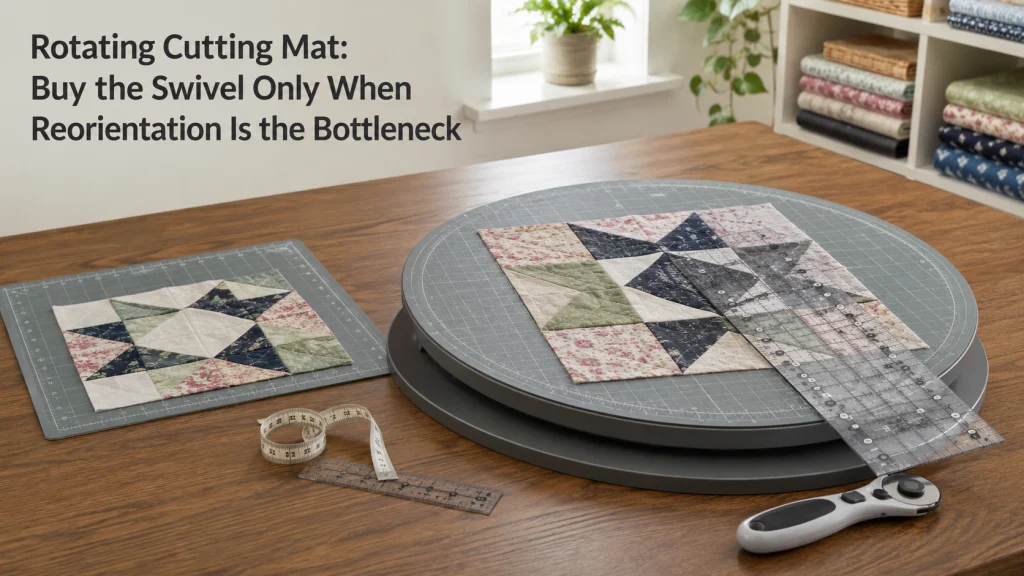
A Rotating Cutting Mat Is Useful Only When Reorientation Is the Bottleneck
A rotating cutting mat solves a narrow problem: the work needs to face several directions while the ruler and cutter keep returning to a comfortable cutting position. Picture a square quilt block that needs trimming on four sides. On a fixed mat, you can lift and turn the block, walk your hands around the work, or rotate the entire mat if it is small enough. On a swivel cutting mat, the cutting surface itself can turn while the block remains positioned on top.
That sounds convenient, but convenience alone is not a reason to add another reusable tool. If most cuts are long straight strips, garment sections, or pieces that already fit a simple fixed orientation, the rotating mechanism may add little to the workflow. If small pieces repeatedly need two, three, or four new orientations before the task is finished, rotation has a clearer job to do. The buying question is therefore not whether rotation is pleasant, but whether it removes a repeated handling step you actually perform.
| Work pattern | What keeps changing? | First tool question |
|---|---|---|
| Long strips or large panels | Cut location more than orientation | Is a larger fixed cutting area more useful? |
| Small block trimming | Piece orientation after each edge | Would surface rotation reduce repeated lifting? |
| Template or detail work | Cutting angle around the piece | Does the entire piece fit the rotating surface? |
Use that distinction before reading feature lists. A rotation mechanism is useful only after the task itself has shown that orientation changes are frequent enough to matter. For the broader reusable-tool decision, the sewing tools guide separates cutting equipment from other sewing-tool families. If you still need to decide what cutting-mat family fits the rest of your sewing work, compare fabric cutting tools by task before treating the swivel as an automatic upgrade. The next step is to count the cuts that actually force the work to turn.
Identify the Cuts That Require Repeated Turning
Start with one normal cutting session and list the pieces that make you stop solely to change orientation. A square block may need four edge trims, a small polygon may present several angled sides, and a curved template piece may require the work to face a new direction more than once. Do not count every pause as evidence for a rotating mat, because moving a ruler, checking a measurement, or repositioning a large fabric section can be a different problem. Count only the moments when turning the work surface would directly replace turning the piece or your cutting position.
Frequency matters more than novelty. A task that appears once in a large project can be mildly inconvenient without justifying a dedicated swivel surface, while the same four-way trim repeated across many small units creates a much stronger case. Record how often the turn occurs within one piece and how often that piece appears in your normal work. This gives the rotating mechanism a measurable purpose without inventing claims about speed, comfort, or cutting accuracy.
| Cutting task | Turns per piece | Pieces per normal session | What the turn is solving |
|---|---|---|---|
| Block squaring | Enter your count | Enter your count | New edge presented to ruler and cutter |
| Small template piece | Enter your count | Enter your count | New cutting angle around the piece |
| Long strip cutting | Often few orientation changes | Enter your count | Usually more about length than rotation |
This is the first half of the buy-or-skip worksheet. If the rotation column stays nearly empty, the tool has not yet earned a place in the workflow. If the same small-piece task keeps producing several turns, you have identified the exact problem a swivel surface is designed to address. The second half is whether the work actually fits the rotating area.
Measure the Typical Piece or Block Before Choosing the Mat
A rotating quilting mat is only useful when the piece can stay supported through the orientations you need. Measure the largest recurring block or detail piece that you expect to rotate, including any extra fabric that must remain on the surface during trimming. A mat that looks large enough from one direction can become restrictive when a corner swings toward the edge during rotation. The useful dimension is therefore the full work footprint while the piece turns, not just the finished size printed on a pattern.
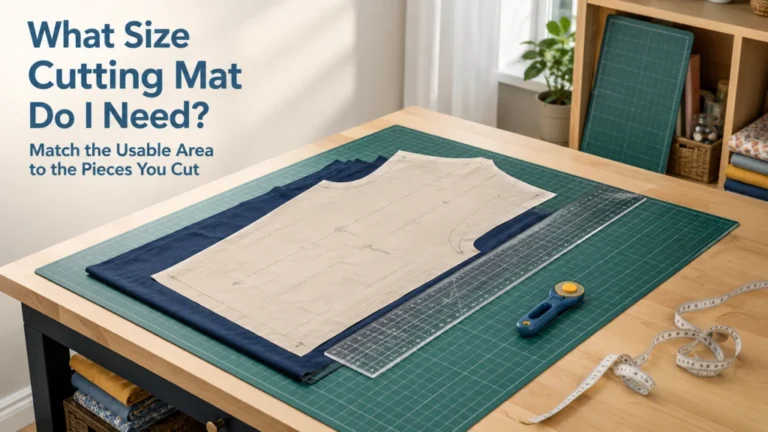
Keep this measurement separate from general cutting-mat sizing. A large garment pattern piece may justify a broad standard mat but still have no reason to rotate, while a compact quilt block can create frequent directional changes on a much smaller surface. If you need help choosing the overall dimensions for nonrotating work, match cutting mat size to your work before narrowing the swivel decision. The rotating mat should be sized for the repeated piece that actually benefits from rotation.
Also compare the piece with the ruler you normally place across it. A block may fit the mat while a long ruler extends well beyond the rotating surface, which can change how stable or convenient the setup feels. That does not automatically disqualify the mat, but it means the mat dimensions alone do not describe the whole cutting arrangement. Once the work footprint is known, you can read actual rotating-surface dimensions with a useful reference point.
Check the Rotating-Surface Dimensions, Not Just the Product Footprint
Rotating mats are sold in different geometries, and the number that matters most is the usable cutting surface that turns with the work. One current manufacturer documents a 12-inch rotating surface built from a stationary lower layer and an interlocking upper cutting layer, while another documents a 14-inch-diameter replacement surface for its swivel system. Those examples show why a generic label such as swivel cutting mat does not tell you how much usable rotating area you are buying. Read the exact product dimensions and distinguish the cutting surface from any base, border, or mechanism beneath it.
A circular rotating area and a square rotating area can also fit the same block differently near the corners. The right comparison is whether your measured work footprint stays supported in every orientation required by the task. Do not assume that a larger outside footprint automatically creates a larger cutting field, because base hardware can occupy space that is not intended for cutting. If the manufacturer does not clearly state the usable surface, mark that measurement as unverified rather than estimating it from product photography.
| Evidence item | What to record | Why it matters |
|---|---|---|
| Rotating cutting area | Exact stated width, length, or diameter | Shows whether the recurring piece can stay supported |
| Overall base footprint | Exact stated dimensions when available | Shows how much table space the tool occupies |
| Surface shape | Round, square, or another documented geometry | Changes corner clearance while the work turns |
| Rotation range | Exact manufacturer description | Confirms whether the surface turns through the required orientations |
This size-and-stability evidence card keeps dimensions attached to their real job. It also prevents one convenient size recommendation from being treated as a universal answer. A useful rotating surface is large enough for the repeated work and small enough to function on the available support. The mechanism underneath that surface is the next evidence check.
Check Base Stability and Rotation Behavior From Exact Product Information
A rotating mat needs two behaviors that can sound contradictory: the base should remain stable on the work surface while the cutting layer turns when you intend it to. Manufacturers solve that relationship in different ways. Current documentation includes examples with a non-slip stationary lower layer and an interlocking rotating top, a ball-bearing swivel system, and a lockable turning mechanism on another specialist cutting setup. Those descriptions are useful because they show that “rotating” is a category, not one universal mechanism.
Look for the exact words the maker uses for the base, bearing or turning structure, and any lock or friction behavior. One maker also states that its swivel works best on a very flat surface, which is a reminder that an uneven support can affect how a rotating assembly behaves. Do not infer that one friction level, lock style, or bearing design is safer or more precise without evidence under stated conditions. The practical buying question is whether the documented mechanism provides intentional rotation while the base is designed to remain planted during normal use.
Assume every rotating mat locks, every swivel relies on the same friction, or a non-slip base means the cutting surface itself cannot move unexpectedly.
Check the exact base construction, rotation mechanism, lock behavior if any, surface requirement, and manufacturer instructions for the tool being considered.
Safety still depends on normal rotary-cutting practice and the exact product instructions. Keep fingers out of the blade path, use the cutter’s guard or blade-closing system as directed, and do not improvise a restraint around a moving surface while cutting. This article is comparing reusable-tool architecture, not teaching cutting technique. Once the mechanism makes sense, compare it with the simplest alternative: turning a small standard mat by hand.
Compare the Swivel With Simply Rotating a Smaller Standard Mat
A dedicated swivel is not the only way to keep a small piece oriented toward the cutter. If you already own a compact standard mat that can be lifted or turned easily on the work surface, rotating the entire mat may solve much of the same handling problem. The difference is that a rotating mat has a mechanism designed to turn while its base remains in place, whereas a standard mat depends on you moving the whole sheet. Which approach is better depends on how often the turn occurs, how large the mat is, and whether moving the whole mat disturbs the ruler, piece, or surrounding setup.
Run the comparison with the same recurring block or detail piece. Count how many times you must lift the fabric, move the ruler, shift your body position, or turn the whole mat to complete the sequence on your existing setup. Then ask which of those actions a swivel would actually remove. Do not assign imaginary minutes saved, because the benefit varies with the task, mat, ruler, workspace, and user workflow.
| Step | Rotate the work | Rotate a small standard mat | Rotate a swivel mat |
|---|---|---|---|
| Present the next edge | Lift or turn the piece | Turn the entire mat | Turn the cutting surface |
| Keep the base location fixed | Usually yes | No, the mat itself moves | Designed to remain in place |
| Extra mechanism | None | None | Rotation system must be stored and maintained |
| Best fit | Few turns or easy piece handling | Small mat already solves the problem | Repeated turns justify a fixed-base rotating surface |
This rotate-work-versus-rotate-mat map is the most important skip test in the article. If the smaller standard mat already turns easily and does not disturb alignment, the specialized mechanism may duplicate something you can already do. If the whole-mat movement is exactly what keeps interrupting a repeated small-piece sequence, the swivel has a clearer role. That is a workflow distinction, not a claim that one tool always produces better cuts.
Decide Whether the Rotating Tool Earns Its Storage Space
A reusable cutting tool has to fit both the cutting session and the space between sessions. A rotating base can be thicker or more mechanically complex than a plain sheet mat, so check the complete stored footprint rather than assuming the cutting-surface dimension tells the whole story. Decide whether it will stay on the cutting table, slide onto a shelf, travel to classes, or need another protected storage position. The best location is one that follows the manufacturer’s storage guidance and does not force the mat to bend or rest against unsuitable heat.
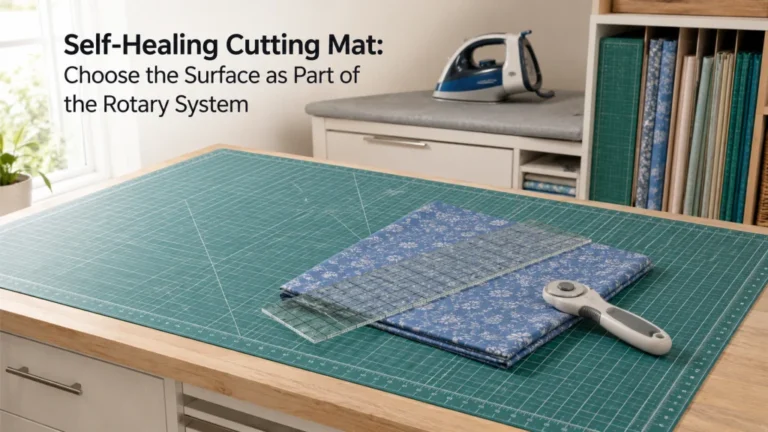
This is where the buy-or-skip worksheet becomes a final decision rather than a feature comparison. A mat that solves frequent reorientation, fits the recurring piece, turns predictably on the available surface, and has a realistic storage location has earned a clear job. A mat that solves only occasional turning while duplicating a small standard mat has a weaker case. If you are still deciding whether the basic cutting surface itself should be self-healing, compare self-healing cutting mat characteristics separately from the swivel mechanism.
- Repeated orientation changes are present in normal work.
- The recurring piece fits the usable rotating surface in every needed orientation.
- The base and rotation behavior are documented by the maker.
- The tool fits the available flat support without crowding the cutting path.
- A smaller standard mat does not already solve the same problem well enough.
- The complete rotating assembly has a realistic storage location.
If most of those checks are positive, you have enough evidence to start shopping within the rotating-mat category rather than treating the mechanism as a novelty. If several fail, skipping the swivel is a reasonable equipment decision and does not leave a gap in the basic cutting setup. For care questions about an existing self-healing surface, follow cutting mat cleaning guidance rather than turning this buying article into a maintenance procedure. The decision should end with a tool that solves a repeated handling problem, not with another surface that simply needs storage.
Final Thoughts: Buy Rotation for a Repeated Handling Problem
A rotating mat is most convincing when the same small piece has to face several directions and moving the work keeps interrupting the sequence. Measure that piece, check the usable rotating area, and read the exact base and rotation mechanism before comparing prices or brands. Then test the simplest alternative in your reasoning: could a smaller standard mat be turned just as effectively? If the answer is yes, the specialized swivel may not add enough to justify another tool.
If the answer is no, the rotating surface has a specific job rather than a vague convenience claim. It should support the recurring work in every orientation, remain stable according to its documented design, fit the available cutting area, and have a sensible storage location. None of those checks proves faster cutting or better accuracy by itself, and they do not replace safe rotary-cutter handling. They simply make the purchase decision match the real reorientation problem that prompted it.
FAQs
Questions about rotating mats usually come down to whether the mechanism changes a recurring cutting task enough to justify owning another surface. The answer depends on piece size, number of orientation changes, usable rotating area, base behavior, and the standard mats already available in the workspace. A feature such as 360-degree rotation is meaningful only when the work fits and frequent turning is part of the job. Use the answers below as buying filters rather than universal rules.
These answers stay at the reusable-tool decision level. They do not replace the exact cutting-mat instructions or the rotary cutter’s blade-safety directions. They also do not assume that one person’s preferred mat size or swivel resistance is technically best for everyone. When a product-specific claim matters, check the maker’s current dimensions and mechanism description.
🔄 Is a rotating cutting mat worth buying?
It can be when small pieces repeatedly need new orientations and turning the work is a real interruption. If a small standard mat already rotates easily enough for the same task, the swivel may be unnecessary.
📏 What size rotating cutting mat should I choose?
Choose from the largest recurring piece that actually benefits from rotation, including the space it occupies after turning. Verify the usable rotating surface rather than relying only on the overall product footprint.
🧩 Are rotating mats mainly for quilt blocks?
Quilt blocks are a common use because several edges may need trimming, but the broader requirement is repeated reorientation of a piece that fits the surface. Templates, curves, and other detailed pieces can create the same buying question.
🛑 Do all rotating cutting mats lock in place?
No. Current products use different mechanisms, including non-slip stationary bases, swivel or bearing systems, and designs that include a lock. Check the exact product information instead of assuming one mechanism applies to the entire category.
🪚 Can I just rotate a normal cutting mat instead?
Yes, especially when the standard mat is small enough to turn without disrupting the setup. A dedicated swivel becomes more useful when moving the entire mat is the repeated handling problem you are trying to remove.
📦 How should I store a rotating mat?
Follow the exact manufacturer’s storage guidance and account for the entire base as well as the cutting surface. Avoid bending the mat or exposing it to unsuitable heat when the maker warns against those conditions.
References and Sources
The sources below are limited to claims that require exact product documentation, especially rotating-surface dimensions, base construction, rotation mechanism, and flat-surface requirements. They are used as examples of how current rotating mats can differ mechanically, not as recommendations to buy a named product. The article does not use community preference as proof of technical performance. Any exact product being considered should be checked against its own current instructions and specifications.
Manufacturer documentation also shows why the word rotating is not enough to predict behavior. One current design uses a stationary non-slip lower layer with an interlocking upper mat, while another describes a ball-bearing swivel and states that a flat support helps the system rotate properly. A specialist supplier documents a separate lockable rotating mechanism, which confirms that locking behavior is model-specific rather than universal. Those differences support the article’s evidence-first comparison of size, base stability, and rotation behavior.
- OLFA rotating mat specifications: documents a 12-inch rotating self-healing surface, a stationary non-slip lower layer, an interlocking upper mat, and 360-degree rotation.
- Swivel replacement mat specifications: documents a 14-inch-diameter replacement cutting surface for the manufacturer’s swivel system.
- Swivel setup information: documents 360-degree rotation, product weight, and the recommendation to use the swivel on a very flat work surface.
- MadamSew rotating mat specifications: documents a 12-inch-square rotating mat with a non-slip base and lockable turning mechanism.