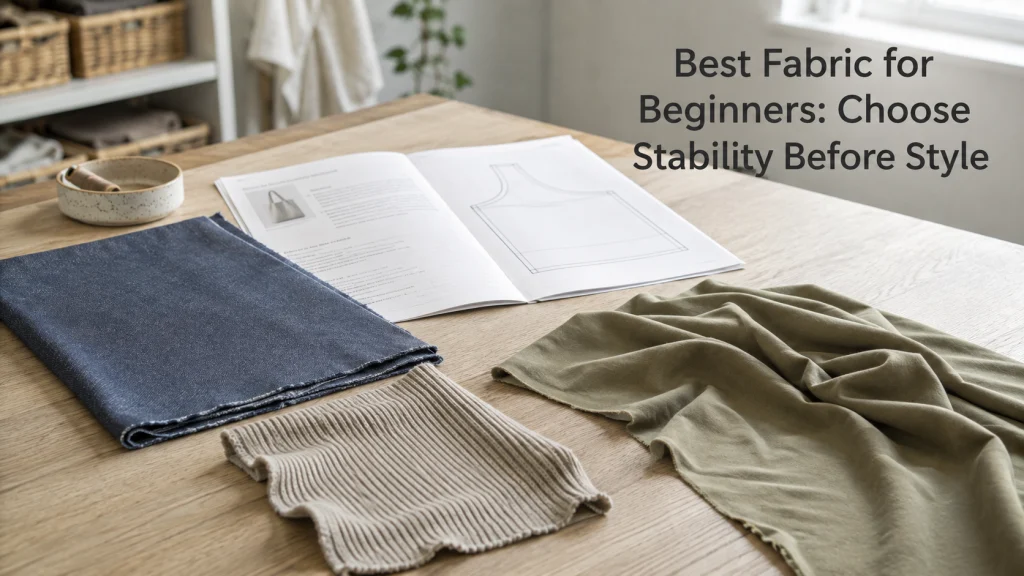
The best fabric for beginners is not defined by fiber name alone. A stable woven cotton and a stretchy cotton knit can both say cotton on the label while creating very different handling demands for a first machine-sewn project. Start with the project shape and required drape, then check construction, stability, weight, opacity, stretch, recovery, and signs of edge or surface mobility before buying. The goal is to reduce avoidable variables on early projects without pretending one fabric is universally easiest.
Start With the Project Shape and Required Drape
Two fabrics can both list cotton as the fiber and still create very different first-project experiences. A compact woven may stay close to the shape you place on the table, while a cotton knit can extend and relax because its yarns are arranged in loops. That contrast shows why beginner-friendly behavior cannot be predicted from fiber name alone. The first buying question is whether the exact fabric has the shape, drape, stability, and movement the project actually requires.
A manageable fabric can still be the wrong fabric if it fights the intended silhouette. A structured tote, simple apron, loose pajama pants, gathered skirt, and fluid top do not ask for the same amount of body or drape. Read the pattern’s suggested fabrics and study the finished shape before choosing mainly for ease of control. When drape remains unclear, compare fabric drape and body before letting stability override the design.
| Project question | Beginner selection check | What to avoid assuming |
|---|---|---|
| Does the project need structure? | Look for enough body to support the intended shape. | Heavier always means better structure. |
| Does the project need soft folds? | Check whether the material falls rather than standing away from itself. | A stable fabric will automatically create the right silhouette. |
| Does the pattern name fabric families? | Use those recommendations as the first shopping range. | Any fabric with the same fiber will substitute cleanly. |
| Is the first project mainly practice? | Choose a project whose shape works with a stable, manageable material. | Practice fabric can ignore the project’s basic material requirements. |
After the project requirement is clear, use a short purchase filter to compare plausible fabrics. Reject candidates that fail the required drape or stretch first, then compare the survivors for stability, weight, opacity, recovery, and edge or surface movement. This keeps a stable knit in play when the project needs knit fabric and prevents a difficult woven from passing simply because it is non-stretch. The filter narrows the shopping decision without turning fabric names into a fixed beginner ranking.
| Filter step | Question | Keep the fabric when |
|---|---|---|
| 1. Project fit | Does the material suit the intended shape and pattern recommendation? | The basic material behavior fits the project. |
| 2. Construction | Is the construction stable enough for the amount of movement you want to manage? | Mobility is appropriate to the project and learning goal. |
| 3. Weight and opacity | Are bulk and coverage appropriate? | Neither creates an unnecessary project mismatch. |
| 4. Stretch and recovery | Does the project need the observed stretch? | Stretch matches the design rather than adding random complexity. |
| 5. Surface and edge behavior | How much shifting, fraying, or rolling appears before sewing? | The added handling variables feel reasonable for the project. |
The easiest first material is the one that fits the design while asking you to manage fewer unfamiliar behaviors at once. For the broader classification framework, use the fabric types for sewing guide before narrowing the choice to beginner handling. If you are still building the full project list, choose sewing supplies by function so fabric stays connected to the rest of the project requirements. That keeps the decision tied to the finished item instead of to a generic fabric recommendation.
Prefer a Stable Construction When Learning Basic Control
Construction is the more useful clue when the buying question is how much a fabric will move during ordinary handling. Woven fabrics are formed by interlacing lengthwise and crosswise yarn systems, while knits are formed from intermeshing loops that usually allow more shape change. A stable woven can remove one source of movement during an early project, but loose wovens and firm knits show why the category still needs a closer look. Use construction to narrow the field, then judge the exact material by how well it holds its shape for the project.
Stability varies substantially inside each construction family. A loose woven can shift more than a compact woven, while a firm double knit can feel more controlled than a very light single jersey. Look for a fabric that keeps its shape reasonably well when lifted, folded, and placed on a flat surface, provided that behavior still suits the project. If construction itself is confusing, compare knit and woven fabric before using stretch or fiber content as shortcuts.
| Material signal | More stable behavior | More mobile behavior |
|---|---|---|
| Shape on a flat surface | Stays close to the placed shape. | Distorts, creeps, or relaxes noticeably. |
| Stretch without force | Little unintended extension for the project. | Extends easily or changes shape with light handling. |
| Surface movement | Layers tend to remain aligned. | Layers slide readily against one another. |
| Edge behavior | Cut edges remain relatively calm during handling. | Edges curl, roll, shed, or shift enough to add another variable. |
Use the card as a purchase screen rather than a sewing method. It identifies materials that may require less correction during early projects without turning woven or knit into universal good and bad categories. If a stable woven candidate is quilting cotton and the intended project is clothing, check quilting cotton for clothing before assuming its stability also makes it the right garment fabric. Technique choices such as cutting, stabilizing, feeding, or stitch setup belong after the material has been selected.
Check Weight and Opacity for the Project
Very light and very heavy fabrics can create different kinds of difficulty, so moderate weight is often easier to assess on an early project. A very light fabric may be more mobile or translucent, while a very heavy material can create bulk that complicates the project. Those are tendencies rather than universal rules because construction, density, finish, and design also matter. Use weight to narrow plausible options instead of turning one number into a beginner ranking.
Opacity belongs in the same purchase check because a stable fabric can still be too sheer for the intended use. When possible, hold a swatch against light and compare its coverage with what the finished project requires. If you are shopping online, ordering a small swatch before full yardage can also help you judge real weight, coverage, surface movement, and color more reliably than product photos alone. When weight needs more detail, compare fabric weight for sewing before choosing between neighboring materials.
Also check whether the seller or pattern guidance gives any information about expected shrinkage or care-related dimensional change before you commit to the full quantity. A fabric that changes noticeably after its first cleaning can affect finished dimensions or the amount of usable yardage, even when its weight and opacity looked appropriate at purchase. If the listing is silent and the project is size-sensitive, a swatch can help you decide whether that uncertainty is acceptable before buying more material. Keep this as a purchase consideration rather than turning it into a washing or preshrinking procedure.
- Check whether the weight suits the project rather than searching for one universal beginner number.
- Look for enough body to keep the material manageable without making the project unnecessarily bulky.
- Check opacity against the intended use, especially when the project will not be lined.
- Compare similar fabric candidates using the same weight unit when supplier data is available.
- Keep weight separate from drape because two fabrics at similar weights can hang differently.
The best beginner choice is usually the material that removes unnecessary extremes while still fitting the project. A moderate, stable fabric can make the first few machine tasks easier to observe because the material itself is not changing shape dramatically. That is a selection advantage, not a claim that every medium-weight fabric will be easy.
Check Stretch and Recovery Before Buying
Stretch describes how far a fabric can extend, while recovery describes how well it returns toward its original dimensions. A pattern designed for stretch may require a material that reaches a stated amount or moves in a particular direction, so replacing it with a stable woven simply for easier handling can make the material unsuitable. The opposite mistake is choosing a highly elastic fabric for a project that does not need that movement. Treat stretch as a project requirement first and a handling consideration second.
If the project does not require stretch, a low-stretch or non-stretch material can simplify early machine control. If the design does require stretch, stay within that requirement and look for a comparatively stable option rather than abandoning the intended fabric family. Fiber content may offer clues, but it does not establish the finished fabric’s stretch percentage or recovery. Use the exact listing, pattern requirement, or swatch behavior to decide whether the material belongs in the candidate set.
Note: Knits should not be banned from beginner projects as a category. A stable knit used in a project designed for knit fabric can be a more sensible first stretch project than forcing a stable woven into a design that depends on stretch.
Once the purchase decision is made, stop at the selection boundary. Needle choice, stitch choice, feeding adjustments, stabilizing methods, and other handling techniques belong to the next stage of sewing the chosen fabric. Keeping that boundary clear prevents this article from becoming a technique tutorial.
Check Whether the Fabric Frays, Shifts, or Rolls Only as Selection Signals
Some fabric behaviors are worth noticing before purchase even though the solution belongs to sewing technique. A loosely constructed woven may fray readily, a slick surface may let layers move against one another, and some knit structures may curl at cut edges. Each behavior adds another handling consideration while a beginner is also learning basic machine control. One signal may be manageable, while several together can make an early project unnecessarily demanding.
Use a swatch, store sample, or detailed seller description to look for these behaviors before committing to full yardage. Repositioning a sample can reveal whether the surface slides easily, and a cut swatch can show whether the edges remain calm or become mobile quickly. Do not turn those observations into a blanket ban on satin, jersey, linen, rayon, or any other named material because construction and finish can change the behavior substantially. The purchase decision is simply whether the added handling demands make sense for this project.
| Selection signal | What it may add to a first project | Purchase-level response |
|---|---|---|
| Pronounced fraying | Cut edges change quickly during normal handling. | Decide whether that extra edge management belongs in the first project. |
| Slippery surface | Layers can move relative to each other. | Compare with a more stable candidate if the project allows it. |
| Edge rolling or curling | The cut shape becomes harder to keep visually flat. | Choose a calmer construction when stretch is not required. |
| High stretch with slow recovery | The piece can change shape during ordinary handling. | Confirm the project actually needs that behavior. |
A learner does not need a fabric with zero movement, zero fraying, and zero stretch. The goal is simply to avoid stacking several new handling problems onto a project that is supposed to teach basic control. When you want inexpensive material for testing shape or construction rather than a final project fabric, choose muslin by its intended role instead of assuming every muslin listing serves the same purpose.
Final Thoughts: Reduce Variables on the First Projects
The best fabric for beginners is usually the one that fits the project while avoiding unnecessary handling complications. Start with shape and drape, then compare construction, stability, weight, opacity, stretch, recovery, edge behavior, and any care-related dimensional uncertainty that could affect the project. A familiar material name can help you find candidates, but the purchase should be decided by the properties that matter to the finished item. This approach gives you a reason for the choice instead of a rule that every beginner should buy the same fabric.
More demanding materials can be introduced whenever the project makes them worthwhile. A stretchy knit, fluid woven, sheer material, or mobile surface can be an appropriate choice when the design needs that behavior and you are ready for the extra handling demands. Early projects simply benefit from keeping the number of new complications reasonable. Choose stability before style only when stability still supports the project you actually want to make.
FAQs
🧵 Is cotton always the best fabric for beginners?
No. The fiber label is only one part of the specification, so two fabrics in the same fiber family can differ greatly in stability, stretch, weight, drape, and surface behavior. Choose by the exact material and project requirements rather than by fiber reputation alone.
🧱 Why are stable woven fabrics often easier to start with?
A stable woven usually changes shape less during ordinary handling than a highly stretchy or mobile material. That can remove one variable while a beginner is learning basic cutting, alignment, and machine control.
⚖️ Should a beginner always choose medium-weight fabric?
No single weight is correct for every project. Moderate weight can avoid some extremes, but the fabric still has to provide the body, drape, opacity, and stretch required by the design.
🧶 Are knit fabrics wrong for a first sewing project?
No. If the project is designed for knit fabric, a comparatively stable knit can be a reasonable first stretch project. The key is to match the required stretch and avoid adding more mobility than the design needs.
✂️ Should I avoid fabric that frays or rolls at the edges?
Not automatically. Fraying, rolling, shifting, and strong stretch are selection signals that tell you how many handling variables the material may add to the project.
🪡 What should I do after choosing the fabric?
Move to the fabric-specific sewing instructions for the material and project you selected. Needle, stitch, feeding, stabilization, and handling decisions belong to that next stage rather than the purchase filter used here.
References and Sources
- Simplicity fabric selection guidance: Supports checking project needs, fiber content, width, stretch, weight, and swatches before committing to yardage.
- Simplicity pattern envelope guidance: Supports starting from suggested fabrics, stretch requirements, yardage, and other project material information.
- CottonWorks weaving basics: Supports the description of woven construction as interlacing lengthwise and crosswise yarn systems.
- CottonWorks knit basics: Supports the description of knit construction as intermeshing yarn loops and its greater shape flexibility compared with typical woven structures.