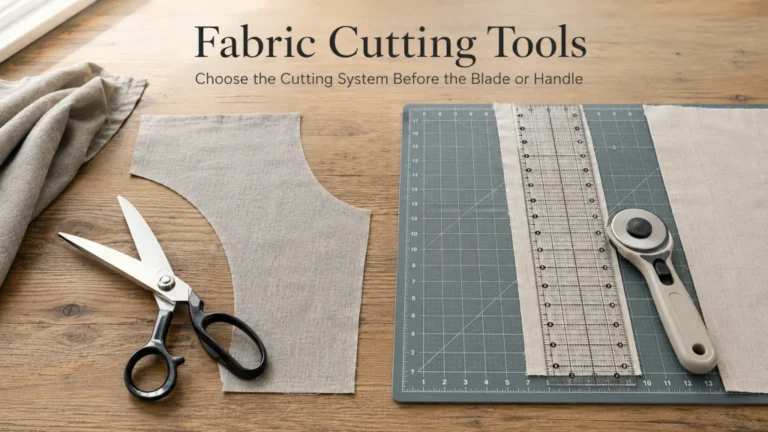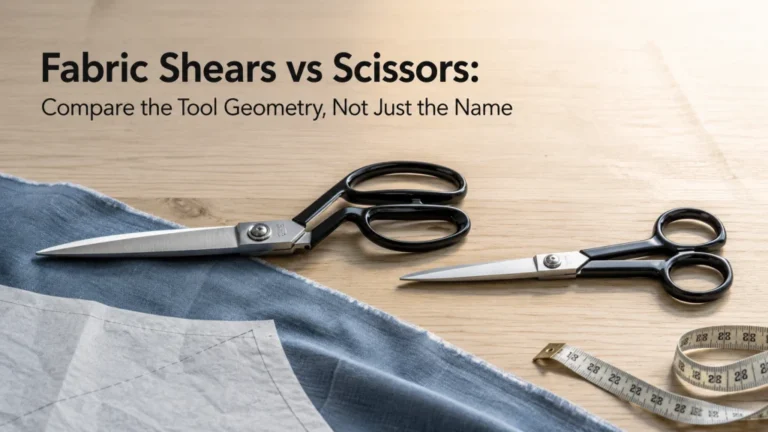
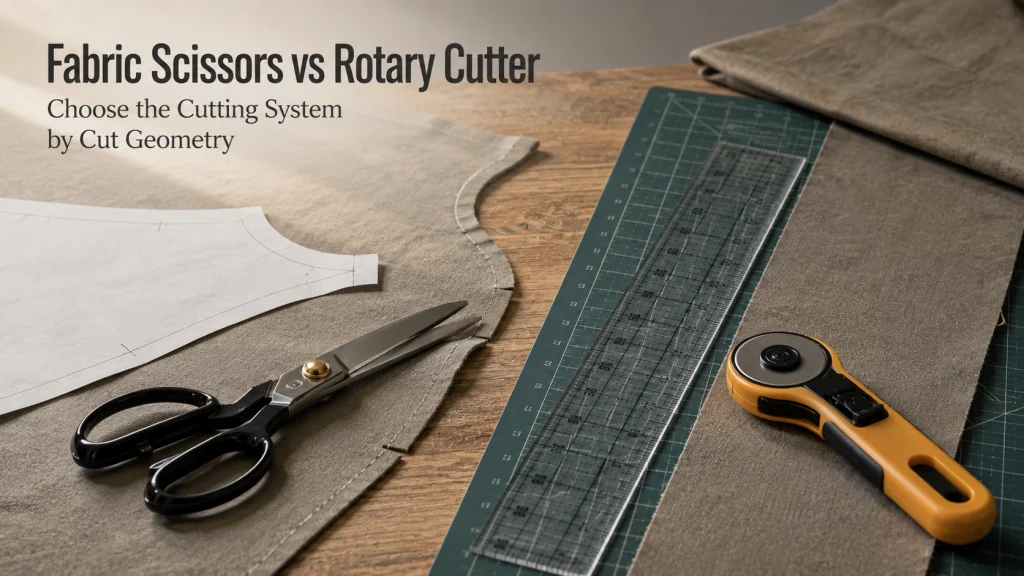
Fabric scissors vs rotary cutter is not a universal winner-takes-all comparison. Scissors lift and shear the fabric between two blades, while a rotary cutter rolls a circular blade across fabric that stays supported on a cutting mat. That difference changes how each system handles curves, notches, ruler-guided straight cuts, workspace, and replacement-blade ownership. Choose by the cut geometry and the total system your projects actually require, then leave blade size, exact material capacity, and cutting technique to their own decisions.
Let Cut Geometry Decide Before Brand Preference
Imagine two pattern pieces on the same table: one is a long straight strip, and the other has a curved armhole with several small notches. Both need clean fabric cuts, but they ask different things from the cutting tool. The straight strip favors a system that can follow a long guide without repeatedly opening and closing blades, while the curved piece rewards a tool that can turn easily and make short, controlled cuts.
That is the useful frame for fabric scissors vs rotary cutter. Sailrite’s comparison describes scissors as useful for tight curves and detail work and rotary cutters as keeping fabric flat while supporting long cutting passes. Those are tool-geometry differences, not proof that one system is always faster, easier, or more accurate for every person and fabric.
If the broader cutting-tool family is still undecided, compare fabric cutting tools before narrowing the choice to these two systems. For the wider sewing-tool map, review essential sewing tools without treating every cutting task as the same ownership problem.
Compare Whether the Fabric Stays Flat or Is Lifted
Scissors cut by bringing two blades together around the material. In normal hand use, that action can lift part of the fabric as the lower blade moves under it. Fiskars even distinguishes tabletop shears with elevated handles as a design intended to reduce fabric lift, which shows that lift is a real part of scissor geometry rather than an invented drawback.
A rotary cutter works differently. The circular blade rolls across fabric supported on a mat, so the material can remain flat on the work surface during the cut. That can matter when a pattern or ruler is already aligned and you want to avoid repeatedly raising the fabric to make the next blade stroke.
Neither geometry is automatically more accurate. Fabric can still shift under poor handling, a dull blade can change the cut, and a badly supported pattern can move with either tool. The useful distinction is simply whether the cutting method itself requires the fabric to be lifted between blades or allows it to remain supported on the surface.
These Fiskars fabric shears use a spring assisted handle that opens the blades after each cut, reducing the need to repeatedly spread the fingers while cutting. Their stainless steel cutting edges are intended for dressmaking fabrics and other common sewing materials, especially when fabric is laid flat on a table. This alternative is the eight inch version rather than the original nine inch model. Keep these shears reserved for fabric, check that the handle suits your grip, and use a separate tool for paper or wire.
Check On AmazonIf you click this link and buy, we earn a commission at no additional cost to you.
Compare Curves, Notches, and Tight Details
Scissors can turn progressively because each cut is created by a short closing motion. That makes them naturally suited to small directional changes, narrow notches, clipped details, and curved pattern edges where the cutting line changes direction frequently. Sailrite’s current comparison specifically highlights tight curves and detail work as a place where scissors remain useful.
Rotary cutters can also follow curves, but blade diameter and the amount of surface needed to steer the cutter affect how sharply the path can change. That is one reason the family-level decision should stop before blade-size selection. A small rotary blade and a large one do not have the same turning behavior, so a generic statement that “rotary cutters cannot cut curves” would be too broad.
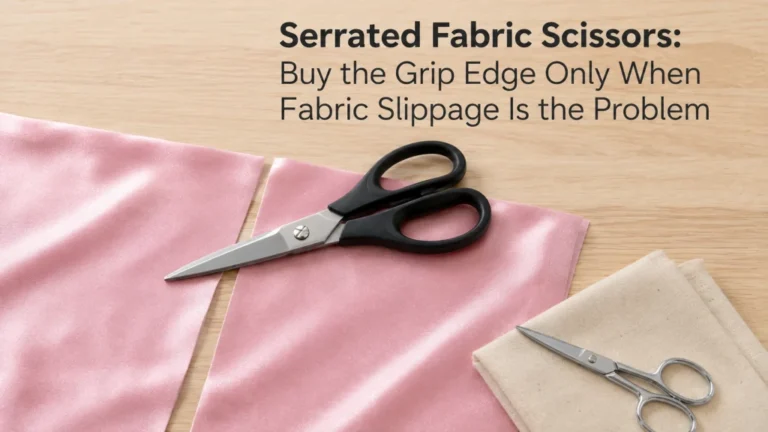
If the decision is clearly in the scissors family, choose fabric scissors for the cutting job rather than turning this comparison into a shears-buying guide. This page only establishes why repeated directional change favors a different cutting geometry from a long ruler-guided pass.
Compare Straight Ruler-Guided Cuts
A rotary system becomes most distinct when the cut can follow a straight guide. The cutter rolls beside an acrylic ruler while the fabric stays on the mat, so the ruler becomes part of the cutting path rather than merely a measuring tool. OLFA sells fabric-cutting kits that pair a rotary cutter with both a self-healing mat and a non-slip acrylic ruler, which is direct evidence that the system is designed as a coordinated group of tools.
Scissors can make long straight cuts too, but the blade path is created by repeated openings and closings rather than one continuous roll along a ruler edge. Whether that difference matters depends on how many straight strips, rectangles, or long edges the project actually contains.
The important boundary is not to convert that geometry into a universal speed or accuracy promise. A ruler-guided rotary cut has a strong structural advantage for straight repeatable paths, but real results still depend on blade condition, ruler control, mat support, fabric behavior, and the operator’s technique.

The Fiskars Loop Rotary Cutting Set includes a 45mm rotary cutter, a 6.5 by 24.5 inch sewing ruler, and an 18 by 24 inch folding cutting mat. The cutter uses a steel blade and supports right- or left-handed setup, while the ruler provides measurement and angle guides. The folding mat supplies a protected work surface for fabric cutting.
Check On AmazonIf you click this link and buy, we earn a commission at no additional cost to you.
Use a Cut-Geometry Matrix
A simple matrix is more useful than asking which tool is “better.” Match the dominant cut shape to the system whose physical geometry makes that cut easier to support.
| Cut geometry | Scissors | Rotary cutter | Decision cue |
|---|---|---|---|
| Long straight strip | Possible with repeated blade strokes | Works naturally with ruler-guided rolling cuts | Rotary becomes more relevant when straight guided cuts dominate. |
| Large gentle curve | Can turn progressively through the curve | Possible with suitable blade geometry and technique | Either system may remain viable. |
| Tight curve or small detail | Short blade strokes can follow frequent direction changes | Turning behavior depends strongly on cutter and blade geometry | Scissors often remain the simpler family-level choice. |
| Notch or short snip | Direct short closing cut | Less natural as a one-off short inward cut | Scissors usually match the cut shape more directly. |
| Repeated ruler-based squares or strips | Can perform the cuts but without a rolling guide system | Designed to work with mat and ruler | Rotary ownership becomes more defensible when this work repeats often. |
The matrix is deliberately task-led. It does not rank brands, prescribe blade diameter, or claim a measurable speed advantage without a controlled comparison.
Compare Multi-Layer Claims Only from Exact Tools
Rotary-cutter marketing often mentions cutting multiple layers, but layer capacity cannot be generalized across the entire tool family. Blade diameter, blade condition, fabric density, thickness, mat condition, and the exact cutter design can all affect what a manufacturer supports. OLFA publishes layer claims on some specific rotary-cutter pages, which is useful evidence for those exact tools and nothing more.
Scissors face the same evidence problem. A large pair of dressmaker shears and a small detail scissor are both fabric scissors, yet their blade length and leverage differ substantially. It would be just as unreliable to publish one universal scissor layer count as it would be to borrow a layer figure from one rotary cutter and apply it to every rotary model.
For this comparison, leave layer count unresolved unless the exact tool documentation states it under conditions relevant to the material. The family-level decision can still be made from cut geometry and ownership requirements without inventing a capacity number.

The OLFA RTY-3/DX is a 60mm ergonomic rotary cutter preloaded with an RB60H Endurance blade. OLFA documents this 60mm cutter for up to twelve layers of cotton and materials such as fleece, wool, and leather. Its squeeze handle exposes the blade, the blade self-retracts when released, and a safety lock can secure it open or closed.
Check On AmazonIf you click this link and buy, we earn a commission at no additional cost to you.
Count the Mat and Ruler as Part of Rotary Ownership
A rotary cutter is not a complete cutting system by itself. OLFA recommends using its rotary cutters with a rotary mat, both to protect the work surface and to support blade life, and its fabric-cutting kits pair the cutter with a self-healing mat and acrylic ruler. That means the real ownership question includes the surface and guide, not just the handheld cutter.
The mat also changes workspace requirements. Scissors can be used on a smaller cleared area because the table does not need to accept a rolling blade. Rotary cutting needs enough supported mat area for the intended cut, and ruler-guided work needs room to position and hold the ruler without pushing the cutter off the protected surface.
If the rotary system already makes sense, choose a self-healing cutting mat based on the work area and cutter system rather than treating the mat as an optional afterthought. The mat is part of the cutting environment.

The OLFA RM-MG is a 24 by 36 inch, 1.5 mm self-healing rotary cutting mat. It is double-sided, with grid lines for straight and angled measurements on one side and a solid cutting surface on the other. OLFA specifies the mat for rotary cutters and states that it protects the work surface while helping extend rotary blade life.
Check On AmazonIf you click this link and buy, we earn a commission at no additional cost to you.
Count Blade Replacement as Part of Rotary Ownership
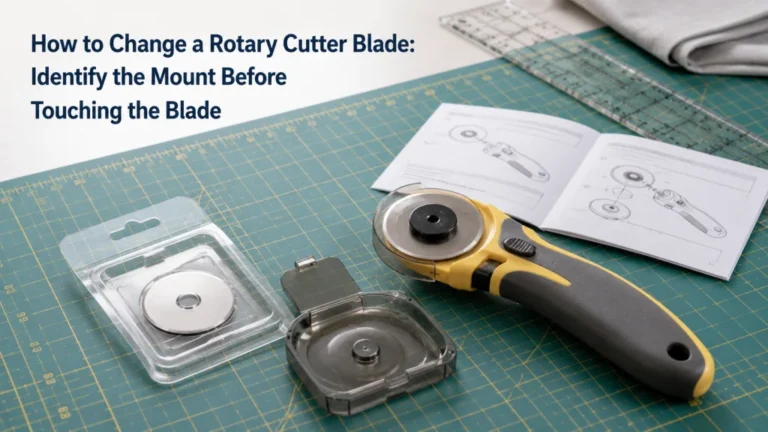
A rotary blade is a replaceable cutting edge. OLFA’s rotary-cutter pages identify compatible blade refills, and its FAQ tells users to replace a blade when it begins skipping threads or sections of material or requires excessive pressure. That makes blade replacement a normal ownership responsibility rather than a defect in the tool family.
Fabric scissors follow a different maintenance path. Depending on construction and manufacturer guidance, a pair may be sharpened, professionally serviced, or replaced when the cutting edges no longer perform properly. This page does not turn that difference into a lifetime-cost calculation because serviceability and blade life vary too much by exact tool and use.
The useful comparison is simply that rotary ownership includes a consumable sharp edge that must be changed safely. If you prefer a system with no removable circular blade, scissors remain mechanically simpler even though they still require edge care.

The OLFA RB45-10 pack contains ten 45mm replacement rotary blades made from tungsten tool steel. The blades fit most 45mm rotary cutters and are listed for materials including cotton, fleece, felt, leather, suede, foam, and vinyl. The replacement blades are packaged together for storage and are designed for use with compatible 45mm rotary cutters.
Check On AmazonIf you click this link and buy, we earn a commission at no additional cost to you.
Count the Mat, Ruler, and Safe Operating Workflow as Part of Rotary Adoption
The rotary system adds more than equipment. It also adds a blade-exposure and storage routine that must follow the cutter’s exact instructions. Current OLFA cutters use blade covers, guards, or retracting mechanisms depending on the model, and those differences are not interchangeable safety procedures.
A ruler is also more than a measuring accessory when it is used as the cutting guide. It needs enough width and stability for the user’s hand to remain clear of the blade path while the cutter travels beside the edge. This article stops before teaching the cutting stroke itself, but the ownership decision should include whether the user has space and equipment for that workflow.
Sharp-tool boundary: Follow the exact cutter instructions for exposing, retracting, changing, and storing the blade. Do not bypass a guard, handle an exposed blade contrary to the instructions, or use a rotary cutter directly on an unprotected work surface.
If the system requirement feels larger than the cutting problem you are trying to solve, that is useful information. A one-off curved pattern piece may not justify adopting the full rotary workflow, while repeated ruler-guided cutting can make the extra system more relevant.

The OLFA RTY-2/DX uses a 45mm rotary blade with a squeeze-trigger handle that exposes the blade for cutting and self-retracts it when released. A dual-action safety lock can secure the blade in either the open or closed position. The cutter supports right- and left-handed use after reversing the blade assembly and accepts compatible OLFA 45mm replacement blades.
Check On AmazonIf you click this link and buy, we earn a commission at no additional cost to you.
Decide Whether One System Covers the Actual Project Mix
Some sewing work can be handled comfortably with one cutting family. If projects are dominated by garment pattern pieces, curves, notches, and one-off shapes, fabric scissors may cover most of the cutting geometry. If work is dominated by repeated strips, blocks, straight template cuts, or ruler-based layouts, a rotary system may solve more of the recurring task.
Many sewing rooms eventually use both because the cut geometries are complementary. That should not be treated as a requirement. The better question is whether the second system solves a repeated cutting problem that the first system handles awkwardly enough to justify more tools, workspace, or blade maintenance.
Frequency can reveal that need over time. If several recent projects keep producing the same long strips, repeated rectangles, or other ruler-guided cuts, that pattern is a stronger reason to reconsider rotary ownership than one isolated cut on one project. The same logic works in reverse: if the recurring work remains mostly curves, notches, and short detail cuts, scissors-only may still match the real workload without adding another cutting system.
| Decision step | If yes | If no |
|---|---|---|
| Do tight curves, notches, and detail cuts dominate? | Start with the scissors family. | Continue to the straight-cut question. |
| Do long ruler-guided cuts repeat often? | Consider the rotary system. | Scissors may still cover the project mix. |
| Do both cut types recur often? | Owning both systems may be justified. | Buy only the family that solves the dominant task. |
| Is mat, ruler, blade replacement, and storage acceptable? | Rotary ownership remains viable. | Keep the decision with scissors unless the cutting need changes. |
This decision flow keeps the choice tied to repeated tasks rather than tool loyalty. It also creates a clean stopping point before model selection.
Use a Total-System Ownership Checklist
Before adding a rotary cutter because one straight-cut example looked convenient, count every part of the system. A scissors purchase and a rotary-system purchase do not have the same supporting equipment.
- Dominant cut shape: Are the recurring cuts mostly curves and details or long guided lines?
- Work surface: Is there enough protected flat area for the intended rotary mat?
- Guide: Will ruler-guided cutting be part of the actual project mix?
- Blade ownership: Are compatible replacement blades readily identifiable for the cutter family?
- Storage: Can the cutter be stored with the blade secured according to its instructions?
- Portability: Does the full mat-and-ruler system fit how and where you sew?
- Existing tools: Does a current pair of fabric scissors already handle the dominant cuts well enough?
If most of the rotary-specific checks do not solve a real recurring problem, the additional system may not be necessary yet. If several of them match the project mix, the family-level decision can move forward to the exact cutter, blade, and mat questions.
Decide Which Cutting-System Purchase Remains Unresolved
Once the family choice is clear, this comparison should stop. If scissors fit the recurring cuts, compare fabric-scissor features without bringing rotary specifications into that decision. If rotary cutting fits the job, choose a rotary cutter for fabric based on the cutter system rather than repeating the family-level debate.
Blade diameter is another later decision. Different rotary sizes change turning behavior, material reach, and cutter geometry, so compare rotary cutter sizes only after rotary has already won the family-level choice. Likewise, learn the rotary-cutter operating workflow only after the tool system has been selected.
If powered cutting is actually the unresolved requirement, this comparison is no longer sufficient. compare electric fabric scissors separately because a powered cutter changes the drive system, control sequence, and safety boundary.
Final Thoughts: Choose by Cut, Not Tribe
Scissors and rotary cutters solve overlapping but different cutting problems. Scissors naturally handle repeated direction changes, tight details, and short snips. Rotary systems keep fabric supported on a mat and become especially relevant when long ruler-guided cuts repeat across the project.
The ownership difference matters as much as the blade shape. Rotary cutting brings a mat, ruler, replaceable blade, storage routine, and protected work surface into the decision. Choose one system if it covers the real project mix, add the second only when a recurring cut geometry justifies it, and leave model or blade-size selection until after the family decision is settled.
FAQs
✂️ Are fabric scissors or a rotary cutter better for beginners?
Neither is universally better. Start with the cut geometry you expect to repeat. Curves, notches, and detail cuts often align naturally with scissors, while repeated ruler-guided straight cuts make the rotary system more relevant.
📐 Is a rotary cutter better for straight fabric cuts?
A rotary cutter is designed to work with a mat and can follow an acrylic ruler as a cutting guide, so long straight and repeated ruler-based cuts are a natural use case. That does not guarantee better results without proper blade condition and technique.
🌀 Can a rotary cutter handle curves?
Yes, but turning behavior depends on blade diameter, cutter design, and the curve itself. Tight or intricate details often remain easier to approach with scissors, while broader curves can be practical with an appropriate rotary setup.
🧵 Do I need both scissors and a rotary cutter for sewing?
No. One system may cover the dominant project mix. Owning both becomes useful when straight ruler-guided cuts and detailed curved or notched cuts both recur often enough to justify separate tools.
🟩 Does a rotary cutter require a cutting mat?
Use the mat required or recommended by the cutter manufacturer. OLFA recommends its rotary mats with its cutters to protect the work surface and support blade life, so the mat should be counted as part of that rotary system.
🔄 How often should a rotary blade be replaced?
There is no universal replacement interval. OLFA advises replacement when the blade begins skipping threads or sections of material or requires excessive pressure. Follow the exact cutter and blade instructions rather than a fixed schedule.
🧱 Can a rotary cutter cut several fabric layers at once?
Some exact cutters have manufacturer-published multi-layer claims, but there is no single layer count for the entire rotary-cutter family. Use the specification for the exact cutter, blade, and material rather than borrowing a number from another tool.
References and Sources
- Sailrite scissors and rotary-cutter comparison: Supports the family-level distinction between detail and curve work, fabric lift, ruler-based rotary cutting, and the need for a cutting mat.
- OLFA fabric-cutting system documentation: Shows a rotary cutter packaged with a self-healing mat and acrylic ruler, supporting the total-system ownership comparison.
- OLFA rotary cutter and mat guidance: Documents blade-replacement indicators, blade-change support, and self-healing mat use and care.