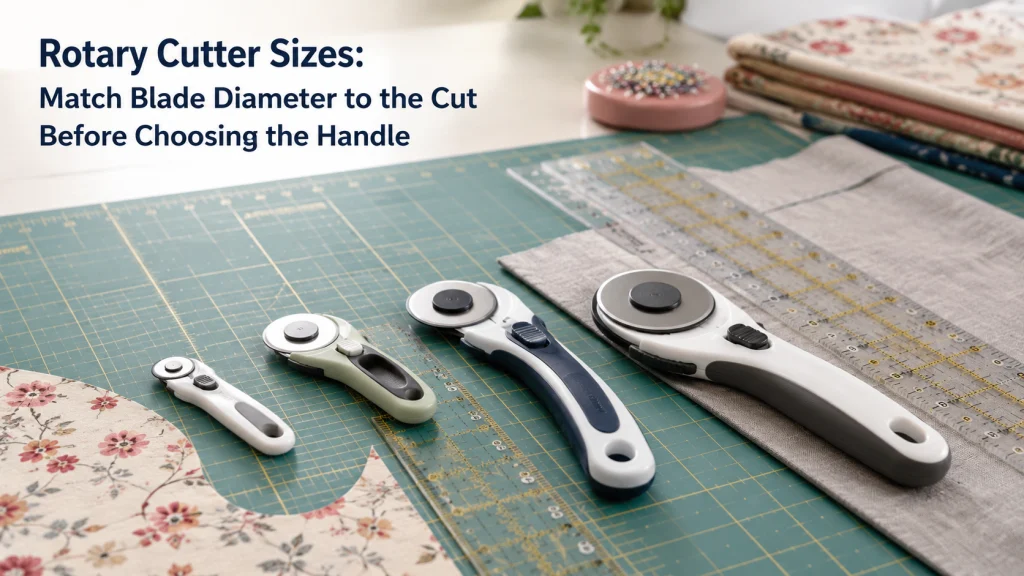
Rotary cutter sizes change how easily a blade follows curves, crosses long straight paths, and works within the material limits documented for a particular cutter. Bigger is not automatically better: smaller diameters suit tighter geometry, while larger diameters are more at home on broad, continuous cuts. For many sewing tasks, 45mm sits in the middle as a general-purpose size, but 18mm, 28mm, and 60mm each make sense when the cut itself calls for a different turning radius or cutting path. The practical choice is to match diameter to the job first, then verify the exact cutter, mat, and blade system.
Rotary Cutter Sizes Start With the Shape of the Cut
Rotary cutter sizes matter because a circular blade has to travel through the path you are asking it to follow. A smaller circle can change direction over a tighter area, while a larger circle naturally favors broader arcs and longer continuous travel. That difference shows up before handle style, grip shape, or other cutter features enter the decision. If the cut itself is wrong for the diameter, a more elaborate handle does not change the underlying geometry.
A useful first split is between cuts that change direction often and cuts that stay mostly straight or gently curved. Small appliqué shapes, compact garment openings, and narrow templates make maneuverability more important, while long ruler-guided strips and broad pattern edges reward steadier forward travel. If the larger question is which cutting system belongs on the sewing table, start with choosing fabric cutting tools before narrowing the choice to blade diameter. The broader sewing tools for machine work overview also covers workspace equipment that sits outside this size-specific decision.
Read the Actual Blade Diameter, Not the Handle Size
The number attached to a rotary cutter refers to the circular blade diameter, not the overall dimensions of the handle. Two cutters can carry the same 45mm blade size and still have noticeably different bodies, guards, grips, and activation mechanisms. Those body differences matter for ownership and operation, but they do not change what a 45mm circle is geometrically capable of tracing. When comparing sizes, keep the blade diameter and the cutter body as two separate decisions.
The relative scale below makes that distinction easier to see because each circle represents the diameter relationship among 18mm, 28mm, 45mm, and 60mm blades. The drawing is proportional to the stated diameters, so the jump from 45mm to 60mm is visibly smaller than someone might assume from seeing four separate product photos. That matters because size selection is not a simple small, medium, large progression in handling behavior. The cutter still has to be judged in the context of the curve radius, length of cut, material, and tool-specific documentation.
The scale is useful for comparing turning geometry, not for predicting how deep a cutter will travel through a stack. A larger circle provides more cutting edge around its circumference, but material capability still depends on the exact cutter and the conditions stated by its manufacturer. That separation prevents a common buying mistake: treating blade diameter as a complete performance specification. Use the diagram to understand size, then use product documentation to understand the individual tool.
18mm and 28mm Cutters for Tight Curves, Points, and Detail
Small rotary cutter blade sizes become useful when the cutting line changes direction often enough that a larger circular blade starts to resist the path. An 18mm cutter is positioned for very small shapes and intricate curves, while 28mm provides more blade circumference without moving all the way into general-purpose 45mm territory. The difference becomes most obvious on compact pattern pieces where the cutter has little room to sweep around a turn. Neither size is automatically more accurate, but both reduce the mismatch between a large circular edge and a small cutting path.
Sharp points create a different geometry problem from smooth curves. On a smooth curve, the blade can keep rolling while its direction changes gradually; at a tight point, the path changes abruptly and may require the cut to end and restart rather than forcing the wheel through an impossible turn. A smaller diameter gives more room to work near that point, but it does not eliminate the need to respect the shape of the cutting line. This is still a size-selection issue, while the separate article on using a rotary cutter correctly covers the actual cutting method.

The OLFA RTY-4 is a compact rotary cutter preloaded with an 18mm stainless steel blade for detailed cutting. Its straight handle can be used right- or left-handed, and the integrated sliding cover shields the blade between cuts. The quick-change mechanism simplifies blade replacement, while the small blade is intended for fabric, paper, curves, template work, and other intricate cuts.
Check On AmazonIf you click this link and buy, we earn a commission at no additional cost to you.
Curve-versus-Straight Selection Matrix
Once the four common diameters are viewed as different turning radii, the choice becomes easier to sort by cut shape. The matrix below does not rank one size as universally superior; it shows where each diameter has a geometric advantage or tradeoff. A size marked strong for curves is not automatically the best choice for long strips, and a size marked strong for straight work may feel unnecessarily large around compact shapes. Use the matrix as a first filter before considering the exact cutter body or material claim.
| Blade diameter | Tight curves and small shapes | Moderate curves | Long straight cuts | Typical decision signal |
|---|---|---|---|---|
| 18mm | Strong fit | Usable | Less efficient | Choose when intricate geometry dominates the work. |
| 28mm | Strong fit | Strong fit | Usable | Choose when small curves matter but the work is not exclusively tiny detail. |
| 45mm | Limited on very tight shapes | Strong fit | Strong fit | Choose when everyday strips and broad pattern work dominate. |
| 60mm | Poor fit for tight geometry | Best on broad arcs | Strong fit | Choose when long, continuous cutting paths are the priority. |
The important word in the last column is “dominates.” A sewist who cuts mostly broad garment pieces with one occasional tight curve does not necessarily need to optimize the entire tool choice around that single curve. The reverse is also true for someone working repeatedly with small templates or compact appliqué shapes. Select the diameter around the recurring geometry, then decide whether a second size is justified by a genuinely different cutting task.
28mm vs 45mm Rotary Cutter for Everyday Fabric Work
The 28mm vs 45mm rotary cutter decision often comes down to whether maneuverability or general-purpose travel matters more. A 28mm blade remains relatively nimble on shaped edges and compact templates, while 45mm provides a larger rolling edge for ordinary strips, broad pattern pieces, and routine fabric cutting. Manufacturer guidance commonly positions 45mm as an everyday size, which explains why it appears so often as a first-cutter option. That does not make 28mm a specialty-only tool, especially when the project mix includes frequent curves.
Someone buying only one cutter should look at the cuts that repeat across actual projects. Mostly straight garment pieces, quilting strips, and moderate curves can make 45mm the more flexible baseline, while repeated small openings and compact templates create a stronger case for 28mm. The separate decision about choosing a rotary cutter for fabric should then account for the whole tool rather than diameter alone. That sequence keeps blade geometry from being confused with grip style, guard design, or other handle-level features.

The Fiskars 45mm Rotary Cutter uses a precision-ground steel blade for cutting fabric, felt, vinyl, and other sewing or quilting materials. Its symmetrical stick handle supports both right- and left-handed cutting. A sliding control extends and locks the blade during use and retracts it for storage, while the 45mm blade is replaceable when it becomes worn.
Check On AmazonIf you click this link and buy, we earn a commission at no additional cost to you.
45mm vs 60mm Rotary Cutter for Long Cuts and Layered Stacks
The 45mm vs 60mm rotary cutter comparison becomes most useful when the work shifts toward long straight paths or thicker documented stacks. A 60mm blade has a larger circumference and is positioned for broad, continuous cutting, while 45mm remains easier to use across a wider mix of straight and gently curved work. OLFA, for example, lists its 45mm cutter for up to eight layers of cotton fabric and its 60mm cutter for up to twelve layers of cotton fabric. Those figures are useful evidence for those specific products, but the practical lesson is to check the stated capability of the exact cutter rather than treating diameter as a universal layer rating.
Material also changes what a layer count means. Eight layers of one cotton stack do not establish the same resistance, compression, or cutting behavior as batting, fleece, vinyl, or another material. A sewist choosing 60mm because multilayer cutting is common should therefore look for documentation that actually names the intended material or use, not just the blade size. This keeps the comparison focused on a real purchasing decision: use diameter to narrow the likely geometry, then confirm whether the individual cutter is documented for the workload.

The Fiskars 60mm Rotary Cutter uses a premium steel blade with a titanium coating and is intended for thicker materials and multiple fabric layers. Its curved loop handle includes SoftGrip touchpoints for added comfort and control. A sliding control extends and locks the blade during cutting, retracts it for storage, and the blade snaps in and out for replacement.
Check On AmazonIf you click this link and buy, we earn a commission at no additional cost to you.
Check the Cutter Body Available in the Diameter You Want
Choosing a diameter does not finish the buying decision because the same blade size can appear in cutters with very different bodies. Straight handles, squeeze-style mechanisms, automatic retraction systems, and handed configurations can all change how the tool is operated even when the circular blade measures the same. A sewist may settle on 28mm for repeated curves and then discover that a preferred body style is not offered in that diameter by the manufacturer being considered. That creates a real tradeoff between blade geometry and the way the cutter itself is designed to work.
Resolve that tradeoff by checking the exact product instructions rather than trying to make one body behave like another. The documentation should show how the blade is exposed, how the guard or retraction mechanism works, and whether the cutter can be configured for the intended hand. These details belong after the size choice because they refine the tool decision without changing the geometry that led to it. If the operating method feels wrong for the user, choose a different cutter design rather than bypassing a built-in safety feature.
Match the Cutting Mat to the Cutter and Workpiece
A rotary cutter is part of a cutting system, and the work surface can make a sensible diameter choice awkward if it is too small for the cutting path. A 60mm cutter chosen for long strips gains little from that geometry when the mat forces the fabric and ruler to be shifted repeatedly before the cut is complete. Smaller cutters can also run into clearance problems when a compact template leaves no room for the cutter body beside its edge. Cutter size therefore works best when mat area, ruler or template clearance, and workpiece size are considered together.
- Keep the full cutting path on a rotary-cutter-safe mat.
- Check that the ruler or template leaves enough room for the cutter body.
- Choose a mat large enough for the fabric pieces you cut most often.
- Confirm that the cutter can travel through the planned path without leaving the protected surface.
If the mat is the limiting part of the setup, solve that before moving to a larger blade. The separate article on choosing the right cutting mat size focuses on work-surface dimensions rather than repeating the blade choice here. A larger mat can improve layout freedom, but it does not make a 60mm blade turn like a 28mm blade. Once the surface supports the work, the diameter can be judged on the geometry it was selected to handle.

The Fiskars Self Healing Cutting Mat provides a 24 x 36 inch work surface for sewing, quilting, and fabric cutting. It has easy-to-read measuring grids plus 30, 45, and 60 degree bias lines for measured and angled cuts. The self-healing surface protects the work area, and the mat is double-sided to extend its usable life.
Check On AmazonIf you click this link and buy, we earn a commission at no additional cost to you.
Separate Cutter Diameter From Replacement-Blade Compatibility
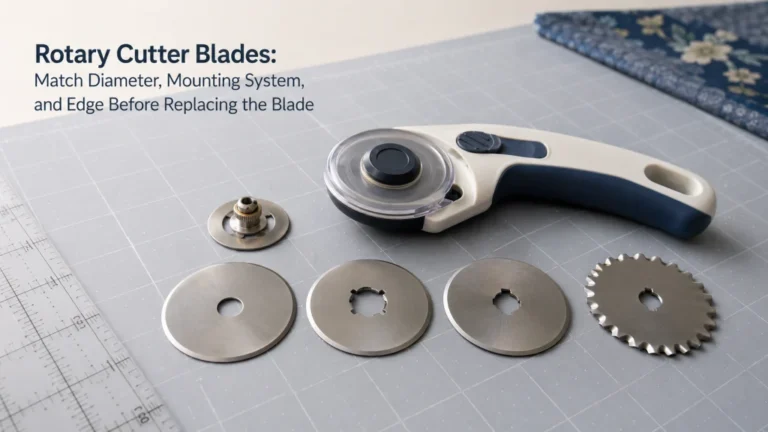
Blade diameter identifies size, not the complete interface between a replacement blade and a cutter. Two blades can both be labeled 45mm while differing in the details that matter to a particular mounting system or cutter family. The exact cutter model should therefore be identified before a replacement blade is selected. Visual similarity and matching diameter are useful clues, but they are not complete compatibility evidence.
This article stops at that boundary because replacement selection begins only after the cutter itself is known. The article on choosing replacement rotary cutter blades handles that next decision and should be used with the manufacturer’s blade-change instructions for the exact cutter family. Keeping these two questions separate prevents a diameter guide from quietly turning into a parts-compatibility guide. It also gives a first-time owner a cleaner sequence: choose the cutting geometry, identify the cutter, then verify the blade that belongs in it.

The HEADLEY TOOLS pack contains ten 45mm replacement rotary blades made from SKS-7 Japanese steel. The blades are listed for 45mm rotary cutter handles including models from OLFA and Fiskars and are intended for sewing, quilting, scrapbooking, and craft cutting. The blades have visible surface markings and come lightly oiled in a plastic storage case.
Check On AmazonIf you click this link and buy, we earn a commission at no additional cost to you.
Final Thoughts: Choose Diameter for the Cut
The simplest way to choose among 18mm, 28mm, 45mm, and 60mm is to start with the path the blade must follow. Tight, detailed shapes favor smaller diameters, mixed everyday work often fits the middle of the range, and long continuous cuts make better use of a larger blade. The curve-versus-straight matrix is useful because it turns those differences into a practical choice instead of a bigger-is-better ranking. After that first choice, the exact cutter documentation can settle material capability and operating details.
Before buying, identify the cuts that appear most often in your work and decide whether one diameter handles that recurring geometry well enough. A second cutter only earns its place when another repeated task asks for a clearly different turning radius or cutting path. This keeps the purchase tied to real sewing work rather than to collecting every available size. Choose the diameter that fits the cut, then build the rest of the cutting setup around it.
FAQs
📏 What size rotary cutter should I buy first?
Choose from the cuts you make most often. A 45mm cutter commonly suits general strips and broad pattern work, while 28mm makes more sense when smaller curves appear frequently. Move toward 60mm when long continuous cuts are a recurring priority, and toward 18mm when intricate geometry dominates.
🌀 Is a 28mm rotary cutter better for curves than a 45mm cutter?
A 28mm blade has a geometric advantage on tighter curves because the smaller circle changes direction over a smaller path. A 45mm cutter can still handle broad and moderate curves well. Choose based on how tight and how frequent the curved cuts are in your actual projects.
📐 Is a 45mm rotary cutter enough for most sewing projects?
It can be enough when most work involves ordinary strips, larger pattern pieces, and gentle curves. The answer changes if your projects repeatedly include intricate shapes or long cutting paths that make another diameter more practical. One cutter is reasonable when one size covers the majority of your recurring cuts.
🧱 When does a 60mm rotary cutter make sense?
A 60mm cutter makes the strongest case when long, continuous cuts or an exact manufacturer’s documented thicker-stack use are common. Its larger blade is less suited to tight geometry than smaller sizes. Check the specific cutter’s material claims before treating stack capability as part of the buying decision.
🪚 Can any replacement blade fit a cutter if the diameter matches?
No. Matching diameter identifies blade size, but the cutter’s mounting and approved replacement system still control fit. Verify the exact cutter model against the manufacturer’s replacement information before installing a new blade.
🛡️ Does blade size change how I should handle the cutter?
The exact cutter design controls how its guard, retraction system, and blade exposure are operated. Blade diameter changes cutting geometry, but it does not replace the model-specific instructions. Follow the directions supplied for the cutter you actually own.
References and Sources
- OLFA rotary cutter size guide: Supports the size-by-task distinctions and the cited 45mm and 60mm cotton-layer claims.
- OLFA cutter blade-change instructions: Supports the distinction between blade diameter and cutter-family replacement procedures.