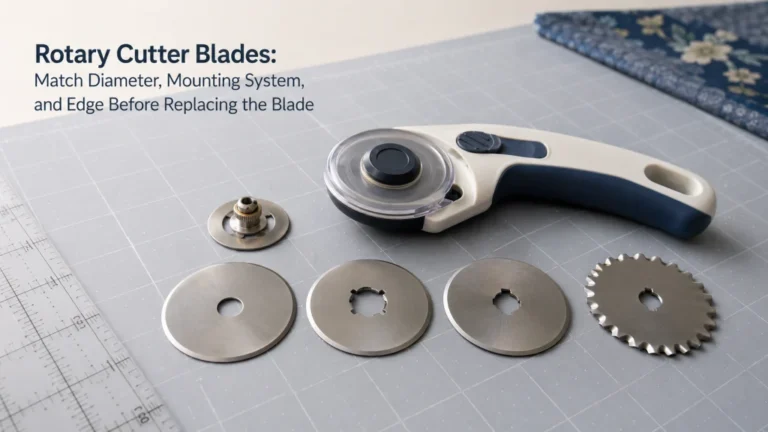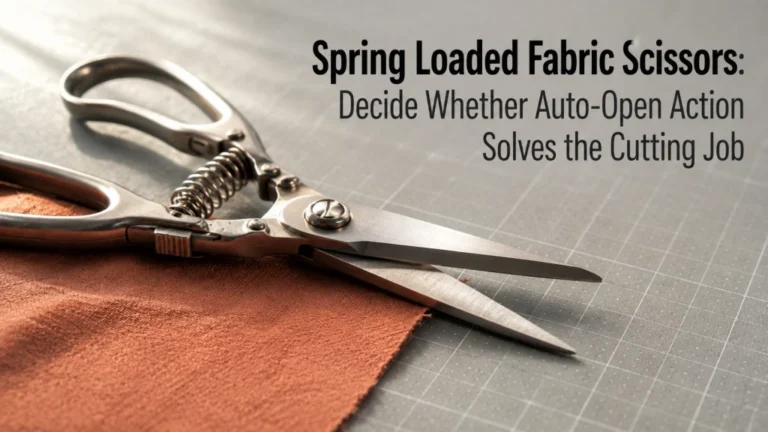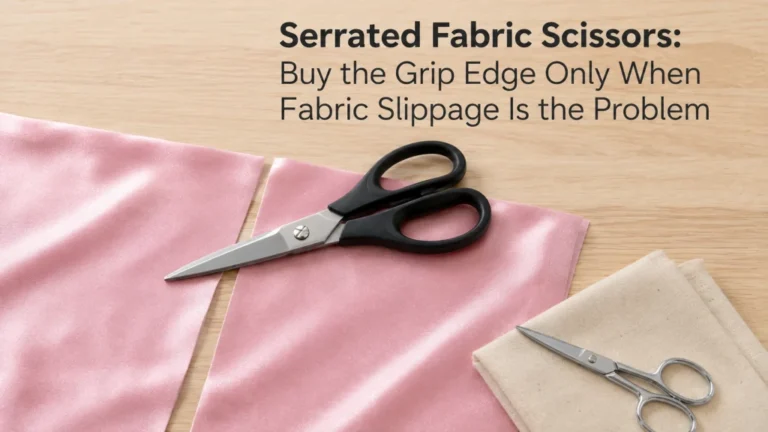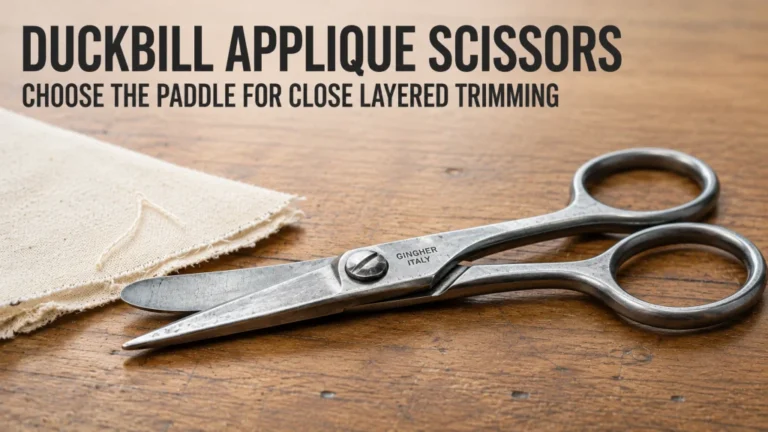
A rotary cutter for fabric should be chosen as part of a cutting system, not as an isolated handle. Blade diameter, blade mounting design, guard or retraction mechanism, replacement-blade compatibility, cutting mat, and ruler all affect whether the tool fits the work you plan to do. The goal is to choose the cutter body only after confirming that rotary cutting suits the task and that the rest of the system is available and compatible. Operating technique, detailed blade-size comparison, and blade-change instructions belong to separate decisions after the cutter family is chosen.
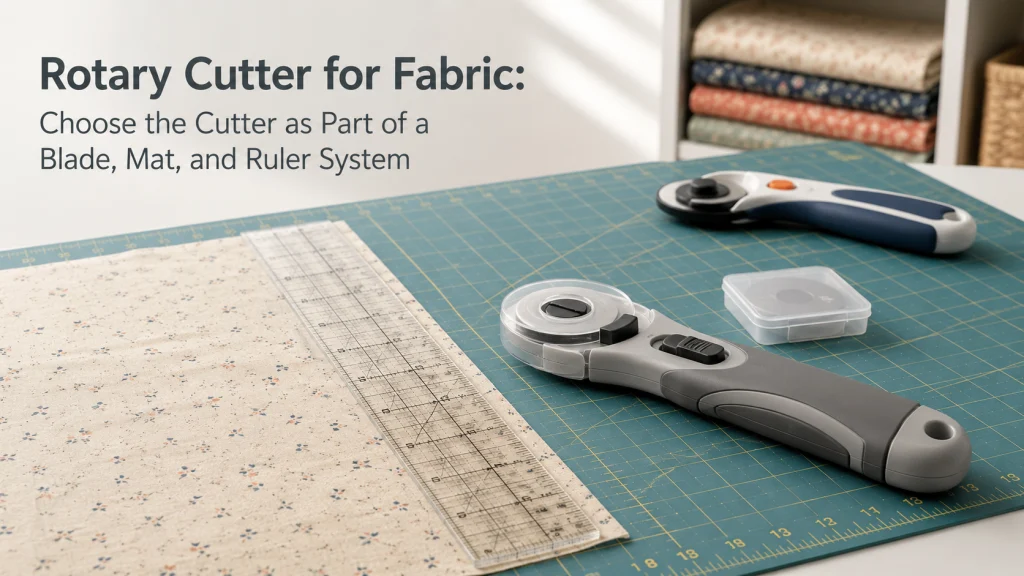
A rotary cutter is one part of a cutting system
A rotary cutter for fabric can look simple on a product page: a handle, a round blade, and some kind of guard. The buying decision is broader than that. The cutter body determines which blade diameter and replacement family it accepts, how the blade is exposed or retracted, how the blade is secured, and how the tool interfaces with the ruler and cutting mat you will use underneath it.
This matters because two cutters with the same nominal blade diameter can use different handle shapes and different blade-mounting or guard systems. A third cutter in a smaller diameter may belong to a different type of cutting work entirely. Before choosing any body style, place the cutter inside the larger set of fabric cutting tools for sewing so the purchase is driven by the cut you need rather than by one attractive handle feature. For the broader equipment context, keep this choice inside your essential sewing tools and equipment setup rather than treating the cutter as a standalone purchase.
Confirm that rotary cutting fits the task first
A rotary cutter is useful when the work benefits from a rolling circular blade on a flat cutting surface, especially for straight lines, repeated shapes, and cuts guided by a ruler or template. It is not automatically the better tool for every sewing project. Tight interior cuts, freehand trimming, notches, or work that cannot lie safely on a cutting mat may point toward another cutting tool.
If you are still deciding between shears and a rotary system, resolve that first with the fabric scissors versus rotary cutter comparison. This page starts after rotary cutting already makes sense for the task. That keeps the purchase question focused on cutter design, compatible blades, mat support, and the surrounding measuring system rather than repeating the scissors-versus-rotary decision.
Choose blade diameter at a routing level
Blade diameter is one of the first visible differences among rotary cutters, but this article only needs it at the routing level. Manufacturer ranges commonly include smaller cutters for tighter curves and detail work, mid-size cutters for general sewing and quilting, and larger cutters for longer straight cuts or thicker stacks. That is enough to narrow the cutter family before the size decision becomes more detailed.
A smaller blade can physically navigate a tighter path more easily, while a larger blade changes how much edge meets the work and often appears on cutters intended for broader or heavier cutting tasks. Do not convert that into a universal rule about how many fabric layers a cutter will handle, because material, blade condition, cutter design, and manufacturer guidance all matter. If blade diameter is the unresolved variable, use the separate rotary cutter size comparison before choosing the body.
Compare straight and squeeze-handle mechanisms
Handle shape is not just cosmetic because it can be tied to how the blade is exposed, locked, or retracted. A straight-handle cutter may use a sliding guard or another manual exposure mechanism. A squeeze-handle design may expose the blade when the handle is squeezed and retract it when released. Current manufacturer documentation shows both approaches in fabric-cutting lines, so the useful question is how the mechanism works, not which shape looks more advanced.
Comfort is also personal and should not be turned into a medical or ergonomic-treatment claim. A curved or cushioned grip may feel better to one user and worse to another, and hand preference cannot be proved from a product photo. Check the control action, blade visibility, right- or left-hand configuration where offered, and whether the safety lock behaves in a way you can understand and use consistently.
- Identify whether blade exposure is controlled by a slider, guard, squeeze action, button, or combination of controls.
- Check whether the blade retracts automatically or must be covered manually after a cut.
- Confirm how the cutter is locked for storage.
- Check whether the blade can be configured for right- or left-handed use if that matters to you.
- Look at the exact blade-change mechanism before assuming all cutters of the same diameter are assembled the same way.
- Choose the mechanism you can operate predictably without bypassing or defeating the safety design.
This checklist is about control logic, not a promise that one handle will be more comfortable or safer for every person. The best evidence is the exact manufacturer’s mechanism description and the instructions supplied with that cutter family.

The OLFA RTY-2/DX uses a 45mm rotary blade with a squeeze-trigger handle that exposes the blade for cutting and lets it retract when released. A dual-action safety lock can secure the blade open during use or closed for storage. The cutter supports right- or left-handed setup and accepts compatible OLFA 45mm replacement and decorative blades.
Check On AmazonIf you click this link and buy, we earn a commission at no additional cost to you.
Identify the blade mounting and guard or retraction system
The center of the cutter deserves as much attention as the handle. Some cutters secure the blade with a conventional fastener and washer arrangement, while others use a quick-release or magnetic blade-mounting system. Manufacturers also use different guard designs, including sliding covers, split guards, and self-retracting mechanisms.
Those differences affect ownership because they determine which instructions apply when the blade eventually needs replacement. They can also determine which replacement blades or blade carriers fit the tool. A quick-change label therefore describes a specific mounting design, not a universal promise that any blade of the same diameter will snap into place.
| System part | What to verify before buying | Why it matters |
|---|---|---|
| Cutter body | Handle mechanism, blade exposure control, storage lock | Defines how the tool is controlled during normal use |
| Blade diameter | Exact size accepted by the cutter | Routes the tool toward the intended scale of cutting work |
| Blade mounting system | Fastener, quick-release, magnetic, or other documented design | Controls which replacement and change instructions apply |
| Guard or retraction system | How the blade is exposed, retracted, and locked for storage | Determines the normal safety workflow |
| Cutting mat | Enough protected area for the intended cut | Provides the cutting surface the rotary system depends on |
| Ruler or template | Suitable dimensions, markings, and edge for the intended cut | Guides measurement and straight or repeatable cutting |
Read the table as a dependency map. If one part is still unknown, the system is not fully specified yet, even if the cutter handle itself looks suitable.

The Fiskars 45mm rotary cutter uses a premium steel blade and an ergonomic loop-style handle. Its sliding control extends the blade for cutting, locks it in position, and retracts it for storage. The blade assembly uses a quick-change design with fewer loose pieces, and the cutter is intended for fabric, felt, vinyl, and quilting materials.
Check On AmazonIf you click this link and buy, we earn a commission at no additional cost to you.
Verify the replacement-blade family before buying
Replacement-blade compatibility should be checked before the original blade ever becomes dull. The nominal diameter is necessary, but it is not always sufficient evidence by itself. Manufacturers may document a cutter as accepting a specific family of straight or decorative blades, while another cutter with the same diameter may use a different mounting design or a narrower compatibility list.
This is where a fabric rotary cutter becomes an ownership system instead of a one-time purchase. Check the cutter page, blade page, and blade-change documentation for the exact family. Do not assume that visual similarity, a matching diameter printed on the package, or a generic marketplace listing proves fit.
The detailed choice among replacement edge types belongs in the separate rotary cutter blade guide. Blade-changing technique also stays out of this buying decision. For safety, follow the exact manufacturer’s change instructions and avoid handling an exposed blade in a way the product documentation does not support.

The OLFA RB45-10 package contains ten 45mm rotary replacement blades made from tungsten tool steel. The listing identifies them for cutting materials including cotton, fleece, felt, wool, leather, suede, foam, and vinyl. OLFA documents the RB45 family for compatible 45mm rotary cutters, including the RTY-2/DX and other supported 45mm cutter bodies.
Check On AmazonIf you click this link and buy, we earn a commission at no additional cost to you.
Pair the cutter with an appropriate cutting mat
A rotary cutter requires a suitable cutting surface. Manufacturer guidance commonly pairs rotary cutters with self-healing cutting mats to protect the work surface and support the blade during cutting. The buying question is not simply whether you own any mat, but whether the mat is large enough for the intended pieces and appropriate for rotary cutting.
Mat selection has its own tradeoffs involving dimensions, markings, storage, and usable cutting area, so it should not be collapsed into the cutter-body decision. If the cutter is right but the mat is too small for the project, the system is still poorly matched. Use the self-healing cutting mat selection guide when the cutting surface is the remaining question.

The Fiskars cutting mat provides a 24 by 36 inch self-healing surface for sewing, quilting, and fabric cutting. Measuring grids are printed on both sides, and the mat includes 30-, 45-, and 60-degree bias lines for angled cuts. Its extra-large work area is designed for full-width fabric, long strips, and larger fabric pieces.
Check On AmazonIf you click this link and buy, we earn a commission at no additional cost to you.
Treat operating workflow as a separate post-purchase job
Choosing the cutter does not automatically teach safe cutting technique. Blade exposure, ruler placement, cutting direction, storage, and the exact way a guard or retraction mechanism is used belong to normal operation after purchase. Manufacturer safety guidance should control those actions because the mechanism can differ by cutter family.
That separation also prevents a shopping page from drifting into a technique tutorial. Once you own the tool and have verified the blade, mat, and ruler setup, move to the rotary cutter operating procedure for the actual cutting workflow. If a guard, lock, or blade mechanism does not behave as its instructions describe, stop rather than forcing it.
Separate cutter selection from ruler and measuring-tool selection
The ruler influences the cut, but it does not make one cutter body inherently better than another. A long straight strip, a smaller patchwork shape, and a curved template can require different measuring or guiding tools even when the same rotary cutter remains suitable. The ruler’s dimensions and markings should therefore come from the geometry of the work, not from the cutter’s marketing package.
For a first-time rotary setup, this distinction is easy to miss because cutter, mat, and ruler are often displayed together. Buying them as a system does not mean treating them as one specification. Choose the cutter body for blade and control compatibility, then choose the measuring tool for the cut you actually need to guide.

The Fiskars Sewing Ruler measures 6 by 24 inches and is made from clear acrylic for fabric measuring and cutting. It uses incremental grid lines and two-toned markings to remain visible over light and dark materials. The ruler also includes 30-, 45-, and 60-degree angle indicators for angled fabric cuts.
Check On AmazonIf you click this link and buy, we earn a commission at no additional cost to you.
Separate cutter-body choice from blade size, replacement, and change procedure
The cutter body decision should finish with a clear family, not with every future blade decision solved at once. You need to know the accepted diameter, the compatible replacement family, and the mounting mechanism before buying. You do not need to turn this page into a detailed comparison of every blade material, edge style, or replacement procedure.
Before buying, read the listing for information gaps instead of repeating the entire system checklist. A candidate becomes harder to verify when the page names the cutter but leaves the blade family, mounting design, or safety mechanism vague.
- The listing gives a blade diameter but does not identify the compatible replacement-blade family.
- The blade mounting or change system is not described well enough to match it to manufacturer instructions.
- A guard, lock, or retraction feature is pictured or named without explaining how that mechanism works.
- The page shows mats, rulers, blades, or other accessories without clearly separating included items from items sold separately.
Those are verification red flags, not automatic proof that the cutter is poor quality. They mean the product page has not yet supplied enough evidence for a confident system decision, so the next step is to check the manufacturer’s documentation rather than fill the gap with an assumption.
Buying in stages: The cutter, mat, ruler, and future blades do not have to be purchased in one transaction. If you already own a suitable mat or measuring tool, treat its usable area and the cuts you plan to make as existing constraints. Complete the compatible cutting system before using the cutter rather than assuming every later component can be added interchangeably.
That boundary keeps the purchase process manageable. Choose the cutter family only after its control, blade support, and safety documentation are clear, then leave detailed blade selection and change procedure to their own decisions.
Final Thoughts: buy the system, not only the handle
The useful rotary cutter decision is not “Which handle looks best?” It is whether the candidate fits the cuts you actually need, has a clearly documented blade and safety system, and can be supported with compatible replacement parts and a suitable cutting setup.
Start with the task, reject unresolved compatibility claims, and carry forward only the fields you can verify. If part of the cutting setup is already owned, let that existing constraint shape the remaining purchase instead of rebuilding the whole system from scratch. Leave operating technique and blade-change procedure for the exact tool after the purchase decision is complete.
FAQs
Most first-purchase questions become easier when the cutter body is separated from blade compatibility, cutting-surface needs, and operating technique. The answers below keep those decisions in the right order.
🧵 What size rotary cutter is best for fabric?
There is no single best diameter for every fabric-cutting task. Smaller blades are commonly used for tighter curves and detail work, mid-size cutters cover many general sewing jobs, and larger blades are commonly routed toward longer or heavier cuts. Check the exact manufacturer guidance before choosing.
🔄 Are all replacement rotary blades interchangeable?
No. Matching diameter is only one compatibility check. Verify the exact cutter family, blade-mounting system, and manufacturer’s compatibility list before buying replacements.
✋ Is a squeeze-handle rotary cutter better than a straight handle?
Not universally. The two designs can use different blade-exposure and retraction mechanisms, while comfort remains user-specific. Compare the control action, storage lock, blade visibility, and instructions rather than assuming one handle shape is better.
📐 Do I need a cutting mat with a rotary cutter?
Use the cutting surface specified by the manufacturer for rotary work. Self-healing cutting mats are commonly paired with fabric rotary cutters, and the mat also needs enough usable area for the pieces you plan to cut.
🛡️ Should the blade retract automatically?
Not every cutter uses the same safety mechanism. Some designs self-retract, while others use a sliding guard or manual lock. Follow the exact product instructions and never bypass the designed guard or lock.
🪡 Can I choose the cutter first and figure out blades later?
It is better to verify replacement-blade support before buying the cutter. That confirms the tool belongs to a blade family you can identify and maintain instead of leaving compatibility until the original blade needs replacement.
The pattern behind all six answers is the same: choose from verified system relationships, not from one isolated feature. Cutter diameter, blade fit, guard behavior, and cutting surface all need their own evidence.
References and Sources
Manufacturer documentation is necessary here because blade fit, mounting design, guard behavior, and replacement procedure vary by cutter family. These sources support the compatibility and mechanism distinctions used above without serving as product recommendations.
- OLFA rotary cutter size overview: documents the manufacturer’s current 18 mm, 28 mm, 45 mm, and 60 mm craft-cutter families and their stated task routing.
- OLFA squeeze-handle cutter documentation: verifies a 45 mm squeeze-trigger design, self-retraction, storage lock, handedness configuration, and stated blade compatibility.
- OLFA quick-change cutter documentation: verifies a different 45 mm blade-mounting and split-guard design, showing why diameter alone does not define the mechanism.
- Fiskars blade-change system guide: distinguishes standard, EasyChange, and DuoLoop blade-mounting systems and provides family-specific replacement instructions.
These references establish current manufacturer terminology and compatibility examples for the cited tool families. They do not prove that one handle shape is universally more comfortable, that one cutter is best for every fabric, or that a blade from another family fits unless the manufacturer documents that compatibility.