Duckbill applique scissors are specialty cutting tools built around one defining feature: a wide paddle that can separate or guard a lower fabric layer while the cutting blade trims the layer above. That geometry matters most when the job is close layered trimming, not ordinary pattern cutting or general-purpose fabric cutting. Before buying, verify the paddle orientation, handedness, blade reach, and the exact shape of the cutting side instead of assuming every tool labeled “applique scissors” works the same way. This article stays with tool selection and geometry, not applique construction technique.
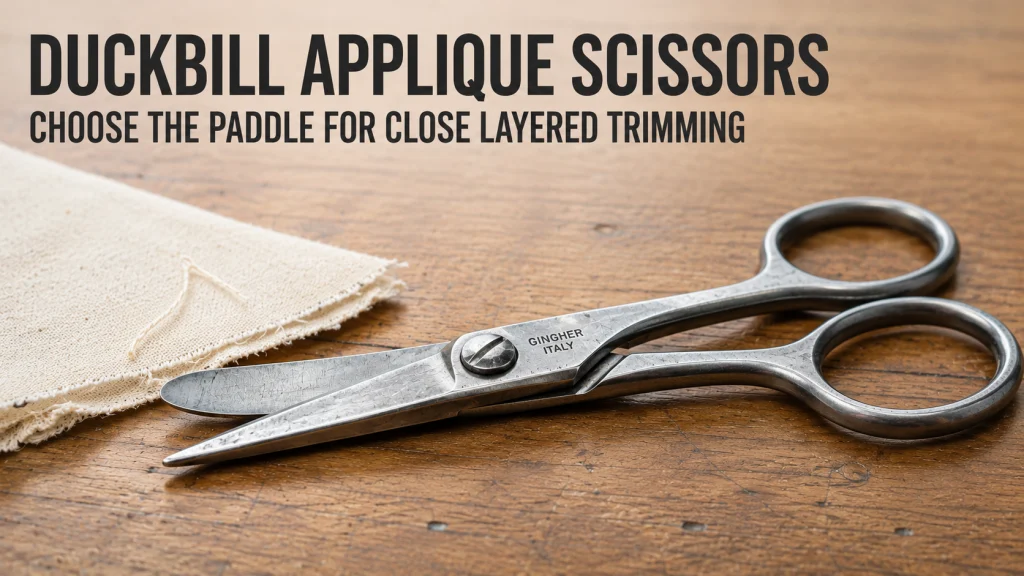
The wide paddle is the reason this tool exists
Duckbill applique scissors make sense only when the wide paddle solves a real cutting problem. The paddle is designed to sit against or beneath the layer you want to protect while the opposite blade does the cutting. Current Havel’s descriptions use this same basic idea, describing the bill as separating or lifting away the fabric being trimmed while protecting the base layer.
That is a much narrower job than “small scissors for applique.” If you mainly need to cut pattern pieces, square fabric, or make long clean cuts through a single layer, start with the broader decision process for fabric cutting tools for sewing instead. The duckbill shape earns its place when the lower layer is the thing you are trying not to nick.
Layered-trimming use case: Picture an upper applique layer already secured near its edge with a base fabric directly beneath it. The paddle belongs against the protected layer, while the cutting blade removes the excess upper fabric. That protected-layer relationship, not the overall scissor length, is the purchase question.
Define the close layered-trimming job first
The useful question is not simply whether you do applique. It is whether your work creates a point where one layer must be trimmed close to stitching while another layer remains immediately underneath. If that layered relationship is absent, the wide paddle may add bulk without solving a problem you actually have.
For example, trimming a small motif away from a larger base is different from cutting the motif out before it is attached. The first situation can benefit from a separator or guard under the cut layer. The second is simply a small-shape cutting task, where another scissor geometry may be easier to position.
This distinction also keeps the tool from replacing ordinary shears by accident. If your main need is long pattern cuts or broad fabric preparation, the article on how to choose general fabric scissors covers that job more directly. A duckbill is a specialist solution for a specialist layer relationship.
Identify the paddle and the cutting blade
A duckbill tool has two sides doing different jobs. One side presents the broad, rounded paddle or wave-shaped guard. The other side carries the cutting edge that closes against it. Product photos can make the pair look symmetrical at a glance, so do not judge orientation from the handle loops alone.
Havel’s current duckbill listings describe a wide bill that lifts or pushes away the fabric being removed, and its double-pointed duckbill version pairs that broad outer edge with a thinner lower blade for close cutting. Quilters Select describes its wave design in similar terms, with the wave separating and lifting cut-away fabric while guarding the base fabric. Those descriptions support the same buying principle even though the exact shapes are not identical.
| Duckbill anatomy | What to verify | Why it matters |
|---|---|---|
| Wide paddle or wave | Which side is broad and rounded | This is the separator or guard side that belongs against the layer you want protected. |
| Cutting blade | Which edge performs the close cut | The cutting side must approach the excess layer without forcing the paddle into the cutting path. |
| Tip shape | Rounded, pointed, or double-pointed geometry | Tip shape changes how the tool approaches corners and tight areas. |
| Handle offset | Straight, angled, or double-curved handle position | Handle geometry changes hand position and sightline over the work surface. |
The important part of this anatomy map is the separation of functions. A product can have curved handles without having a duckbill paddle, and it can be sold for applique without being designed to guard a lower layer. Read the exact blade description, not just the product family name.

The Famore 712D is a compact 4.5-inch applique scissor with a wide duckbill blade for close edge trimming. Its stainless steel blades are joined with an adjustable screw and bolt rather than a fixed rivet. The scissors also use offset handles and an ambidextrous layout for controlled positioning around detailed work.
Check On AmazonIf you click this link and buy, we earn a commission at no additional cost to you.
Check right- or left-handed orientation
Handedness matters more here than it does with a simple pair of symmetrical-looking craft scissors because the paddle and cutting blade have different roles. Reversing the tool in the hand does not necessarily reproduce the same relationship between the wide guard, the cutting edge, and the line you are trying to see.
Current listings show why the exact version matters. Quilters Select sells separate right-handed and left-handed editions of its wave applique scissors. Havel’s also lists right-hand-only duckbill models as well as a separate left-handed version of its 6-inch double-pointed duckbill design. The presence of a left-handed tool somewhere in a manufacturer’s range does not mean every duckbill model is ambidextrous.
- Confirm whether the exact tool is labeled right-handed, left-handed, or genuinely ambidextrous.
- Check which side carries the paddle when the tool is held in the intended hand.
- Make sure the cutting edge remains visible from your normal viewing position.
- Do not assume a mirrored handle loop means the blades are mirrored too.
- If handedness is not stated clearly, verify it before purchase rather than inferring it from a photo.
This is also why a general left-handed-scissors rule cannot answer the duckbill question by itself. The handedness check here is specifically about the orientation of a guard blade and a cutting blade during close layered trimming.
After the scissors arrive, make the same orientation check before cutting fabric. With the blades closed, hold the tool in the hand it was sold for and look at where the broad paddle sits relative to the cutting edge and your normal sightline. The paddle should be positioned to face the layer you intend to protect while the cutting edge remains easy to identify from your viewing side. If the geometry appears reversed or the listing and tool disagree, recheck the exact model and handedness rather than adapting your grip or forcing the tool to work backward.
Compare straight, curved, and double-point variants only from exact designs
“Applique scissors” is not one blade shape. Havel’s current applique-scissors page, for example, lists curved-tip scissors, double-curved applique scissors, multi-angled duckbill scissors, and double-pointed duckbill scissors as separate designs. Some manufacturers and sewing references also use the label pelican applique scissors for the same broad-bill idea. If you are comparing duckbill scissors for applique, treat those names as search labels first and verify the actual blade geometry before assuming two listings describe the same tool.
A curved or double-curved handle can raise the hand above the work and change the viewing angle, but it does not automatically create the protected-layer function of a duckbill. A double-pointed duckbill adds another design decision at the tip. Havel’s describes that version as intended for sharp angles and tight corners while retaining the wide outer duckbill edge that separates layers.
Similarly, a pointed applique scissor can be useful for detail cutting without providing a broad guard under the fabric. The right comparison is therefore shape against task: paddle or no paddle, point geometry, handle offset, and blade reach. Do not compare by name alone.
Note: Serration is a different buying variable. If the problem is fabric slipping away from the cutting edge rather than protecting a lower layer, the decision belongs with serrated fabric scissor geometry, not with the duckbill paddle.

These MAKER AND MARKET applique scissors use a pelican-style duckbill blade with a bent, curved handle configuration. The 5.8-inch scissors are made from stainless steel and use a smooth finished cutting surface. The Amazon product information also lists a storage pouch with the scissors.
Check On AmazonIf you click this link and buy, we earn a commission at no additional cost to you.
Check reach and visibility before using length as a shortcut
Overall scissor length is easy to compare, but it does not tell you how much of the blade reaches into the work or how clearly you can see the cutting line. Havel’s currently lists duckbill designs at 5 1/2 inches and 6 inches, while its non-duckbill applique scissors include other lengths and handle shapes. Those numbers describe the exact tools, not a rule that one length is automatically better.
The more useful check is whether the paddle can sit where it needs to sit without the handle blocking your view, and whether the cutting blade can reach the part of the seam or motif you actually need to trim. An angled handle may improve the sightline on one design. A shorter blade may be easier to place in one small area. A longer body may provide more reach on another tool. Those are geometry differences to inspect, not performance promises.
Quilters Select publishes an exact 0.05-inch blade width for its current left- and right-handed wave applique scissors. That specification is useful because it is tied to one identifiable design. It should not be generalized into a target width for every duckbill tool.
When shopping online, treat the image set as a geometry check rather than decoration. Look for a side view that shows which blade widens into the paddle, a close view of the tip where the cutting blade meets the guard, and an angle that shows the handle offset relative to the blades. A photo with the scissors partly open is often more informative than a straight-on closed view because the two blade roles are easier to distinguish. Still, use the written handedness and model description as the deciding evidence, since a single product image may not show orientation clearly.
A useful warning sign is a listing that repeatedly says “applique scissors” but never shows the underside, paddle profile, blade relationship, or handedness. In that case, the photos have not answered the question this tool is supposed to solve. Confirm those details from the exact manufacturer or seller documentation before treating the tool as a duckbill design for protected-layer trimming.

The SPEEDWOX duckbill scissors use a 6-inch format with double-bent offset handles and stainless steel construction. The duckbill-shaped jaws are designed to separate the cutting layer from the material underneath during close trimming. The scissors also include an adjustable tension screw and a protective pouch for storage.
Check On AmazonIf you click this link and buy, we earn a commission at no additional cost to you.
Keep close-trimming geometry separate from applique technique
A duckbill can help separate layers during a close cut, but it does not tell you where to stitch, how wide a seam or satin stitch should be, which stabilizer to use, or how an applique should be constructed. Those are project and technique decisions. This page starts only after the cutting job has been defined.
That boundary matters because many product descriptions mix the intended tool role with broad claims about applique work. The tool can still be evaluated cleanly: Is there a lower layer to protect? Does the paddle sit on the correct side for your hand? Can the cutting edge reach the area? Is the tip shape suitable for the corners you actually need to enter?
Warning: These are sharp cutting tools. Keep fingers clear of the blade path, store the scissors closed, and follow the exact manufacturer’s instructions for handling, storage, guards, or maintenance when those instructions are provided. Do not force, bend, modify, or sharpen a specialty blade contrary to its documentation.
If your goal is simply to create a decorative edge on a fabric margin, that is another cutting geometry again. The article on when to use pinking shears for edges covers that separate purpose. The broader sewing tools decision framework can then place each cutting tool back into the rest of a machine-sewing workspace.
Final Thoughts: buy the paddle only when a lower layer needs protection
Duckbill applique scissors are easy to understand once the decision is reduced to geometry. The wide paddle is not decoration and it is not a universal sign of a better applique scissor. Its job is to separate or guard a lower layer while the cutting blade trims close above it.
Before buying, verify the exact paddle orientation, handedness, tip shape, handle offset, blade reach, and visibility. If you cannot identify the protected lower layer in the job you actually do, a duckbill may be solving a problem you do not have. If that lower layer is present repeatedly, the paddle becomes a meaningful feature rather than a specialty label.
FAQs
🦆 What are duckbill applique scissors used for?
They are designed for close layered trimming where a wide paddle can separate or guard the fabric underneath while the opposite blade cuts the upper layer. The exact geometry varies by tool, so verify the blade layout rather than relying on the name alone.
✂️ Are all applique scissors duckbill scissors?
No. Current tool ranges include pointed, curved, double-curved, and duckbill designs under the broader applique-scissors label. Look for the actual wide paddle if protecting a lower layer is the job you need the tool to do.
🖐️ Do duckbill scissors come in left-handed versions?
Some do. Current manufacturers list both handed versions for certain designs, while other duckbill models are right-hand only. Check the exact model because handedness is not guaranteed across an entire product range.
👁️ Why does paddle orientation matter?
The paddle and cutting blade have different jobs, so their position affects which layer is guarded and what you can see while trimming. A tool that is oriented for the opposite hand may not place those two sides where you expect them.
📏 Is a longer duckbill scissor always better?
No. Overall length is only one dimension. Reach, blade shape, handle offset, tip geometry, and visibility around the cut are more useful when deciding whether a specific tool fits your trimming job.
🧵 Can duckbill scissors replace regular fabric shears?
They are built for a much narrower cutting task. Regular fabric shears are better suited to broad pattern and fabric cutting, while the duckbill geometry is valuable when one layer must be trimmed close to another protected layer.
References and Sources
- Havel’s applique scissors page: Verifies current duckbill, curved, double-curved, double-pointed, handedness, length, and intended layer-separation descriptions used in this article.
- Quilters Select applique scissors: Verifies the current wave or duckbill geometry, separate right- and left-handed versions, and published blade-width specification.
- Bohin pelican scissors page: Confirms current manufacturer use of the pelican and duckbill terminology for the broad-blade applique geometry.