Spring loaded fabric scissors add one main mechanical change to ordinary fabric scissors: a spring reopens the handles and blades after each cut. That auto-open action can matter when repeated reopening is the part of cutting you want the tool to handle, but it does not replace the need to judge blade quality, cutting length, handle fit, or storage design. The useful buying check is to verify the return mechanism, blade style, lock, handle geometry, handedness, and intended material before deciding whether the spring solves a real cutting problem.
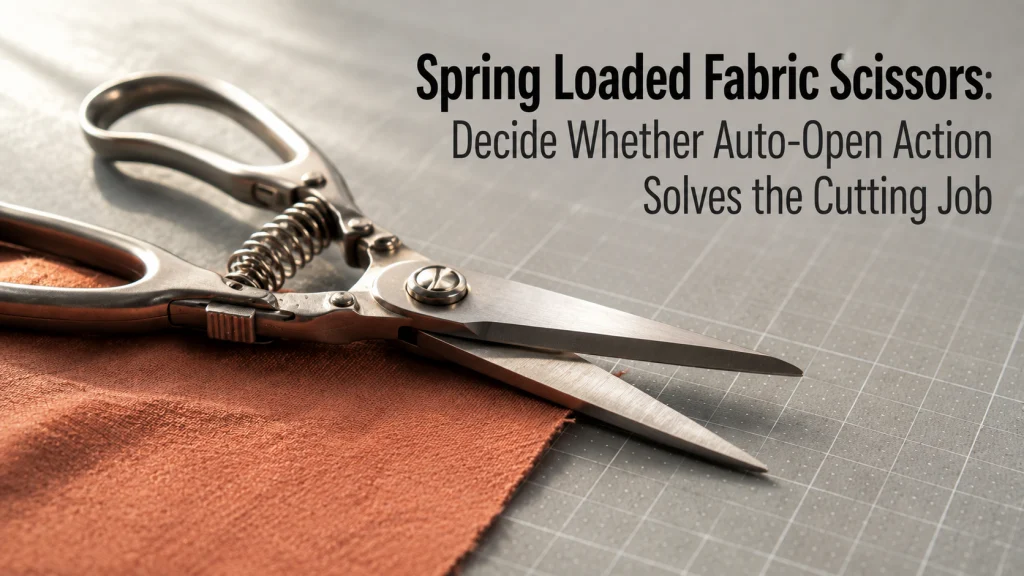
The spring changes reopening, not the definition of a good cut
Conventional fabric scissors require you to close the blades for the cut and reopen the handles before the next one. A spring-assisted pair adds return force so the tool opens again when you release pressure. That is the feature to evaluate first, because the spring changes the return stroke rather than replacing the blade geometry, edge quality, pivot, handle fit, or material limits that still determine whether the scissors suit the job.
This distinction is easy to lose in product descriptions. Spring action sewing scissors may be presented alongside claims about comfort, ease, precision, or reduced effort, but those ideas are not interchangeable. The mechanical fact is narrower: the spring supplies return force. Blade behavior, handle fit, and how the tool feels in use still need their own evaluation.
| Feature | Conventional fabric scissors | Spring-assisted fabric scissors |
|---|---|---|
| Closing the blades | User applies hand pressure | User applies hand pressure |
| Reopening after a cut | User actively opens the handles | Spring return assists or performs the reopening |
| Blade performance | Depends on blade design, edge, pivot, and intended material | Still depends on blade design, edge, pivot, and intended material |
| Storage | May or may not include a lock or sheath | Often needs a lock or other restraint because the spring tends to hold the tool open |
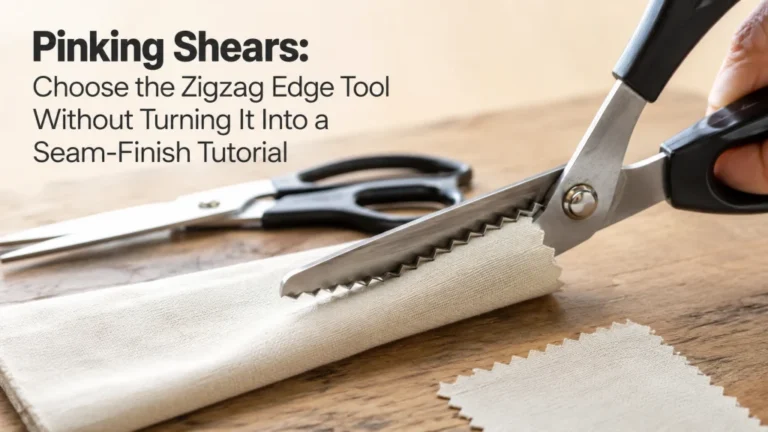
The table is the core mechanism check, not a verdict that one design is universally better. If repeated reopening is not a problem in your normal cutting, the spring may add little. If reopening is exactly the repetitive motion you want the tool to handle, the mechanism becomes a meaningful feature worth checking more closely.
Confirm that repetitive opening is the unresolved requirement
Start with the cutting task rather than the product label. Ask what currently interrupts the work: closing force, reopening the handles, blade reach, inaccurate tips, fabric lifting, poor grip, or simply using the wrong style of scissors. Spring assistance addresses the reopening part. It does not automatically correct a dull edge, short cutting length, unsuitable blade profile, loose pivot, or handle that does not fit your hand.
A useful example is long pattern cutting with ordinary fabric shears. If the blades already cut cleanly and the handle fits well, but you specifically dislike reopening the handles through a long sequence of cuts, an auto-open mechanism changes that part of the cycle. If the real problem is that the blades push fabric ahead of the cut or fail to reach accurately into a corner, you need to evaluate blade design first rather than assuming spring assistance solves the issue.
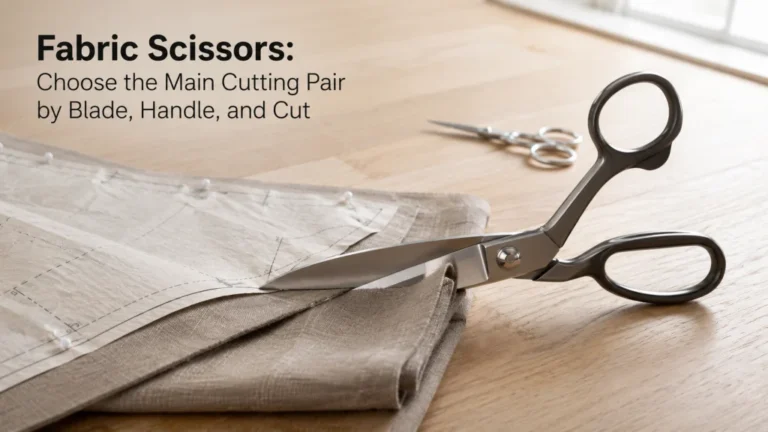
At the broader reusable-tool level, the sewing tools guide helps place cutting equipment among the other sewing-tool families. The broader overview of fabric cutting tools for sewing then separates scissors from rotary cutters, snips, and other cutting mechanisms before you add another tool. For the conventional baseline, the article on choosing fabric scissors by cutting job covers the blade-and-handle decision without making spring return the starting point.
- Identify whether reopening is actually the repetitive motion you want changed.
- Confirm that the current problem is not dullness, poor blade alignment, or the wrong cutting length.
- Decide whether you need long continuous cuts, short controlled snips, or detailed tip work.
- Check whether the spring mechanism adds value to that specific cutting pattern.
- Keep medical suitability separate from a mechanical feature comparison.
This ownership check keeps the decision practical. You are not buying a vague promise of easier cutting; you are deciding whether automatic reopening removes a specific repeated action from a task you already understand.
Identify the spring action and return force
The defining feature is simple to verify: after the blades close, the spring should return the handles toward the open position when pressure is released. Current Fiskars Easy Action documentation describes a spring-action design that gently opens the blades after each cut. MadamSew likewise documents a spring-supported handle that opens the scissors automatically as handle pressure is released. These are manufacturer descriptions of how their mechanisms work, not evidence that every spring-loaded design uses the same spring strength or handle travel.
Return force matters because the spring is part of what your hand feels between cuts. Product photos can show that a spring exists, but they rarely tell you whether the opening span, resistance, or resting position suits your grip. When possible, inspect the documented handle dimensions and return design, then judge the actual tool in hand under normal retailer return conditions rather than treating “spring assisted” as a complete fit specification.
Mechanism boundary: The spring proves automatic reopening only when the manufacturer documents that action. It does not prove medical benefit, disability suitability, reduced injury risk, a specific reduction in effort, or better cutting accuracy for every user.
This is also why marketing language needs careful translation. A phrase such as easy action sewing scissors may name a product family or feature set, while the mechanical fact you can carry across brands is narrower: a spring supplies return force after the closing cut.

The Fiskars Easy Action Scissors No. 8 use a spring-assisted handle that gently opens the blades after each cut. They have precision-ground stainless steel blades and a bent handle with SoftGrip touchpoints. The scissors are designed for both right- and left-handed use.
Check On AmazonIf you click this link and buy, we earn a commission at no additional cost to you.
Check blade style and cutting length separately from the spring
Spring assisted fabric scissors can use different blade lengths, tip shapes, edge treatments, and handle offsets. Those differences decide what kind of cut the tool can make comfortably and accurately. A compact pointed blade may suit detail work, while a longer blade can cover more distance per closing stroke; neither characteristic is created by the spring.
Manufacturer documentation illustrates that separation clearly. Fiskars describes Easy Action scissors with different blade formats, including Micro-Tip designs for detailed cuts and other fabric shears intended for longer tabletop cutting. MadamSew documents a long precision-ground blade on its spring scissors. The spring-return concept is shared, but the cutting geometry is not identical.
Before buying, match the blade to the cut you expect to make most often. If you need to follow small curves and clip close to a marked line, tip access matters. If the job is cutting long pattern edges, useful blade length and stable tabletop handling may matter more. A spring can make the return stroke automatic in either case, but it cannot turn one blade style into another.
Note: Current manufacturer pages treat spring action and blade geometry as separate features. That is a useful specification-reading habit: verify the return mechanism, then independently verify the blade shape and intended cutting task instead of assuming the words “spring loaded” describe the whole tool.

The Fiskars 6-Inch Easy Action Micro-Tip Titanium Scissors use precision-ground stainless steel blades with a titanium coating and a Micro-Tip point for detailed cutting. An Easy Action spring gently opens the blades after each cut. The scissors also use a symmetrical SoftGrip assisted handle designed for both right- and left-handed users.
Check On AmazonIf you click this link and buy, we earn a commission at no additional cost to you.
Check the safety lock and storage position
An auto-open tool naturally wants to return toward its open position, so the storage mechanism deserves a deliberate check. Look for the manufacturer’s instructions on a slide lock, thumb lock, sheath, or another method of holding the blades closed. Confirm how the lock is engaged and released without placing fingers along the blade path.
MadamSew documents a slide lock that keeps its spring scissors closed for storage, while Fiskars lists locking features on spring-action designs within its Easy Action range. Those examples show why the lock is part of the mechanism decision rather than a decorative extra.
Warning: Sharp scissors can cause injury. Follow the exact manufacturer’s instructions for locking, carrying, cleaning, and storing the tool. Do not defeat a lock, force a damaged mechanism, or store spring-loaded scissors open where the exposed blades can be contacted accidentally.
Also check whether the lock is easy for you to operate while keeping a secure grip on the handles. A lock that exists on the specification sheet still needs to work predictably in normal ownership. If it sticks, feels damaged, or requires contact near the cutting edges, stop and follow the manufacturer’s support guidance rather than improvising a workaround.
Verify handedness and handle geometry
Spring return does not determine handedness. The handle shape, blade orientation, thumb position, loop size, and viewing line along the cut can still differ from one tool to another. A label that says spring assisted therefore tells you very little about whether the handle and blade arrangement work equally well in either hand.
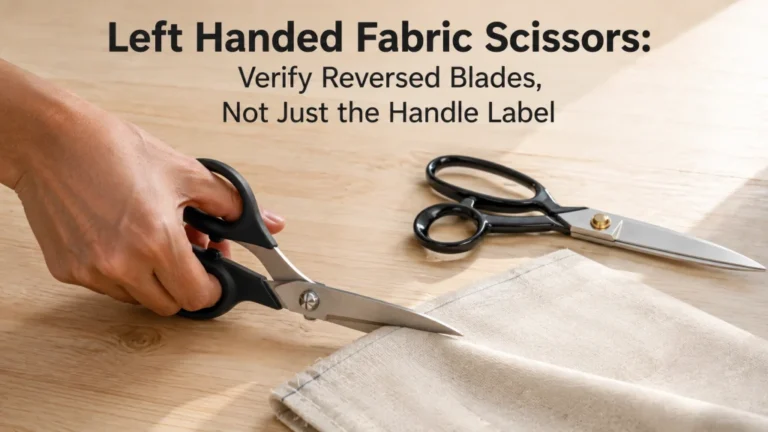
Some current tool documentation explicitly states ambidextrous use. MadamSew lists its spring scissors as suitable for right- and left-handed users and describes a lower grip opening for four fingers with a separate upper thumb lever. Fiskars also distinguishes general right-and-left use on some scissors from dedicated left-handed designs with reversed blades and handles, which reinforces the need to read the exact specification rather than infer handedness from handle appearance.
For a buyer, the practical check is to verify both claims separately: what the manufacturer says about handedness and what the handle geometry actually requires. If a pair is marketed as usable in either hand but the grip position feels awkward or blocks your view of the cutting line, the spring mechanism has not solved the fit problem.
Comfort language is useful only when it is kept in proportion. Manufacturer claims can describe the intended benefit of a handle or return spring, but they do not replace checking the exact geometry or provide a medical recommendation for an individual user.

The Fiskars 9-Inch RazorEdge Easy Action Fabric Shears combine stainless steel blades with a spring-action opening mechanism. Their handle design helps keep fabric flat on the work surface, while the extended lower blade travels beneath the material during cutting. The product listing identifies the shears as ambidextrous.
Check On AmazonIf you click this link and buy, we earn a commission at no additional cost to you.
Separate spring assistance from powered cutting
A spring-loaded pair is still manually powered for the cutting stroke. Your hand closes the blades, and the spring helps return them open. Electric fabric scissors change a different part of the system because a powered mechanism drives the cutting action rather than merely reopening a manual pair.
That difference should decide which question you ask next. If you want conventional scissor control but would like the tool to reopen after each cut, stay with the spring-assisted category. If the unresolved requirement is reducing or replacing repeated manual blade-driving motion, compare the operating method and safety requirements in the article on electric fabric scissors for powered cutting.
Do not treat the two mechanisms as stronger and weaker versions of the same tool. They create different ownership questions around control, storage, power, guards, charging or cords where applicable, and blade service. This article stops at manual spring-assisted scissors so those powered-tool decisions remain separate.
Separate general spring assistance from repeated rag-quilt snipping
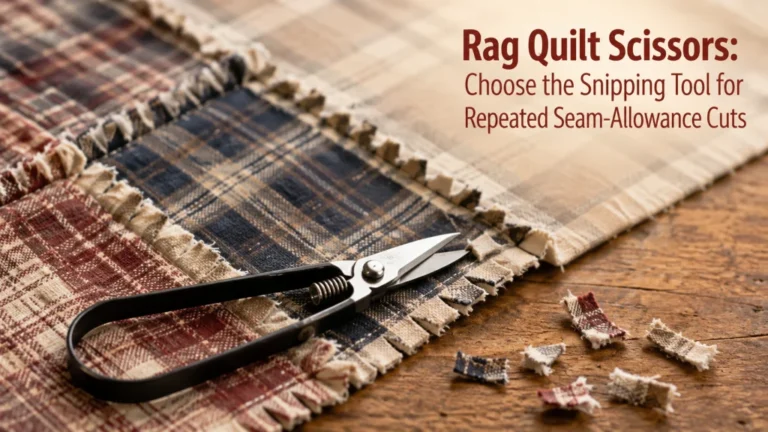
Rag quilting creates a very specific cutting pattern: many repeated short snips into exposed seam allowances. Spring return can be relevant to that repetitive motion, which is why spring-action mechanisms also appear on scissors sold for rag-quilt work. But the fact that both tool types reopen automatically does not make a general spring-assisted fabric scissor and a rag-quilt snip the same buying decision.
For rag-quilt work, blade reach, tip shape, stopping depth, access to seam allowances, and the repeated snipping pattern become more important than they are in a general comparison of auto-open scissors. The dedicated article on choosing scissors for rag-quilt snipping starts from that task rather than from the spring mechanism.
A general sewing example makes the boundary clearer. Cutting a pattern piece from yardage may involve long continuous blade travel, then a few detailed turns. Rag-quilt finishing can involve short repeated snips over many seam allowances. Both may benefit from automatic reopening, but the dominant cutting geometry is different, so the tool should be judged against the actual job.
Final Thoughts: buy the mechanism only when repeated reopening matters
Spring-loaded fabric scissors are easiest to evaluate when you strip the decision down to what the spring actually does. It supplies return force so the scissors reopen after a cut. That can be useful when repeated reopening is the unresolved part of your cutting cycle, but it does not replace the need to verify blade style, cutting length, lock, handedness, handle geometry, and intended material.
Use those checks to build a short comparison before you buy: eliminate any option with the wrong blade job, unclear handedness, unsuitable handle geometry, or an undocumented storage lock, then compare the remaining tools by the auto-open mechanism you actually wanted in the first place. If the spring solves that defined requirement and the rest of the specifications fit, you have a defensible reason to add the tool rather than buying on the feature name alone.
Frequently Asked Questions
✂️ What are spring-loaded fabric scissors?
They are manually operated scissors with a spring that returns the handles and blades toward the open position after each cut. The spring changes reopening; blade design, handle fit, lock, and intended material still need separate checks.
🔁 Do spring scissors cut fabric automatically?
No. On the scissors covered here, your hand still provides the force that closes the blades and makes the cut. The spring assists the return to the open position.
🖐️ Are spring-action scissors suitable for left-handed users?
Some are documented for use in either hand, while other scissors use dedicated left-handed blade and handle geometry. Check the exact manufacturer’s handedness statement rather than assuming the spring mechanism determines fit.
🔒 Why do spring-loaded scissors need a lock?
The spring tends to return the tool toward an open position, so many designs include a lock or other storage restraint. Use only the locking method documented for the exact tool and keep fingers away from the blade path.
🧩 Are spring scissors the same as rag-quilt scissors?
Not necessarily. Rag-quilt scissors are chosen around repeated seam-allowance snipping, while general spring-assisted scissors can be intended for broader fabric cutting. Auto-open action can appear in both without making the tools identical.
⚡ Are spring-assisted scissors the same as electric fabric scissors?
No. A spring-assisted pair remains manually powered for the cutting stroke and uses the spring for reopening. Electric scissors use a powered cutting mechanism and bring different operating and safety considerations.
The recurring theme is to verify one feature at a time. Spring return is a mechanical fact when documented; blade performance, handle fit, storage, and task fit still require their own checks.
References and Sources
- Fiskars Easy Action scissors: Supports the description of spring-action reopening and shows that blade formats and cutting purposes vary within the same auto-open feature family.
- MadamSew spring scissors documentation: Supports the documented spring return, slide lock, handle layout, blade description, and stated right- and left-hand use for this specific tool.