Hand quilting thread is not automatically suitable for a domestic sewing machine just because the spool also says quilting. The deciding evidence is the exact product’s intended-use label, any glaze, wax, or coating identified by its maker, and the thread limits published for the exact machine. Some hand-quilting products are specifically made for hand stitching and should stay out of a machine, while a thread approved for both hand and machine use must still fit the machine’s thread and needle requirements. Read the product evidence first, then move to machine-quilting thread when the hand-labeled spool is not approved for machine use.
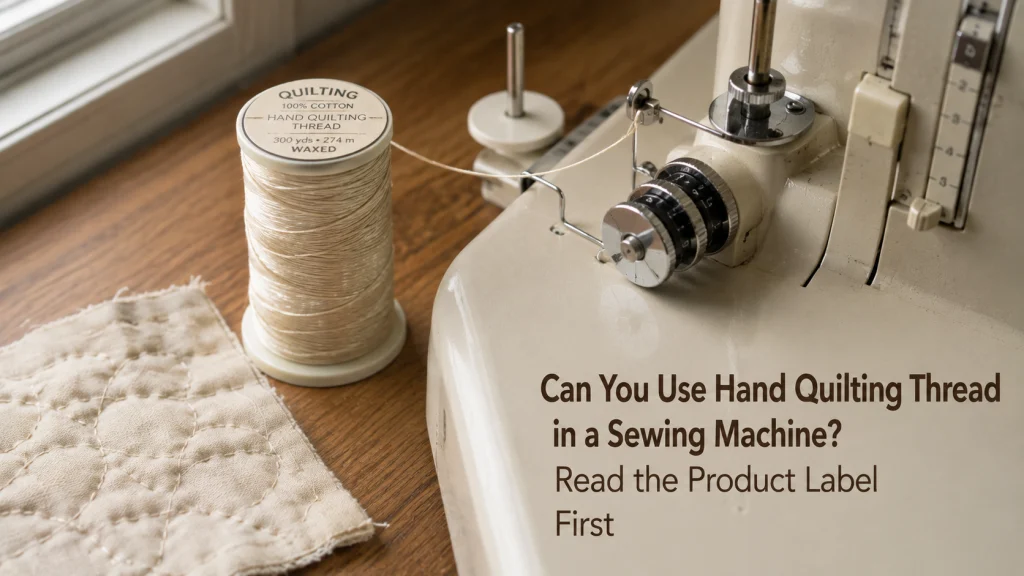
Quilting on the label does not prove machine use
If you are asking, “can you use hand quilting thread in a sewing machine,” the safest answer is conditional: only when the exact thread maker permits machine use and the exact machine documentation accepts that thread construction. The word quilting describes an application, but it does not tell you whether the thread was finished for hand stitching, machine stitching, or both. Two spools can both mention quilting while having different intended uses.
That distinction matters because thread travels through tension components, guides, the take-up system, the needle eye, and the stitch-forming area at machine speed. A finish intended to help hand stitching can create a different machine-use question from an uncoated thread designed to pass repeatedly through a domestic machine. The label gate comes before assumptions about fiber, color, or whether the thread feels strong enough by hand.
If the real task is choosing among threads already intended for machine quilting, use the machine quilting thread selection criteria instead. This page is only the suitability gate for a thread labeled for hand quilting.
Read whether the product says hand, machine, or both
The strongest first clue is the manufacturer’s intended-use statement. “Hand quilting,” “for hand stitching only,” “machine quilting,” and “for hand or machine use” are not equivalent labels. If the maker explicitly limits a thread to hand stitching, do not override that restriction because another thread with a similar fiber or weight works in your machine.
The machine vs. hand quilting thread decision becomes harder when a package uses broad wording or a retailer description conflicts with the thread maker’s current page. In that situation, use the manufacturer’s product information as the controlling thread source, then check the exact sewing-machine guidance. If intended use is still unclear, treat machine suitability as unverified rather than testing a questionable spool merely because it fits on the spool pin.
| What the exact product says | Machine-use decision | Next check |
|---|---|---|
| Hand stitching or hand quilting only | Do not treat it as machine-approved | Choose a thread whose maker allows machine use |
| Machine quilting or domestic machine use | Machine use is within the stated application | Verify size, needle relationship, and exact machine limits |
| Hand and machine use | Both uses are stated by the maker | Check coating, size, and machine-specific restrictions |
| No clear intended-use statement | Suitability remains unknown | Find current manufacturer documentation before using it |
This label gate also prevents the article from drifting into general thread shopping. If you need a normal construction thread rather than a quilting-specific choice, the all-purpose sewing thread decision is the more relevant path.
Check coating or finish only from exact product data
Do not assume every hand-quilting thread is waxed, glazed, or built the same way. The important distinction is the exact product, because different makers can use different fibers, twists, finishes, and intended-use language. A coating claim should come from the spool label or the current manufacturer page, not from the fact that the product sits in a hand-quilting aisle.
One current thread-maker example shows why that evidence matters. YLI describes its Hand Quilting Thread as 40 wt glazed cotton and states that its glazed thread is designed for hand stitching rather than machine work because the glaze can rub off onto tension discs and clog the thread path, causing tension issues. SINGER’s Heavy Duty 6800C support guidance separately identifies coated or overly thick thread as a jamming risk and warns against those thread types for that model. These are practical consequences tied to documented products and machines, not proof that every hand-quilting thread creates the same problem in every sewing machine.
Note: Treat terms such as glazed, waxed, coated, bonded, mercerized, and low-lint as separate construction or finish descriptions. None of those words should be added to a thread merely because its marketing category says hand quilting.
- Read the exact intended-use statement from the thread maker.
- Look for explicit words such as glazed, waxed, coated, or uncoated.
- Record the fiber and size exactly as the manufacturer states them.
- Check whether the maker gives a direct machine-use warning or approval.
- Do not substitute a retailer’s generic description when the manufacturer’s current data is available.
If you encounter the search question “waxed quilting thread sewing machine,” convert it into a product-specific check: is this exact thread actually waxed, and does its maker approve machine use? That wording keeps a useful warning from turning into a blanket statement about an entire category.
This three pack of Coats and Clark Dual Duty Plus hand quilting thread is intended for traditional hand quilting stitches and other projects that call for a thread specifically prepared for hand sewing. Each spool contains approximately three hundred twenty five yards, offering a combined quantity greater than a single five hundred yard spool. The listed shade is natural, not bright white, and the thread construction differs from an all cotton quilting thread. Check fiber content, needle size, thread finish, color match, and the fabric care requirements before substituting it in a quilt.
Check On AmazonIf you click this link and buy, we earn a commission at no additional cost to you.
Check exact machine guidance for coated or heavy thread
Thread approval does not stop at the spool. The sewing machine may impose its own limits on thread type, thread size, needle relationship, or coated materials, and those limits are model-specific. A thread that works in one domestic system is not automatically approved for another machine with a different tension path, needle range, bobbin system, or manufacturer restriction.
SINGER’s support guidance for the Heavy Duty 6800C provides a concrete example. That model’s troubleshooting page lists waxed or coated thread and hand quilting thread among thread types not recommended for that machine, while also identifying examples of machine-suitable thread categories and maximum sizes for some heavier threads. The evidence is useful because it names an exact machine; it should not be rewritten as a rule for every domestic sewing machine.
| Machine check | What you are looking for | Why it matters |
|---|---|---|
| Thread type | Any prohibited coating, finish, or thread category | The machine maker may exclude materials the thread maker sells for other uses |
| Thread size | Published upper limits or recommended ranges | An oversized thread may not pass normally through the machine or needle system |
| Needle relationship | Needle size and type appropriate for the permitted thread | The thread needs adequate clearance through the needle eye |
| Bobbin guidance | Whether heavy thread is limited to the needle or allowed below | A thread accepted on top may still be unsuitable in the bobbin path |
When the exact machine documentation prohibits coated or oversized thread, do not use it as an experiment. If the manual or support material is silent, that silence is not approval; look for manufacturer clarification or select a clearly machine-intended thread that stays within documented limits.
Do not generalize one brand’s hand-quilting construction
A useful rule has to survive product variation. Saying “hand quilting thread is waxed” is too broad because the category name does not establish one universal finish, and saying “hand quilting thread will damage any sewing machine” goes beyond the evidence. The reliable statement is narrower: some exact hand-quilting products use coatings or finishes intended for hand work, and some exact sewing machines expressly prohibit hand-quilting or coated threads.
That narrower framing is also more practical at the store or sewing table. Instead of asking whether a category is safe in the abstract, you can read the spool, check the manufacturer’s current product information, and compare it with the machine’s thread restrictions. When both sources permit the combination, move on to the ordinary needle, fabric, stitch, and test-seam checks that apply to machine sewing.
Decision rule: Product label first, machine limits second. If either source says the thread is for hand use only or prohibits its construction in the machine, choose a machine-intended alternative rather than trying to make the combination work.
For broader context on how fiber, construction, and application labels differ across machine threads, see the sewing thread types explained page. The machine sewing supplies overview provides the wider consumables context without changing this article’s narrow suitability test.

Simthread Cotton Quilting Thread is made from 100% long-staple mercerized cotton and is intended for sewing and quilting applications. The set contains 12 colors with 550 yards on each spool and uses a 50s/3 thread construction. The spools are designed to fit standard sewing-machine spindles, providing a machine-suitable alternative to hand-only glazed quilting thread.
Check On AmazonIf you click this link and buy, we earn a commission at no additional cost to you.
Final Thoughts: the exact product label controls
Do not put hand quilting thread into a sewing machine solely because both the project and the spool mention quilting. Read whether that exact thread is intended for hand use, machine use, or both, then check any glaze, wax, coating, size, and fiber information the maker provides. After that, verify the exact machine’s thread restrictions.
If either side of the evidence says no, use a thread intended for machine work instead. If both permit the combination, the remaining setup still depends on the machine, needle, fabric, stitch, and thread size. That approach answers the suitability question without pretending every hand-quilting product is constructed the same way.
Frequently Asked Questions
These answers stay focused on whether a hand-labeled quilting thread belongs in a domestic machine. They do not replace the intended-use statement on the thread or the thread limits for the exact machine.
🧵 Can you use hand quilting thread in a sewing machine?
Only when the exact thread maker permits machine use and the machine documentation accepts that thread type and size. If the product is labeled for hand use only, choose a machine-intended thread instead.
🧴 Is all hand quilting thread waxed or coated?
No universal coating should be assumed from the category name alone. Read the exact product label or manufacturer data to identify glaze, wax, or another finish.
⚙️ Why can coated thread be a problem in a sewing machine?
Some manufacturers warn that a coating can transfer into the machine’s thread path or tension area, and some machines expressly prohibit coated thread. Apply that warning only to the documented thread and machine rather than every thread sold for hand quilting.
🪡 Does a larger needle make hand quilting thread machine-safe?
No. Needle size can be part of a valid machine-thread setup, but it does not override an intended-use restriction or a machine prohibition on coated or oversized thread.
🏷️ What if the spool just says quilting thread?
Look for a more specific intended-use statement on the spool or the manufacturer’s current product page. If machine use is not established, do not assume the broad word “quilting” is approval.
🧶 What should I use if my hand quilting thread is not machine-approved?
Choose a thread whose manufacturer identifies it for domestic machine sewing or machine quilting and whose size fits your machine’s guidance. Then match the needle and setup to that permitted thread and the fabric.
The same evidence order works when packaging language is confusing: exact product use first, exact machine restriction second, then the normal project setup. It prevents a familiar word on the label from becoming unsupported permission to run the thread through the machine.
References and Sources
Only the technical sources needed for the article’s suitability claims are included here. One documents an exact hand-quilting thread construction and use warning; the other documents thread restrictions for a specific domestic machine.
- YLI hand quilting thread guidance: identifies its hand-quilting thread as glazed cotton and warns that glaze can rub onto tension discs, clog the thread path, and cause tension issues.
- SINGER Heavy Duty 6800C thread guidance: lists hand quilting and waxed or coated threads as not recommended for that model and links unsuitable coated or overly thick thread with jamming risk.
These sources support exact product and model examples, not a universal claim that every hand-quilting thread has the same finish or that every sewing machine has identical thread restrictions.