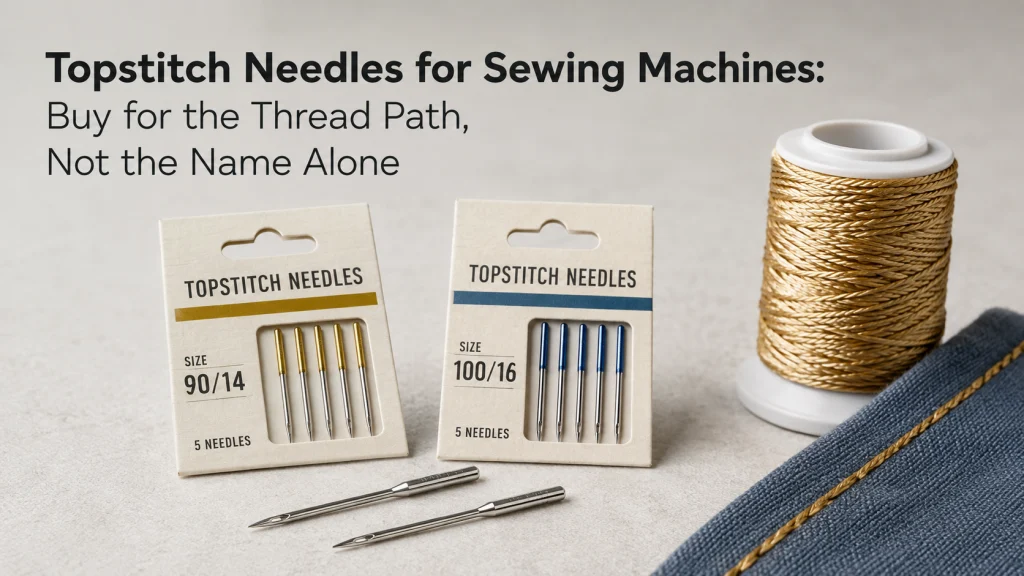
When I consider Topstitch needles for sewing machines, I start with the thread path rather than the product name. A documented Topstitch design uses a longer eye and a larger groove to give thicker, multiple, or specialty upper threads more room as they pass through the needle, while the exact needle system and size still have to match the machine. A Universal needle of the same nominal size is not automatically inferior, and a Topstitch needle is not a universal upgrade for every fabric or stitch. I verify fit first, then ask whether the thread and sewing context actually benefit from the Topstitch geometry.
Buy for the thread path, not a premium label
Put a Universal 90/14 beside a Topstitch 90/14 and the shared size number can make the choice look simple. It is not. The number identifies needle size, while the needle type changes other geometry that can matter to the upper thread. I therefore start with what the thread must pass through, not with the assumption that a specialty label means a stronger or better needle.
SCHMETZ documents its Topstitch needle with an elongated eye, a larger groove on its U.S. selection page, and a slightly rounded point. The parent-company technical page specifies a 2.0 mm eye in all listed Topstitch sizes. Those are concrete features. They do not prove that every machine, thread, fabric stack, or stitch will improve simply because the package says Topstitch.
Key point: I consider a Topstitch needle when its documented thread-path geometry answers a real thread requirement and the exact needle system is compatible with the machine.
That distinction keeps the purchase narrow. If ordinary sewing thread already runs cleanly through a compatible Universal needle and the material does not call for another point style, there may be no reason to buy a specialty type at all.

These SCHMETZ Topstitch needles are size 90/14 and use the 130 N household needle system identified by SCHMETZ. The Topstitch design has an elongated eye and slightly rounded point, with the extra thread clearance intended for heavy, multiple, and specialty upper threads. Confirm the exact machine system and permitted 90/14 size before purchase.
Check On AmazonIf you click this link and buy, we earn a commission at no additional cost to you.
Confirm the machine’s needle system before comparing types
The first thing I check is not eye size. It is the needle system named in the exact machine manual. Household machines commonly use a flat-shank household system, but not every machine that looks domestic uses the same needle architecture, and specialist or high-speed machines can require something different. Generic names and visual similarity are not compatibility evidence.
This matters because current SCHMETZ pages use more than one designation around the Topstitch product. The U.S. product page identifies the system as 130 N, while the parent-company household page identifies the Topstitch Needle as 130/705 H-N. I treat that as a reason to match the machine manual and the actual package rather than assuming that a familiar product name settles fit.
- Find the needle-system designation in the machine manual.
- Check the package for the system or compatible household designation.
- Confirm the needle can be installed in the orientation specified by the manual.
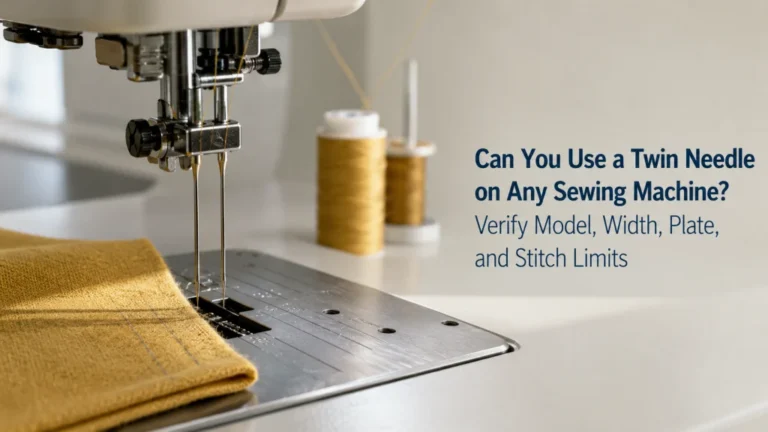
- Stay within the machine’s permitted needle sizes and needle-plate configuration.
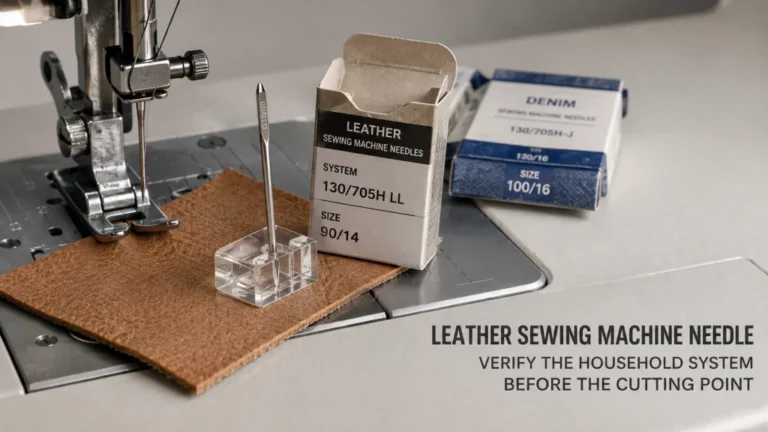
When you are reading a blister card in a store or checking package photos online, separate three pieces of information instead of treating the front label as one specification: the needle designation or type, the needle system, and the NM/SIZE marking. SCHMETZ documents those fields on its household needle packaging, and its clear lid also allows the needle’s color marking to remain visible. The system field is the compatibility check, while a marking such as 90/14 is the needle size, so one should not be used as proof of the other. If a listing photo hides the system designation, verify it from the manufacturer or the actual package before buying.
If the manual calls for another needle system, stop there. The broader sewing machine needle selection process is the right place to resolve system fit before comparing specialty needle types.
Define a Topstitch needle by documented eye, groove, and point features
I define the product mechanically. SCHMETZ documents a particularly long eye on its 130/705 H-N Topstitch needle, measuring 2.0 mm in the listed sizes, and describes the point as slightly rounded. Its U.S. needle-selection material also describes an extra-large eye and large grooves intended to accommodate topstitch thread.
Those features describe the path the upper thread takes through the needle. The eye gives the thread clearance at the lowest part of that path, while the groove along the blade provides space for the thread as the needle enters the material. If a thicker or multiple upper thread is crowded by a smaller eye or groove, geometry becomes a real buying variable rather than a marketing detail.
Notice what this definition does not claim. It does not say the Topstitch needle has a universally stronger blade, that it will always make straighter stitches, or that it will prevent every thread break. Those outcomes depend on more than eye and groove geometry.
Compare Topstitch and Universal needles at the same nominal size
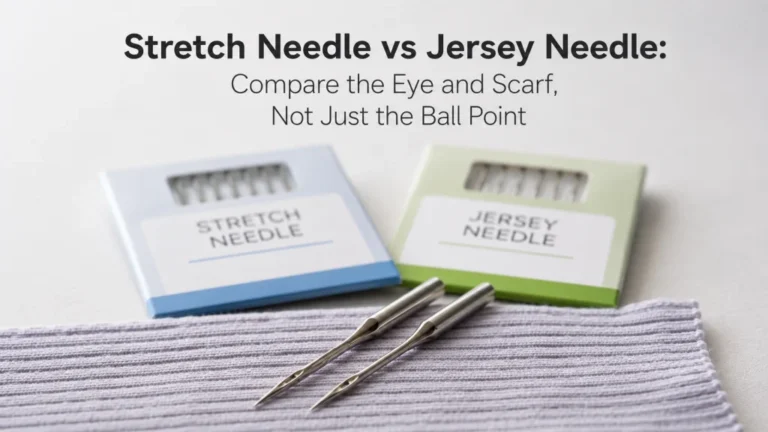
I like same-size comparisons because they separate needle type from needle diameter. SCHMETZ lists both Universal and Topstitch needles in overlapping sizes such as 80/12, 90/14, and 100/16. At those shared sizes, choosing Topstitch is not simply choosing a larger needle.
| Same-size check | Universal needle | Topstitch needle | What the difference means |
|---|---|---|---|
| Nominal size | Can share sizes such as 80/12, 90/14, or 100/16 | Can share those same sizes | Type and size are separate decisions |
| Point | Slightly rounded in current SCHMETZ documentation | Slightly rounded in current SCHMETZ documentation | The product name does not automatically mean a sharper point |
| Eye | No Topstitch-specific long-eye feature is listed | Particularly long eye, documented at 2.0 mm on the parent-company page | Topstitch geometry can provide more room for thicker or multiple upper threads |
| Groove | General-purpose geometry | U.S. SCHMETZ guidance describes a large groove for topstitch thread | Thread clearance along the blade is part of the purchase decision |
For example, moving from a Universal 90/14 to a Topstitch 90/14 can change eye and groove geometry without changing the nominal 90/14 size. Moving instead from 90/14 to 100/16 changes size as well, which creates a second variable. Keeping those two decisions separate makes it easier to understand what you are actually testing.

These SCHMETZ Universal needles are size 90/14 in household system 130/705 H. Universal is the manufacturer's general-purpose needle type, so this pack provides a useful same-size comparison against a Topstitch 90/14 without changing nominal needle size. Check the machine manual for the required system and permitted size before treating either needle as compatible.
Check On AmazonIf you click this link and buy, we earn a commission at no additional cost to you.
Start from thread diameter and the sewing requirement
I find the Topstitch label most useful when the upper thread is the reason for shopping. SCHMETZ specifically names heavy, multiple, metallic, and other specialty-thread applications on its current U.S. product material. That does not mean every heavy thread needs the same needle size, or that a Topstitch type replaces the normal relationship among thread diameter, needle size, material, and stitch formation.
Use a short purchase check instead of jumping straight to a size:
- Identify the exact upper thread you intend to use.
- Decide whether you are using one thread, multiple threads through one needle, or a specialty decorative thread.
- Check whether the thread has adequate clearance through the needle eye and along the groove.
- Choose only among sizes allowed by the exact machine and suitable for the material stack.
- Test on the actual material stack before committing to visible work.
A common misunderstanding is to treat a thicker visible thread as proof that the largest available Topstitch needle is the correct answer. I do not make that jump. Needle size changes the shaft diameter and the hole made through the material, so larger is not automatically better. The general machine accessory selection framework still applies: compatibility and the actual task come before a specialty label.

This 20-needle ORGAN pack uses the HAX130N household needle system with a flat shank. The listing describes a long eye intended for topstitching and decorative sewing with heavy or multiple upper threads. Verify the exact machine needle system and allowed size before purchase rather than assuming that a similar household needle designation guarantees fit.
Check On AmazonIf you click this link and buy, we earn a commission at no additional cost to you.
Separate topstitching, quilting, and machine-embroidery contexts
Topstitch needles appear in several sewing contexts because the thread-path feature can be useful in more than one technique. SCHMETZ currently lists topstitching, quilting or patchwork, and machine embroidery among its applications. The overlap is real, but the buying question changes with the work.
Visible garment topstitching may begin with a thicker decorative upper thread. Quilting may begin with multiple layers, a quilting method, or a comparison between a dedicated Quilting needle and another type. Machine embroidery may involve specialty thread and a different combination of stitch density, stabilizer, and machine settings. The same Topstitch product name should not flatten those into one rule.
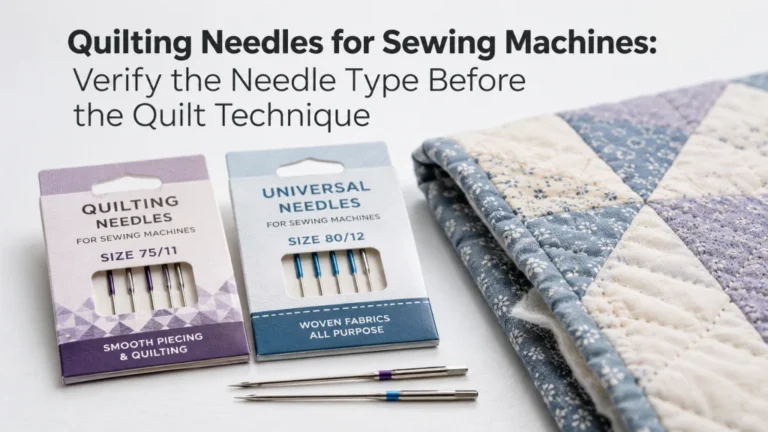
If the actual question is whether a dedicated quilting needle is the better fit, compare the needle choices for machine quilting rather than assuming Topstitch wins because quilting appears on an application list. If the material and point shape are driving the decision instead, the Microtex needle selection criteria address that different purchase question.
Check current sizes against the exact machine
Availability is another place where a generic article can become misleading. The current U.S. SCHMETZ Topstitch product page lists 80/12, 90/14, and 100/16, while the parent-company technical page also lists NM 70 along with NM 80, NM 90, and NM 100. I treat regional product listings separately even when the needle family name is the same.
For a U.S. buyer, that means the practical choices are the sizes currently sold in the relevant market, filtered again by the machine manual and the material-thread combination. Do not select a needle size just because another regional page shows it, and do not force a size outside the machine’s documented range.
Warning: Stop after an abnormal needle strike or repeated breakage. A needle that contacts the presser foot, needle plate, or another machine part needs a compatibility and setup check before sewing continues.
The purchase sequence I use is machine system first, permitted size second, thread-path requirement third. That order prevents a specialty needle from becoming an excuse to bypass the exact machine documentation.
Treat coating and longevity claims separately from needle geometry
A Topstitch needle can be sold with different surface treatments or coatings, but a coating claim is not the same claim as a long eye or enlarged groove. The eye and groove describe physical thread-path geometry. Wear resistance, heat behavior, or longer service life requires evidence for the specific coated product and the conditions under which the claim is made.
Do not transfer a durability statement from one coated variant to every Topstitch needle. Likewise, do not turn a manufacturer’s promotional longevity statement into a fixed replacement interval for all machines and materials. Needle wear changes with fabric, stitch count, speed, adhesive exposure, accidental impacts, and other conditions.
If coating is the reason for paying more, I treat it as a separate evidence question: what coating is actually on the package, what does the manufacturer claim it changes, and is there independent testing that supports a measurable performance advantage under comparable conditions? Without that evidence, geometry remains the stronger basis for the basic Topstitch purchase decision.
Reject unsupported universal-upgrade claims
Commercial needle content often moves too quickly from a real design feature to a universal outcome. A longer eye can be documented. A larger groove can be documented. Claims that the same needle will eliminate breakage, last a fixed multiple longer, or improve every stitch need a different level of evidence.
| Claim | Evidence status | Buying response |
|---|---|---|
| Topstitch geometry includes a longer eye | Documented by the manufacturer | Use it when added thread clearance is relevant |
| A larger groove is intended to accommodate topstitch thread | Documented in current manufacturer guidance | Consider it as part of the thread-path check |
| Topstitch needles prevent all thread breakage | Unsupported as a universal claim | Do not buy on that promise |
| A Topstitch needle always improves stitch quality | Unsupported as a universal claim | Test the exact machine, thread, and material combination |
| One coating lasts a fixed multiple longer in every use | Condition-dependent performance claim | Require product-specific evidence before treating it as a buying advantage |
This ledger keeps marketing language from swallowing the actual decision. I buy for the geometry I can verify for the thread path, then test the result on the exact machine and material.
Carry the chosen needle into technique and settings
I treat needle selection as complete once I have a compatible type and size that makes sense for the thread and material. It does not determine stitch length, presser-foot choice, seam position, top tension, speed, or how a visible row should be guided. Those are technique and setup decisions.
For example, choosing a Topstitch 90/14 because a thicker upper thread needs more eye clearance does not prove that a longer stitch length is automatically correct on every material. The machine, thread, fabric stack, stitch design, and desired appearance still control the test. Keep the purchase decision from absorbing the execution decision.
That boundary is especially useful when troubleshooting. If a compatible needle and thread combination sews normally in one setup but fails only when a particular stitch, material stack, or technique changes, the next question is no longer simply which needle to buy.
| If the question is really about… | Move the decision to… |
|---|---|
| General thread diameter versus needle-size clearance | The broader thread, needle, and fabric relationship |
| Stitch length, guiding, tension, or how to make visible topstitching | Topstitching technique and machine settings |
| Repeated shredding, snapping, strikes, or unexplained breakage | Symptom-led troubleshooting and service boundaries |
Keeping those routes separate prevents a needle-shopping page from turning into a settings tutorial or a repair diagnosis. Once geometry and compatibility are settled, follow the question that remains.
Route repeated thread breakage to troubleshooting
Repeated upper-thread breakage can make a Topstitch needle look like an obvious purchase, especially when a larger eye seems likely to reduce crowding. Sometimes thread clearance is relevant, but breakage can also come from threading errors, burrs, damaged needles, incorrect installation, tension problems, spool delivery, thread condition, or contact with machine parts.
That means breakage is a symptom, not proof that the needle type is wrong. If changing to a compatible Topstitch needle does not resolve the issue, or if the machine shows abnormal strikes, fraying at one location, jams, or repeated needle damage, stop using the product label as the diagnosis and follow a symptom-led troubleshooting path.
Note: Do not continue sewing through repeated hard needle strikes or unexplained breakage. Verify installation and compatibility, inspect only the owner-serviceable areas described by the manual, and use qualified service when the fault exceeds owner-level checks.
The buying decision should stay modest: select a Topstitch type because its documented geometry fits the thread-path requirement, not because it promises to cure an unresolved machine problem.
Final Thoughts: Geometry is evidence, marketing superlatives are not
The best reason I see to buy a Topstitch needle is visible in the needle itself: a documented long eye, a thread-accommodating groove, an appropriate point, and a system that matches the machine. That is much stronger evidence than a claim that the needle is simply premium, stronger, professional, or better for everything.
Before buying, I confirm the machine’s needle system, identify the upper thread, keep needle type separate from needle size, and check the current package against the exact machine manual. If the thread already runs well through a compatible general-purpose needle, buying nothing is a valid outcome. If the thread genuinely needs the Topstitch geometry, I stay within the machine’s allowed range and test the actual material stack before visible sewing.
From there, continue with the broader needle-selection process when compatibility is still uncertain, compare a dedicated Quilting or Microtex type when that is the real competing geometry, and move to technique or troubleshooting when the purchase question has already been answered.
Frequently Asked Questions
🧵 What is a Topstitch needle used for?
It is used when its longer eye and thread-accommodating groove suit thicker, multiple, or specialty upper threads. It can appear in topstitching, quilting, and machine-embroidery work, but the exact machine system and size still control compatibility.
🪡 Is a Topstitch needle better than a Universal needle?
Not universally. A Topstitch needle offers different thread-path geometry, while a Universal needle remains appropriate for many general sewing tasks. Choose the specialty type only when its features answer a real thread or technique requirement.
📏 Does a 90/14 Topstitch needle have the same size as a 90/14 Universal needle?
The shared 90/14 designation refers to nominal needle size, but the needle types can differ in eye, groove, and other geometry. Same size does not mean same design.
🧶 Can I use a Topstitch needle for quilting?
Manufacturer documentation lists quilting among Topstitch applications, especially where thicker or multiple threads are involved. A dedicated Quilting needle uses different geometry, so compare the actual thread, material stack, and machine requirement rather than choosing from the technique name alone.
⚙️ Why does my thread still break with a Topstitch needle?
A larger eye cannot correct every cause of thread breakage. Verify the needle installation, threading path, thread condition, spool delivery, owner-serviceable contact points, and the exact machine setup before assuming another needle purchase is the answer.
References and Sources
- SCHMETZ U.S. Topstitch product page: verifies the current U.S. sizes, 130 N designation, elongated eye, slightly rounded point, and listed applications.
- SCHMETZ Topstitch technical page: verifies the 130/705 H-N designation, 2.0 mm eye, available technical sizes, point shape, and comparison context.
- SCHMETZ needle selection guidance: supports the documented large-eye and large-groove description and the distinction between needle type and size.
- SCHMETZ needle packaging guidance: verifies that household packets identify the needle designation, needle system, and NM/SIZE information used in the package-reading check.