A Microtex needle is a household sewing-machine needle type defined by its system and slim acute point, not simply by the size number printed on the package. The practical buying decision is to verify that the needle system fits the exact machine, then decide whether that sharper point geometry matches the material structure or precision requirement you actually have. A Universal, Quilting, and Microtex needle can share a nominal size while remaining different products. This article keeps needle-type selection separate from blade-size selection, machine setup, and troubleshooting.
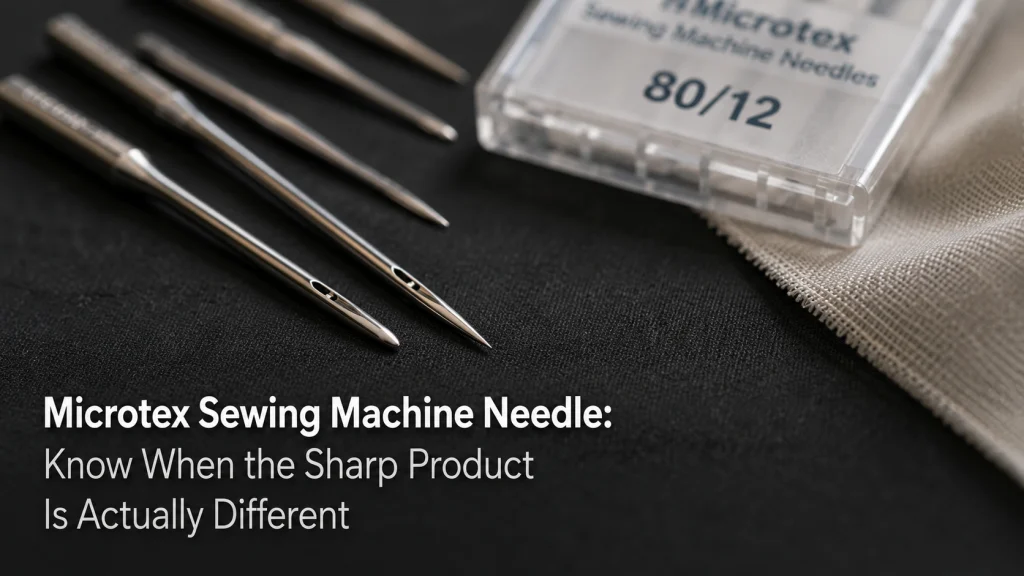
Same nominal size, different needle product
A Microtex needle can carry the same nominal size as a Universal or Quilting needle and still be a different buying choice. An 80/12 label, for example, does not tell you whether the point is slightly rounded, tapered for a quilting product, or slim and acute. Holding the size constant is useful because it exposes the real question: which needle geometry are you buying?
That distinction matters before any fabric-size chart enters the conversation. A buyer who sees several 80/12 packages in the same search results should not treat them as interchangeable just because the numbers match. For the broader map of household needle families, start with compare household sewing machine needles; this page stays focused on what makes the Microtex or Sharp family different.
The takeaway is simple: size and type answer different questions. Once that separation is clear, the rest of the purchase check becomes much more precise.
Confirm household needle-system fit first
Before choosing Microtex over another needle type, verify the needle system required by the exact sewing machine. SCHMETZ documents its standard household Microtex needle as system 130/705 H-M, while its FAQ explains 130/705 H as a household flat-shank needle system and identifies the added letter as a type designation. That is useful evidence, but the machine manual still controls the compatibility decision for the machine in front of you.
Do not replace that check with a package that merely says “home sewing machine” or with visual similarity. Two needles can look nearly identical on a store card while belonging to different systems or specialized configurations. The same compatibility discipline applies across sewing machine accessory compatibility: the exact interface or system is stronger evidence than a generic product name.
In this household system, flat shank means the upper shank has a flattened side instead of being fully round. That shape is part of the needle-system description; it does not tell you the point style or blade size. Seeing the flat side is therefore not enough by itself: the system code in the machine manual remains the compatibility check.
- Read the needle system named in the exact machine manual.
- Match that system to the needle package or manufacturer documentation.
- Confirm that the product type is Microtex or Sharp, not just the same nominal size.
- Keep the blade-size decision separate until the needle type is established.
- Do not install or continue using a needle after bending, breakage, repeated hard strikes, or other damage.
This first pass should eliminate incompatible products before point geometry becomes relevant. A sharper point does not make an incompatible needle system acceptable.
Treat Microtex and Sharp as the same family only when the maker says so
Product naming is not perfectly universal across every needle manufacturer, so the label needs documentary support. SCHMETZ explicitly markets its household product as “Microtex (Sharp)” and describes a Microtex sewing machine needle as generically known as a sharp needle. That supports treating those two names as the same needle type in this specific manufacturer context.
It does not support assuming that every package labeled “Sharp” from every maker has the same system code, geometry, coating, eye, or application list. If a different manufacturer uses the word Sharp, read that maker’s own technical description before equating it with 130/705 H-M. A Microtex Sharp needle label is therefore a clue to investigate, not a substitute for system and geometry evidence.
Note: SCHMETZ documentation identifies the standard household Microtex product as 130/705 H-M with a slim acute point. That combination is the evidence anchor used here; it should not be generalized to a differently named product without checking that product’s own documentation.
The buying rule is deliberately narrow. Match the name only after the manufacturer has clearly defined what it means.
Read 130/705 H-M without confusing type with blade size
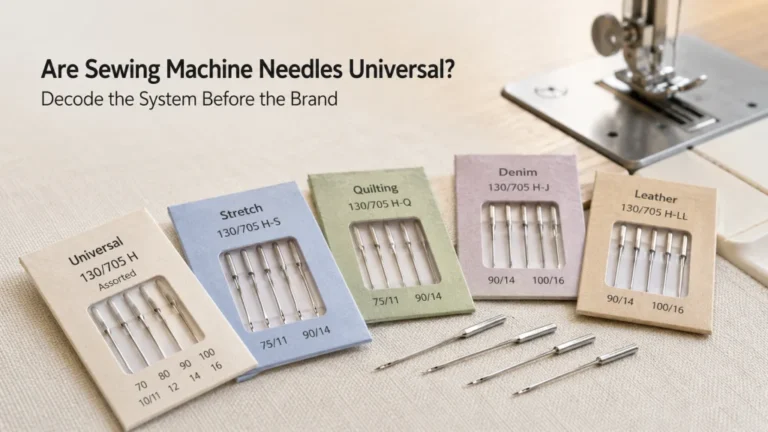
The code 130/705 H-M contains information that is easy to mash together with the separate size marking. In SCHMETZ household documentation, 130/705 H identifies the household flat-shank needle system, while the added M identifies Microtex. The blade-size marking is separate, commonly shown as paired values such as 80/12 or 90/14.
That means “M” is not a size. It tells you which product type you are looking at within the household system, while the numerical size describes blade diameter under the needle sizing convention. If your package says 130/705 H-M 80/12, there are at least three different decisions encoded there: system fit, needle type, and blade size.
| Label element | What it tells you | What it does not decide |
|---|---|---|
| 130/705 H | Household flat-shank system in SCHMETZ documentation | Point family or blade size by itself |
| M | Microtex type designation | Whether the chosen size fits the fabric and thread |
| 80/12, 90/14, and similar | Nominal blade size | Whether the needle is Universal, Microtex, Quilting, or another type |
This separation prevents one of the most common shopping shortcuts: treating the largest or smallest visible number as if it describes the whole needle. It does not.
Identify the slim acute point before deciding whether Microtex matters
The defining geometry SCHMETZ specifies for Microtex is a slim acute point. The manufacturer associates that geometry with very fine, densely woven, and coated materials, as well as work where accurate straight stitching is important. That makes the point shape the useful reason to consider the product, not a broad claim that Microtex is a higher grade of needle.
For example, a sewist comparing two same-size household needles for a densely woven material has a real geometry question: slightly rounded Universal point or slim acute Microtex point? That is a valid purchase comparison. It is different from saying a Microtex needle will automatically fix puckering, skipped stitches, fabric damage, or feed trouble, because those outcomes also depend on size, thread, machine setup, material, stitch, and machine condition.
Key point: A confirmed sharper point changes the product geometry. It does not prove greater machine capacity, universal stitch quality, or permission to force dense material through the machine.
Use point shape as one input in the purchase decision, then keep performance claims inside the conditions that can actually support them.

SCHMETZ Microtex Sharp needles in size 80/12 use a very slim acute point for precise straight stitching. This package contains five cards with five needles per card. The listing identifies applications including microfibers, polyester, silk, foils, artificial leather, coated materials, cotton, batik, and woven fabrics.
Check On AmazonIf you click this link and buy, we earn a commission at no additional cost to you.
Compare Microtex with Universal at the geometry level
The clean comparison is not “specialty versus basic.” SCHMETZ lists its Universal household needle as system 130/705 H with a slightly rounded point and its Microtex needle as 130/705 H-M with a slim acute point. A same-size comparison therefore holds blade diameter steady while changing the type designation and point geometry.
Universal remains a general-purpose needle type, while Microtex is a more specific geometry choice. That does not mean Microtex needles are always better than Universal needles. If the existing Universal needle already fits the machine, thread, material structure, and desired stitch result, the word Microtex alone is not a reason to replace it.
A first-time buyer often misunderstands “Universal” as meaning “replaces every specialty needle.” Manufacturer FAQ material directly addresses that confusion by comparing Universal, Quilting, and Microtex as distinct choices. The useful question is not whether Universal is good or bad, but whether a specific point or thread-path geometry is the unresolved requirement.
Once the need is framed that way, the buyer can stop shopping by product hierarchy and start shopping by verified construction.

These SCHMETZ Universal needles are size 80/12 household sewing machine needles using the 130/705 H system. They have a slightly rounded point and are intended for a broad range of woven and knit fabrics. The package contains 20 needles arranged on two cards of 10 needles each.
Check On AmazonIf you click this link and buy, we earn a commission at no additional cost to you.
Separate Microtex from Quilting and Topstitch product jobs
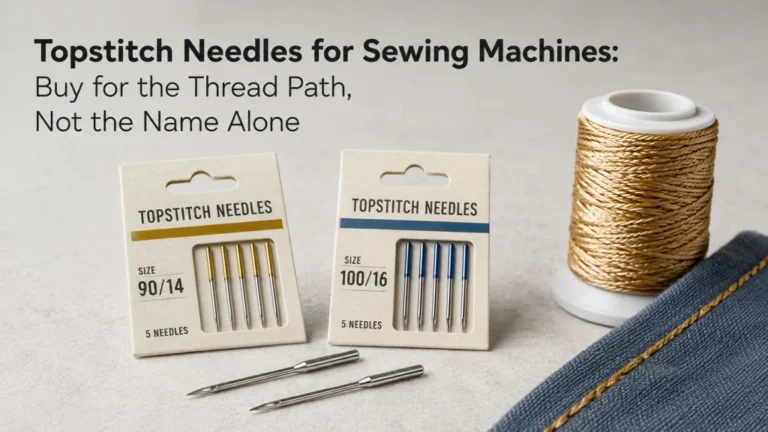
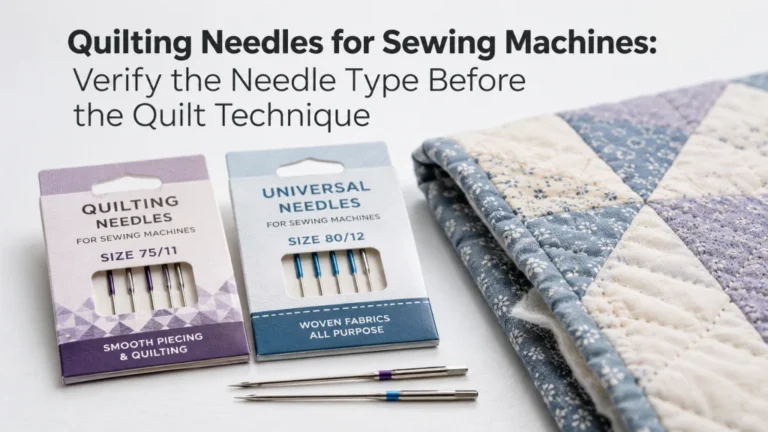
Microtex, Quilting, and Topstitch needles can appear together in search results because their application descriptions overlap around piecing, quilting, and visible stitching. Their geometry is not the same. SCHMETZ describes the Quilting needle as 130/705 H-Q with a slightly rounded point and special taper, while its Topstitch product emphasizes an elongated eye and a different system designation.
So the project name alone does not settle the product choice. If the unresolved question is the Quilting needle’s special taper, continue with compare quilting needle geometry. If the concern is thread passage through an elongated eye for heavier, multiple, or specialty threads, compare Topstitch needle geometry instead.
| Unresolved buying question | Needle type to investigate | Feature to verify |
|---|---|---|
| Do I specifically need a slim acute point? | Microtex or Sharp | 130/705 H-M and slim acute point in SCHMETZ documentation |
| Is a quilting-specific taper the reason for changing needles? | Quilting | 130/705 H-Q, slightly rounded point, special taper |
| Is thread-path room the unresolved issue? | Topstitch | Elongated eye and the exact system listed for the product |
The routing rule keeps one project from turning into three vague recommendations. Choose the needle type by the feature you actually need to verify.
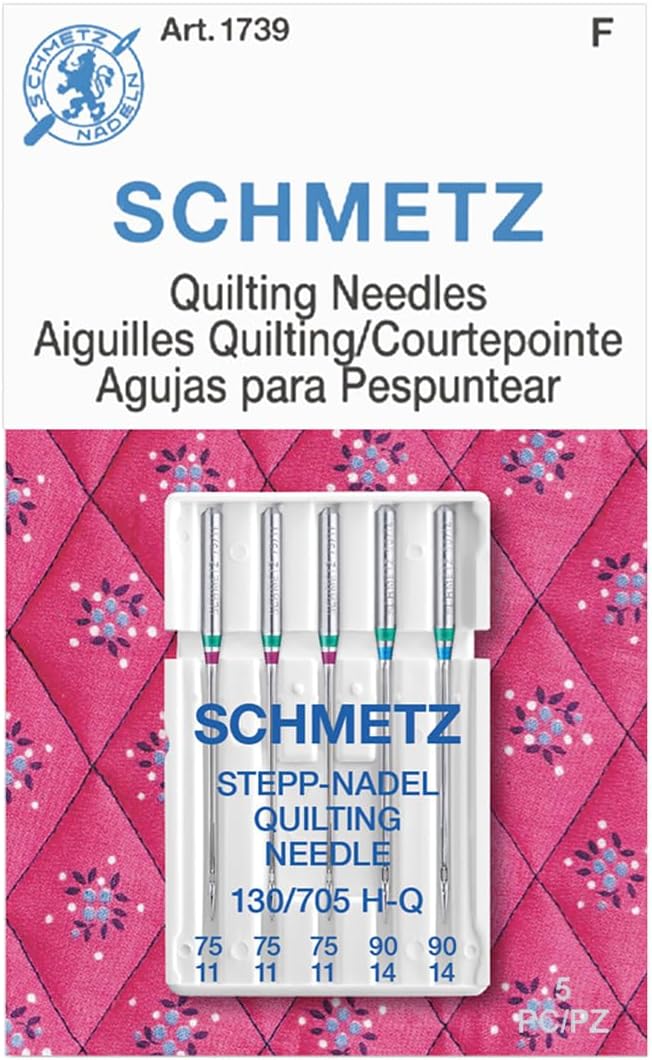
SCHMETZ Quilting needles use the 130/705 H-Q household needle system with a slightly rounded point and special taper. This assorted pack contains three size 75/11 needles and two size 90/14 needles. The product is made for machine quilting and sewing through woven fabric and quilt layers.
Check On AmazonIf you click this link and buy, we earn a commission at no additional cost to you.
Use material structure as a purchase input, not a universal size rule
Manufacturer application lists are useful because they show why the product exists. SCHMETZ Microtex documentation names very fine, densely woven, and coated materials among the intended applications. That supports considering this acute-point type when material structure makes point geometry relevant.
It does not justify a universal statement such as “use size 80/12 Microtex for coated fabric” or “all batik requires Microtex.” Blade size still depends on the actual material, construction, thread, and machine conditions. Two fabrics sold under the same broad name can differ enough in weight, density, coating, layer count, or finish to make one fixed size rule misleading.
Consider a densely woven cotton and a much heavier coated material. Both may appear on a Microtex application list, but that shared Microtex relevance does not prove they should use the same blade size. The needle-type decision can be the same while the size decision remains different.
This is why product selection should stop before it turns into a fabric-by-size chart. The next step belongs to size reasoning, not to the Microtex label itself.
Route blade-size reasoning to the material and thread decision
Once Microtex is the verified needle type, the numerical needle size still needs its own decision. Do not assume that buying a sharp-point family solves the fabric, thread, and blade-diameter match. The exact machine must permit the system and size, and the selected blade must suit the actual sewing conditions.
This boundary protects the article from becoming another universal needle-size chart. It also prevents false certainty when a package is offered in several sizes. The right next question is “which allowed size matches this material and thread combination?”, not “which Microtex size is best for every fabric with this name?”
For a buyer, that means the purchase can be narrowed in two passes. First verify the needle type and system; then make the size decision using the actual material and thread rather than the product label alone.
Keeping those passes separate is especially useful when two same-size packages are being compared. You can decide geometry first without accidentally treating size as proof of product purpose.
Carry the verified product into actual setup and representative testing
Buying the correct needle type is not the same as proving the final sewing result. After the system, type, and size are verified, the needle still has to be installed according to the exact machine manual and evaluated with the real fabric, thread, stitch, layers, and settings. A package description cannot substitute for that setup.
For example, if a Microtex needle was chosen because a material is densely woven, the representative test should use the actual material stack and intended thread rather than a convenient scrap with different construction. Record what changed if a comparison is being made. Without that controlled context, a better or worse stitch line cannot be attributed to point geometry alone.
Pro Tips: Keep the test modest: correct system, permitted size, fresh undamaged needle, actual material, intended thread, and normal owner-level settings. If the machine strikes the needle, bends it, breaks it, or develops a hard mechanical problem, stop rather than forcing the test.
This is the point where a purchase decision becomes a machine setup decision. The evidence standard should change with it.
Do not turn a Microtex purchase question into troubleshooting
Skipped stitches, repeated needle breakage, unexplained fabric damage, or a needle that strikes the machine are symptoms, not proof that the needle type was wrong. A different needle type may be part of the eventual answer, but the symptom can also involve installation, size, thread, presser-foot setup, needle plate, timing-related service issues, material handling, or damage elsewhere in the sewing system.
That distinction matters because changing to a sharper point can hide the real diagnostic question. If a machine sews ordinary fabric normally but fails only with one dense material stack, the next checks differ from a machine that repeatedly strikes the needle on every sample. Do not keep changing needle products while ignoring a hard strike, damaged component, or service-only condition.
Warning: Use only a needle system and size permitted by the exact machine. Stop after repeated hard needle strikes, bending, breakage, uncontrolled motion, overheating, smoke, a burning odor, damaged cords or pedals, or any condition the manual reserves for service.
A Microtex purchase page should help identify the product. Once a failure symptom takes over, the task is diagnosis, not shopping.
Set an evidence threshold before buying
A useful shortlist does not need dozens of claims. It needs enough evidence to prove that the package is the right needle type for the machine and for the reason you are considering it. If one of those pieces is missing, pause before turning a broad label such as Sharp into a compatibility assumption.
Use the following evidence checklist when comparing microtex sewing machine needle listings or packages. It is intentionally stricter than matching a fabric name on the front of a card.
- Exact system: Does the package or manufacturer page state the needle system, and does the exact machine manual allow it?
- Exact type: Is the product identified as Microtex, Sharp, or both by that manufacturer?
- Point geometry: Does the maker document a slim acute point or another clearly defined geometry?
- Separate size: Can you distinguish the product type from the numerical blade size?
- Application evidence: Does the stated application resemble the material structure or precision requirement that triggered the search?
- No unsupported promise: Are you avoiding claims that the sharp point guarantees capacity, prevents every skipped stitch, or is universally better?
If the first four checks are clear, you know what product you are looking at. The final two checks decide whether there is a documented reason to consider it without inflating that reason into a performance guarantee.
Final Thoughts: Microtex is a point-geometry choice, not another name for Universal
The strongest reason to choose Microtex is specific: the exact machine accepts the household system, the manufacturer documents the product as Microtex or Sharp, and the slim acute point is relevant to the material structure or precision requirement. That is a much narrower and more useful standard than “Microtex is better” or “Universal does everything.”
Keep system, type, and size as separate checks. If Quilting taper or Topstitch eye geometry is really the unresolved issue, route the decision to that needle type instead. If Microtex remains the right family, carry the verified needle into the actual size, setup, and representative test rather than expecting the label to decide the whole sewing result.
FAQs
🪡 What is a Microtex needle used for?
Microtex is a sharp-point household needle type specified for fine, densely woven, coated, and other precision-oriented applications. Treat that as a needle-type clue, then verify the exact machine system, blade size, material, and thread before sewing.
🔍 Is a Microtex needle the same as a Sharp needle?
SCHMETZ explicitly uses “Microtex (Sharp)” and describes Microtex as generically known as a sharp needle. Do not assume another manufacturer’s Sharp product is identical until its own system and geometry are confirmed.
📏 Does 80/12 tell me that a needle is Microtex?
No. 80/12 is a blade-size marking, not the needle type. A Universal and Microtex needle can share that nominal size while using different type designations and point geometry.
🧵 Is Microtex always better than a Universal needle?
No. Universal and Microtex are different geometry choices, not quality grades. If a Universal needle already fits the machine, material, thread, and intended result, the Microtex label alone is not evidence that changing will improve the work.
🧩 Is a Microtex needle the same as a Quilting needle?
No. SCHMETZ specifies a slim acute point for Microtex and a slightly rounded point with a special taper for Quilting. Hold size constant and compare those product features rather than treating the project name as proof that the needles are interchangeable.
🧶 When should I look at a Topstitch needle instead?
Investigate Topstitch when the unresolved requirement is thread-path geometry such as an elongated eye for heavier, multiple, or specialty threads. That is a different buying question from selecting Microtex for its slim acute point.
References and Sources
- SCHMETZ Microtex product page: Verifies the Microtex (Sharp) naming, 130/705 H-M system, slim acute point, regular eye, and stated application range.
- SCHMETZ needle FAQ: Supports the household-system explanation, Microtex type code, needle-size distinction, and the Universal, Quilting, and Microtex selection question.
- SCHMETZ Universal needle page: Verifies the 130/705 H system and slightly rounded point used for the same-size geometry comparison.
- SCHMETZ Quilting needle page: Verifies the 130/705 H-Q system and slightly rounded special-taper point used to distinguish Quilting from Microtex.
- SCHMETZ Topstitch needle page: Verifies the Topstitch system, elongated eye, and thread-oriented geometry used to separate that buying question from Microtex.