Sewing machine bobbins are not universal, and a bobbin that drops into the machine is not automatically the correct one. The safe purchase route is to start with the exact machine make and model, find the manufacturer-specified bobbin class or part number and material, then compare any replacement against that evidence. Diameter alone, brand alone, and a seller’s “universal” label are weak proof because bobbins that look almost identical can differ in height, flange profile, material, or model-specific geometry. If the exact fit cannot be established, treat compatibility as unknown and do not force the bobbin into the winder, holder, or case.
A near fit is not a proven fit
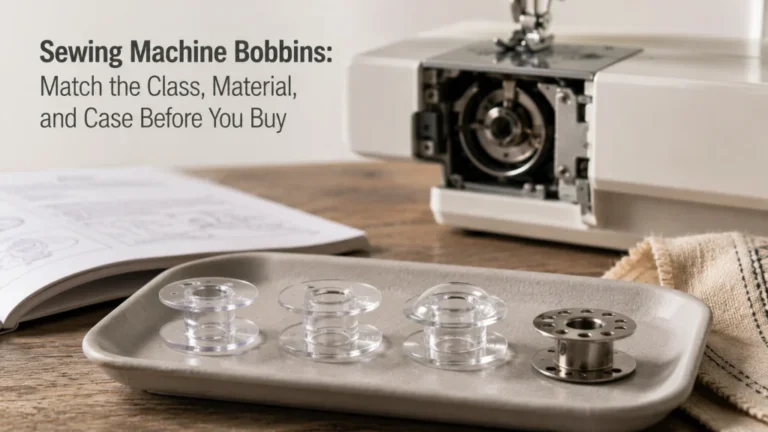
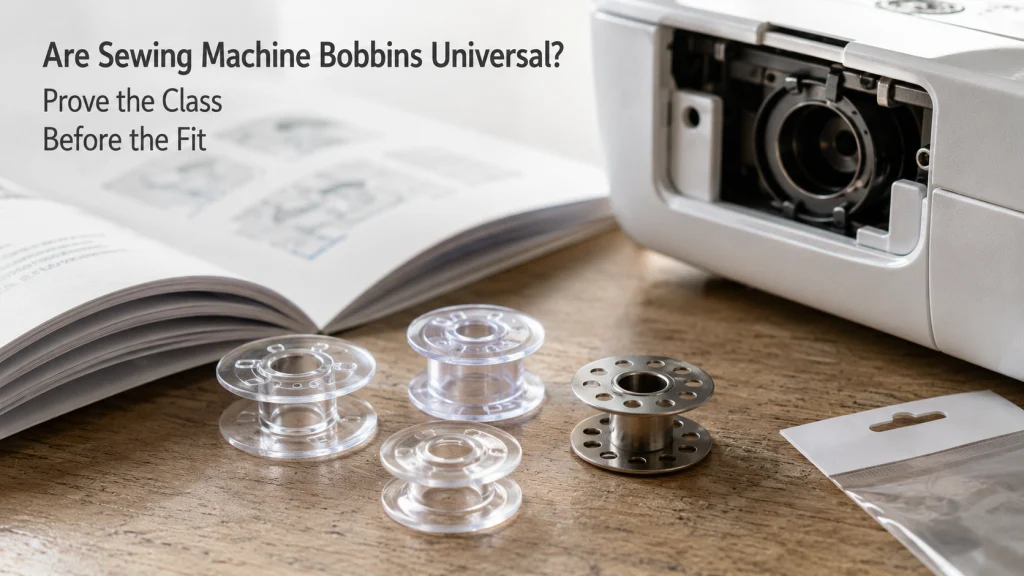
Are sewing machine bobbins universal? No. Put four loose bobbins of nearly the same diameter on a table and it can be surprisingly hard to tell which one belongs in which machine, especially when the differences are a small change in height, a flatter or more curved flange, a different material, or a proprietary center shape. The buying question is not “Will this bobbin physically go in?” but “What evidence shows that this exact machine is designed to use it?”
That distinction matters before any bobbin is wound or inserted. Singer’s own bobbin guidance gives a useful example: its transparent Class 15 and transparent Class 66 bobbins are both listed at 13/16 inch in diameter, yet the Class 15 is taller with flat top and bottom surfaces while the Class 66 is shorter with curved surfaces. Same diameter does not make them interchangeable. If you need the broader process for identifying and buying bobbins, start with the sewing machine bobbin buying map; this article stays focused on the yes-or-no compatibility gate.
Start with the exact make and model
The machine model is stronger evidence than a loose bobbin, a package that says “fits most,” or a guess based on whether the machine is top-loading or front-loading. Find the full model designation on the machine label and match it to the manufacturer manual, support page, or accessory list. A broad brand name is not enough because one manufacturer can use several bobbin systems across different machine families.
For a first-time owner, this is an easy place to go wrong. A person may inherit a box containing one working bobbin, several similar spares, and a machine manual that uses only a generic word such as “bobbin.” The correct move is not to choose the closest-looking spare. Record the machine model first, then trace the required bobbin from a source that actually covers that model.
| Worksheet item | What to record | Why it matters |
|---|---|---|
| Machine identity | Brand and full model designation | Compatibility rules can change within one brand |
| Primary source | Manual, support page, or accessory list for that model | This sets the machine boundary |
| Required bobbin | Class, manufacturer part number, or both | A class name alone may not capture every restriction |
| Material | Plastic, metal, or another specified construction | Some machines limit material as well as class |
| Candidate replacement | Its exact class, part number, material, and stated model list | This is what must be compared with the machine requirement |
If any of those fields remains unknown, keep it marked unknown. Guessing from appearance turns a simple accessory purchase into an avoidable compatibility gamble.
Find the manufacturer bobbin part number or class
Once the model is known, look for the strongest identifier the manufacturer provides. That may be a specific part number, a named class such as Class 15J or Class 66, a proprietary family, or a product page with an explicit model list. When both a class and part number are provided, keep both in your notes instead of reducing the requirement to the broader class name.
Brother illustrates why that model boundary matters. Its support information for a large group of covered machines specifies the SA156 high plastic Class 15-type bobbin and warns against using bobbins from other models; the same support page also says metal bobbins should not be used in those machines. “Class 15” is useful information, but the exact supported bobbin and material rule are stronger than assuming that every object carrying a broad Class 15 label is equivalent.
| Evidence level | Example | How much confidence it gives |
|---|---|---|
| Strongest | Exact machine manual or manufacturer support page naming the bobbin | Use this as the compatibility boundary |
| Strong | Manufacturer accessory page with an explicit model list | Good evidence when your exact model is listed |
| Conditional | Documented equivalent that matches class, material, geometry, and model support | Accept only when equivalence is actually stated or traceable |
| Weak | Generic class chart without exact model coverage | Useful for terminology, not final proof |
| Weakest | Same diameter, same brand, visual match, or “universal” seller claim | Not enough to establish fit |
This evidence ladder is also useful for other machine-interface parts. The same principle appears throughout sewing machine accessories compatibility: the exact machine requirement outranks a generic product label.

The Brother SA156 package contains 10 genuine Brother top-load bobbins. Each bobbin is 7/16 inch deep and includes a security notch used during bobbin winding. The listing identifies these as clear replacement bobbins intended for compatible Brother sewing and embroidery machines.
Check On AmazonIf you click this link and buy, we earn a commission at no additional cost to you.
Separate diameter, height, flange profile, and material
A bobbin is a three-dimensional machine part, not just a circle with thread around it. Diameter is only one measurement. Height affects how the bobbin sits in the case or holder, the flange profile can change clearance and thread behavior, the center geometry can matter to winding or positioning, and material may be part of the machine’s design requirement.
The Singer class guide makes the same-diameter trap easy to see. Its Class 15 transparent and Class 15 metal examples share the same listed diameter and height, yet the manufacturer explicitly says not to substitute one for the other. Its Class 15J differs in both height and diameter and uses a gently curved profile. The lesson is not to memorize a chart; it is to treat every physical feature as subordinate to the machine’s stated requirement.
Same-diameter check: If two bobbins share the same outside diameter, you still need the correct height, flange shape, material, center geometry, and machine approval. A diameter match proves only one dimension.
If you are comparing two loose bobbins at home, measure the outside diameter and overall height with a caliper if you have one; a straight ruler can give a rough check when the difference is large enough to see clearly. Set the bobbins side by side on a flat surface to compare height, then look across the flange edges to see whether they are flat, curved, or noticeably different in profile. Record what you see rather than trying to make a near match fit a class by eye.
Those measurements are identification clues, not permission to use the bobbin. They can eliminate an obvious mismatch or help you search the right class, but the exact machine documentation still closes the compatibility decision.
Treat the same brand as insufficient evidence
Brand loyalty does not create universal fit inside a manufacturer’s own catalog. Janome’s standard clear bobbin page lists broad compatibility across many sewing and embroidery machines but names exceptions including the 1600P, HD9, MB4, and MB7 families. Its L-Class metal bobbin is limited to select machines and is specifically described as not interchangeable with the standard plastic Janome bobbin.
This is a useful buying lesson because packaging often makes same-brand accessories feel inherently safe. The manufacturer name is only the start. You still need the exact model list, part number, class, and material requirement that applies to your machine.

This Janome package contains 10 clear bobbins for compatible Janome household sewing and embroidery machines. The bobbins use Janome's plastic and rubber formulation intended to hold thread while reducing vibration and operating noise. They are sold as Janome J bobbins rather than as a generic universal bobbin.
Check On AmazonIf you click this link and buy, we earn a commission at no additional cost to you.
Treat the same diameter as insufficient evidence
A loose bobbin that appears to be the right width can still sit too high, too low, or differently against the surrounding mechanism. Even before sewing, that can show up as binding, scraping, poor seating, or a winder that does not accept the part normally. Do not force the bobbin to prove a point.
It is also important not to use an existing stitch problem as backward proof that a bobbin must be wrong. Thread nests, uneven tension, or poor stitch formation can have several causes. This page answers compatibility before purchase; diagnosing an existing sewing fault belongs to a separate troubleshooting process.
Use manufacturer-approved equivalents only when they are documented
A third-party replacement is not automatically unsafe, but “looks equivalent” is not the same as documented equivalence. If you are considering a non-original bobbin, compare the candidate against the machine maker’s requirement and look for an explicit model list or a reliable equivalence record. The burden is on the replacement claim to show why it fits.
Generic bobbin charts can be useful for learning terminology or recognizing broad families, but they should not override an exact model requirement. If a chart calls something Class 15 while the machine manufacturer specifies a particular Class 15-type part and material, keep the narrower machine requirement. Compatibility is strongest when both sides of the comparison are identifiable.
Take Class 15J questions to the class-specific check
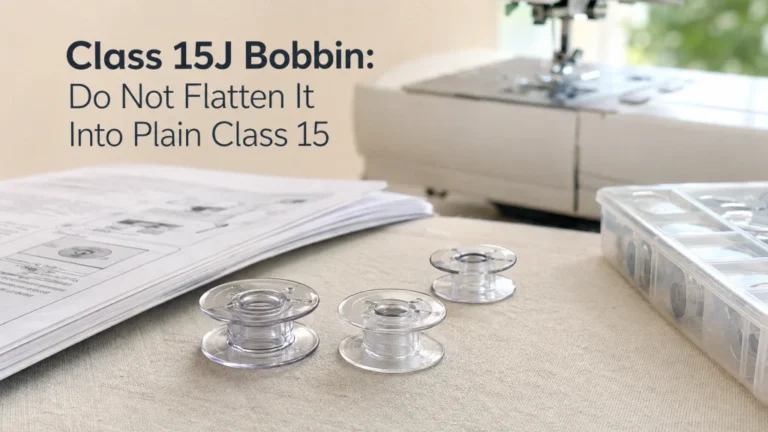
Once Class 15J appears in the machine documentation, stop comparing it loosely with every bobbin carrying “Class 15” in the name. The shared numbering is exactly what can create confusion. The useful comparison is now between the machine’s stated 15J requirement and the exact replacement in front of you.
The Class 15J bobbin identification page handles that narrower check. Keep the model number beside the class name so the label never becomes a shortcut around the machine-specific requirement.
Take Class 66 questions to the class-specific check
A curved flange can make a Class 66 candidate easier to recognize beside a flatter bobbin, but recognition is not the same as approval for your machine. Treat shape as a clue that helps narrow the family, then return to the exact model requirement before buying or using the part.
If Class 66 is the family you are actually working with, the Class 66 bobbin identification page takes over from here. That lets you focus on one class instead of carrying the whole universal-fit question into the next decision.

This SINGER package contains four empty transparent plastic Class 66 bobbins. Class 66 bobbins have curved upper and lower surfaces and are used by selected SINGER sewing machine models. The listing provides a model-specific compatibility range rather than presenting the bobbins as a universal replacement.
Check On AmazonIf you click this link and buy, we earn a commission at no additional cost to you.
Take L-style questions to the class-specific check
L-style becomes relevant only after the machine or candidate has been narrowed to that system. At that point, a quick visual comparison with another small bobbin is not useful enough, because near-matches can share a similar overall footprint while belonging to different systems.
Move to the L-style bobbin identification page and compare within that family. The job is no longer to ask whether bobbins are universal, but to confirm whether the candidate matches the machine’s stated L-style requirement.
Separate material substitution from class identification
Sometimes the class is already settled and the remaining question is whether metal and plastic versions can be swapped. Do not treat that as a cosmetic choice. Manufacturer guidance can make material part of the fit requirement, as shown by Brother’s restriction against metal bobbins for the covered SA156 machines and by Janome’s separation between its standard plastic bobbins and selected metal-bobbin systems.
If the class is known and only construction material remains unresolved, continue with the metal versus plastic bobbin choice. That narrower comparison is more useful than repeating the broad “are bobbins universal” question after the machine system is already known.
This package supplies twelve metal Class 15 bobbins for compatible sewing machines that specify this particular bobbin system. Extra bobbins help keep frequently used thread colors wound and organized without repeatedly emptying the same bobbin. Check the machine manual before purchasing, because Class 15 metal bobbins are not interchangeable with all plastic, Class 66, or specialty bobbin styles. This is a twelve count package rather than the ten count set previously listed, while retaining the relevant Class 15 metal format.
Check On AmazonIf you click this link and buy, we earn a commission at no additional cost to you.
Stop if the part is actually the bobbin case
A bobbin and a bobbin case are different compatibility decisions. If the part you are replacing is the removable case or holder surrounding the bobbin, do not use bobbin class alone to choose it. The case can have its own machine-specific geometry, tension components, and part number.
Keep the original part identity clear before buying anything. A known bobbin case replacement should be handled as a case-replacement question, not folded into a bobbin interchangeability answer.
Mark undocumented compatibility as unknown
There is no requirement to force every candidate into a yes or no answer. If you know the machine model but cannot find a reliable bobbin requirement, or you have a loose bobbin with no trustworthy class, part number, or model list, “unknown” is the correct result. That protects you from turning missing evidence into an invented fit claim.
Stop: Do not force a bobbin into the winder, case, or holder. Stop if it binds, sits unusually high, scrapes, or creates needle contact with the lower assembly.
Unknown does not mean the bobbin is definitely incompatible. It means the evidence is not strong enough to use it as a replacement yet. Return to the exact model manual, manufacturer support, or an authorized service source before proceeding.
Final Thoughts: universal is a claim that needs a machine boundary
Sewing machine bobbin compatibility starts with the machine, not with the loose bobbin in your hand. Record the exact make and model, find the specified class or part number and material, then compare the candidate against that requirement. Same brand, same diameter, same loading layout, or a package marked “universal” cannot replace model-specific evidence.
Once the class is known, move to the narrower class or material check instead of continuing to shop broadly. If the fit cannot be documented, leave the result as unknown and do not force the part. That is a better outcome than buying a near match and hoping physical fit proves compatibility.
FAQs
🧵 Do all sewing machine bobbins fit all machines?
No. Machines can require different bobbin classes, dimensions, flange profiles, materials, or proprietary parts. Use the exact machine model and manufacturer requirement to establish fit.
📏 Can I use a bobbin if it has the same diameter?
Not on diameter alone. Two bobbins can share the same diameter while differing in height, profile, material, or machine approval.
🏷️ Are bobbins from the same sewing machine brand interchangeable?
Not necessarily. Manufacturers may use several bobbin systems across their own machines, so check the exact model list or part requirement rather than relying on brand.
🔍 How do I know what bobbin my sewing machine takes?
Start with the full machine model number and look for its manual, support page, or manufacturer accessory list. Record the stated class, part number, and material before comparing replacements.
⚙️ Can I use any Class 15 bobbin in a machine that says Class 15?
Do not assume so from the broad class label alone. Some manufacturers specify a particular Class 15-type bobbin, material, or model-bounded part, so the exact machine requirement should control the decision.
🛑 What should I do if the correct bobbin type is unclear?
Treat compatibility as unknown and do not force the candidate into the machine or winder. Check the exact model documentation or manufacturer support before using it.
References and Sources
These manufacturer sources are included because the article relies on exact bobbin geometry, material restrictions, and same-brand exceptions that should not be inferred from generic class charts.
- Singer bobbin class guidance: Supports the examples showing that diameter, height, flange profile, material, and class can differ even among visually similar bobbins.
- Brother bobbin type support: Supports the model-bounded SA156 Class 15-type requirement and the restriction against metal bobbins for the covered machines.
- Janome standard bobbin compatibility: Supports the same-brand exception example and the need to check exact model compatibility rather than assuming one Janome bobbin fits every machine.
Generic class charts and community discussions can help explain terminology or common confusion, but they do not override an exact machine-manufacturer requirement.