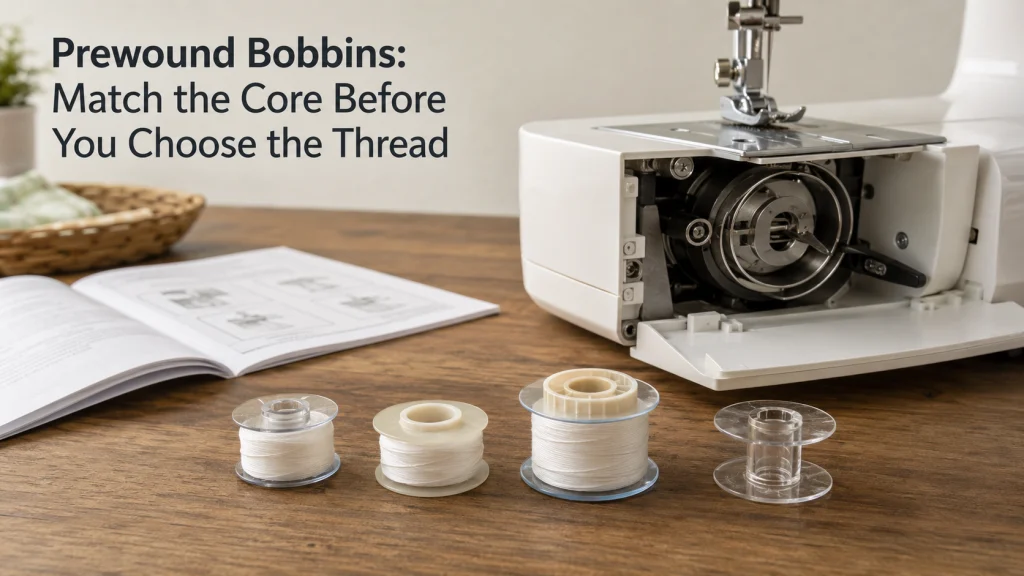
Prewound bobbins can save time, but the convenience matters only after the bobbin core is verified for the exact machine. Class 15, L-style, M-style, plastic, paper-sided, and sideless formats are not interchangeable labels, and a familiar-looking core is not proof of fit. Start with the machine documentation, confirm the permitted bobbin type and construction, then compare that requirement with the prewound core before considering thread fiber, weight, or color. This article stays with physical compatibility and routes thread choice, winding technique, and fault diagnosis to the places where those decisions can be handled properly.
The Thread Can Be Right While the Core Is Wrong
Three boxes of prewound bobbins can carry thread that looks almost identical while the cores underneath are labeled Class 15, L-style, and M-style. That difference comes before color, fiber, or any promise about how evenly the thread was wound. Prewound bobbins are still machine-interface parts, so the physical bobbin must match the hook, bobbin case, and cover system the machine was designed to use. A first-time buyer can easily focus on thread because that is the visible consumable, even though the core is the part that decides whether the package belongs near the machine at all.
The safest starting question is therefore not whether a prewound looks close to the empty bobbin already in the accessory tray. It is whether the exact machine documentation identifies an accepted bobbin type, part family, material, dimension, or prewound procedure that matches the core being considered. This is the same compatibility logic used throughout sewing machine accessory compatibility: the product label is useful only when it can be connected to the exact interface on the machine. Once that connection is proven, thread selection becomes a separate decision rather than a substitute for fit evidence.
Confirm Whether the Exact Machine Accepts Prewound Bobbins
A machine manual or official support page should settle the first gate because manufacturers do not describe bobbin requirements with the same level of detail. One machine family may identify a common bobbin class, while another may specify a particular plastic part, height, material, or installation procedure. Brother support, for example, documents machine groups that use its SA156 plastic Class 15 type and warns against substituting other bobbins on those covered models. That does not prove that every Class 15 prewound is acceptable, because the documented requirement includes more information than the class name alone.
Prewound support can also be narrower than ordinary empty-bobbin support when the machine requires an alternate bobbin case, center pin, or another model-specific arrangement. A Brother procedure for a defined group of machines requires an alternate bobbin case and center pin, and it explicitly states that the bobbin thread sensor does not work when prewound bobbins with a center core are used. That establishes a useful boundary: a documented prewound setup can change whether a machine’s low-bobbin monitoring feature remains available, but the support page does not attribute that limitation to core weight or dimensions. If the exact machine has a bobbin thread sensor, check the model-specific prewound procedure instead of assuming the sensor will behave the same way as it does with the regular bobbin. No hands-on fit trial is used as evidence here; the compatibility decisions in this article are based on documented machine and core requirements.
| Compatibility ledger field | What to record before purchase |
|---|---|
| Exact machine | Brand, model number, and the manual or support page that applies to it |
| Accepted bobbin identity | Class, style, part family, dimensions, or other wording used by the machine maker |
| Construction restriction | Plastic, metal, sided, sideless, paper-sided, or another documented requirement |
| Prewound instruction | Whether the manual or support page allows prewounds and requires any special installation step |
| Product-side evidence | The prewound maker’s stated core style and construction, not visual resemblance |
The completed ledger should leave a short chain of evidence rather than a guess: this machine accepts this bobbin identity, and this prewound is documented as that identity. If either side is missing, the answer is not yet known. That distinction matters because a package can be accurately labeled and still be wrong for a particular machine. Compatibility is a match between two documented sides, not a property that belongs to the prewound by itself.
Match Class 15, L-Style, M-Style, or a Proprietary Core Before Thread
Class 15, L-style, and M-style are useful shopping labels because current prewound makers sell bobbins in those formats, but the labels do not collapse into one universal size. Superior Threads describes Class 15, L-style, and M-style as three commonly used bobbin styles. It also notes that some machines require a special bobbin. That is enough to show why a package of Class 15 prewound bobbins should be evaluated as Class 15 first, not as simply “prewound.” The same logic applies to L-style prewound bobbins and M-style formats even when the thread wound onto them appears identical.
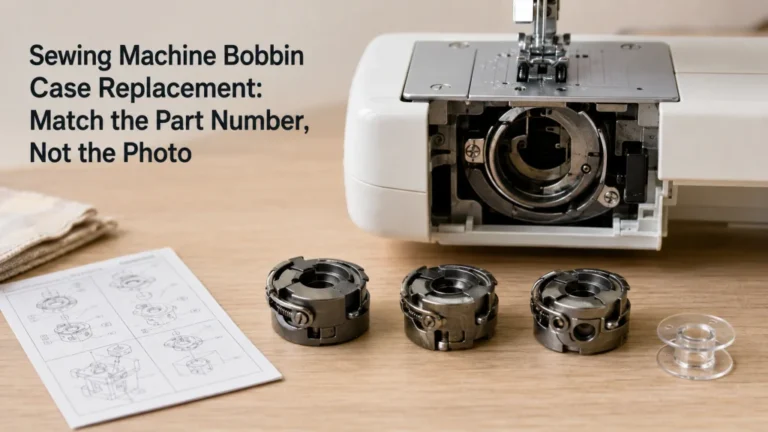
Visual comparison is especially weak when two cores are close in diameter but differ in height, flange shape, side construction, center opening, or the way the machine controls the bobbin. A core can drop into the opening and still fail the more important test of being the documented type for that machine. If the manual uses a proprietary part number instead of a generic class, preserve that identifier rather than translating it into a familiar label without evidence. The job at this stage is only to establish physical eligibility, not to decide whether the thread on the eligible core is desirable for the project.
| Prewound core label | What the label tells you | What still needs verification |
|---|---|---|
| Class 15 | The seller identifies the core with the Class 15 family | Exact-machine acceptance, construction, dimensions, and any prewound restriction |
| L-style | The seller identifies an L-style core | Whether the exact machine uses L-style and whether the stated construction is permitted |
| M-style | The seller identifies an M-style core | Whether the exact machine is designed for that larger style and configuration |
| Proprietary or model-specific | The core is tied to a defined machine or part family | Exact matching model or official compatibility listing |
This core-style card is deliberately simple because it prevents thread marketing from entering too early. It does not rank one style over another, and it does not imply that a common style is better than a proprietary one. A machine designed around a proprietary bobbin needs the proprietary evidence, while a machine documented for a common class still needs the correct construction within that class. The right label is the one that matches the machine’s requirement, not the one that appears most often in search results.
Check Material, Sided, or Sideless Construction Only When Documentation Makes It Relevant
Bobbin class is not always the final compatibility field because machines and prewound products can also differ in core construction. Some prewounds use a reusable plastic bobbin, others use paper sides, and some are built around sideless or specialty cores. Those details matter only when the exact machine documentation or the prewound maker gives them compatibility significance. A buyer should not invent a rule that plastic is always safer, sideless is always better, or paper sides are automatically unacceptable across domestic machines.
The Brother examples above show why material can be a real restriction rather than a cosmetic detail: the covered models call for a specific plastic Class 15 type. Another Brother prewound procedure tells users of covered machines to remove paper sides from certain prewound bobbins before installation, which is a different requirement from simply buying by diameter. When the manual says nothing about a construction feature, record that silence instead of creating a universal prohibition from another machine’s instructions. If the concern is specifically whether changing from plastic to metal alters fit, move to the separate discussion of metal versus plastic bobbins rather than stretching a prewound article into a material-substitution rulebook.
Key point: Treat core material and side construction as compatibility evidence only when the exact machine or the exact prewound documentation makes that feature relevant.
A useful check is to photograph or write down the wording from both sides before ordering: the machine requirement and the prewound core description. That small record is more dependable than remembering that two bobbins “looked the same” on a product page. It also makes a return or support question easier to explain without relying on color, packaging, or thread appearance. Physical compatibility should remain traceable even after the disposable box or label is gone.
Keep Thread Fiber, Weight, and Color Separate From Core Compatibility
Once the core is proven eligible, the thread wound onto it becomes a second decision with different evidence. Cotton versus polyester, fine versus heavier thread, color matching, and project-specific bobbin-thread choices do not prove that the core fits the hook system. The reverse is also true: a perfectly compatible core does not prove that the thread on it is suitable for the fabric, upper thread, stitch purpose, or finish the sewist wants. Keeping those questions separate prevents an attractive thread specification from smuggling an unverified bobbin into the machine.
This boundary is particularly useful when the same prewound core style is sold with several fibers, weights, or colors. First verify that the physical format belongs in the machine, then evaluate the thread itself through the site’s separate material and consumable guidance rather than turning compatibility into a thread-buying shortcut. The machine-side question ends with fit, construction, and permitted use; the thread-side question begins with fiber, size, application, and the rest of the sewing system. That division makes it possible to reject the thread without rejecting the core format, or reject the core without making claims about the quality of the thread.
For a practical buying sequence, write “core fit” and “thread choice” as two separate lines instead of one combined yes-or-no judgment. The first line should be answerable from machine and core documentation, while the second may depend on project requirements beyond this page. This keeps a compatibility article from quietly becoming a best-thread list. It also makes the unresolved part obvious when only one side of the decision has been researched.
Treat Extra-Capacity and Consistency Claims as Product Claims Requiring Evidence
Prewound makers commonly emphasize convenience, dense winding, consistent winding, or more thread than a home-wound bobbin. Those statements may be useful when they are tied to a defined product and test or manufacturing description, but they are not compatibility evidence. A claim that one prewound holds more thread does not tell you whether its core is the correct height, material, side construction, or style for the machine. It also should not be expanded into a universal performance claim about every prewound bobbin on the market.
Superior Threads, for example, publishes capacity statements for its own prewound products and explains that its winding process can place more thread on a bobbin than home winding. WonderFil similarly describes its own prewounds as densely and uniformly wound. Those are manufacturer claims about their products, not proof that another maker’s bobbin behaves the same way or that either format is approved for a particular sewing machine. The useful editorial move is to keep the claim attached to its source and then return to the machine document for eligibility.
Note: Capacity, winding consistency, and convenience can help compare eligible prewound formats, but they do not replace the machine-side compatibility check.
That separation also prevents a common reasoning error: assuming that a claimed benefit justifies trying a physically uncertain core. If fit is undocumented, a larger thread supply is irrelevant because the product has not passed the first gate. If fit is documented, the capacity claim can be considered later alongside thread choice, price, package quantity, and how often the user wants to change bobbins. Compatibility is therefore a prerequisite for evaluating convenience, not one of the convenience claims themselves.
When L-Style Is the Uncertain Part, Identify the Bobbin Before Evaluating the Prewound
L-style creates a special source of confusion because a buyer may encounter the term on prewound packaging before knowing whether the machine uses that style at all. The correct response is not to infer fit from a similar diameter, a seller photo, or a comment that a bobbin “works in many machines.” Start with the machine model. Identify the required bobbin style independently of the prewound product. If that underlying identification is the unresolved task, the dedicated L-style bobbin identification process provides the narrower comparison that belongs there.
Once L-style has been established for the exact machine, return to the prewound and verify that its core construction also matches any documented restrictions. This order matters because “L-style prewound” contains two separate claims: the core is L-style, and the bobbin arrives already wound with thread. The first claim must match the machine before the second becomes useful. A product can be accurately described as L-style and still be wrong for a machine that uses Class 15, M-style, or a proprietary bobbin.
If the Empty Bobbin Type Is Unknown, Solve That Compatibility Question First
A prewound package cannot resolve an unknown machine bobbin type. If the sewist does not know whether the machine takes Class 15, L-style, another common form, or a model-specific bobbin, the shopping process is already one step too far ahead. The machine model, manual, parts list, or official support page should be used to identify the underlying bobbin requirement before prewound options are compared. For that broader starting point, use the site’s explanation of why sewing machine bobbins are not universal.
This distinction is useful with secondhand machines because the bobbin found inside the case may not be original or correct. Treating an inherited bobbin as a master sample can reproduce an earlier owner’s substitution instead of confirming the machine’s design. A visual match from an online listing can then compound the mistake by adding a second assumption. Exact-machine documentation breaks that chain because it supplies an independent reference point rather than comparing one unknown object with another.
- Identify the exact machine model before comparing prewound packages.
- Find the documented bobbin class, style, part family, or dimensions.
- Record any material or construction restriction that applies to that machine.
- Only then compare a prewound core with the documented requirement.
If the documentation cannot be found, the compatibility status should stay unresolved rather than being converted into a confident purchase recommendation. A dealer or manufacturer support channel may be able to confirm the bobbin from the exact model and serial context where public documentation is incomplete. The important point is that uncertainty belongs on the machine side until the machine requirement is known. Prewound convenience should not be used to erase that uncertainty.
Treat Bobbin Material Substitution as a Separate Compatibility Decision
A prewound core may be plastic even when an empty bobbin in the sewing room is metal, or the reverse may occur with another machine and supply source. That visual difference can tempt a buyer to treat material as the only changed variable, even though the replacement also has to match the documented bobbin design. A shared class label does not prove that a plastic and metal version use the same profile, dimensions, or machine approval. The exact machine’s documentation therefore has to confirm the permitted bobbin identity rather than leaving the decision to material alone.
This page only asks whether the prewound core’s documented construction is permitted. It does not attempt to rank metal against plastic or claim that one material produces better stitches, lasts longer, or handles tension differently in every machine. When the real question is a material swap rather than a prewound purchase, follow the separate bobbin material compatibility comparison and keep the reasoning tied to the exact machine. That prevents a small construction detail from expanding into unsupported performance claims.
For a material-substitution question, compare the proposed bobbin with the documented part identity instead of using the old bobbin as the standard by itself. A secondhand machine may already contain a substitute, and two bobbins made from different materials can share a familiar class name without sharing every relevant specification. Record the permitted part number, class, dimensions, or machine list that the manufacturer actually provides, then see whether the proposed material version is included in that evidence. This gives the section a different job from the construction check above: it tests a deliberate material swap rather than interpreting the sides or core of a prewound already under consideration.
Keep Bobbin Winding Technique Out of the Prewound Fit Decision
Prewound bobbins are attractive partly because they arrive already wound, but that does not make bobbin-winding technique part of the compatibility test. Questions about threading the winder path, placing the bobbin on the spindle, winding evenly, stopping at the correct point, or following a model’s winding controls are setup questions for the owned machine. They should be answered from that machine’s instructions, not reverse-engineered from a prewound package. Mixing the two topics can make a compatibility article sound as if winding technique determines whether a foreign core physically belongs in the hook system.
The distinction also helps when a sewist keeps both prewound and self-wound bobbins. The same machine may accept a documented bobbin core that can be wound at home while separately allowing a particular prewound form under its own instructions. That does not mean every prewound using a similar label is approved, and it does not mean the home-winding procedure can be transferred to a disposable or sideless core. Keep the installation and winding procedures attached to the exact machine manual, while this page stays focused on the evidence required before a prewound core is chosen.
If an accepted prewound binds, contacts the case abnormally, or does not behave as the machine documentation describes, stop rather than forcing it into operation. Recheck the core identity, orientation, required accessories, and the exact support procedure before continuing. Thread breakage, tension symptoms, and other stitch problems then belong to symptom-led diagnosis rather than to a generic claim that prewounds are good or bad. Physical fit is the gate; setup and troubleshooting follow only after that gate has been passed.
Final Thoughts: Buy the Compatible Core Before the Convenient Thread
Prewound bobbins become a simple purchase only after the machine-side requirement is known. Verify the exact model, record its accepted bobbin identity and any construction restrictions, then match the prewound core to that evidence before comparing thread or convenience claims. If the class itself is uncertain, go back to the broader sewing machine bobbin compatibility overview rather than guessing from a package photo. A correct core is not glamorous, but it is the part of the decision that keeps every later comparison grounded.
From there, route the remaining question by what is actually unresolved: L-style identification, unknown bobbin class, material substitution, thread choice, winding technique, or a sewing symptom. That keeps each decision small enough to verify and prevents one familiar label from being asked to prove too much. Do not force an undocumented prewound into the machine, and stop if there is binding or abnormal contact. The convenience of factory winding is useful only when the physical core belongs in the machine first.
FAQs
🧵 Can I use prewound bobbins in any sewing machine?
No. Confirm that the exact machine accepts the bobbin style and construction used by the prewound. A general Class 15, L-style, or M-style label is not universal permission.
⚙️ Are all Class 15 prewound bobbins interchangeable?
No. Some machines specify a particular Class 15 type, material, dimension, or part family, so the class name alone may not prove fit. Match the product-side core description to the exact machine documentation.
🧰 Does a prewound bobbin need to be plastic if my machine uses plastic bobbins?
Follow the exact machine documentation. If it specifies a plastic bobbin or a defined part type, treat that as a compatibility requirement rather than assuming another material is interchangeable.
🔍 Can I match a prewound bobbin by comparing it with the bobbin already in my machine?
Use the existing bobbin only as a clue, especially with a secondhand machine. The manual, parts information, or official support page should independently confirm the correct type before purchase.
🧶 Should I choose bobbin thread weight before checking the core?
No. Verify core compatibility first, then evaluate thread fiber, weight, color, and application as a separate supply decision. A suitable thread does not make an incompatible core fit.
References and Sources
- Superior Threads bobbin styles: Explains Class 15, L-style, M-style, and the need to match bobbin style to the machine.
- Brother bobbin type support: Documents a defined group of machines using the SA156 plastic Class 15 type and warns against other bobbins.
- Brother prewound bobbin procedure: Shows model-specific prewound installation requirements, including alternate bobbin-case and paper-side instructions.
- WonderFil prewound bobbin specifications: Documents a current prewound format offered in Class 15, L, and M sizes on reusable plastic cores.