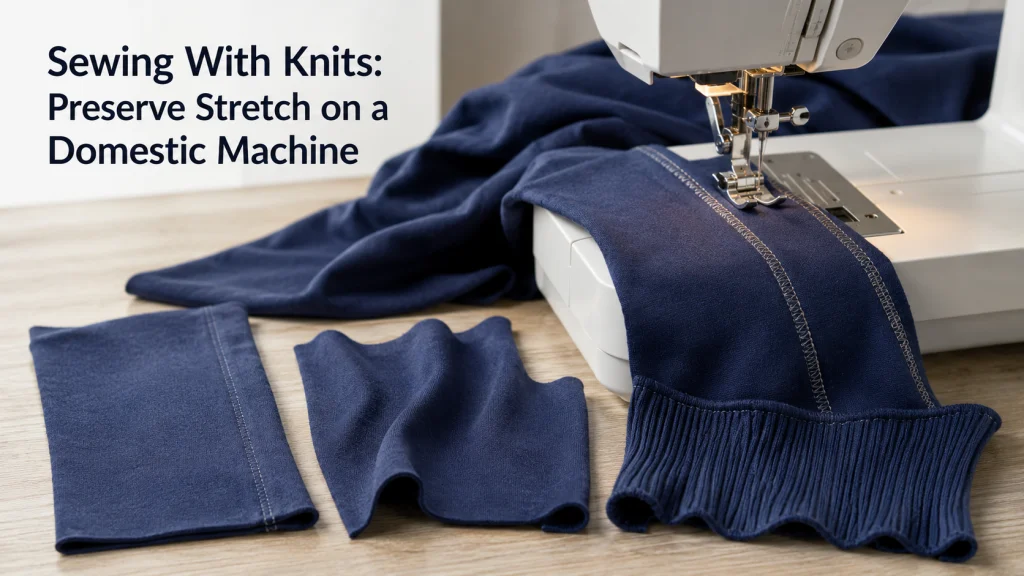
Sewing with knits starts with the fabric’s behavior, not with a universal stitch number or a new machine. A stable ponte, an ordinary jersey, and a highly elastic knit can all need different handling because the seam may need very different amounts of stretch in use. The practical workflow is to classify the fabric, decide whether the seam must stretch, choose an appropriate stitch your machine actually provides, verify compatible machine-interface parts, and test the real fabric stack without pulling it through the feed. If the machine begins skipping stitches, producing severe waviness, striking the needle, or failing despite documented setup, the job has moved from normal material handling into troubleshooting or service.
Start With How the Knit Behaves
Sewing with knits becomes much easier to reason through when you stop treating knit fabric as one material with one setting. A stable ponte may resist distortion under its own weight, while a soft jersey can lengthen at the edge as you handle it, and a high-stretch knit may need the finished seam to expand substantially in wear. Those differences change what the machine must accomplish even before stitch choice enters the discussion. The first question is therefore not which setting another sewist used, but what the actual fabric does when it is gently handled in the direction the seam will run.
That material-first approach also keeps normal setup separate from fault diagnosis. A functioning domestic machine can sew many knits when the fabric, stitch, compatible needle system, and handling are matched to the job, so a serger is not automatically required simply because the fabric stretches. If you need a broader frame for adapting normal machine use to different materials, the sewing with different fabrics workflow keeps those decisions organized around material behavior rather than generic recipes. The rest of this process narrows that idea specifically to stretch and recovery without turning every imperfect test seam into a repair problem.
Separate Stable, Moderate-Stretch, and High-Stretch Behavior
A useful first pass is to compare how much the knit changes shape under light handling and how readily it returns when released. Stable ponte and many double knits often hold their edges and shape more firmly, ordinary jersey tends to move and curl more readily, and rib knit can extend much more easily across its ribs. Interlock often feels more stable than a lightweight single jersey, while French terry may combine moderate stretch with extra bulk from its looped back. These are starting clues rather than fixed labels, because fiber content, knit construction, weight, and finish can change how two fabrics with the same generic name behave.
Direction matters as much as the overall impression of stretch. A fabric can behave differently across the width, along the length, and on a bias direction, so inspect the direction that corresponds to the planned seam rather than stretching a random corner. Also look at recovery, because a fabric that extends easily but stays distorted after release presents a different handling problem from one that returns close to its original shape. Use the gate below to place the fabric in a working behavior group, then confirm that judgment on a representative scrap. The purpose is not to assign a permanent fabric category, but to decide how much support and seam flexibility the current project is likely to need.
| What you observe | Working group | What to verify next |
|---|---|---|
| Edges stay comparatively controlled and the sample resists easy extension | Stable knit behavior | Whether the planned seam actually needs stretch in use |
| Sample extends clearly but remains manageable under light support | Moderate-stretch behavior | Whether the machine has a suitable documented stitch and feeds the real stack normally |
| Sample extends very easily or changes shape with light handling | High-stretch behavior | Whether the seam needs substantial movement and whether the domestic workflow can meet it on a scrap |
A generic fabric name should never overrule what the actual sample does. Use the table as a gate into the next decision, not as a substitute for testing the fabric you will sew. Two jerseys sold under the same broad label can differ enough in weight, recovery, and edge behavior to need different handling. Treat the working group as a practical starting point and update it if the representative scrap behaves differently.
Decide Whether This Seam Must Stretch in Use
The fabric can be stretchy while a particular seam has little reason to stretch during normal use. A side seam in a roomy garment may experience far less extension than a neckline, cuff, fitted body seam, or opening that must pass over a wider part of the body. That distinction controls how much flexibility the stitched line needs to retain. If the seam will be pulled in use, the stitch must tolerate that movement rather than merely looking neat while the fabric lies flat on the table.
This is the point where many one-size-fits-all instructions become misleading. A straight-looking result on a stable test strip does not prove that the same seam will survive repeated extension on a more elastic project area, and a very flexible stitch is not automatically necessary for every seam cut from knit fabric. Use the decision card below before touching another control. It keeps stitch selection tied to a real job instead of to the word “knit” alone. If you cannot state what the seam must do in use, you do not yet have enough information to judge the test seam.
- Name the seam or project area you are testing.
- Note the fabric stretch direction that crosses or follows that seam.
- Decide whether the finished seam must stretch in normal use.
- State the minimum practical outcome in plain language, such as “must open enough to pass over the body” or “little extension expected.”
- Judge the scrap against that requirement, not against a universal stitch recipe.
This card deliberately avoids a fixed percentage because the article has no documented original measurement set to support one. If you later measure stretch for a real test, record the method and direction with the result rather than treating the number as a generic rule. A measured value is useful only when it describes the actual sample and the direction relevant to the seam. The decision still comes back to whether that seam can perform its intended job after stitching.
Choose From the Stitches Your Machine Actually Provides
Once you know how much seam flexibility is needed, work from the stitch options documented for your machine rather than borrowing a universal width or length. Many domestic machines provide a zigzag or one or more stretch-tolerant stitches, but the names, symbols, adjustment ranges, and intended uses differ by model. The useful comparison is between the stitches your machine can actually form and the amount of extension the seam needs to tolerate. If a manual identifies a stitch for stretch fabrics, treat that as model-specific guidance and still verify the result on your own fabric stack.
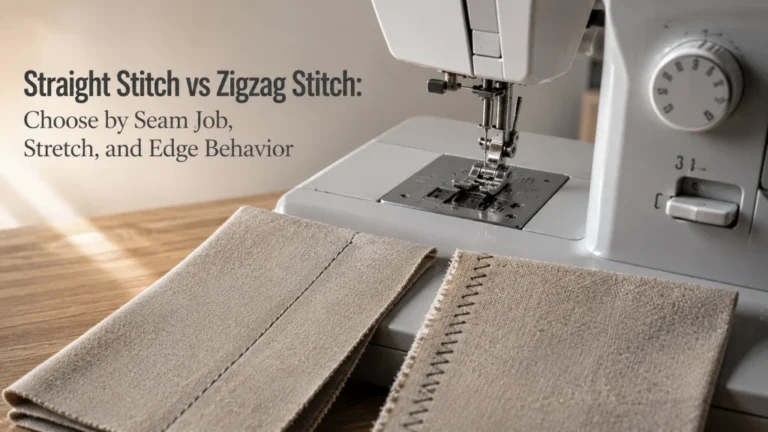
Do not assume that a stitch with a more complicated icon is automatically better. A simple available stitch that preserves enough stretch and feeds cleanly can be a better fit than a dense specialty pattern that adds bulk or changes the appearance of the seam. If you need to refresh how stitch controls relate to normal machine operation before experimenting, use the basic sewing machine use workflow and then return to the knit test. The goal here is not to prescribe one number, but to select a documented option and prove that it works for the intended seam.
Verify the Needle and Any Special Foot Separately
Needle and presser-foot questions are compatibility questions, not shortcuts around the stretch decision. Brother support guidance for covered machine models, for example, directs users sewing jersey or tricot toward a ballpoint needle or another needle designed for knits, but that does not make one needle type universal across every machine, fabric, and stretch application. Check the exact machine manual or manufacturer compatibility information before changing any interface component. A visually similar needle package or presser foot name is not enough evidence that the part is appropriate for the machine in front of you.
The same rule applies if someone recommends a walking foot, knit foot, roller foot, or another special attachment. First determine whether the machine accepts that attachment system, then decide whether the attachment addresses a real feeding or handling need in your test. Do not buy or install a special foot merely because the fabric is knit. This article keeps the decision at that boundary because part selection belongs to machine-specific compatibility, while the material workflow here is about preserving the stretch the project actually requires.
Use Presser-Foot Pressure Only When the Machine Makes It Adjustable
Presser-foot pressure affects how firmly the fabric is held against the feed system, but not every domestic machine gives the owner a pressure control. If your model has an adjustment, use the manual to identify the normal range, control location, and any fabric-related guidance before changing it. If the model does not expose an owner adjustment, do not improvise one or try to alter internal mechanisms. The absence of a pressure dial does not by itself mean the machine cannot sew knit fabric.
When adjustment is available, change one variable at a time on a scrap so you can see whether feeding improves without creating a new problem. Keep the stitch, fabric layers, handling, and sewing speed as consistent as practical while comparing the result. If reducing or increasing pressure within the documented range makes no useful difference, return to the broader setup instead of continuing to chase the control. The point is to use an available feature as a measured input, not as a universal cure for waviness or stretch.
How to Sew Stretchy Fabric Without Pulling It Through the Machine
Support the fabric so its own weight does not drag the section being stitched away from the needle area. Keep enough material on the table that the feed system is moving the layers, rather than your hands stretching them from the front or holding them back from behind. Guide the fabric for alignment, but do not use hand tension as a substitute for normal feeding. Stretch introduced during sewing can make a seam look acceptable under the presser foot and then appear rippled after the fabric relaxes.
This matters especially with soft jersey or long garment pieces that can hang off the table and create steady pull. Reposition the bulk before it starts tugging on the seam line, and keep the area immediately around the presser foot relaxed. If you must actively stretch the fabric just to make the machine advance, stop because that is no longer ordinary handling. The feed system should remain responsible for transport while your hands support direction and fabric weight.
Test the Actual Knit and Layer Stack
A useful test scrap should match the project more closely than a single random offcut. Use the same fabric, the same number of layers, the same stretch direction, and any ordinary seam allowances or interfacing conditions that materially change the stack. Sew far enough to observe whether feeding remains stable and whether the seam lies acceptably after it leaves the machine. A tiny two-inch sample can hide problems that become obvious over a longer seam, so make the test long enough to judge behavior without wasting project fabric.
Keep a simple result log instead of relying on memory. Record the machine, stitch used, exact knit, stretch direction if measured, layer count, compatible needle and foot already verified for the setup, any owner-adjustable pressure change, and what happened after the fabric relaxed. Do not invent durability conclusions from one scrap because the test only shows how that setup behaved under those conditions. A useful log also separates observed results from assumptions, which makes later comparisons much cleaner. The value of the record is that it lets you compare controlled changes and return to the best result without guessing.
| Log field | What to record |
|---|---|
| Fabric | Exact knit description, including structure if known |
| Stretch direction | Across, lengthwise, or another tested direction; include a measured percentage only if you actually measured it |
| Layer stack | Number of layers plus any folded edge or interfacing that changes the test |
| Machine setup | Exact machine, documented stitch, verified needle and foot, and any owner-adjustable control changed |
| Observed result | Feeding behavior, seam appearance after relaxation, and whether the seam met the intended movement requirement |
A blank log is more trustworthy than a fabricated “example result.” Fill it only with observations from the actual machine and fabric being tested, then use that record to decide whether another controlled change is justified. If a later test changes the stitch, pressure, layer count, or another variable, make a new entry instead of overwriting the earlier result. That keeps the comparison useful without pretending one scrap proves long-term durability. Keep failed tests as well as successful ones because both help prevent repeated guesswork.
Check That the Test Seam Still Meets the Stretch Requirement
After sewing knit fabric on the scrap, let the sample relax before judging it. Inspect whether the seam lies reasonably flat, then extend it only as much as the real seam is expected to extend in use. You are not trying to discover a maximum breaking point or create a durability test. You are checking whether the stitched line can accommodate the intended movement without obvious thread failure or a seam that prevents the fabric from doing its job.
A seam can look visually clean and still fail this functional check. Conversely, a stitch can look slightly different from a straight woven-fabric seam while still being the better choice because it preserves the movement the project requires. If the seam needs more flexibility, return to the documented stitch options and make another controlled scrap test rather than widening, lengthening, or tensioning at random. The passing result is the one that meets the actual seam requirement on the actual fabric, not the one that matches a universal recipe from another machine.
Keep Hems and Elastic Construction in Their Own Workflow
Hems, neckbands, elastic applications, and other construction details add decisions that go beyond basic material handling. They can introduce additional layers, folded edges, elastic recovery, visible topstitching, or a need for a specific finish, all of which can change what an acceptable test looks like. Do not use one successful plain seam as proof that every hem or elastic application will behave the same way. Treat those construction details as their own technique problem once the basic knit-feeding workflow is stable.
This separation also prevents you from changing too many variables at once. First prove that the machine can feed and stitch the knit stack appropriately without you stretching it through the machine. Then move to the exact hem, elastic, or edge construction called for by the project and test that construction separately. If the project changes the stack substantially, make a new representative sample rather than assuming the earlier seam result transfers automatically.
Know When a Domestic Machine Is Enough
A serger or coverstitch machine can be useful for particular construction and finishing workflows, but knit fabric alone does not prove that you need one. Educational guidance from BERNINA’s WeAllSew demonstrates knit construction on a conventional machine, which is a useful reminder that the first question is what the owned machine can do with the required seam. If your domestic machine forms a suitable stitch, feeds the representative stack normally, and the test seam retains the needed movement, that may be enough for the project. The route card below keeps that judgment focused on function rather than on machine type.
| Test outcome | Route |
|---|---|
| Domestic machine feeds the stack normally and the seam retains the required movement | Continue with the domestic workflow |
| Basic knit handling is stable, but the project repeatedly needs a specialist construction or finishing function | Evaluate a serger or coverstitch system as a separate equipment decision |
| Skipped stitches, severe waviness, hard strikes, locking, or another repeatable fault persists | Leave material setup and move to troubleshooting or service |
This route card is intentionally outcome-based. It prevents a useful specialist machine from being treated as mandatory while still giving the reader a clean exit when the domestic setup no longer matches the job. A successful domestic test is evidence that the current seam can proceed on that setup, not proof that every knit operation belongs on the same machine. Likewise, moving to a specialist system should answer a repeated construction need rather than simply react to the presence of stretch fabric.
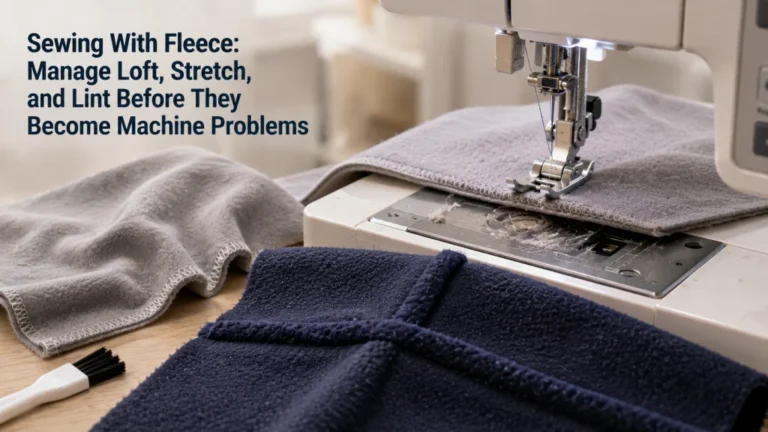
Move to a specialist-system decision only when the project repeatedly calls for functions the domestic workflow does not provide well enough for the intended work. That is an equipment question, not a failure of basic knit technique. If loft and bulk become more important than stretch, move to sewing fleece on a domestic machine instead. If a stretch backing is covered with hard sequins, use the separate sewing stretch-backed sequin fabric workflow because the surface treatment changes the handling problem.
Stop When the Problem Becomes Troubleshooting
Normal knit setup ends when the machine begins showing a repeatable fault that persists after the documented material setup has been checked. Repeated skipped stitches, severe waviness that remains despite ordinary handling checks, failure to feed, repeated hard needle strikes, or an abnormal mechanical lock should not be treated as invitations to keep changing random controls. At that point, preserve the test sample and note the setup that produced the symptom. Those details are more useful for a troubleshooting path than another round of uncontrolled experimentation.
Stop immediately for damaged cords, overheating, smoke, a burning odor, sparks, exposed wiring, uncontrolled motion, a hard mechanical lock, or work the exact manual reserves for service personnel. Do not pull a thick or elastic stack through the machine to force progress, and do not continue through repeated needle impacts. A material-led article can tell you where normal setup ends, but it should not disguise a service or machine-fault question as a fabric technique. That boundary protects both the project and the machine while keeping the next diagnostic step clear.
Final Thoughts: Preserve the Required Stretch, Not a Universal Recipe
The most reliable way to approach knit fabric is to start with what the fabric and seam must do, then work backward to the controls your machine actually provides. Classify the fabric’s behavior, decide whether the seam must stretch in use, select a documented stitch option, verify machine-interface compatibility, and support the fabric without pulling it through the feed. A representative scrap then tells you whether that specific combination meets the project requirement. Keep the result log so the successful setup is reproducible instead of relying on memory.
Keep the boundaries just as clear as the setup. Needle and special-foot selection require exact compatibility checks, specialist machines are a separate equipment decision, and repeated sewing faults belong to troubleshooting rather than normal knit handling. When your test seam lies acceptably and stretches as much as the project needs, you have evidence for that setup instead of a guess. That is the practical standard to carry into the real seam.
FAQs
Questions about knits often mix together fabric behavior, stitch choice, machine compatibility, and fault diagnosis. Keeping those questions separate makes the answer more useful because the next step depends on which part of the system is actually changing. The answers below stay at normal owner-level setup and testing. They do not replace the exact machine manual or a troubleshooting process when the machine shows a repeatable fault.
For any setup question, start with the real fabric and the seam’s job rather than with a setting copied from another machine. Verify model-specific limits before changing a needle, foot, plate-related part, or owner adjustment. Test one controlled change at a time on a representative scrap. If the machine begins striking, locking, overheating, or behaving abnormally, stop the fabric experiment and follow the correct service path.
🧵 How do I sew knit fabric on a regular sewing machine?
Start by deciding how stretchy the fabric is and whether the seam must stretch in use. Choose a documented stitch your machine provides, verify compatible machine-interface parts, support the fabric without pulling it, and test the real layer stack on a scrap before sewing the project.
↔️ Does every knit seam need a stretch stitch?
No single rule covers every knit seam. The required flexibility depends on the fabric, stretch direction, seam location, and how much that seam will be extended during use, so test the available stitch against the actual requirement.
🪡 Does every knit fabric need the same needle?
No. Manufacturer guidance may specify ballpoint, jersey, stretch, or another needle for particular fabrics and machine families, so verify the exact machine and application rather than relying on a generic package label.
⚙️ Do I need a serger to sew stretchy fabric?
Not automatically. A domestic machine can be sufficient when it has a suitable stitch, feeds the fabric normally, and produces a test seam that retains the movement the project requires.
🛑 When should I stop adjusting settings?
Stop random adjustments when a repeatable fault persists after the documented setup has been checked. Repeated hard needle strikes, a mechanical lock, overheating, smoke, a burning odor, sparks, exposed wiring, or uncontrolled motion are reasons to stop using the machine and follow the manual or qualified service guidance.
References and Sources
Only a small number of external sources are needed for the technical boundaries in this article. Brother support material is used to show that knit-needle guidance is tied to documented machine coverage rather than a universal accessory rule. BERNINA’s WeAllSew material is used only to support the bounded point that conventional machines can sew knit fabrics without making a serger mandatory. Neither source is used to turn one machine’s settings into a recipe for every knit or every domestic machine.
The handling and decision framework remains deliberately model-specific. Exact stitch names, adjustment ranges, needle compatibility, presser-foot compatibility, and service limits still belong to the manual or support information for the machine being used. The sources below support the narrow claims stated in the article and are not a substitute for that model documentation. No community setting or retailer recommendation is treated as technical proof.
- Brother fabric, thread, and needle guidance: Supports the model-covered guidance that jersey or tricot may require a ballpoint or knit-specific needle.
- WeAllSew knit fabric guidance: Supports the bounded domestic-machine workflow for sewing knits without treating a serger as mandatory.