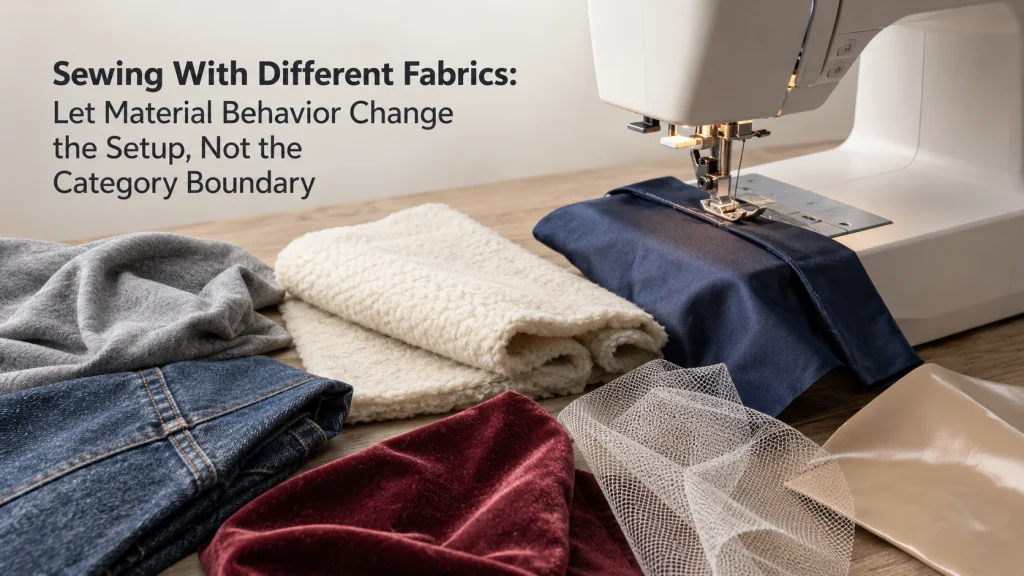
Sewing with different fabrics gets easier when you classify what the material does at the machine instead of memorizing settings by fabric name. Stretch, loft, pile, density, open weave, slipperiness, sheerness, mesh, loops, sticky surfaces, and hard embellishments change handling in different ways. Confirm that the owned machine can handle the actual stack, verify component compatibility separately, and test representative layers before the project. If the material requires another machine class or the machine develops a fault, stop normal-use adjustments and change troubleshooting paths.
Classify Material Behavior Before Changing a Setting
The fabric name is only a label. What matters at the machine is whether the material stretches, compresses, shifts, catches, opens around stitches, resists the foot, or places hard objects in the needle path. Different fabrics can create the same handling problem, while two versions of one fabric can behave differently. Route by the behavior that actually changes feeding or stitch formation.
| Controlling behavior | Typical example | What changes at the machine |
|---|---|---|
| Stretch | Jersey | Can distort while feeding |
| Loft | Fleece | Compresses and shifts |
| Long pile | Faux fur | Pile hides the seam |
| Short pile | Velvet | Layers can creep |
| Dense stack | Denim | Resistance rises at folds |
| Open weave | Burlap | Yarns can distort |
| Slipperiness | Satin | Layers can shift |
| Sheerness | Sheer woven | Low support shows distortion |
| Loose layers | Double gauze | Layers can move independently |
| Open mesh | Tulle | Little support around stitches |
| Loop pile | Terry cloth | Loops can snag |
| Sticky surface | Vinyl | Surface resists feeding |
| Hard embellishment | Sequins | Rigid pieces enter stitch path |
When two behaviors overlap, solve the one that changes the test first. A sheer stretch knit that lengthens while feeding should first be tested without stretching it. A lofty slick fabric that shifts before compression matters should first be checked for layer movement. Keep the second behavior visible, but change only one documented variable at a time.
This table identifies the first behavior to investigate, not settings to copy. Exact stitch, needle, foot, pressure, and other controls still depend on the machine and material. If two behaviors matter, keep both in mind during the test. The physical sample is stronger evidence than the fabric name alone.
Confirm the Owned Machine Remains Within Normal-Use Capability
First confirm that the project remains a normal-use job for the machine. The exact manual controls supported needles, presser-foot clearance, plate options, warnings, and any stated material limits. Brother documentation for covered machines links fabric, thread, and needle choice and warns that poor combinations on heavy fabric can bend or break a needle. That is more reliable than assuming a domestic machine can sew any stack that fits under the foot.
Check the hardest project area, not only a flat sample. A folded denim intersection may create far more resistance than two flat layers, while flexible vinyl may differ from a rigid sheet. Review the normal sewing machine operating process when setup or controls are uncertain. If the job changes machine class, stop treating it as a fabric adjustment.
Warning: Do not force material under the foot, pull fabric behind the needle, bypass safety controls, or continue through repeated needle deflection, hard strikes, abnormal resistance, overheating, smoke, or electrical symptoms. Those signs change the question from normal material handling to safety or service.
Keep Compatibility and Material Product Choice Separate From Technique
Material behavior can explain why handling changes, but it cannot prove that a needle, foot, plate, or accessory fits the machine. A stretch or low-drag solution still needs model-specific compatibility evidence. Check the attachment system, stitch width, plate, and manufacturer documentation before using a component. This keeps sound technique from turning into an unsafe fit assumption.
| Question | What this article can decide | What requires separate verification |
|---|---|---|
| Why are layers shifting? | Identify the controlling behavior | Exact compatible foot or attachment |
| Why is the stack hard to penetrate? | Recognize density or bulk | Exact needle system, size, and machine limit |
| Why is fabric entering the plate opening? | Recognize low support | Compatible plate, foot, or support method |
| What stabilizer should I buy? | Identify that support may help | Specific stabilizer or interfacing selection |
The same boundary applies to product choice. Interfacing, stabilizer, thread, and backing may help a project, but this article does not prescribe products. Use the table to separate handling from compatibility or purchasing, then verify the interface before returning to the material workflow. A sensible technique can still involve the wrong component for the owned machine.
Route Stretch Knits by Extension and Recovery
If a seam grows longer as it moves under the foot, stretch is probably the behavior to solve first. Jersey, rib knit, and spandex blends can differ sharply in extension and recovery even when they look similar on the table. Let the fabric feed without being pulled from the front or back. A scrap cut in the same direction as the project shows whether the machine is controlling the material or stretching it.
The dedicated workflow for sewing with stretch knits takes over when extension and recovery dominate the setup. Spandex belongs there for the same reason when stretch controls feeding. A skipped stitch or bending needle is a separate symptom, not proof that more fabric tension is needed. Keep the material relaxed, then diagnose any remaining fault on its own evidence.

This SCHMETZ Jersey pack contains five size 80/12 sewing machine needles for domestic machines. The needles use a ball point designed for knit and stretch fabrics. The package contains one five-needle card for sewing projects that call for this needle style and size.
Check On AmazonIf you click this link and buy, we earn a commission at no additional cost to you.
Route Fleece by Loft, Bulk, and Stretch
A fleece stack can look heavy while behaving very differently from dense denim. Its loft compresses under the foot, and some fleece also stretches enough for the layers to drift as that loft collapses. WeAllSew identifies both bulk and stretch as common handling concerns. The useful test is therefore how the actual stack compresses and stays aligned, not how thick it looks before sewing.
When compression is the main challenge, move to practical tips for sewing fleece. Test a bulky crossing if the project contains one because flat layers can hide the hardest point. Keep the material relaxed rather than adding hand pressure to force alignment. Abnormal resistance changes the problem from fleece handling to a machine or setup check.

The MumCraft Multipurpose Sewing Clips set contains 100 assorted-color clips stored in a reusable tin box. Each clip opens wide to hold multiple layers of fabric, and the flat base allows the clipped edge to move closer to the presser foot during sewing. The clips measure approximately 2.5 by 0.8 by 1.3 cm and can be used for sewing, quilting, binding, and other fabric-holding tasks.
Check On AmazonIf you click this link and buy, we earn a commission at no additional cost to you.
Route Faux Fur by Long Pile and Backing Behavior
With faux fur, the backing carries the seam while long pile hides the working edge. The pile adds bulk and can interfere with visibility even when the backing stays flexible. WeAllSew also notes nap, stretch, and loose fibers. That makes long faux fur different from velvet or ordinary fleece.
Use faux fur sewing techniques when pile visibility controls the job. Keep the backing as the seam reference. A plush fabric dominated by stretch or loft may belong elsewhere. Route by the behavior actually disrupting sewing.

These 8-inch scissors use precision-ground steel blades for clean cuts through fabric and other craft materials. The bent handle helps keep material flat on the work surface while cutting. The classic orange handle provides an ergonomic grip for everyday sewing and craft work.
Check On AmazonIf you click this link and buy, we earn a commission at no additional cost to you.
Route Velvet by Short Pile and Layer Creep
Short pile changes how velvet layers contact each other. One layer can creep while the surface also shows pressure and nap direction. WeAllSew notes marking sensitivity, fraying, and puckering as additional concerns. Alignment is therefore the first thing to watch on a test seam.
Check layer position early rather than after a long seam. Sewing velvet with control covers that pile-specific workflow. Do not copy one pressure or stitch value across all velvet. If stretch dominates, treat it as a second behavior.
Route Denim by Density and Sudden Stack Changes
The hardest point in a denim project is often not the flat fabric. A folded intersection can increase penetration load and change the presser-foot angle within a few stitches. Brother warns on covered machines that unsuitable fabric, thread, and needle combinations on thick material can bend or break a needle. Test the difficult stack itself rather than assuming success on two flat layers proves the whole project is within range.
Density and sudden thickness changes are handled in sewing dense denim stacks. Canvas can usually follow the same route when a firm woven stack is the main challenge. A domestic machine should not be expected to cross unlimited layers simply because the material fits under the foot. Repeated deflection, hard strikes, or abnormal resistance is the point to stop.

This SCHMETZ pack contains five sewing machine needles designed for heavy fabrics such as denim, twill, and canvas. The needles use a medium ball point and an optimized blade intended to reduce needle deflection through dense material. The package provides an assorted five-needle card for compatible household sewing machines.
Check On AmazonIf you click this link and buy, we earn a commission at no additional cost to you.
Route Burlap by Coarse Open-Weave Movement
Open weave changes the problem before weight does. Burlap yarns can shift or spread because the structure has visible spaces. A seam can distort even when the machine penetrates easily. Watch whether the weave stays stable during feeding.
Use sewing with open-weave burlap when yarn movement controls the result. Avoid dragging the material sideways. Match the project weave, layers, and edge condition on the test. Keep edge finishing as a separate construction decision.
Route Slick Fabrics by Layer Shift
When the top layer arrives first, slipperiness is the useful clue. Satin and some silk weaves can shift even while the machine feeds normally. Fiber content does not predict how much the layers will move. If the fabric is also sheer, start with the behavior causing the visible problem.
Mark a short test seam and compare the layer ends. Use controlling slippery fabric layers when relative movement dominates. Do not pull one layer to correct drift. Broad silk belongs here only when its weave behaves slickly.

Clover Silk Pins are fine metal pins made for lightweight and delicate fabrics. The package contains 100 pins measuring approximately 0.5 mm in diameter and 35 mm long. Their fine dimensions are intended for fabrics such as silk and other lightweight materials where a smaller pin is preferred.
Check On AmazonIf you click this link and buy, we earn a commission at no additional cost to you.
Route Woven Sheers by Low Body and Visible Distortion
A very light woven can misbehave even when it is not especially slippery. Low body gives the material less support around the needle, so puckering or plate interaction becomes more visible than it is on medium-weight fabric. That is the behavior to isolate first. If the structure is actually an open net, however, mesh is a better description than sheerness.
Test the same layer count the project will use because a doubled sheer can behave differently from one layer. The focused sheer fabric sewing tips cover low-body handling in more detail. Keep plate and presser-foot fit as separate compatibility checks for the exact machine. Do not solve a support problem by assuming a similar-looking accessory will fit.

These SCHMETZ Microtex needles are size 60/8 household sewing machine needles with a slim acute point. The listing identifies applications including microfibers, polyester, silk, coated materials, cork, batiks, bamboo, and cotton. The product is supplied as a box of 100 needles for compatible domestic sewing machines.
Check On AmazonIf you click this link and buy, we earn a commission at no additional cost to you.
Route Double Gauze by Loose Connected Layers
Double gauze contains loosely connected layers that can shift within the fabric. Stretching it flat before testing changes the condition you are trying to sew. WeAllSew describes two loosely woven cotton layers and emphasizes testing. Preserve the relaxed structure while evaluating feeding.
Compare the seam with an untouched offcut. Sewing double gauze fabric covers those loose layers. Keep pressure and stitch changes model-specific. Treat any separate machine fault as a fault, not normal crinkle behavior.
Route Tulle by Open Mesh and Limited Stitch Support
Mesh removes material from the places where an ordinary woven would support the stitch. Tulle can also stretch more in one direction, but its open structure is often the first behavior that changes sewing. WeAllSew notes that tulle does not fray, reinforcing that it should not simply inherit woven-sheer assumptions. Test the exact mesh because opening size and layer count can change how much support exists around the needle.
A single sheet and a multilayer stack can behave very differently. Use how to sew tulle when open mesh controls feeding or stitch support. Keep the material relaxed and away from plate openings rather than forcing it through. Gathering and edge construction remain separate project decisions.

Sulky Solvy is a translucent water-soluble stabilizer supplied on a 7.875-inch by 9-yard roll. It can be used as temporary stitch support, a design template, or a pattern guide during sewing and embroidery work. The stabilizer dissolves in water after the stitching is complete so it does not remain in the finished project.
Check On AmazonIf you click this link and buy, we earn a commission at no additional cost to you.
Route Terry Cloth by Loop Pile and Compressible Bulk
Terry combines a raised loop surface with compressible bulk. Loops can snag while folded areas become much thicker than flat fabric. That differs from velvet and faux fur. Decide whether snagging, compression, or both are changing the test.
Test folded intersections before the project reaches them. Terry cloth sewing tips focuses on loop pile and bulk. Let the feed system move the fabric. Repeated needle deflection or abnormal resistance means stop.

New Brothread Wash Away is a lightweight 1.5-ounce water-soluble stabilizer supplied as a 10-inch by 3-yard roll. It dissolves completely in cold or warm water after stitching. The listing specifically identifies washable high-pile fabrics such as terry cloth, towels, fleece, and other fluffy materials among its applications.
Check On AmazonIf you click this link and buy, we earn a commission at no additional cost to you.
Route Home-Sewable Vinyl by Surface Drag
A coated surface can create feed resistance even when the material is not especially thick. WeAllSew notes that vinyl ranges from flexible to rigid, so the label alone says little about domestic-machine capability. Surface drag is the behavior that defines this branch. Rigidity, backing, and total stack thickness still decide whether the specific project remains within normal use.
Cork and oilcloth can enter the same route when coating or contact resistance is what changes feeding. See sewing home-use vinyl for the surface-drag workflow. Verify any proposed low-drag foot or plate against the exact machine before using it. If rigidity or thickness becomes the limiting factor, move back to the machine-capability decision.

Dritz 406 Wash Away Wonder Tape is a double-sided temporary sewing tape measuring 1/4 inch wide by 10 yards long. It is designed to hold seams or hems in position before stitching and can be sewn through without gumming the needle. The tape washes away after use and is intended as a temporary positioning aid.
Check On AmazonIf you click this link and buy, we earn a commission at no additional cost to you.
Route Sequin Fabric by Hard Embellishments in the Stitch Path
Hard decoration changes the needle path in a way ordinary slippery fabric does not. Sequins may be plastic or metal and can sit on a backing such as tulle or chiffon, so both layers of the problem matter. The backing may need gentle handling while the embellishment itself can become a rigid obstacle. Map where the needle is expected to pass before treating the fabric like any other decorated textile.
The dedicated article on sewing sequin fabric safely starts from that hard-contact constraint. Test the same backing and embellishment density found in the project. Do not deliberately drive the needle through a rigid piece unless the documented technique supports it. Repeated hard contact means stop and reassess the path.

The Dritz Dual Purpose Marking Pen combines two temporary fabric-marking inks in one tool. The blue end uses water-soluble Mark-B-Gone ink, while the purple end uses ink that disappears through air exposure or water. It is designed for transferring pattern markings, seam allowances, embroidery designs, and other temporary sewing references onto suitable fabrics.
Check On AmazonIf you click this link and buy, we earn a commission at no additional cost to you.
Route Other Fabric Names by the Behavior That Actually Controls Sewing
Not every fabric name needs a separate workflow. Minky may route by stretch, loft, or pile, while canvas usually routes with dense woven stacks unless a coating changes surface behavior. Cork and oilcloth often fit the coated-surface branch, and spandex fits stretch when extension controls feeding. Broad silk must be routed by its actual weave because silk can be slick, sheer, piled, or stable.
| Material name | Route by | Why it does not need a separate default |
|---|---|---|
| Minky | Stretch, loft, or pile | Behavior varies by construction |
| Canvas | Dense woven | Density usually controls |
| Cork or oilcloth | Coated surface | Contact drag usually controls |
| Spandex | Stretch | Extension controls feeding |
| Silk | Actual weave | Fiber name is too broad |
| Lace | Construction | Joining often dominates |
| Wool | Actual construction | Woven, knit, felted, lofty, or piled behavior controls |
| Leather | Machine class | May exceed domestic scope |
The table keeps retail names from becoming duplicate rules. Lace often belongs with construction when joining or edge treatment dominates, while wool must be routed by its actual woven, knit, felted, lofty, or piled behavior. Leather exits this normal domestic route when the material or project requires a different machine class. The sample in front of you is stronger evidence than the category name.
Test the Actual Material Stack Before Sewing the Project
A useful test reproduces the project condition most likely to change feeding or stitch formation. Match material, layer count, direction, backing, coating, pile, and any difficult fold or intersection. Brother guidance for covered machines recommends trial stitches on the actual type and number of fabric layers. A flat scrap is not representative when the problem is a thick fold, slippery double layer, or dense embellishment area.
| Record on the test | Why it matters |
|---|---|
| Material and layers | Matches the project stack |
| Behavior direction | Preserves stretch, pile, or coating orientation |
| Verified needle and foot | Separates fit from technique |
| Thread and stitch | Keeps the test repeatable |
| One changed control | Shows what affected the result |
| Observed result | Guides the next decision |
Change one documented variable at a time and keep the successful sample as a reference. Watch layer alignment, feeding, needle entry, and visible distortion instead of changing several controls together. If the machine starts skipping stitches, breaking needles, shredding thread, or refusing to feed normally, the task has moved into troubleshooting. Stop adding material-specific adjustments until that fault is understood.
Stop When Machine Class or Fault Diagnosis Changes the Question
Material guidance assumes a functioning domestic machine within documented limits. If the job needs different feeding, penetration capacity, or specialist capability, another fabric setting is not the answer. Stop for repeated hard strikes, a mechanical lock, uncontrolled motion, overheating, smoke, sparks, or exposed wiring. Those conditions require a machine or service decision first.
Less dramatic faults still need separation from technique. Persistent skipped stitches, thread damage, failed feeding, or repeated needle bending should be diagnosed after basic setup is verified. Do not assume difficult fabric makes every malfunction normal. If a behavior-first test does not simplify the problem, the question has changed.
Explore Material-Specific Sewing Workflows
Once the controlling behavior is clear, use the workflow that stays focused on that material problem. The articles below separate stretch, loft, pile, density, open weave, slip, sheerness, loose layers, mesh, loops, surface drag, and hard embellishments. Choose the closest physical behavior first, then verify the exact machine and project conditions there. If two behaviors apply, start with the one causing the immediate difficulty.
| Material behavior | What the article focuses on |
|---|---|
| Sewing with stretch knits | Stretch and feeding distortion. |
| Tips for sewing fleece | Loft and shifting layers. |
| Faux fur sewing tips | Long pile and backing. |
| Sewing velvet with control | Nap and layer creep. |
| Sewing dense denim stacks | Density and thick intersections. |
| Sewing open-weave burlap | Open weave and yarn movement. |
| Sewing slippery fabric layers | Layer shift during feeding. |
| Sheer fabric sewing tips | Low body and distortion. |
| Sewing double gauze fabric | Loose connected layers. |
| How to sew tulle | Open mesh and support. |
| Terry cloth sewing tips | Loop pile and bulk. |
| Sewing home-use vinyl | Surface drag and rigidity. |
| Sewing sequin fabric safely | Hard embellishments and needle path. |
Use the selected route as a starting point, not a replacement for the machine manual. The directory keeps handling separate from accessory fit, product choice, construction, and repair. The test stack still decides whether a technique works on the exact combination in front of you. If the problem becomes a machine fault, stop following the material route and diagnose the symptom.
Final Thoughts: Let Material Behavior Choose the Branch
Sewing different fabrics does not require one setup for every name. Start with the behavior that changes at the machine, then confirm it can handle the actual stack. Stretch, loft, pile, density, open weave, slip, mesh, loops, coating, and hard embellishments point to different handling questions. Keep compatibility and product choice separate.
The representative test is decisive. Match difficult layers, use verified components, change one variable, and watch feeding. Stop if the job changes machine class or the machine develops a fault. Let behavior choose the workflow while the manual defines safe limits.
FAQs
Fabric questions often sound like requests for one number, needle, or foot. The material name rarely gives enough information because weight, layer count, coating, stretch, pile, and construction change the answer. Start with behavior, then check the exact machine. That avoids turning useful guidance into a universal settings chart.
These answers assume a functioning domestic machine within documented limits. Compatibility still needs model-specific verification, and real machine faults need separate diagnosis. Test the actual project stack when advice depends on material behavior. Stop normal sewing if resistance or machine behavior becomes abnormal.
🧵 Do different fabrics need different sewing machine settings?
Often, but no universal settings table fits every machine and fabric. Identify the behavior, check the manual, and test the actual layers.
🪡 How do I know what needle to use for a fabric?
Needle choice depends on fabric, thread, machine needle system, and model guidance. Verify that combination instead of choosing by fabric name.
🧶 Is minky a separate sewing problem from fleece?
Not automatically. Route minky by the behavior that dominates, such as stretch, loft, or pile.
👖 Can I use the denim approach for canvas?
Usually, when dense woven thickness is the main challenge. A coating or surface drag can point to another route.
✨ Is sequin fabric just another slippery fabric?
No. Hard embellishments in the needle path create a constraint that ordinary slick fabric does not have.
🕸️ Is tulle handled the same way as sheer fabric?
Not necessarily. Tulle’s open mesh provides different stitch support from a fine woven sheer.
🧥 Can a domestic machine sew every thick fabric?
No. Capability depends on the exact machine, material, layer stack, needle system, and documented limits.
⚠️ When does a fabric problem become a machine fault?
Persistent abnormal symptoms after correct material setup need separate diagnosis. Repeated strikes, hard resistance, heat, or electrical symptoms are stop signals.
References and Sources
External sources are necessary because material behavior cannot establish machine capability or compatible settings by itself. Brother supports matching fabric, thread, needle, and actual layers on covered machines. BERNINA’s WeAllSew material education documents distinct behaviors such as fleece bulk, faux-fur pile, velvet creep, tulle mesh, vinyl surface differences, loose double gauze, and hard sequins. These sources verify the behavior map rather than supply universal setting rules.
- Brother fabric needle guidance: Supports model-specific fabric, thread, and needle matching.
- WeAllSew fleece handling notes: Supports fleece bulk and stretch behavior.
- WeAllSew faux fur notes: Supports pile, backing, bulk, and stretch.
- WeAllSew velvet handling notes: Supports nap and layer creep.
- WeAllSew tulle handling notes: Supports open-mesh behavior.
- WeAllSew vinyl handling notes: Supports flexibility and surface drag.
- WeAllSew double gauze notes: Supports loose connected layers.
- WeAllSew sequin fabric notes: Supports hard embellishments over textile backing.
The list stays intentionally limited. Several fabric names share a behavior branch, while exact manuals still control compatible needles, feet, plates, settings, and machine limits. Use the references to understand why the branches differ, then return to the exact machine documentation for implementation. The strongest sequence is behavior first, model verification second, and a representative test before the project.