The maintenance instruction that matters is the one tied to the exact machine, not a habit carried over from another model. In a fixed audit of five official records from Brother, Janome, and Singer, the permitted owner actions ranged from specific oiling instructions to explicit no-owner-oiling language, while cleaning and service boundaries also differed. The strongest contradiction appeared within Brother itself, which is why brand-level advice is not precise enough for a maintenance decision. The comparison treats cleaning, owner oiling, professional service, and prohibited or omitted actions as separate categories so one kind of maintenance instruction is not mistaken for another.
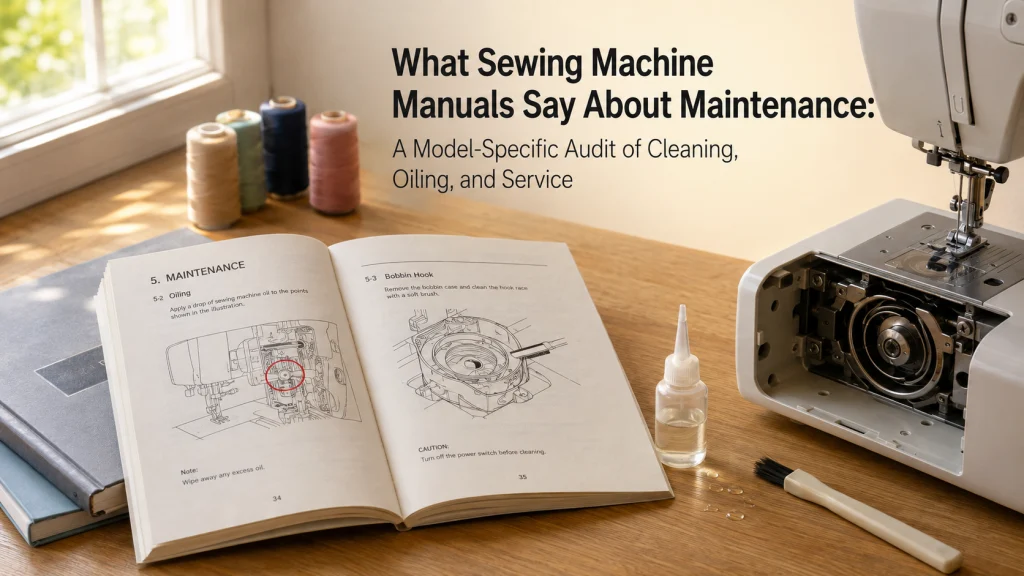
Two official instructions can lead to different maintenance actions
What sewing machine manuals say about maintenance is less uniform than a simple schedule suggests. In Brother LS-series oiling instructions, the manufacturer tells owners of listed models such as the LS2125 to add oil at indicated points and gives a use-based frequency. In a separate Brother BM3850 maintenance instruction, the direction is the opposite at owner level: do not add oil, because lubrication for the covered machines is routed to authorized service. The brand is the same, but the permitted action is not.
When I compare maintenance instructions, I treat each document as a model-linked record rather than carrying one rule across an entire brand. A first-time owner can easily assume that a familiar brand name is enough to decide whether a drop of oil belongs in the bobbin area. The two Brother records show why that shortcut fails before we even compare manufacturers. For the practical maintenance procedure on a known machine, the safer route is to start with the model-specific sewing machine maintenance process and then follow the exact manual or support record for that machine.
The manuals I compare and the method I use
The comparison uses five official records from three manufacturers: three Brother support records with stated model applicability, one Janome 1522PG instruction book, and one Singer maintenance FAQ used as brand-level support rather than model-specific evidence. When a source supplies a version, page, model list, or service interval, I keep that detail attached to the claim. When it does not, I leave the field unstated rather than filling the gap by inference.
This is a document comparison, not a durability test and not a claim about every machine a manufacturer has sold. The Janome record is especially useful because its care section provides concrete owner cleaning steps while the searchable manual contains no matching “oil” or “lubric” procedure. The Singer FAQ is useful for a different reason: it gives general oiling language but does not identify an exact model on the page, so I treat it as supporting context rather than model-specific authority. That distinction keeps sewing machine manual maintenance tied to the level of evidence the document actually supports.
Note: I compare one official manual or support record at a time and keep model applicability, owner cleaning, owner oiling, professional service, prohibition or omission, and document detail separate.
| Official record | Applicability used in this audit | Owner cleaning | Owner oiling | Service or stop boundary |
|---|---|---|---|---|
| Brother LS-series oiling instructions | Listed LS/LX models, with LS2125 used as a representative example | Not the focus of this record | Permitted at stated points | Do not over-apply oil |
| Brother BM3850 maintenance instruction | Large listed model family, with BM3850 used as a representative example | Professional clean-and-oil interval stated | Not permitted by the owner | Authorized service at stated use intervals |
| Brother PP1 oiling guidance | PP1 | Not the focus of this record | Not permitted by the user | Stop and contact authorized service for specified symptoms |
| Janome 1522PG instruction book | 1522PG; Version 1.00; dated manual footer | Permitted in described bobbin, shuttle-race, and feed-dog areas | No owner oiling procedure found in the manual text | Do not dismantle beyond the described care section |
| Singer machine maintenance FAQ | No exact model applicability stated on the page | Not coded as model-specific | General conditional guidance only | Qualified service guidance is included |
The table is intentionally uneven because the source documents are uneven. A support answer that names dozens of covered models is not the same kind of evidence as a model instruction book, and a brand FAQ without a model list is weaker for model-specific action than either one. Keeping those differences visible is more useful than forcing every record into a false one-to-one comparison.
How I separate cleaning, oiling, service, and prohibition
I separate four actions because manufacturers often place them under the same broad idea of “maintenance” even though they do not give the owner the same authority. Cleaning meant an owner-accessible removal of lint, thread, or debris described by the official source. Owner oiling meant the document explicitly told the user where or how to add lubricant. Professional service meant the source routed cleaning, lubrication, adjustment, or fault handling to a dealer, authorized center, or qualified technician.
The fourth category is prohibition or omission. A prohibition is explicit language telling the owner not to perform an action, as in the Brother records that say not to add oil or not to oil the machine yourself. An omission is different: the Janome 1522PG manual contains a care section with cleaning instructions but no oiling procedure in the searchable text. I treat that as “oiling procedure not found,” not as proof that the machine can never require lubrication internally.
- Cleaning: owner action appears in the official document.
- Owner oiling: the official document identifies oiling as an owner action.
- Professional service: the document transfers the action or fault to qualified service.
- Prohibition or omission: the action is forbidden, or no owner procedure is provided in the document being compared.
This classification prevents a common reading error. “The manual does not show me how to oil it” is not automatically equivalent to “the manufacturer says lubrication is unnecessary forever.” The next check is whether an official support page for the exact model adds a service instruction, a no-owner-oiling instruction, or another model-specific maintenance note.
Reading manual language carefully: In this sample, “do not oil” is an explicit prohibition, while no oiling procedure in a care section is only an omission. Likewise, a document that assigns lubrication to authorized service is not giving the owner permission to perform the same action. I keep the actor and the permitted action separate so similar words do not collapse into the same maintenance instruction.
That distinction matters because manuals and support pages do not always use identical wording for owner care and service work. The useful question is not whether a document contains the word “oil” or “lubrication,” but who the manufacturer says should perform the action on the exact model. That keeps the comparison tied to the instruction rather than to a keyword inside the document.
What the manuals said about the bobbin and race area
The bobbin and race area is where generic maintenance advice becomes especially tempting, because it is accessible on many domestic machines and often collects lint. The Janome 1522PG instruction book gives a defined owner-cleaning procedure in its care section: the shuttle race is cleaned with a brush and soft dry cloth, while the feed-dog teeth are brushed free of dust and lint. The same section sets a dismantling boundary, telling the owner not to take the machine apart beyond what that section explains.
That is a good example of why sewing machine cleaning instructions by model are more useful than a generic “clean under the needle plate” rule. The 1522PG uses a front-loading vertical oscillating hook arrangement, and its manual describes the parts the owner is expected to remove and reinstall. A different machine may use a top-loading rotary system with a different bobbin-case removal method and a different cleaning boundary. The accessible area can look familiar while the permitted sequence is not interchangeable.
Key point: An accessible bobbin area does not by itself prove that oil belongs there. Cleaning permission and oiling permission are separate findings in this audit.
For example, a new owner who sees lint around a bobbin case may correctly identify a cleaning need but still be wrong to add oil afterward. The exact model document has to supply that second permission. This is also why a cleaning article and an oiling article should not be treated as the same procedure simply because both involve the lower machine area.
Which models permitted owner oiling
The clearest owner-oiling record in this sample is Brother LS-series oiling instructions. The page applies to a listed family that includes models such as LS1217, LS1520, LS1717, LS2000, LS2125, LS2400, LX2375, LX3014, and LX3125. It instructs the owner to turn off and unplug the machine, place two to three drops at indicated points, wipe excess oil, and run the machine briefly without thread. It also gives a frequency tied to use, including weekly oiling for more than one hour of use per day and more frequent oiling for heavier use.
That is stronger evidence than a general rule because the manufacturer attaches the action to an explicit model list. For an LS2125 owner checking how that exact model should be oiled, this support record answers a real maintenance question with a permitted procedure and a stated interval. It does not follow that another Brother machine should receive the same drops in the same places. The next Brother record proves exactly why that extrapolation would be unsafe.
There is another practical distinction here: an oiling interval only becomes relevant after oiling permission has been established. Asking “how often?” before checking “does this exact model tell the owner to do it?” reverses the decision order. The dedicated explanation of model-specific sewing machine oiling frequency should therefore be read with the machine manual in hand, not as a substitute for it.
A first-time owner may find two search results that both mention the same manufacturer and assume the shorter interval is the more cautious choice. In this sample, that logic would lead directly into conflict with official no-owner-oiling instructions for other models. More maintenance is not automatically better maintenance when the manufacturer has assigned different actions to different machine designs.
Which models prohibited or omitted owner oiling
The Brother BM3850 maintenance instruction says not to put oil in the covered machines, alternate bobbin case, or small holes in the machine body. It explains that the machines were manufactured with the necessary amount of oil and makes periodic owner oiling unnecessary. For the same covered group, Brother instead gives service intervals for professional cleaning and oiling: 500 hours for light-to-moderate use described as two to three hours per day, and 300 hours for heavier or prolonged high-speed use.
The Brother PP1 oiling guidance is even narrower because the listed applicability is the PP1. It tells the user not to oil the machine and routes symptoms such as difficulty turning the handwheel or unusual noise to an authorized service center. Those two records are not evidence that every Brother model is owner-oil-free. They are evidence that these specific official records assign lubrication differently from the LS-series record.
The Janome 1522PG falls into a third category: omission rather than explicit prohibition. Its care section tells the owner how to clean the bobbin case, shuttle race, and feed dog, and the manual sets a boundary against dismantling beyond the described section. In the searchable manual text, however, no owner oiling procedure appears. The useful conclusion is limited: the audited manual does not give the owner an oiling procedure, so adding one from another machine’s instructions would go beyond the document.
That distinction matters for an older or secondhand machine. If the model number is visible but the paper manual is missing, the first move is to locate the correct sewing machine manual and confirm model applicability before following a maintenance routine copied from a similar-looking machine. Visual similarity is not maintenance evidence any more than it is accessory-compatibility evidence.
When instructions routed the owner to service
Service language appeared in several forms across the sample. The Brother record covering BM3850 does not simply tell the owner to leave the machine alone; it replaces owner oiling with an authorized clean-and-oil interval based on use. The PP1 record routes specific symptoms to authorized service. Janome’s 1522PG manual sends a machine with a damaged cord, plug, abnormal operation, or damage to an authorized dealer or service center for examination, repair, or electrical or mechanical adjustment.
Singer’s machine maintenance FAQ guidance also includes qualified-service language, but its page is not tied to one exact model. It says that if a manual does not include oiling instructions, the machine has been pre-lubricated at the factory, while also offering general oil-placement language and a suggested service interval. Because the page does not state exact model applicability, I treat that as supporting context rather than permission to override a machine’s own manual.
Warning: This audit does not provide internal repair steps. Damaged cords, overheating, smoke, burning odor, sparks, exposed wiring, uncontrolled motion, hard mechanical lock, repeated hard needle strikes, or work reserved for service personnel belong outside owner-level maintenance.
The practical takeaway is that “service” is not a failure of home maintenance. On some machines, professional lubrication is the maintenance instruction. On others, the owner has a defined cleaning or oiling task before service is needed. The document tells you which side of that boundary your exact machine is on.
Why brand-level advice was not enough
Brand-level advice loses the detail that changed the answer in this audit. The Brother records already show that a manufacturer name does not tell an owner who is permitted to lubricate a particular machine or whether routine lubrication belongs in owner care at all. Turning those model-linked instructions into one brand rule would erase the very distinction the documents make.
Singer demonstrates a different problem. Its official FAQ provides useful general context, but without exact model applicability on the page, the advice cannot prove what a specific Singer machine manual permits. If a model manual gives a narrower action, the model document is the better evidence for that machine. If the manual is silent, the brand FAQ can help identify the next question, but it should not be treated as a page-numbered instruction for a model it does not name.
Find a maintenance rule for the brand, then apply it to any machine carrying that name.
Match the exact model to its manual or support record first, then follow only the cleaning, oiling, and service actions that source assigns to the owner.
This is one of the easiest mistakes for a beginner to make because model families often share styling and basic controls. A familiar bobbin cover or handwheel does not establish the same lubrication system, service interval, or owner-access boundary. The model number is the maintenance key, not the logo.
What the sample cannot prove
Five official records are enough to demonstrate inconsistency, but they are not enough to estimate how common each maintenance approach is across the domestic sewing-machine market. The sample is not random, does not cover every current or retired model, and includes both model-specific records and one brand-level FAQ. It also does not measure long-term wear, lubricant chemistry, failure rates, or whether one maintenance strategy produces better durability than another.
The comparison also cannot prove that silence in a manual means “no lubrication exists inside the machine.” The Janome 1522PG result is intentionally narrower: the owner manual contains cleaning instructions and no searchable owner oiling procedure. Internal lubrication performed during manufacturing or service is a different question. Treating an omitted owner procedure as a mechanical design claim would go beyond the source.
Limitations: Findings apply only to the official records compared here. A revised manual, changed support page, corrected model list, or newly published service instruction can change the conclusion for a specific machine.
There is also a document-age issue. The Janome 1522PG manual footer identifies Version 1.00, while manufacturer support pages can be edited without preserving a page-numbered revision history for the reader. That is why I keep source type and revision information attached to the evidence instead of pretending every source has the same publication metadata.
The exact-manual rule I use
I do not start a maintenance check with a frequency question. I start with the model number, locate the official manual or support page that explicitly applies to that machine, identify what the owner is allowed to clean or remove, and only then check whether owner oiling is instructed, prohibited, or absent. If the source routes lubrication or a symptom to service, that routing is part of the maintenance instruction rather than an optional extra.
This rule is deliberately simple because it has to work while someone is standing beside a real machine. A used LS2125 with no paper manual should be matched to the official LS-series support record before oil is added. A BM3850 owner who remembers oiling an older Brother should not carry that habit across models. A Janome 1522PG owner can use the manual’s defined cleaning procedure without inventing an oiling step that the audited manual does not provide.
- Confirm the exact model number on the machine.
- Open an official manual or support record that names that model.
- Separate cleaning permission from oiling permission.
- Check whether the document gives a service interval or stop condition.
- Do not transfer oil points, screws, covers, or intervals from a different model.
That check is less memorable than a universal calendar reminder, but I find it much harder to misuse. It also keeps the reasoning easy to update: when a manufacturer revises a source, the affected model can be reconsidered without rewriting maintenance advice for unrelated machines.
Final Thoughts: Match the model, manual, permitted action, and stop boundary
The strongest finding from this comparison is not a preferred oiling schedule. It is the fact that official maintenance instructions can assign different owner actions even within one manufacturer. Brother provides a clean contradiction: listed LS models receive explicit owner-oiling instructions, while other covered models are told not to be oiled by the owner and instead receive service-based lubrication guidance.
For a home sewist, that makes the decision sequence clear. Identify the exact model, verify the official document, follow only the cleaning or oiling action it permits, and respect the point where the source hands the machine to qualified service. If the document is silent, keep the conclusion narrow and look for exact-model support rather than filling the gap with a rule borrowed from another machine.
Frequently Asked Questions
🛢️ Does my sewing machine need oil if the manual does not mention oiling?
Do not treat silence as permission to add oil. Check the manufacturer’s official support information for the exact model, because some machines route lubrication to service while others provide owner oiling instructions.
🧹 Can I clean the bobbin area even if I should not oil the machine?
Possibly, but use the exact model instructions. The Janome 1522PG manual, for example, describes owner cleaning in the shuttle-race and feed-dog area without providing an owner oiling procedure.
📖 Is a manufacturer support page enough if I cannot find my manual?
It can be, if the support page explicitly lists your exact model. A general brand FAQ is useful context, but it is weaker evidence for model-specific maintenance when the page does not state applicability.
⏱️ How often should I oil a sewing machine that allows owner oiling?
Use the interval in the exact manual or model-specific support record. In this comparison, one Brother LS-family instruction uses a frequency based on daily use, while other Brother records assign lubrication to authorized service instead.
🔧 When should maintenance become a service-center job?
Follow the stop conditions in the exact model document. If the manual or support page reserves lubrication, adjustment, electrical work, or an abnormal mechanical symptom for qualified service, do not extend an owner-cleaning procedure into internal repair.
References and Sources
- Brother LS-series oiling instructions: Verifies model-linked owner oiling steps and use-based frequency for the listed LS/LX family.
- Brother BM3850 maintenance instruction: Verifies no-owner-oiling language and authorized service intervals for a large listed model family that includes BM3850.
- Brother PP1 oiling guidance: Verifies that PP1 users are told not to oil the machine themselves and are routed to authorized service for specified symptoms.
- Janome 1522PG instruction book: Verifies the model’s owner cleaning procedure, dismantling boundary, manual version information, and absence of a searchable owner oiling procedure.
- Janome technical support guidance: Confirms Janome directs owners to the machine manual for bobbin-area and feed-dog cleaning and to authorized service when basic checks do not resolve a problem.
- Singer machine maintenance FAQ: Provides general manufacturer guidance on oiling and qualified service, used here only as brand-level context because exact model applicability is not stated on the page.