My sewing machine repair-or-replace decision started when a written estimate for a Janome 4120QDC was high enough to make replacement a realistic alternative. The price mattered, but it was not the whole decision: the machine still matched my work, I already knew its controls and setup habits, and the replacement options introduced their own cost and learning uncertainty. I chose the repair after separating what I had observed from what the technician had actually found. The original hesitation has not returned in normal use so far, but that is still not enough to predict long-term durability.
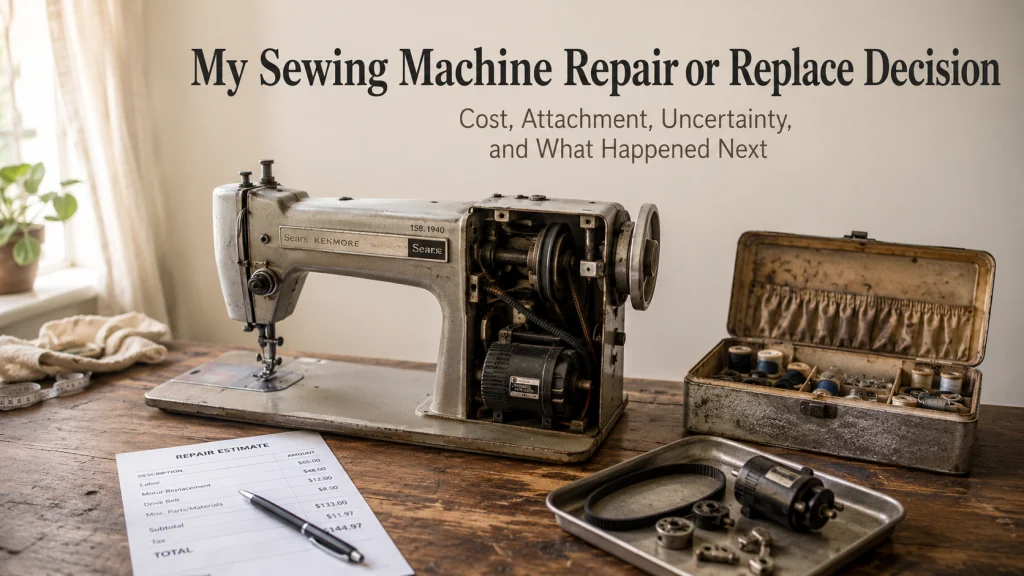
The estimate that created a repair-or-replace decision
The decision became real when the dealer sent the written estimate to replace the main motor and drive belt, complete the associated service work, and test the machine. Until then, I had been thinking mainly about getting my Janome 4120QDC back into normal use. The estimate created a second question: whether repairing a familiar machine still made more sense than starting again with a replacement.
The machine had begun hesitating at low-speed starts, then recovering and sewing normally once moving. When that behavior repeated often enough to stop feeling incidental, I stopped using the machine and took it to the dealer rather than opening the housing or trying to diagnose the drive system myself. Janome’s current support guidance directs owners with service issues to an authorized dealer, which matched the boundary I used in this case.
Machine history and why it mattered
I had owned the 4120QDC long enough for it to become my normal machine for garment sewing, household projects, basic quilting, repairs, buttonholes, and short jobs where I wanted to sit down and work without relearning a control layout. I had also used it through routine professional servicing without a previous major repair. That history mattered because I was deciding what to do with a machine whose normal behavior and workflow I already knew well.
The model itself helped explain why the cheapest functioning sewing machine was not a meaningful comparison. Janome’s 4120QDC product record lists features I had actually built into my workflow, including speed control, memorized needle up/down, start/stop operation, an automatic thread cutter, foot-pressure adjustment, a free arm, drop feed, and an extension table. The same page now marks the model discontinued. The stitch count was not the reason I wanted to keep it; the familiar controls and workflow were.
| Stage | Ownership event | Why it mattered later |
|---|---|---|
| Early ownership | Purchased 4120QDC new | Known ownership and service history |
| Routine service | Routine professional service | No major repair recorded |
| Later routine service | Second routine professional service | Machine returned to normal use afterward |
| First noticeable hesitation | First logged low-speed hesitation | Symptom was new |
| Repeated hesitation | Two failed clean starts in one session | I stopped using the machine |
| Dealer intake | Dealer intake | Professional diagnosis replaced owner-level guesses |
| Written estimate | Repair estimate received | Repair and replacement became separate choices |
| Return to use | Repaired machine collected | Follow-up log began |
That history gave the repair some value that did not fit neatly into a percentage rule. I knew the machine’s controls, noise, bobbin handling, foot pressure, and ordinary behavior well enough to notice when something changed. Familiarity was useful evidence about my own workflow, not a reason to repair the machine at any cost.
Symptoms observed and what I did not know
My observation was limited: the machine sometimes hesitated when starting slowly. The needle would begin to move, stall briefly, then the machine would catch and continue. Increasing the speed setting sometimes made the start feel more normal, but that still told me nothing certain about the cause. I checked the normal external setup, used a fresh needle, rethreaded, removed and reinstalled the bobbin, and confirmed that the handwheel turned without an obvious hard lock while the machine was off.
I did not know whether the cause was the motor, belt, control electronics, a mechanical load somewhere in the drive, or something else. The situation changed only after the dealer opened and tested the machine. My observations established a repeatable problem; they did not establish the failed component.
| Known from my record | Unknown before service | Professional finding |
|---|---|---|
| Low-speed starts hesitated intermittently | Which internal component caused it | Technician attributed the fault to an intermittently failing main motor |
| Handwheel turned smoothly with power off | Whether internal load changed under power | No hard mechanical bind recorded during bench test |
| Problem became more frequent over one week | How quickly it would progress | No prediction of remaining life was offered |
| External threading and needle checks did not change it | Whether electronics were involved | Control board passed the dealer’s functional test at intake |
| Drive belt had never been replaced | Its actual condition | Technician recorded belt glazing and recommended replacement during the motor repair |
I keep the technician findings clearly attributed because I did not inspect those internal parts or reproduce the bench tests myself. The useful distinction is knowing where owner observation stops and professional diagnosis begins.
Manual, warranty, technician, and estimate evidence
Before authorizing anything, I gathered the current Janome support and manual route for the model, the dealer’s intake note, and the written estimate. I used an authorized dealer familiar with the machine’s service history. Janome still provides the 4120QDC through its manual library, even though the model page identifies the machine as discontinued. That mattered because discontinued did not mean undocumented.
I also checked the warranty route rather than letting the machine’s age answer the question by itself. Janome’s warranty support page tells owners to locate the receipt, contact an authorized dealer, and let that dealer determine whether the repair is needed and covered. In my case, the repair was treated as customer-paid. That is not a general statement about every Janome warranty situation.
Service record: Technician finding: intermittent main-motor failure, drive-belt wear, no hard mechanical bind during bench testing, and no control-board fault found during the intake test. The estimate covered those documented issues; it did not promise that unrelated electronic or mechanical faults could not appear later.
That distinction was important. I was authorizing work on the faults the technician had actually documented, not buying certainty about the rest of the machine’s future. A repair estimate can define the work being done without guaranteeing several more trouble-free years.
Repair cost and uncertainty
The written estimate separated the repair into parts, labor, and shop charges. The symptom had looked minor from the outside, so seeing a motor replacement on the estimate changed the scale of the decision. I used the same structure described in the site’s sewing machine repair estimate guide: read the actual written quote instead of comparing a vague “repair cost” with what the machine had cost years earlier.
| Estimate item | Amount |
|---|---|
| Main motor assembly | Major parts cost |
| Drive belt | Additional parts cost |
| Labor and full service | Largest cost component |
| Shop supplies | Minor shop charge |
| Tax on parts and supplies | Applicable tax |
| Total authorized repair | Quoted total |
The dealer expected the needed parts to be available. The uncertainty was not parts availability for this repair. It was what the repair could not buy: a reset of the machine’s age, a new warranty on the whole machine, or proof that another unrelated component would not fail later. The quote addressed a defined fault, not the future.
Replacement cost, accessories, and learning cost
Before comparing replacement prices, I defined what a genuine replacement would need to preserve: speed control, needle up/down, a thread cutter, adjustable foot pressure, a free arm, reliable buttonhole options, enough workspace for the quilting I actually do, and a dealer-service route I could use locally. The plausible replacements I found cost meaningfully more than the repair. A cheaper machine that dropped several of those functions was not a true replacement for the decision I was making.
Then I considered the accessories and setup knowledge attached to the old machine. I had feet, bobbins, and other machine-specific accessories that I actually used. Some might transfer after compatibility verification, while others might not. I treated that as migration uncertainty rather than assuming either guaranteed loss or guaranteed savings.
| Decision item | Repair path | Replacement path |
|---|---|---|
| Immediate cash outlay | Quoted total | Meaningfully higher than the repair in the options I compared |
| Known control layout | Kept | Would need relearning |
| Existing accessories | Kept with the same machine | Transfer would need item-by-item verification |
| Current documented fault | Addressed by quoted repair | Avoided by changing machines |
| Future failure uncertainty | Still present | Different uncertainty, not zero uncertainty |
| Setup interruption | Dealer turnaround | Research, purchase, setup, and learning |
This is where my sewing machine replacement decision stopped being a simple repair-price-versus-new-price comparison. The repair was expensive enough to question, but replacement had friction beyond the checkout price. The site’s repair-or-replace decision framework owns that general comparison. This article records only how those factors landed in my case.
The familiarity factor I could not price
I was attached to the machine, but I did not want that attachment to replace the practical comparison. The 4120QDC had become familiar through years of ordinary sewing, and I knew what healthy operation felt like on that machine. That familiarity had real workflow value even though it could not be reduced to a line item on a repair estimate.
Attachment can easily become an excuse to authorize any repair at any price, so I keep it as one factor rather than hiding it inside the math. I valued keeping the familiar machine, but only if the professional finding was bounded, parts were available, the machine still met my actual work, and the repair remained meaningfully below the replacement paths I had defined.
The part I could not price: I knew how this machine behaved when it was healthy and could use the controls without thinking about them. That familiarity mattered to me even though a spreadsheet could not assign it a precise dollar value.
The opposite possibility remained too: the repair might only postpone a later replacement. The estimate could not answer that, and neither could the technician. I had to make the decision while that uncertainty remained.
Why I chose the repair
I authorized the repair because the machine still covered every task I regularly asked of it, the technician had identified a specific repair rather than an unexplained collection of faults, the required parts were available, and the estimate remained below the functionally comparable replacement paths I had researched. I also accepted that another failure later could make the repair look less attractive in hindsight.
The original purchase price was not the deciding benchmark because that money had already bought years of use. A fixed percentage rule based on replacement cost was not enough either. The decision was about what the repair bought me now compared with the cost and disruption of the alternatives I had actually researched.
Decision record: Repair authorized. Final invoice matched the written estimate. No replacement machine was purchased, existing accessories were retained, and I returned the repaired machine to normal use.
The dealer returned the replaced motor and belt with the machine because I had asked to see the removed parts. I kept them with the service record, but I did not treat my own visual inspection as a substitute for the technician’s bench testing.
What happened after the repair
After the repair, I returned to ordinary sewing across garments, household work, repairs, quilt piecing, and small zip pouches. I paid particular attention to low-speed starts because that was where the original hesitation had been easiest to notice. The machine has started normally in those sessions, and I have not observed the same stall or pulsing start again.
I also did not treat every normal sound as proof that the repair would last indefinitely. As the machine returned to familiar behavior, the original hesitation stopped being the center of every session. That is useful follow-up, but it is still only short-term evidence.
Follow-up outcome: The original low-speed hesitation has not been observed again in normal use. I have not recorded a new service-related fault or additional repair during this follow-up. This is short-term ownership evidence, not a durability claim.
Hindsight is favorable so far, but the case can still change if the same fault returns or another major problem appears. I cannot borrow a future outcome to make the original choice look more certain than it was.
What this case cannot decide for another owner
This case does not produce a repair threshold based on machine age, original price, or a percentage of replacement cost. Another older machine could have a cheaper fault, repeated failures, scarce parts, no local service support, a completely different replacement market, or little value to its owner. A similar repair estimate could reasonably lead someone else to the opposite decision.
It also does not prove that a motor hesitation on another machine has the same cause. The technician finding applies only to this 4120QDC service record. Anyone starting with an unresolved symptom should stay at the documented user-level checks and qualified-service boundary described in the sewing machine repair process, not copy the diagnosis from this story.
- This case does not set an age at which a sewing machine should be replaced.
- It does not create a maximum repair percentage.
- It does not diagnose motor or electronic faults from hesitation symptoms.
- It does not rank replacement machines.
- It does not predict how long my repaired machine will continue to run.
The useful part is the evidence order: symptom record, professional finding, written estimate, realistic replacement comparison, accessory and learning cost, familiarity, decision, and follow-up. The exact numbers belong to the individual case.
Final Thoughts: evidence, uncertainty, and the repair decision
I repaired the machine because the evidence supported that choice for my situation. The fault was professionally identified, the parts were available, the quote was defined, the machine still met my work, and the replacement paths I considered cost substantially more before accessory migration and relearning. Familiarity mattered, but it was not allowed to stand alone.
The part that matters most is how little certainty a repair-or-replace worksheet can actually provide. I knew the quote, the diagnosis, my machine history, and my replacement research. I did not know the remaining life of the machine. The successful follow-up makes the repair look reasonable so far, but it does not erase the uncertainty that existed when I made the decision.
Frequently Asked Questions
🧾 How much was the repair estimate in this case?
The written estimate and final invoice matched. The work covered the motor, drive belt, labor and service work, shop supplies, and the applicable charges shown in the invoice.
⚙️ What did the technician say was wrong with the machine?
The technician attributed the starting problem to an intermittently failing main motor and also recorded wear on the drive belt. No hard mechanical bind or control-board fault was recorded during the intake bench test.
💰 Why did I repair instead of replacing the machine?
The repair addressed a specific documented fault, parts were available, and the machine still fit my actual work. The functionally comparable replacement options I found cost more and also introduced accessory and learning costs.
🧵 Did my existing sewing accessories affect the decision?
Yes, but I did not assume every accessory would become unusable on a new machine. I treated the accessories I actually used as potential migration exposure and would have verified each item separately if replacement had won.
📅 Was the machine too old to be worth repairing?
I did not use age as a cutoff. Service history, current capability, parts availability, the written quote, replacement alternatives, and my willingness to accept future uncertainty mattered more in this case.
🔍 Has the repair held up so far?
So far, the original low-speed hesitation has not returned during normal use. That is useful follow-up evidence, but it is not enough to predict long-term durability.
References and Sources
- Janome 4120QDC product record: Verifies the model’s documented feature set and current discontinued status used to define what a functionally comparable replacement meant in this case.
- Janome software and manuals library: Verifies that Janome continues to provide a manual route for the 4120QDC.
- Janome warranty support process: Verifies Janome’s current instructions to use the purchase receipt and an authorized dealer to determine warranty repair coverage.
- Janome support page: Verifies the current service route directing machine-service issues to an authorized Janome dealer.
The service estimate, technician findings, replacement comparison, accessory considerations, and follow-up described here are specific to this case. Public Janome pages should be rechecked whenever the manufacturer updates support, warranty, manual, or model information.