Presser foot compatibility labels do not all answer the same question. A broad mounting description can identify a useful starting point, while an exact manufacturer part number and model list provide much stronger evidence for a specific machine. This audit compares current official accessory and support pages to show which fields are disclosed, which are omitted, and why sewing machine accessory compatibility still has to be read in layers. The practical takeaway is to separate broad geometry from exact approval, then check movement, plate, holder, adapter, and package details before treating a listing as sufficient evidence.
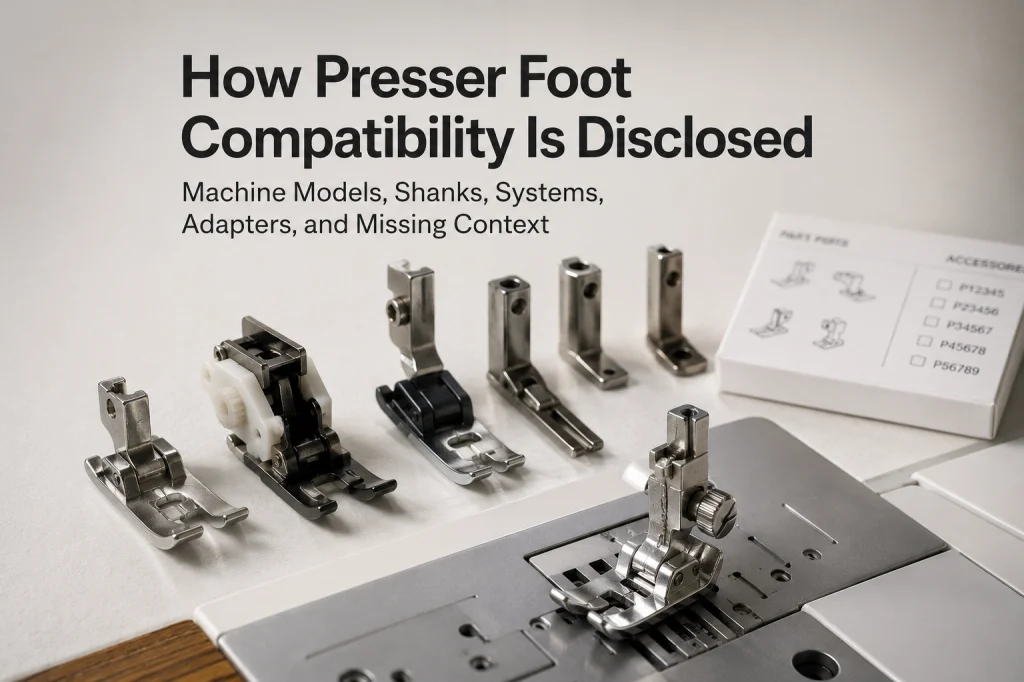
Two compatibility labels can provide very different evidence
How presser foot compatibility is disclosed can change the meaning of an accessory page before the foot ever reaches a machine. When I compare official accessory pages, I treat an exact part-number-and-model mapping as stronger evidence than a broad mounting label. Janome’s Convertible Even Feed Foot Set compatibility listing separates several versions by part number and then names the machines supported by each version. That is a specific manufacturer-to-model claim, not merely a description of the foot’s shape.
By contrast, SINGER’s presser foot kit compatibility section starts with the broader idea of low-shank machines, then narrows the claim with model groups, foot-by-foot differences, and explicit exclusions. Both pages contain useful information, but the labels do not carry equal weight on their own. A first-time buyer can easily read “low shank” as if it settles the whole question when the same page later shows that the exact machine still changes which feet in the package are considered compatible.
Note: I treat this as a document and listing comparison, not a physical fit test. The discussion stays within what official pages disclose and does not claim third-party fit, forced-adapter suitability, modified-part performance, or operation of an unverified attachment.
Accessory sample and audit fields
I separate compatibility evidence into the fields that can materially change a fit decision: accessory or part number, exact machine list, shank or mounting language, holder or adapter requirements, stitch-width or needle-position limits, needle plate or feed-system context, included parts, and exclusions. The distinction I watch most closely is between broad geometry terms such as low-shank or snap-on and stronger machine-specific evidence such as an exact model list or part-number mapping. Keeping those fields separate makes the difference clearer: a mounting label may describe geometry, while a model list records manufacturer approval for named machines, and a movement warning addresses whether the needle can travel safely through the intended opening.
The pages did not disclose every field in the same place or with the same level of detail. JUKI’s HZL Standard Presser Foot page, for example, maps different HZL series to different part numbers. Brother’s presser foot change instructions focus less on a shopping-style compatibility table and more on correct attachment, exact-machine suitability, and the risk of needle contact. The useful comparison is therefore not “which page is best,” but which evidence field each page actually provides.
| Disclosure field | What it can establish | What it does not establish by itself |
|---|---|---|
| Part number | Identifies the manufacturer’s exact accessory version | Fit on a machine that is not listed or documented |
| Exact model list | Shows named machines the manufacturer associates with that accessory | Why a visually similar unlisted foot should also work |
| Shank or snap-on label | Describes part of the mounting geometry | Needle clearance, holder width, plate compatibility, or special feed-system fit |
| Series label | Narrows an accessory to a machine family | That every model or every part inside the family is interchangeable |
| Adapter or holder statement | Shows an additional interface may be required | That any adapter with a similar appearance is equivalent |
| Stitch or clearance instruction | Shows movement limits that matter after attachment | General compatibility with unlisted feet |
| Package contents | Shows what is supplied in the box | That every supplied item is approved for every machine mentioned nearby |
The matrix also explains why a short label can be technically true yet incomplete for a purchase decision. “Snap-on” can describe how a sole attaches to a holder, but it does not identify the holder, machine, stitch range, needle opening, or any proprietary feed interface. The next sections separate those layers instead of treating one label as a complete answer.
Part number and exact model listing carry stronger identification
A part number is the cleanest way to separate accessories that share a name. Janome’s even-feed page lists part number 202133005 for a 9 mm version without AcuFeed, 214516003 for an HS 7 mm version, and 214517004 for an LS 5-7 mm version. Each version is followed by a different list of supported machines. The generic name “Convertible Even Feed Foot” therefore does not identify one interchangeable object across the whole catalog.
This is the kind of distinction that is easy to miss when two feet look similar in a thumbnail. A sewist with a Janome HD-3000, for example, can see that the current official page places that model under part number 214517004, not under the 9 mm version. That is useful documentary evidence for the named machine and part. It still does not prove that an unlisted third-party foot with similar dimensions, packaging, or marketplace wording will behave the same way.
For the broader method of checking whether feet cross between machines, the separate article on whether presser feet are interchangeable handles the evergreen fit question. Here, the point is narrower: an exact model list is a stronger disclosure field than a generic family label because it identifies the manufacturer’s stated machine-accessory relationship.
Shank, snap-on holder, and mounting geometry are only one layer
Low-shank, high-shank, snap-on, and screw-on language describes part of the mechanical interface, but those labels are often read too broadly. SINGER’s kit page is a useful example because it says the accessories fit most low-shank machines, then immediately provides a much more specific compatibility section. The page groups named models and states that the compatible feet in the kit vary by SINGER collection, so the low-shank description is not presented as the final test.
Brother’s support instructions show a different part of the same problem. The page describes aligning the bar on the presser foot with the slot on the shank, then warns that the machine should use a presser foot designed for that machine. In other words, the fact that a foot can reach or snap onto a holder does not erase the machine-specific requirement stated by the manufacturer.
This distinction matters most to a first-time owner because “it snaps on” feels like direct proof. It is really evidence about one connection point. A complete compatibility claim may still depend on holder geometry, needle opening, stitch movement, plate layout, or a system-specific attachment. The dedicated article on presser feet and mounting systems covers those interfaces in more depth without treating one mounting label as a universal shortcut.
Stitch width, needle position, plate, and clearance can change the answer
Mounting is not the end of the evidence chain because the needle still has to move through the allowed space. Brother’s overcasting support instructions explicitly tell users to turn the handwheel slowly after adjusting stitch width and check that the needle does not touch the presser foot. The same page warns that contact can bend or break the needle. That makes clearance an operating condition, not a cosmetic detail.
An easy mistake is to compare only the width of the foot or the shape of the snap-on bar. Consider a foot with a wide-looking needle slot on a machine capable of moving the needle laterally. The opening may appear generous, but the permitted stitch, needle position, and plate arrangement are the conditions that determine where the needle actually travels. A visual match cannot replace the exact machine instructions.
Warning: Do not force, grind, bend, or modify an attachment to create clearance. Follow the exact machine manual and manufacturer instructions. A handwheel clearance check should be used only where the manual or official support procedure permits it, and the machine should remain off during attachment changes when the manufacturer requires that.
That is why a listing that stops at “5 mm,” “7 mm,” or “9 mm” may still leave a gap. Those numbers can be useful context, but they need to be connected to the exact accessory version, machine, stitch range, needle position, plate, and holder before they become actionable evidence.
Adapter and required-holder language deserves its own check
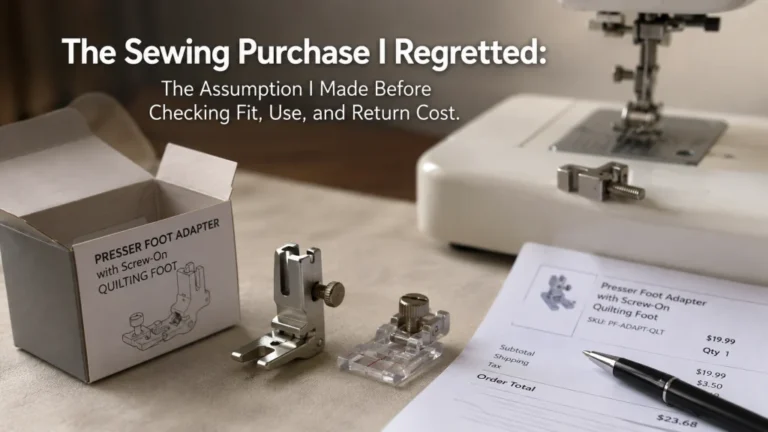
An adapter introduces another interface between the machine and the foot. That means the question is no longer only whether the foot resembles the original. The adapter itself has to match the machine-side mounting point, and the foot has to match the adapter-side connection. If a listing names a required holder, ankle, shank adapter, or attachment screw, that wording should be treated as a separate compatibility field rather than a minor accessory note.
This is also where broad labels become especially easy to conflate. Two snap-on soles can share a familiar crossbar shape while the holders above them differ in width, offset, height, or the way they attach to the presser bar. When an adapter is part of the chain, the safest documentary evidence is an exact manufacturer statement connecting the machine, adapter or holder, and accessory rather than a visual comparison of one piece.
The article on verifying a presser foot adapter handles that owner-level decision separately. For this comparison, the disclosure lesson is simpler: if the adapter or required holder is missing from a listing, the page may not contain enough information to resolve the attachment path even when the foot itself is well described.
System-specific feeds and proprietary attachments expose the limits of broad labels
Some accessories are tied to more than a shank height. Janome’s HP Plate and Foot page describes a matched foot and needle plate, notes that the foot uses the left-side feed dogs, and states that the set is compatible only with selected models. The page also assigns different part numbers to different model groups. This is a clear example of a compatibility claim built around a machine system rather than a generic foot shape.
The practical implication is not that every proprietary system is complicated. It is that broad geometry should not be allowed to overrule a more specific system statement. A foot can be physically small enough to sit under a presser bar while still depending on a special plate, feed arrangement, holder, sensor, or model-specific control. When the official page names those dependencies, they belong higher in the evidence hierarchy than marketplace shorthand.
JUKI’s HZL Standard Presser Foot page makes the same point from another angle. It groups the accessory under the HZL series, but the part number changes across HZL-DX, HZL-H, HZL-L, HZL-K, HZL-NX, and individual models such as HZL-12Z. A family name helps narrow the search. The part mapping is what prevents the family label from being mistaken for one identical component across every machine in that family.
Included parts can create package-level ambiguity
Multi-piece kits create a second disclosure problem: the package can be sold under one broad compatibility statement even when individual items have different model coverage. SINGER’s page handles this better than a single blanket claim because it says the compatible presser feet in the kit vary by collection, then lists which feet apply to each model group. It also names several computerized models that are not compatible with the kit.
That distinction matters because “included” and “compatible with my machine” answer different questions. A kit may physically contain a walking foot, gathering foot, cording foot, or straight-stitch foot, yet the official table can still limit which of those items the manufacturer assigns to a particular machine group. Reading only the package image or the first compatibility sentence would miss that detail.
A useful owner habit is to separate package evidence into two lines: what the box contains and what the compatibility section assigns to the exact model. This avoids turning package contents into an implied approval statement. It also makes stale listings easier to spot if a model list, exclusion, or part number changes later.
What official pages still left unresolved
Official manufacturer pages are the strongest sources for this kind of compatibility check, but they are not all written to answer every question. A model list can state that a named accessory works with a machine without publishing all relevant dimensions. A support page can explain how to attach the correct foot without telling you whether a visually similar third-party version shares the same tolerances. A series page can map part numbers without explaining every engineering difference between those parts.
That leaves a set of unresolved fields worth identifying instead of guessing. When one of these fields is absent, the honest conclusion is not “probably fine.” It is that the current page does not answer that part of the question.
- Does the exact machine model appear on the manufacturer’s compatibility list for the exact part number?
- Is a specific presser-foot holder, ankle, shank adapter, screw, or mounting piece required?
- Does the accessory depend on a particular needle plate, feed system, sensor, or machine mode?
- Are stitch width, needle position, or permitted stitch patterns restricted?
- Does a kit-level compatibility statement apply to every included item or only selected feet?
- Does the machine manual add a warning or limitation that the accessory page does not repeat?
This checklist is deliberately about missing disclosure, not about inventing an answer. If the page does not identify a third-party foot, the available documentation cannot certify that foot. If the manual reserves a procedure for service or warns against an attachment, a broad seller label does not override the machine documentation.
The evidence order I would check before purchase
The pages in this sample suggest a practical evidence hierarchy. It is not a promise that every manufacturer will publish every field, and it is not a substitute for the exact machine manual. It is simply the order that best separates strong, machine-specific documentation from labels that describe only part of the interface.
| Evidence level | What to check | How much it tells you |
|---|---|---|
| 1. Exact pairing | Exact machine model plus exact accessory part number | Strongest starting point when the manufacturer explicitly links them |
| 2. Approved coverage | Official model list or compatibility guide | Shows the manufacturer’s stated machine coverage for that accessory version |
| 3. Required interface | Holder, adapter, plate, or feed-system statement | Identifies dependencies hidden by a generic foot name |
| 4. Movement limits | Stitch width, needle position, stitch pattern, and clearance | Shows whether the documented setup allows the required needle movement |
| 5. Broad geometry | Low-shank, snap-on, or similar mounting label | Useful for classification, but weaker than exact machine-specific evidence |
| 6. Weak signal | Visual similarity or unsupported seller shorthand | Not enough to establish compatibility on its own |
The order matters because each layer answers a narrower question than the one before it. JUKI’s HZL page shows how one accessory name can map to different part numbers across machine series, while Janome’s even-feed page separates versions by part number and exact supported models. Those examples show why a broad family or mounting label should remain a starting point when more specific manufacturer evidence is available.
Key point: Universal presser foot claims are best treated as a prompt to verify the exact machine and interface, not as evidence that every machine, holder, plate, stitch movement, or feed system has already been checked.
Final Thoughts: machine, part, mounting, movement, and official listing
Compatibility disclosure becomes much easier to read once the labels are separated by what they actually prove. An exact part number and model list identify a manufacturer-supported pairing. Shank and snap-on language describe mounting geometry. Adapter, plate, feed-system, stitch-width, and clearance statements add conditions that can change whether the mounted accessory can be used as intended.
The strongest next move is therefore not to hunt for one magic label. Start with the exact machine model and exact accessory identity, then see whether the official documentation fills in the mounting and movement conditions that matter. If those fields remain unresolved, keep the uncertainty visible rather than converting a broad label or visual match into a compatibility claim.
Frequently Asked Questions
🦶 Does low shank mean a presser foot will fit my machine?
Low shank describes part of the mounting geometry, not the whole compatibility decision. Check the exact machine model, holder or adapter, needle movement, plate, and the manufacturer’s accessory list before treating the label as sufficient evidence.
📋 Is an exact model list stronger than a snap-on label?
Yes, for the specific manufacturer accessory being listed. A snap-on label explains how a foot connects to a holder, while an exact model list records which machines the manufacturer associates with that exact accessory or part number.
⚙️ Can two feet with the same name use different part numbers?
Yes. The Janome sample compared here uses multiple part numbers for even-feed feet with different system and width descriptions, and the supported model lists differ. The exact part number is therefore more useful than the generic accessory name alone.
🪡 Why does needle clearance matter after the foot attaches?
The needle may move sideways for certain stitches or positions, so attachment alone does not prove safe movement. Follow the exact machine manual or official support procedure for the permitted stitch and clearance check.
🧩 Does a presser foot adapter make every snap-on foot interchangeable?
No. The adapter adds another interface that must match both the machine side and the foot side, and it does not remove plate, feed-system, stitch, or clearance restrictions. Verify the exact adapter and accessory documentation for the machine.
📦 If a kit is compatible, are all feet in the kit compatible with my model?
Not necessarily. The SINGER page discussed here states that compatible feet in its kit vary by machine collection, so the package-level claim has to be read together with the model-specific table.
References and Sources
- Janome Convertible Even Feed Foot Set: Verifies separate part numbers, width or system labels, and exact supported model lists used in the comparison.
- Janome HP Plate and Foot: Supports the example of a matched foot and plate tied to feed-system behavior, part numbers, and selected models.
- SINGER Presser Foot Kit: Supports the comparison between broad low-shank wording, model-group tables, foot-specific coverage, and listed exclusions.
- Brother Presser Foot Change Instructions: Supports the attachment, exact-machine suitability, power-off, and needle-contact warnings discussed in the article.
- Brother Overcasting Instructions: Supports the model-covered handwheel clearance check and warning about needle contact after stitch-width adjustment.
- JUKI HZL Standard Presser Foot: Verifies that one accessory name is mapped to different part numbers across HZL series and models.