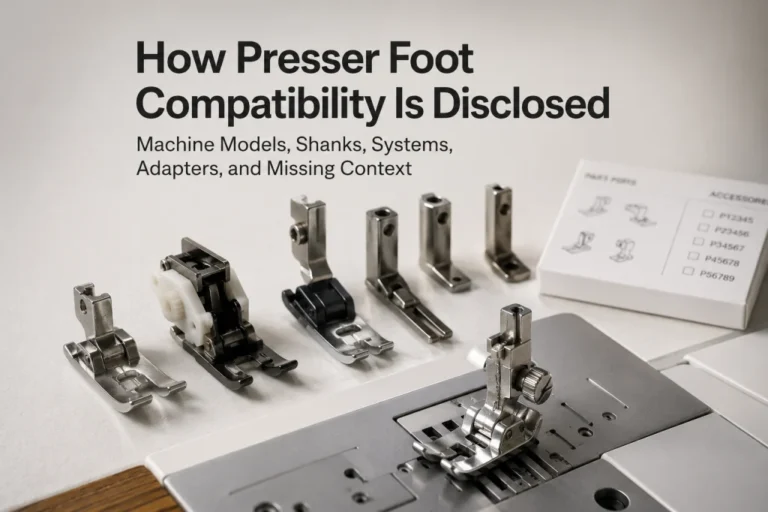
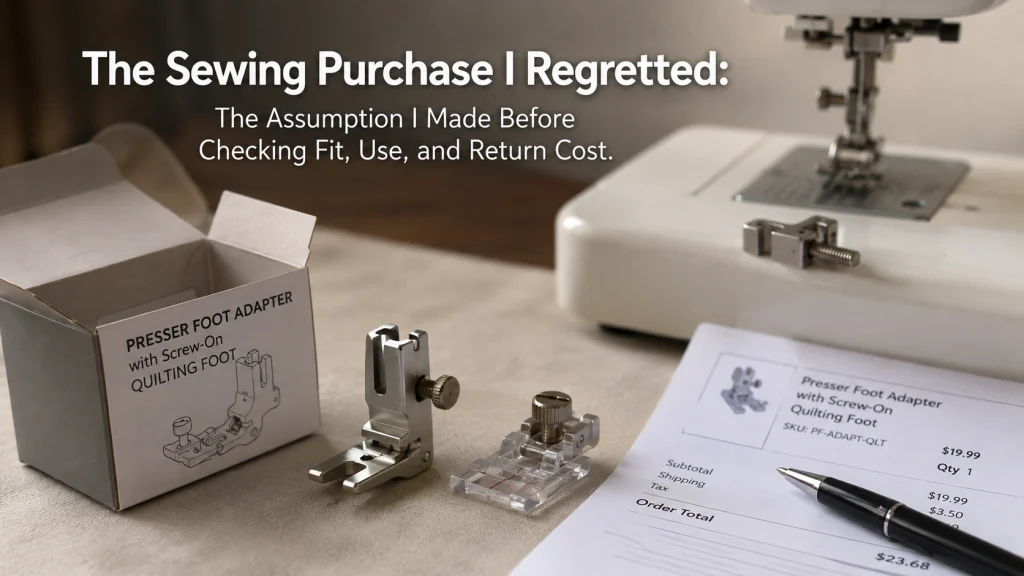
One sewing purchase I regretted was a Brother SA131 adapter I bought for a Brother CS7000X because I treated the phrase “low shank attachments” as if it proved compatibility. It did not. Brother’s own SA131 page gives a specific model list, and the CS7000X is not on it. The adapter itself was not defective; the problem was treating a broad interface description as if it were a model-level compatibility claim. That mistake changed the order in which I now verify sewing-machine accessories.
The point where the compatibility problem became clear
I knew the purchase was wrong as soon as the fit check showed that the adapter and the screw-on foot were not sitting in the working position I expected. The CS7000X was off and the presser foot holder had been removed. The parts could be brought together at the presser bar, but the assembled foot sat incorrectly when the presser foot lever was lowered. I stopped there rather than turning an uncertain fit into a powered compatibility test.
The same-brand connection had made the purchase look more straightforward than it really was. The product description also talked about an adapter for low-shank attachments, which sounded relevant to the task I had in mind. When I went back to the Brother SA131 compatibility page, the more important evidence was the specific supported-model list. My CS7000X was not one of the listed machines.
What I bought and why
The item was a Brother SA131 adapter for screw-on feet. I bought it because I had a low-shank screw-on quilting foot in an older accessory box and wanted to see whether I could use that foot on the CS7000X instead of leaving it unused.
The task itself was modest. I was not trying to modify the machine or make an industrial attachment work on a domestic presser bar. I wanted one small adapter to bridge an interface between a current machine and a screw-on foot I already owned. The mistake was letting the generic interface description carry more weight than the exact-model check.
| Stage | Event | What I believed at the time |
|---|---|---|
| Before purchase | Looked for a way to reuse an existing screw-on quilting foot | A same-brand low-shank adapter was probably the missing link |
| Purchase | Bought Brother SA131 for the intended screw-on foot | “Low shank attachments” sounded specific enough |
| Fit check | Opened package and performed an unpowered fit check | I expected the adapter to place the foot at the correct working height |
| Fit check | Rechecked Brother’s model list | The purchase assumption collapsed immediately |
| After the mismatch | Listed the unused adapter locally | Keeping it no longer made sense for my machine |
| Resale | Resold the unused adapter | The purchase was closed without a replacement |
Looking back at the sequence, the weak point was simple. Checking the official model list first would have answered the compatibility question before the accessory ever reached the machine.
The assumption behind the purchase
I collapsed three separate ideas into one. The CS7000X is a domestic Brother sewing machine. The foot I wanted to reuse was a low-shank screw-on style. The SA131 description said it was an adapter for low-shank attachments. From those three facts, I jumped to “this should be the adapter I need.” The missing step was proving that Brother intended SA131 for the CS7000X at all.
That is exactly the kind of mistake the site’s presser-foot compatibility process is meant to prevent. A function label such as “adapter,” “walking foot,” or “zipper foot” tells me what family of accessory I am looking at. It does not prove the mount, holder, height, part number, model list, stitch clearance, or other interface details that control whether the accessory belongs on the exact machine.
| My assumption | Evidence I actually had | What the evidence did not prove |
|---|---|---|
| Same brand meant the adapter was likely compatible | Brother made both the machine and the adapter | That SA131 was listed for CS7000X |
| “Low shank attachments” was enough to identify fit | The SA131 description uses that interface language | That every low-shank Brother machine uses SA131 |
| An adapter could bridge any remaining difference | The accessory exists specifically to change an attachment relationship | That the machine-to-adapter side was verified |
| A physical trial would answer the question | I could compare the parts with the machine off | That an undocumented fit test was a substitute for the manufacturer model list |
The useful distinction is between two questions: “Does Brother list CS7000X for SA131?” and “Is this a Brother low-shank adapter?” The second question sounds relevant, but only the first one answers the model-specific compatibility issue. That is the difference between verification and assumption.
What the listing and machine documentation actually said
Brother describes SA131 as an adapter for screw-on feet and says it is used with low-shank attachments where some screw-on feet do not have adequate height for certain sewing and embroidery machines. The same official SA131 product record tells buyers to make sure they are using the correct adapter and provides a defined “For Use With” list. The list includes machines such as the DreamCreator VQ2400, DreamWeaver VQ3000, Innov-ís 1500D, 2500D and 2800D, PC-8500 variants, and several Dream Machine and ULT models. It does not list CS7000X.
The CS7000X documentation points in the same direction without mentioning SA131 by name. Brother’s CS7000X presser-foot guidance tells the owner to use presser feet designed specifically for the machine and to match the foot to the selected stitch. Brother also maintains a dedicated CS7000X manual and accessory library. Those are the kinds of model-specific routes I now check before treating a general accessory description as sufficient.
Evidence I missed: SA131 had a model list, and CS7000X was not on it. The words “Brother,” “adapter,” and “low shank” described useful pieces of the product, but none of those words overrode the published compatibility list.
The model boundary was already there in the official documentation. The more useful conclusion is not that the product description was deceptive, but that a broad accessory label should never outrank a published model list.
What happened in the real fit check
I limited the check to an unpowered comparison. With the CS7000X off, I removed the presser foot and holder and compared the SA131 assembly with the presser bar and the screw-on foot I wanted to reuse. The adapter could be positioned at the attachment area, but the final foot position was visibly wrong when the presser foot lever was lowered. The sole did not meet the fabric in the way I expected from the normal holder and feet.
I did not try to solve that mismatch by stacking another adapter, changing the presser-bar position, forcing the screw, or cycling the needle. Brother provides a model-specific procedure for removing and attaching the CS7000X presser-foot holder, including the warning to secure the holder correctly so the needle does not strike a loose assembly. Once the manufacturer compatibility list and the unpowered fit check pointed in the same direction, I treated the question as settled.
| Fit-check item | Observed result |
|---|---|
| Machine | Brother CS7000X |
| Purchased part | Brother SA131 adapter for screw-on feet |
| Intended use | Reuse an existing low-shank screw-on quilting foot |
| Manufacturer model-list check | CS7000X not listed on SA131 page |
| Unpowered physical check | Final foot position did not sit correctly for the intended setup |
| Powered sewing test | Not performed |
| Machine damage | None observed |
The useful record ends there. I do not know whether an improvised change could have made the combination appear to work, because I did not attempt one. An accessory that lacks model support is not a good place to experiment with presser-bar geometry and needle clearance.
Product limitation versus machine mismatch
The SA131 has a defined compatibility boundary: Brother does not present it as an adapter for every low-shank machine. That matters because a mismatch with the CS7000X is not the same thing as a defective product. I can say the adapter did not suit this machine and intended setup; I would not turn that into a universal judgment about the part itself.
Same-brand reasoning is also weaker than it first appears. Two Brother accessories can belong to different machine families. Two parts can both be described with low-shank terminology and still require a model-specific adapter relationship. The useful compatibility question is whether the exact machine, adapter, and target foot are documented to work together.
My failed CS7000X use case does not show that SA131 is defective, poorly made, or unsuitable for machines Brother explicitly lists.
I bought SA131 without verifying my model, the fit check failed for my intended setup, and the official model list showed that my machine was outside the published compatibility set.
That distinction matters more to me than the regret itself. A poor match can produce a useful verification rule without becoming a negative review of the product as a whole.
Return, resale, storage, or replacement outcome
I did not immediately buy a replacement adapter after the failed check. That would have repeated the same shopping-first sequence that caused the problem. I put the SA131 back in its packaging and kept it aside while I decided whether returning, reselling, or simply leaving it unused made the most sense.
I eventually resold it locally with the exact part number and Brother’s published compatibility limitation included in the description. That closed the purchase without turning the mistake into another immediate accessory hunt.
Cost and outcome: The adapter was resold at a loss. The machine was not damaged, and I did not buy a replacement immediately. The more important cost was the extra time spent unwinding a purchase that an exact-model check could have prevented.
The financial loss was modest, but the wasted time mattered more. The entire sequence could have been avoided by checking the exact machine and accessory relationship before checkout.
The cost and extra work involved
I briefly considered keeping the adapter in a drawer in case it became useful later. In practice, I did not own any machine on Brother’s current SA131 model list and had no clear use for it. Reselling it made more sense than turning an incorrect purchase into permanent clutter.
The useful lesson was procedural rather than emotional. I had promoted a general phrase above a specific compatibility record. Once that became obvious, the mistake was easy to classify: the broad description sounded relevant, but the model list was the stronger evidence and should have controlled the purchase.
- Money: Resold at a loss.
- Time: More time spent researching and unwinding the purchase than the original compatibility check would have required.
- Project delay: The quilting-foot idea was postponed rather than solved immediately.
- Damage: none, because I stopped at the unpowered fit check.
- Most useful consequence: I changed the order of my accessory research.
This was not a catastrophic purchase. It was a modest, preventable mismatch that exposed a weak verification habit, which is why the example is useful.
The verification step I use now
I now start with the exact machine model and part number before I let myself browse by sewing task. For a presser-foot adapter, that means proving both sides of the connection: the machine must support the adapter, and the adapter must support the intended foot or attachment type. The site’s presser-foot adapter verification process treats those as two separate compatibility checks for a reason.
If the manufacturer provides a model list, I search that list for the exact model string. If the model is absent, I do not upgrade vague language such as “low shank,” “snap-on,” “for quilting,” or “fits Brother” into proof. If an accessory requires another holder or adapter, that extra interface gets checked as its own part rather than assumed to be a neutral bridge.
- Write down the exact machine model before opening accessory search results.
- Record the exact accessory part number, not just its generic name.
- Check the manufacturer model list or exact machine manual.
- Verify the machine-to-adapter interface separately from the adapter-to-foot interface.
- Stop if the documentation does not prove the combination instead of using a powered test to discover compatibility.
I also use the broader presser-foot interchangeability check when the listing leans heavily on words such as universal or multi-model. The main change is procedural: compatibility evidence now comes before checkout, not after the package is open.
Who might still find the item suitable
My outcome does not erase the use case Brother actually publishes. SA131 is intended for a defined group of machines and for situations where the documented adapter relationship is needed for certain low-shank screw-on attachments. An owner whose exact machine appears on Brother’s current list has materially different evidence from the evidence I had for CS7000X.
Even then, the model list is only one side of the decision. The target foot still has to be the type the adapter is meant to support, and any stitch, clearance, or attachment limits in the exact machine and accessory documentation still matter. That is not a recommendation to buy SA131. It is the boundary that keeps my regret from turning into a claim about owners whose machines and tasks are different from mine.
Boundary: This post records one failed purchase for one CS7000X use case. It does not rank adapters, recommend a replacement, or judge SA131 outside the documented situation described here.
Once I separated my mismatch from the product’s intended role, the story became simpler. The item did not need to be universally bad for the purchase to be wrong for me.
Final Thoughts: assumption, evidence, outcome, and verification rule
The regret was not really about the money. It was about how quickly an exact compatibility question had been replaced by a comfortable assumption. Same brand sounded reassuring. Low shank sounded technical. Adapter sounded like a solution. None of those facts answered the question that mattered before purchase: was SA131 documented for my CS7000X and the foot I intended to attach?
The answer was available before checkout. My buying rule now is to identify the machine, identify the part number, verify the manufacturer model list, and prove every added interface before buying. If that chain stops, the purchase stops with it.
Frequently Asked Questions
🦶 Why did the presser-foot adapter purchase fail?
I bought Brother SA131 for a CS7000X without checking the exact model list first. Brother’s SA131 page does not list CS7000X, and my unpowered fit check did not produce the correct working position for the intended screw-on foot.
🔩 Does low shank mean a presser-foot adapter will fit?
No. Shank terminology describes part of the interface, but the exact adapter part number and supported machine list still control the purchase. An adapter also creates another interface between the machine and the target foot.
📋 What should I check before buying a sewing-machine adapter?
Start with the exact machine model, then verify the adapter part number against manufacturer documentation. After that, confirm that the adapter is documented for the type of foot you intend to use.
💵 How much money did I lose on this purchase?
I resold the unused adapter at a loss. The exact amount matters less than the fact that the loss and extra effort were both avoidable with a model-specific compatibility check before purchase.
⚙️ Did I test the incompatible setup by sewing with it?
No. I stopped after an unpowered fit check and after confirming that CS7000X was absent from the published SA131 model list. I did not use powered sewing as a compatibility test.
🧵 Does this mean the Brother SA131 is a bad adapter?
No. This record shows that I bought it for the wrong machine and task. Brother publishes a defined set of machines for the adapter, so my CS7000X outcome should not be generalized to those documented applications.
References and Sources
- Brother SA131 adapter page: Verifies the adapter description, its low-shank screw-on purpose, the instruction to use the correct adapter, and Brother’s current supported-model list.
- Brother CS7000X manuals: Provides the current operation manual, sewing guide, accessory instructions, and model-specific documentation route used to bound this post.
- Brother CS7000X presser-foot guidance: Verifies Brother’s instruction to use presser feet designed for the machine and to match the foot to the selected stitch.
- Brother CS7000X presser-foot holder procedure: Verifies the model-specific holder removal and attachment procedure and the related needle-strike warning.
Brother compatibility and support pages should be rechecked whenever the manufacturer updates model lists, manuals, or accessory guidance. The technical claims in this article rely on those official compatibility records rather than on a broad same-brand assumption.