I once took on a structured formal dress that looked straightforward on paper but became much harder once the final fabric and construction came together. I measured carefully, made a test garment, and thought the project was moving in the right direction. At the final try-on, the bodice stood away from the body, the waistline looked wrong, the neckline did not sit properly, and the skirt behaved very differently from what I had planned. I eventually stopped trying to force the project toward the original design and returned to smaller sewing projects before taking on another garment with that many fit and structure variables at once.
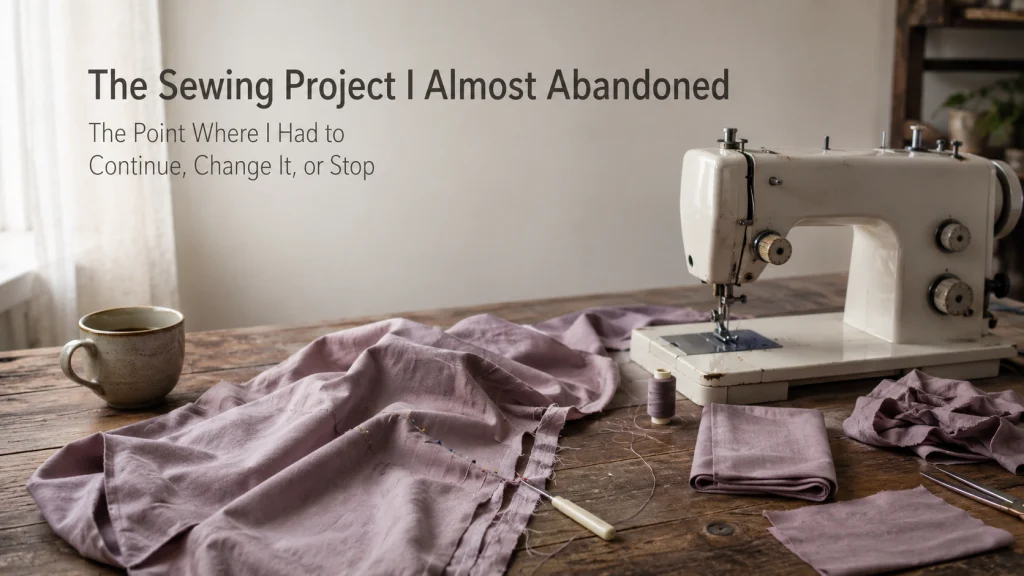
The point where I decided to stop
The point where I wanted to stop came late, not during drafting or basic construction. It came when I tried the dress on and realized that the finished shape was much farther from the intended result than the earlier stages had suggested.
I had already taken the project through sketching, measurements, a test garment, and final construction. Up to the try-on, I still thought the remaining work would be ordinary adjustment rather than a major rethink.
The bodice fit badly. The boning changed the shape more than I expected, the waistline looked bulky, the neckline did not sit correctly, and the gathered skirt added more volume at the waist than the design could carry well.
The fitting process also showed that I had made the garment too difficult to get in and out of while it was still being evaluated. I eventually had to open the skirt further than planned simply to remove the dress, which made it clear that the fitting sequence itself needed to be more reversible.
That was the point where the project stopped feeling like a normal unfinished garment and started feeling like a design that needed a different direction. I could no longer treat the remaining work as one ordinary alteration away from the result I had planned.
What I was making and why it mattered
I was trying to make a structured formal dress with a fitted bodice and a fuller skirt. I wanted the bodice to hold a clean shape without looking rigid and the skirt to have enough movement to feel balanced rather than bulky.
I had drawn the design before I started. Instead of relying on a complete commercial pattern, I drafted the bodice from my measurements because I wanted control over the neckline and overall shape. That added another layer of fit responsibility before the final fabric was even involved.
I did make a muslin first. The test version appeared to fit well enough that moving on seemed reasonable. The problem was that the test material was lighter and more fluid than the final fabric, so it did not reproduce the same structure, bulk, or drape once the dress was assembled.
That difference is one reason I treat test garments as only part of the fitting process. A muslin can help answer fit questions, but it does not automatically reproduce the way another fabric falls, holds shape, gathers, or behaves around structure. The guide to choosing muslin fabric for testing covers the test-material side of that decision, while understanding fabric drape explains why similar pattern pieces can produce different silhouettes in different fabrics.
| Project stage | What I thought at the time | What changed |
|---|---|---|
| Design | The design was clear enough to sketch before construction | I chose a self-drafted structured bodice |
| Muslin | The test version appeared to fit | The test looked good enough to move to final fabric |
| Final construction | The final materials created more structure and volume than the test fabric | The final materials behaved differently from the test fabric |
| Try-on | I expected ordinary adjustment | Several fit and silhouette problems appeared at the same time |
| Removal | I expected the fitting stage to remain reversible | The skirt had to be opened further to remove the garment |
| Afterward | The original plan no longer looked recoverable | I stopped pursuing the original dress and moved to simpler work |
The first documented sign of trouble
The first major sign of trouble was the final try-on. The muslin had looked close enough that I was expecting small corrections, not several structural and silhouette problems appearing at once.
The bodice stood away from the body, the waistline looked uneven and bulky, and the neckline was not sitting where it should. The skirt was another problem. I had planned a gathered skirt attached to the bodice, but the final fabric puffed at the waist seam instead of falling away from it cleanly.
The gathering itself is a construction question, and the separate guide to gathering fabric with a sewing machine covers that process directly. What mattered here was the mismatch between the silhouette I had designed around and the one the final fabric actually produced.
| Evidence point | What happened |
|---|---|
| Before | The muslin appeared to fit well enough to continue |
| Problem | The final bodice stood away from the body, the waistline looked bulky, the neckline sat badly, and the gathered skirt puffed at the waist |
| After | The garment could not be removed normally and the skirt had to be opened further |
What I tried before changing direction
By the time I reached that try-on, I had already done the usual preparation I rely on for a difficult garment. I measured, drew the design, drafted the bodice, made a test version, and moved to the final fabric only after the muslin looked acceptable.
I had also combined several demanding decisions into one project. A strapless bodice needed close fit. Boning changed how the bodice held itself. The skirt depended on gathers behaving predictably. The final fabric behaved differently from the test fabric. Each issue was manageable on its own, but the project depended on all of them working together.
I had also made the fitting process harder than it needed to be by not leaving an easy temporary way in and out of the garment. That is something I would handle differently now. I keep fitting stages more reversible and delay any construction step that makes removal difficult until I know the garment is sitting correctly.
What I did not do was keep dismantling the dress in search of a dramatic last-minute fix. Once the garment had reached that state, I no longer had a clear way to identify which change would actually move it back toward the intended design.
What made the decision harder
The easiest thing to overvalue was the work already invested. By the time the try-on failed, enough effort had gone into the project that continuing could easily feel justified simply because stopping meant accepting that the original plan was not working.
The final fabric also made the decision harder because it had been chosen for this specific design rather than as disposable practice material. Once the skirt had to be opened further during fitting, part of the original construction could no longer be treated as untouched.
The project also exposed the difference between ambition and control. It was self-drafted, strapless, and structured, so several advanced fit and construction decisions had to work together. When the result went wrong, the useful question was not whether the project had been too ambitious, but which parts of the process had become too difficult to evaluate reliably at the same time.
Continuing would not recover the work already spent. It would only decide what happened to the next stage of the project and the remaining fabric. That is why I try not to use previous effort as the main reason to keep sewing when the next corrective step is still unclear.
The decision to continue, change, pause, repurpose, or stop
I stopped trying to complete the dress in its original form.
I did not treat that decision as a judgment on sewing or on formalwear in general. I treated it as a project-specific limit: this version of the dress had reached the point where continuing would have meant redesigning it rather than simply finishing it.
Decision point: The muslin had not predicted the final result, several parts of the garment were wrong at the same time, and the fitting process had already forced changes to the skirt. I no longer had a clear, proportionate path from the garment in front of me to the design I had sketched.
After that, I went back to smaller projects with fewer interacting fit and structure problems. Finishing straightforward work was more useful than immediately repeating another high-complexity garment while the same weak points in my process were still fresh.
It was not a polished success story, and I do not think it needs to become one. The useful change was simply separating the outcome of one difficult project from the broader decision to keep sewing.
The result the project actually produced
I ended with a formal dress that did not work in its intended form.
The bodice did not fit properly. The waistline and neckline were wrong. The gathered skirt did not fall the way I wanted, and the fitting process had already changed the skirt. There was no simple alteration that turned the garment back into the original design.
The practical problem was that the garment no longer matched the purpose it had been built for. I did not have a clear alteration that would restore the original silhouette without changing several major parts at once.
I find it more useful to call that result what it was: the original dress did not work. The information from the project still mattered, but there was no reason to turn an unsuccessful garment into a forced success story.
What I learned and what remains uncertain
The clearest lesson was that a muslin and a final garment are connected by more than pattern shape. If the fabrics differ substantially in weight, body, or drape, the final result can move away from what the test version suggested. I now think more carefully about how closely the test material reproduces the behavior I actually need to evaluate.
I also separate difficult variables earlier than I did on this project. Self-drafting a strapless bodice is one challenge. Fitting around boning is another. Controlling a gathered formal skirt is another. Combining them does not make any one of those questions disappear.
One practical fitting rule stayed with me: while a garment is still being tested, I want an easy and reversible way in and out of it. That makes fitting safer, easier to evaluate, and much less likely to force unnecessary changes to the garment itself.
I still would not assign the outcome to one single cause. The bodice draft may have needed work. The boning may have changed the fit more than expected. The final fabric behaved differently from the muslin, and the gathered skirt created unwanted volume. Several contributors were plausible, which is exactly why I would not reduce the project to one neat explanation.
What this does not prove: This project does not prove that self-drafting is a bad idea, that jacquard, satin, or tulle are poor formalwear fabrics, that test garments are unreliable, or that a difficult project should always be abandoned. It is one project with one combination of decisions and one outcome.
The advice I would not generalize from this case
I would not tell someone to keep going simply because a lot of work has already been invested. More work can be the right choice when the next step is clear and the result still matters. It can also become wasted effort when the project has changed but the plan has not.
I would not tell someone to abandon a project at the first bad fitting either. Another garment may need one alteration or one construction change. This dress had several interacting problems at once, which made the decision very different from a normal fitting correction.
I also would not turn every failed project into a lesson narrative. Sometimes the useful part is simply recognizing what the project exposed and carrying that information into the next piece of work.
The part I would carry forward is to judge the project that actually exists. Not the sketch, not the muslin, not the effort already spent, and not the version you are still hoping will somehow appear if you keep sewing.
Final Thoughts: when stopping becomes the practical choice
The project I almost abandoned is also one I eventually stopped pursuing in its original form.
I did not finish the original formal dress, and I did not force it into a different success story. I stopped when there was no clear correction path left that still matched the design I was trying to make.
What I continued was sewing itself. I moved back to smaller projects for a while and kept the useful parts of the experience without pretending the outcome had been better than it was.
That is the principle I keep from the project. Sometimes continuing is right, sometimes changing the plan is enough, and sometimes stopping one project is simply the most practical decision available.
Frequently Asked Questions
🧵 How closely should test fabric match the final fabric?
For the behavior you are trying to evaluate, the closer the test fabric is to the final fabric in relevant properties such as weight, body, drape, and stretch, the more useful the comparison can be. In my case, the lighter test fabric did not reproduce the way the final material behaved, so the muslin answered fewer questions than it first appeared to.
🚪 How can I avoid getting trapped in a garment during fitting?
Keep the fitting stage reversible until you know the garment can be put on and taken off comfortably. I prefer a temporary opening or delayed closure while the fit is still uncertain so that the garment can be evaluated without forcing the next construction step too early.
✂️ Why did I have to cut the skirt?
The garment had become too difficult to remove normally during fitting, so I had to open the skirt further than planned. That is why I now keep unfinished garments easier to get in and out of until the fit is confirmed.
📐 Was self-drafting the main reason the dress failed?
I cannot isolate one cause. The draft, boning, final fabric, skirt construction, and difference between the muslin and final material all affected the result, so I would not claim that one variable explains everything.
⏸️ What did I sew after this project?
I returned to smaller projects for a while instead of immediately attempting another structured formal garment. Simpler work gave me a chance to focus on clean execution without repeating the same combination of fitting and construction variables.
🪡 Does this mean I think difficult sewing projects should be abandoned?
No. My decision was specific to this project and the state it had reached. A different project may have one clear correction and be completely worth continuing.