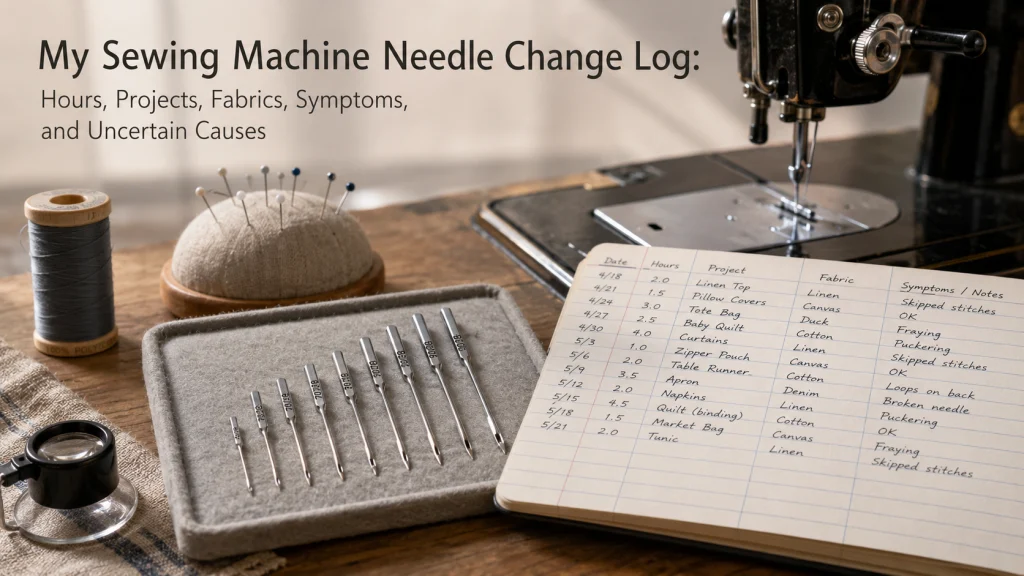
My needle changes on a SINGER 4423 have been shaped more by material, symptoms, and setup than by any single replacement interval. Some changes were routine, one followed a pin strike, one coincided with an improvement in a thread problem after I also rethreaded, and one fresh needle did not fix the skipped stitches I expected it to fix. I find it more useful to keep the reason for a change separate from what happened afterward. That makes it easier to learn from a sewing problem without pretending the needle was automatically the cause.
The needle change that did not fix the problem
One of the more useful needle changes happened while I was sewing lightweight jersey with all-purpose polyester thread. Skipped stitches began appearing, so I swapped in a fresh Ball Point needle in the same general setup. I expected the new needle to clean up the stitch line because SINGER lists an old, bent, dull, or wrong-style needle among possible causes of skipped stitches, and its current guidance specifically routes stretch fabrics toward a ball point needle.
It did not. The skipped stitches remained intermittent after the replacement. That was a useful reminder not to force a neat explanation onto a sewing problem just because a needle change seemed like the obvious first move. The needle was reasonable to check, but the replacement itself did not isolate the cause.
Machine and how I track needle changes
The machine used throughout the log is the SINGER 4423, a domestic mechanical model for which SINGER maintains current product support and a model manual. Keeping one machine constant avoids mixing entries from systems with different setup instructions or needle expectations. The machine choice is part of the record, not a product recommendation.
I separate active sewing from the rest of the project when I think about needle use. Cutting, pressing, pinning, bobbin winding, rethreading, and fitting can take a lot of time, but they do not put the same wear on the needle as actual stitching. I find that distinction more useful than pretending every project can be reduced to a perfectly precise needle-hour total.
The most useful habit is to keep the reason for a replacement separate from the result. I may remove a needle because of accumulated use, a material change, a symptom, or a pin strike. What happens afterward can be improved, unchanged, worse, or simply uncertain. Keeping those ideas separate stops every removed needle from turning into supposed evidence of wear.
| Context | Needle | Project and fabric | Approximate use | Reason for change | Post-change result |
|---|---|---|---|---|---|
| Light woven work | Style 2020, 80/12 | Cotton lawn seam samples | A few hours | Moved to a heavier woven | No failure recorded |
| Heavier woven work | Style 2020, 90/14 | Medium-weight cotton poplin tote | Several hours | Moved to lightweight jersey | No failure recorded |
| Jersey project | Style 2045, 80/12 | Lightweight jersey top | A few hours | Skipped stitches | Fresh same-style needle did not resolve symptom |
| Interfaced poplin | Style 2020, 90/14 | Poplin apron with interfaced areas | Several hours | Thread shredding near needle | Improved, but machine was rethreaded at the same time |
| Denim and canvas | Style 2026, 100/16 | Denim and canvas utility pouch | Brief use before impact | Needle struck a pin | Removed immediately; no pre-strike symptom |
| Cotton twill | Style 2020, 90/14 | Cotton twill cushion cover | Extended use | Preventive time cue | No symptom to compare |
| Fleece project | Style 2045, 90/14 | Sweatshirt fleece test seams | A few hours | Popping sound at a bulky crossing | Sound disappeared after change, but seam condition also changed |
The table is intentionally mixed. I changed some needles because the material changed, some because a symptom appeared, one after an impact event, and another because a published time cue was enough to make replacement reasonable. That variety is more representative of normal sewing than a neat lifespan number.
Needle identity and the details I pay attention to
SINGER separates its domestic needle guidance by style and size. Its current machine needle selection guidance lists Universal or Regular Point Style 2020 for woven fabrics, Ball Point Style 2045 for knits, and Denim or Jeans Style 2026 for denim and canvas. The same page pairs lighter fabrics with smaller sizes and lists 16/100 for denim and canvas.
SCHMETZ uses a different naming system but makes the same structural point. Its official needle guide separates household needle system, needle type, and needle size. That is why the log does not use a bare number such as 90/14 as the whole needle identity.
Needle-log template: Date | Exact machine | Needle style or system | Needle type | Needle size | Project | Fabric and layer stack | Thread | Logged or bounded sewing time | Reason for change | Symptom before | Result after | Other changes made at the same time | Confidence in interpretation.
The separate fields are especially useful when a fresh needle does not solve the problem. In the jersey example, I kept the machine, fabric, thread, and general needle setup as consistent as practical. That made the negative result more informative than simply writing down “new needle” and moving on.
Projects, fabrics, and thread contexts
The way I changed needles depended heavily on the material. Lightweight woven work could end with a perfectly serviceable needle simply because the next project moved into a heavier fabric. Likewise, a needle used on poplin might come out because I was switching to a knit, not because anything had gone wrong.
The knit work was different. SINGER currently directs sheer to lightweight knits such as jersey toward Ball Point needles in 70/10 or 80/12, while medium to heavier knits are listed with 90/14. I use that kind of manufacturer guidance as a starting point, then pay attention to the actual fabric and stitch behavior rather than treating the size number as a guarantee.
Thread stayed recorded because it can change the meaning of a symptom. SINGER notes that thread can influence needle choice, and SCHMETZ states that a larger thread generally needs a larger needle. The site’s fabric, thread, and needle relationships covers that interaction as a broader system question. In this log, the job is narrower: keep the thread visible so a later problem is not blamed on the needle by default.
Time-based changes
I occasionally replace a needle even when there is no obvious symptom, especially when it has already seen a fair amount of stitching on a consistent material. That fits the general direction of SINGER’s current 6 to 8 hour recommendation in its SINGER Needle Guide. A separate SINGER help article uses an 8 to 10 hour stitching cue, while SCHMETZ’s troubleshooting material says replacement at approximately eight hours is a useful general point.
I do not average those numbers into a new personal rule. A preventive change is still different from a symptom-led change, and it does not prove the needle was about to fail at the next minute of sewing. Another needle used under different conditions may behave differently.
Project count is not a substitute for sewing time, and sewing time is not a substitute for the reason a needle came out. I have removed perfectly usable needles because the next material called for a different setup, and I have removed a relatively fresh needle immediately after a pin strike. Looking only at “time until removal” would make those changes look like wear when the reasons were completely different.
Material-change decisions
Some of my most routine needle changes happen because the next material calls for a different setup, not because the current needle shows a problem. That distinction matters. A material-change removal says something about the next sewing condition; it does not automatically say anything about the remaining life of the previous needle.
A switch from medium-weight poplin to lightweight jersey is a good example. A Regular Point needle can be working normally on the woven fabric, while SINGER’s current guidance routes the knit toward a Ball Point needle instead. I treat that as a material and compatibility decision, not as evidence that the previous needle was worn out.
That same distinction helps prevent false pattern finding later. If every removed needle were counted as “worn out,” the log would suggest that several needles failed unusually early. Once the reason field is visible, the pattern disappears.
Symptoms that improved after replacement
One thread-shredding problem improved after I changed the needle, but it was not a clean needle-only result. I replaced the Regular Point needle with a fresh one of the same general setup, but I also rethreaded the upper path before sewing again.
The shredding stopped in the next test seam. SINGER’s troubleshooting guidance says thread shredding can mean the needle is too small for the thread, but it also notes that thread condition itself can be responsible. SCHMETZ likewise lists incorrect threading, excessive tension, damaged or old needles, and a needle that is too small among possible causes of upper-thread breakage.
| Entry | Symptom before | Needle action | Other simultaneous change | Result after | Confidence |
|---|---|---|---|---|---|
| Interfaced poplin | Upper thread shredding near needle | Fresh Style 2020, 90/14 | Upper path rethreaded | Shredding stopped in next test seam | Low for needle-only causation |
| Fleece project | Popping at bulky fleece crossing | Fresh Style 2045, 90/14 | Next seam no longer crossed the same bulk | Sound disappeared | Low because seam condition changed |
Both entries improved, but neither deserves the sentence “the old needle caused it.” The record is more useful precisely because it keeps the confounders attached.
Symptoms that did not improve
The jersey skipped-stitch problem is the one I would have been most tempted to oversimplify afterward. The symptom matched a problem that official guidance says can involve an old, bent, dull, incorrect-size, or wrong-style needle. Replacing it with a fresh Ball Point needle in the same general setup seemed like a sensible first check.
The replacement did not resolve the intermittent skipped stitches. That did not prove the needle was irrelevant, but it did show that a fresh same-style needle was not a complete fix under that setup. I left the cause unresolved rather than forcing a diagnosis onto the result.
No-causation boundary: improvement after a replacement can support a before-and-after observation. No improvement can eliminate one simple explanation. Neither result proves the complete cause without accounting for the other variables in the sewing setup.
That is where this record hands off to the site’s sewing machine stitch problem framework. A field log can show which intervention did or did not change the symptom. It should not grow into an internal repair diagnosis.
Needles removed without a clear failure
Several needle changes in my normal use have ended without evidence that the needle itself failed. Material changes, a pin strike, and preventive replacement are all different reasons for taking a needle out. Lumping them together as “used-up needles” would erase the most important part of the decision.
A pin strike deserves its own category. SINGER’s current guidance explicitly says to change the needle after hitting a pin. I would replace that needle even if it had seen very little use and had shown no stitch symptom beforehand. The short use period would say nothing about the normal lifespan of a Denim or Jeans needle; the replacement was triggered by an event.
The same logic applies to preventive replacement. Sometimes I choose to treat a published time cue as a reasonable maintenance point even when the stitch line still looks normal. The absence of a symptom is useful information, not a gap that needs to be filled with a failure story.
What changed in how I track needle problems
The failed needle-only fix changed what I pay attention to more than the successful changes did. A needle, project, and rough amount of use are not enough when several setup variables can move at once. I now pay particular attention to what else changed at the same time and how confident I am in the interpretation.
That approach makes improvements easier to read correctly. When the thread shredding stopped after a fresh needle went in, the machine had also been rethreaded. If I ignored that second change, it would look like a clean needle fix. Keeping both changes visible lets the result stay useful without pretending to be more specific than it was.
Changed-practice note: I do not stop at “needle changed.” I also note the trigger, simultaneous setup changes, post-change result, and how confident I am in the explanation. Negative results are useful because they keep a reasonable first guess from turning into a false diagnosis.
I am also cautious with time estimates. Total project duration is not the same as actual needle use, so I do not convert one into the other automatically.
What my experience cannot prove
My experience on one domestic machine cannot establish a universal needle-change interval. It includes different fabrics, needle types and sizes, material changes, a pin strike, preventive replacement, and several symptoms. Those conditions are too mixed for a durability comparison.
My experience also cannot rank brands or prove that one needle type lasts longer than another. A denim needle removed after a pin strike cannot be compared fairly with a needle changed preventively after ordinary stitching. Turning those two situations into a lifespan comparison would create a durability story the experience does not support.
| Entry | Main change | Confounder | What the record can support |
|---|---|---|---|
| Jersey project | Fresh same-style ball point needle | None recorded at replacement | Replacement alone did not resolve skipped stitches |
| Interfaced poplin | Fresh regular point needle | Upper thread path rethreaded | Combined change was followed by improvement |
| Denim and canvas | Needle removed | Pin strike | Removal was event-driven, not time-driven |
| Fleece project | Fresh ball point needle | Bulky seam condition changed | Sound disappeared, but needle-only causation is uncertain |
The strongest conclusion is therefore about how I interpret a needle change, not about needle lifespan. When the trigger, material, amount of use, symptom, and simultaneous changes stay separate, it becomes much harder to overinterpret the result.
Final Thoughts: the reason for change matters more than one number
My needle changes have never produced one neat replacement interval. Some happen because the next material calls for a different setup, some follow an impact or symptom, some are preventive, and sometimes a fresh needle does not fix the problem I expected it to fix.
That mixed result is the useful part. I pay more attention to the reason for removal before interpreting the result, then consider every simultaneous setup change before assigning confidence. Time still matters, but it does not get to tell the whole story by itself.
Frequently Asked Questions
The questions below stay within the limits of the record and the official guidance used to constrain it. They are not a universal replacement schedule for every machine or project.
Machine-specific setup still belongs to the exact manual, and symptom-led troubleshooting may require checks beyond the needle itself.
🪡 What should I record when I install a new sewing-machine needle?
I record the exact needle identity, machine, material, thread, reason for the change, symptoms before the change, what else changed at the same time, and what happened afterward. That context is more useful than a bare replacement interval.
🪡 Did a fresh needle fix every stitch problem?
No. I have had skipped stitches remain after installing a fresh same-style Ball Point needle. That kind of negative result is exactly why I keep replacement separate from diagnosis.
🧵 Why record thread if the article is about needles?
Official guidance treats thread thickness as part of needle choice, and thread condition can also contribute to shredding or breakage. Without the thread field, a later symptom can be over-attributed to the needle.
📌 Why was the denim needle removed after only brief use?
I remove a needle after a pin strike because the event itself changes the decision, not because an hour limit has been reached. SINGER’s current guidance also treats hitting a pin as a reason to change the needle.
🔊 Did the popping sound prove the fleece needle was damaged?
No. The sound disappeared after the needle change, but the next seam did not reproduce the same bulky crossing. The entry therefore remains uncertain rather than assigning the result to the needle alone.
🔍 What was the biggest change in the tracking method?
The biggest change was paying attention to simultaneous setup changes and confidence after a fresh needle failed to solve a skipped-stitch problem. That makes later improvements easier to interpret without turning them into stronger causal claims than the experience supports.
The useful pattern is not a single number. I get more value from separating why a needle came out from what happened after the replacement went in.
References and Sources
These official sources support the machine, needle styles and sizes, replacement cues, and symptom language used throughout the article.
- SINGER 4423 product support: verifies the domestic machine model used in the record and its current support context.
- SINGER needle selection guidance: supports Style 2020, Style 2045, Style 2026, fabric-to-size examples, the 8 to 10 hour cue, pin-strike advice, and needle-related troubleshooting language.
- SINGER Needle Guide: supports the current 6 to 8 hour and fabric-change replacement recommendation.
- SCHMETZ Needle Guide: supports household needle-system terminology, needle-size interpretation, and the separation of system, type, and size.
- SCHMETZ troubleshooting guide: supports the approximate eight-hour cue and the multiple possible causes associated with upper-thread breakage and other sewing symptoms.
- SCHMETZ needle basics Q&A: supports condition-based replacement clues and the statement that exact needle life varies with sewing conditions.