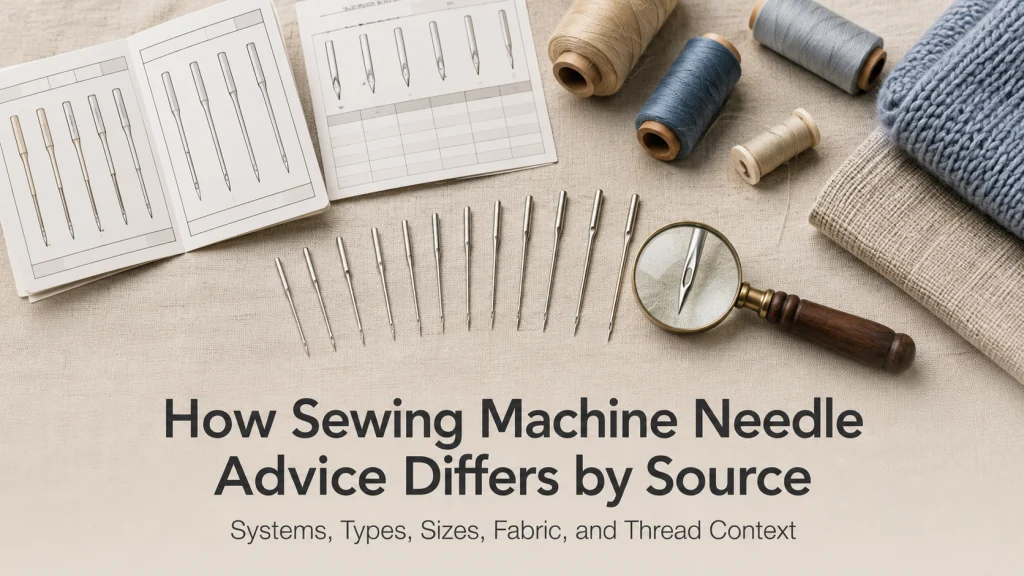
Needle charts often look as if they disagree because they are not always answering the same question. One source may be naming a household needle system, another may be grouping needles by fabric, and a machine manual may narrow the answer to the styles and sizes expected by one model. This source comparison separates system, type, point, size, fabric construction, thread context, replacement language, and machine-specific limits so the differences are easier to interpret. The practical takeaway is to compare like with like first, then let the exact machine manual control anything that depends on the machine itself.
A recommendation can change when the missing condition is restored
Needle advice can look contradictory when two charts are read without the conditions that sit behind them. A general household needle page may call a Universal needle suitable for many woven and knit applications, while another source separates woven fabrics from knits more aggressively and directs the reader toward a ball point, jersey, or stretch category. That is why needle advice can change from one source to another: the words on the chart are only useful when the source’s fabric, thread, needle-system, and machine assumptions travel with them.
This is a sewing needle source comparison, not another universal selection chart. When I compare official SCHMETZ education pages, current SINGER needle guidance, and exact model manuals, I separate what each source is actually describing before I compare the wording. The goal is to identify true agreement, terminology differences, different operating conditions, and questions that a general chart cannot settle. For an evergreen explanation of the actual selection process, use the site’s sewing machine needle selection framework instead of treating this comparison as a replacement for model-specific checking.
Sources and fields I compare
I keep the source set deliberately narrow and use official material from SCHMETZ and SINGER because the useful comparison is how recognized needle and machine sources structure their own advice, not an average of retailer copy, forum shorthand, and brand-independent summaries. The SCHMETZ needle education library exposes separate references for needle points, size designations, thread sizing, household needle comparisons, overlock needles, and other topics. The SINGER needle selection article combines fabric, needle type, size, troubleshooting, and replacement guidance in a different format.
I read each source for the same fields: household needle system or style, named needle type, point or geometry, size notation, fabric or material condition, thread condition, replacement language, and any stated machine or model limitation. That matters because a chart cannot be called wrong merely for omitting a field it was never designed to answer. A household needle advice page that groups by fabric weight is doing a different job from a machine manual that tells the owner what that exact model expects.
Source-selection method: compare official source language field by field, preserve the condition attached to each recommendation, and do not convert a general chart into model compatibility evidence. Community questions can reveal where readers get confused, but they do not override manufacturer documentation.
Needle system is not needle type or size
The first useful separation is structural. In the SCHMETZ Needle Guide, 130/705 H is identified as the needle system used by home sewing machines, while needle type and needle size are shown as separate pieces of information. The same guide describes the household needle’s flat shank and scarf, then separately lists types such as Universal, Jersey, Stretch, Jeans/Denim, Leather, and Microtex. That layout makes it harder to confuse “fits the household system” with “is the right point and size for this fabric and thread.”
SINGER often presents its own style numbers beside the type name. Its current selection page, for example, identifies Universal as Style 2020, Ball Point as Style 2045, Denim/Jeans as Style 2026, and Leather as Style 2032. Those style labels are useful inside SINGER documentation, but they are not the same field as the paired European/American size notation such as 90/14 or 100/16. A first-time owner can easily read every number on a package as “needle size,” even though some numbers identify a style or system and others describe diameter.
| Field | What it answers | Example from the audited sources |
|---|---|---|
| Needle system or style | Which needle architecture or coded family is being discussed | SCHMETZ 130/705 H for household machines; SINGER style numbers such as 2020 or 2045 |
| Needle type | What point, eye, scarf, blade, or application design is intended | Universal, Jersey/Ball Point, Stretch, Microtex, Denim/Jeans |
| Needle size | How large the needle blade is | Paired notation such as 75/11, 90/14, or 100/16 |
| Fabric or thread condition | Why one type or size may be favored over another | Knit construction, fabric weight, elasticity, or thread thickness |
The practical check is simple: before comparing two recommendations, make sure the numbers and names occupy the same column in this mental crosswalk. If one source is talking about the household system and the other is talking about size, there is no disagreement to resolve yet.
Where the official sources agreed
The strongest agreement was not a single fabric-to-needle recipe. It was the idea that needle choice is conditional. SCHMETZ states that needle size should be chosen according to thread thickness and needle type according to fabric application. The SINGER needle selection article likewise explains that different sizes and types are used for different fabrics, and that thread can also affect the choice. Both sources therefore reject the idea that one printed word on the package settles every decision.
They also agree that size numbers represent a progression from finer to larger needles. The SINGER needle selection article explains that the lower number is finer and the higher number is larger in both its European metric and American sizing systems. SCHMETZ describes needle size through blade diameter and gives the example that a size 75 needle has a 0.75 mm blade diameter. The presentation differs, but the underlying idea is compatible: size is a physical dimension, not a fabric name.
| Question | Shared direction | Why the wording may still differ |
|---|---|---|
| Does size matter? | Yes, size changes with the sewing condition | SINGER explains fine-to-large numbering; SCHMETZ ties size to blade diameter and thread thickness |
| Does fabric matter? | Yes, fabric application or construction affects type choice | One source may group broadly while another splits knit or stretch applications more finely |
| Does thread matter? | Yes, thread thickness can affect the usable needle size or type | Some charts put thread in the main table; others discuss it in a separate reference |
| Should a damaged needle stay in service? | No, both sources associate worn or damaged needles with stitch or thread problems | Their replacement intervals and warning language are not identical |
That agreement is more useful than forcing a single brand-neutral chart. It tells the reader which variables must be carried into the next check: machine, fabric construction and weight, thread, needle type, and needle size.
Where terminology differed
The most obvious terminology problem appears around knit fabrics. SCHMETZ separates Jersey (Ball Point) from Stretch. Its guide describes Jersey as a medium ball point for knits and some stretch fabrics, while Stretch adds a specially designed eye and scarf for elastic materials and highly elastic knitwear. The SINGER needle selection page uses Ball Point Style 2045 for knits and describes the rounded tip as passing between fabric threads. If those two pages are reduced to a one-line “needle for knits” rule, the extra condition around elasticity disappears.
Universal is another example. SCHMETZ describes its Universal needle as a general-purpose option for numerous woven and knit fabrics. The SINGER web needle guidance describes Universal Style 2020 for woven fabrics, while its Ball Point category handles knits. That difference should not be turned automatically into “one company is right and the other is wrong.” The source vocabulary, product families, and intended sorting method are different, so the next question is which exact fabric construction, machine, and available needle family the reader is dealing with.
| SCHMETZ wording | SINGER wording | Condition that changes the comparison |
|---|---|---|
| Jersey (Ball Point) | Ball Point Style 2045 | General knit application versus the exact knit construction and elasticity |
| Stretch | Covered within broader knit guidance | Highly elastic material may introduce a more specific needle geometry or application note |
| Universal | Universal Style 2020 | The fabric range stated by each source is not identical |
| Jeans/Denim | Denim/Jeans Style 2026 | The labels overlap, but system, size, material stack, and exact machine still need separate verification |
The crosswalk shows why terminology should be compared with its attached condition, not by matching labels alone. A similar name can hide a different scope, while different names can still point toward overlapping applications.
Where fabric construction changed the answer
Fabric names are often too broad to carry a needle decision by themselves. “Jersey” describes a knit construction, but the amount of stretch, fiber content, density, finish, number of layers, and seam structure can change what happens at the needle. SCHMETZ’s separate Jersey and Stretch categories make that distinction visible: both may involve a ball point, but the Stretch design adds eye and scarf features for more elastic material. The SINGER Ball Point guidance groups several knit examples together. The sources are not necessarily answering at the same level of detail.
A practical example is a stable cotton jersey versus a highly elastic knit containing spandex. Treating both as one broad knit category erases a condition that one source explicitly uses to separate categories. The right next move is not to memorize a single knit rule from this article. It is to identify the material’s construction and elasticity, then use the relevant official guidance and the exact machine manual. The site’s explanation of fabric, thread, and needle relationships covers that interaction as a sewing-system decision rather than as a brand-language comparison.
Where thread changed the size context
Thread is the variable most likely to vanish when a needle chart is copied into a simplified fabric list. SCHMETZ makes the relationship explicit by telling readers to choose needle size according to thread thickness. The SINGER selection article also says thread may determine the needle choice and gives the example of pairing a fine, delicate thread with a smaller needle size. This is a point of agreement even though the wording and chart structure are different.
Consider two projects using fabric that falls into the same broad weight class but different thread thicknesses. A chart sorted only by fabric weight can make the needle size look fixed, while a source that includes thread immediately shows why the answer may shift. A useful comparison therefore has to record the thread field instead of treating fabric weight as the whole problem. The reader should carry the actual thread into the decision, not just the fabric label.
Where the exact machine manual narrowed compatibility
General needle education can explain systems, types, sizes, and applications, but it cannot prove that every needle described on a general page is approved for every machine. The SINGER model manual library lists separate manuals for machines including the Heavy Duty 4423, 4452, 4432, 4411, and other models. That is the correct level of documentation to check when the question becomes machine-specific rather than purely about needle terminology.
This distinction matters most when two needles look interchangeable. A household-format package, a familiar size such as 90/14, or a generic name such as Universal is not enough evidence by itself. The reader still needs the exact model’s needle-system instructions, insertion orientation, size or type limitations, twin-needle rules where relevant, and any service or safety notes. The separate article on whether sewing machine needles are universal deals directly with that compatibility question.
Machine-manual boundary: use a general chart to understand terminology and application logic. Use the exact manual for the owned machine when the question is what the machine accepts, how the needle is installed, or what the manufacturer restricts. Visual similarity and a matching size number are not compatibility proof.
Replacement language and what it did not prove
Replacement advice was the clearest example of why a number should not be detached from its source. The SINGER Needle Guide recommends changing the needle every 6 to 8 hours of sewing and/or with a change of fabric. A separate SINGER needle selection article says to change it after two to three garments or after hitting a pin, while its troubleshooting list gives an 8 to 10 hour interval. Those statements come from the same brand’s current help environment and already show that replacement language can be framed by time, project count, fabric change, or an event such as striking a pin.
SCHMETZ uses more condition-led language on the pages compared here, pointing readers toward signs such as broken or shredded thread, skipped or uneven stitches, puckering or fabric damage, and popping sounds. That does not establish a universal service-life number for a needle. More importantly, none of these general statements proves how long a particular needle will remain suitable in every fabric, thread, speed, stitch, or machine condition. A replacement interval is a maintenance cue, not a laboratory durability result.
Questions the documents cannot answer
Several questions remain outside what these documents can prove. The pages do not establish a universal needle lifespan under controlled conditions, a cross-brand ranking of stitch quality, or a guarantee that one needle type will eliminate skipped stitches on every knit. They also do not prove that two differently named needle families from different brands are mechanically identical just because the suggested fabric application overlaps.
The sources also cannot diagnose a sewing problem from a fabric name alone. Skipped stitches can involve needle condition, type, size, installation, threading, fabric handling, machine setup, or a fault that needs service. If a general chart and the exact machine manual still leave a question unresolved, I treat that as the limit of what the documents can support, not as an invitation to fill the gap with a confident guess.
Unresolved question: if two official sources use different labels for what appears to be the same job, verify the exact needle system, point or geometry, size, thread, fabric construction, and machine model before treating the difference as technical disagreement.
Final Thoughts: source, condition, machine, and unresolved question
I find the more useful question is not “Which chart is correct?” but “Which field is this source actually answering?” SCHMETZ and SINGER often agree on the variables that matter while organizing them differently. System, type, size, fabric application, thread, and replacement cues need to stay separate long enough to see whether two recommendations are genuinely incompatible or simply written for different conditions.
For an owner standing beside a machine, the final sequence is straightforward: identify the needle system and type language, keep the fabric and thread condition attached to the recommendation, and check the exact machine manual before turning general advice into a compatibility claim. If the documents still do not answer the question, leave it unresolved until better evidence exists. That is more useful than making a universal rule out of a chart that never promised one.
Frequently Asked Questions
The most common needle questions become easier once the source and condition are named. These answers stay deliberately narrow because the exact machine, fabric construction, thread, and needle family can change the result.
Use them as a check on what kind of evidence you still need, not as a substitute for the model manual or a full needle-selection process.
🪡 Is a Universal needle the same thing in every needle guide?
No. The general idea overlaps, but official sources can define the fabric range and product family differently. Check the source’s own type description and the exact machine requirements before assuming two Universal labels are interchangeable in every condition.
🧶 Why does thread thickness matter when choosing needle size?
The thread must pass through the needle eye and work with the groove without being mismatched to the needle’s scale. Both SCHMETZ and SINGER tie thread context to needle choice, so fabric weight alone is not enough to settle size.
🧵 Are Ball Point, Jersey, and Stretch needles identical?
Do not assume they are identical from the names alone. SCHMETZ separates Jersey and Stretch by application and needle geometry, while SINGER’s current general guidance uses Ball Point for knit fabrics. Compare the actual needle description, not just the fabric label.
📖 Should I follow a needle chart or my sewing machine manual?
Use the chart to understand type, size, fabric, and thread context. When the question is compatibility, installation, or a machine-specific limit, the exact manual for that model should control.
⏱️ How often should I replace a sewing machine needle?
Official replacement language varies by source, including hours of sewing, number of garments, fabric changes, and signs of damage. Treat those intervals as source-specific maintenance guidance, and replace a bent, damaged, or problem-causing needle according to the machine and needle documentation.
🔍 Does different wording mean two manufacturers disagree?
Not necessarily. First check whether they are discussing the same system, needle type, size, fabric construction, thread, and machine condition. Different terminology or different scope can create an apparent contradiction where no direct comparison exists.
The recurring pattern is that the label alone is rarely enough. Preserve the conditions around the recommendation and the apparent conflict usually becomes much easier to classify.
References and Sources
This article uses official needle-maker and machine-manufacturer material for the published technical claims. The comparison focuses on what each source explicitly states and does not treat general educational pages as proof of model compatibility.
The source set uses live official pages, but exact wording can change when manufacturers revise their education material. I recheck the same fields before carrying an older chart statement forward as if it were still current.
- SCHMETZ Needle Guide: supports the distinction among household needle system, needle type, needle size, point features, fabric applications, and thread-related selection logic.
- SCHMETZ Needle Education: documents the separate official references used for needle points, size designations, thread sizing, household needle comparisons, and related topics.
- SINGER needle selection article: supports SINGER style names, fabric and thread guidance, size ranges, troubleshooting notes, and replacement language discussed in the comparison.
- SINGER Needle Guide: supports SINGER’s current 6 to 8 hour and fabric-change replacement recommendation.
- SINGER model manual library: supports the model-specific manual boundary and confirms that exact manuals are provided for individual domestic machine models.
These references establish what the official documents say. They do not establish cross-brand laboratory performance, universal needle life, or guaranteed stitch outcomes under every material and machine condition.