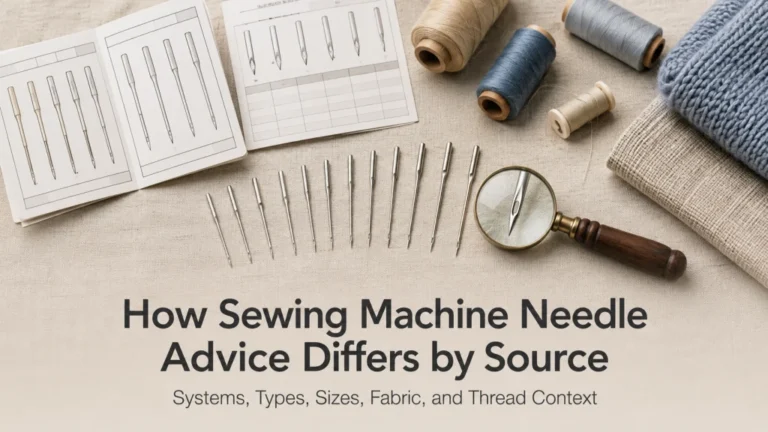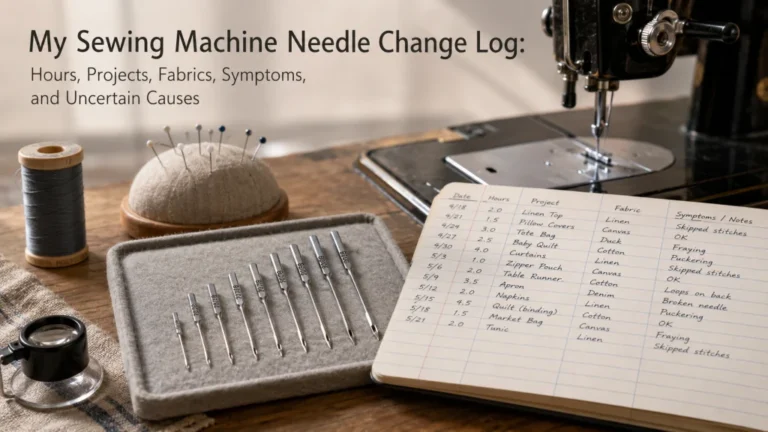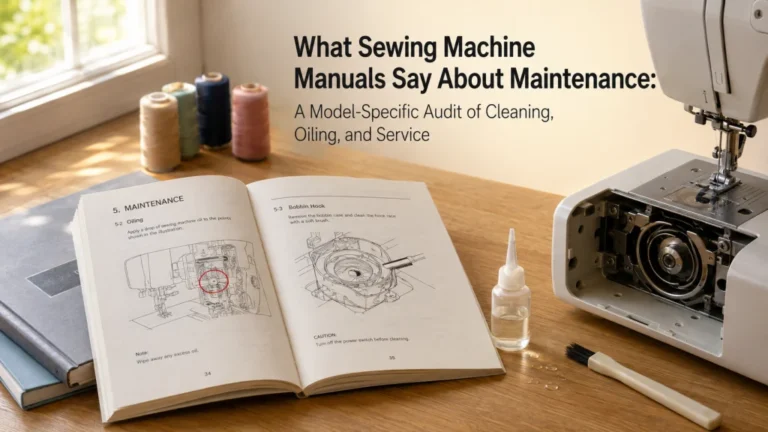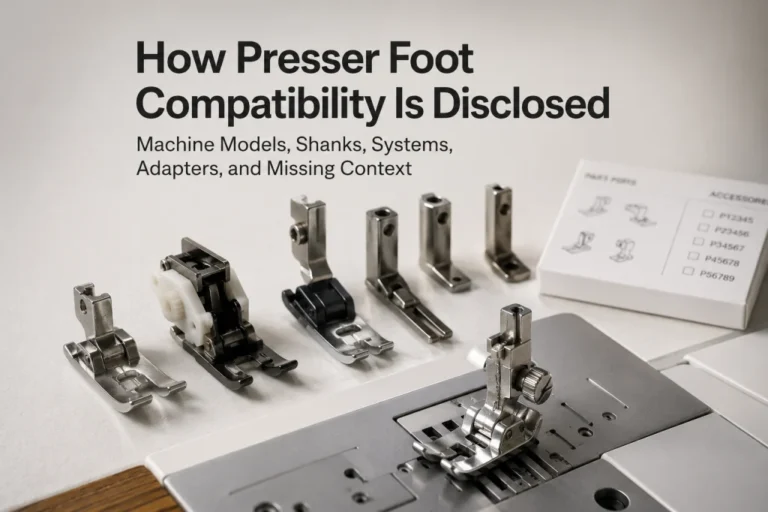
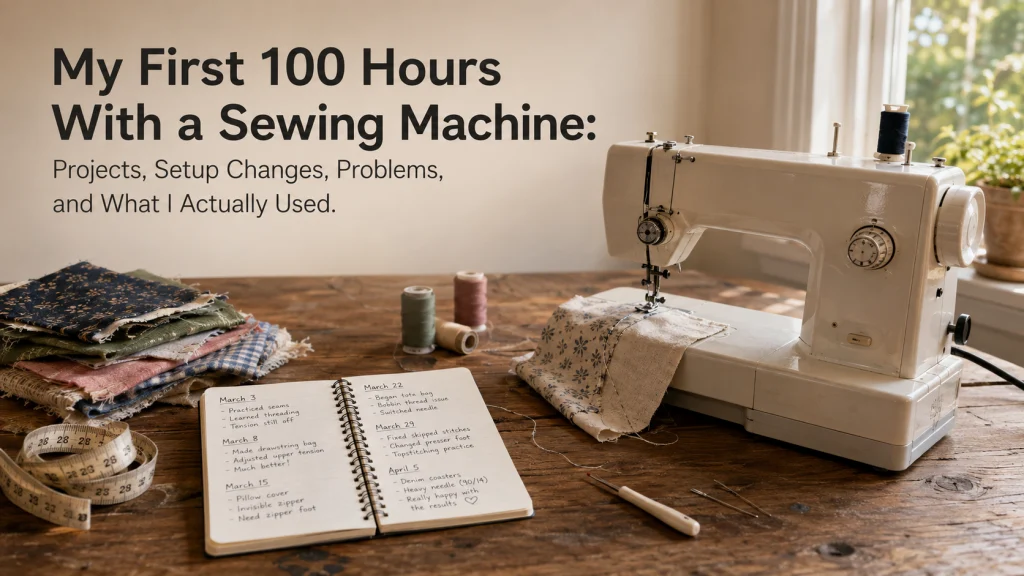
After spending substantial time with a Brother CS7000X, the machine became much easier to judge by what I actually reached for rather than by its feature list. I kept returning to speed control, needle position, the standard zigzag foot, the walking foot, and the quick-set bobbin, while most decorative stitches and several included feet rarely mattered in normal use. The biggest changes were not dramatic upgrades but small setup decisions involving needle choice, presser feet, stitch length, and slowing down before bulky seam crossings. That experience is enough to describe how the machine fit into real projects and routines, but not enough to make a long-term durability claim.
When the machine started to feel familiar
By the time the machine felt familiar, I could finish something like lap-quilt binding with far less interruption than in my early sessions. I was still paying attention to the walking foot, needle choice, thread, stitch length, and speed, but those checks had moved into the setup rather than breaking the sewing rhythm every few minutes. Early on, I stopped often to recheck threading, bobbin direction, foot choice, and stitch mode. With more use, most of those decisions became routine before I pressed Start.
What became clear with use is that the feature count mattered less to me than the controls I could reach without breaking rhythm. Brother lists 70 built-in stitches, 10 included accessory feet, adjustable sewing speed, a quick-set bobbin system, and a wide table on its CS7000X product specification page. In practice, only a smaller group of those features entered my regular work.
Machine, purchase context, and how hours were recorded
I chose the Brother CS7000X because I wanted a domestic computerized machine with speed control, needle up/down control, a free arm, a walking foot in the box, and enough basic utility stitches that I would not immediately feel boxed in. I was never especially interested in using every built-in stitch. Straight stitch, zigzag, buttonholes, basic overcasting, and a few quilting functions were always more relevant to the kind of sewing I actually wanted to do.
I paid attention to active sewing time rather than treating every minute spent on a project as machine use. Cutting, pinning, pressing, fitting, and long troubleshooting pauses are different from time actually spent sewing. Thread changes, needle changes, and other setup work still mattered because they were part of using the machine, but I did not treat the ownership period as a stopwatch exercise.
Field log method: I paid attention to the project, fabric, needle, thread, foot, meaningful setting changes, problems, cleaning, and anything I had to look up. The point was to notice which decisions kept repeating and which features actually mattered during normal sewing rather than reconstructing a dramatic timeline afterward.
| Log point | Date | What I was sewing | What had changed by then |
|---|---|---|---|
| Early use | Early use | Quilting-cotton tote | I checked the manual repeatedly for threading and bobbin setup. |
| Developing routine | Later | Linen-cotton curtain panels | Speed control and needle position had become routine. |
| More deliberate setup | Later | Quilted zipper pouches | I was changing feet deliberately instead of trying to make the standard foot do everything. |
| Broader project mix | Later | Cotton-poplin shirt and lap quilt | Needle selection and seam testing happened before the main work. |
| Established routine | Later use | Lap-quilt binding | Setup was faster, but bulky transitions still made me slow down. |
Not every stretch of use was equally eventful. Repetitive pouch construction produced fewer notes than moving between buttonholes, shirt seams, and quilt piecing. The quiet stretches were useful in their own way because they showed what had become normal.
Projects that shaped my experience
My use was spread across several kinds of projects rather than one repeated task. Lightweight woven cotton made up a large share, but I also used the machine for linen-cotton, knit hemming, jean repairs, zipper insertion, buttonholes, quilt piecing, layered quilting, and binding. That mix mattered because the machine felt most predictable when material and setup stayed familiar. I paid more attention whenever fabric behavior changed or I moved into a construction step I had not repeated many times.
Nothing in the project list was selected as a formal machine test. These were ordinary things I wanted to make or repair. The cotton-poplin shirt used 15.5 machine hours because collar work, buttonholes, edge stitching, and repeated stops made it less continuous than the curtain panels.
| Project or task | Logged hours | Main material or construction | What it added to the log |
|---|---|---|---|
| Two lined tote bags | About 9 | Quilting cotton with interfacing | Basic threading, straight seams, corners, and topstitching |
| Pajama shorts | About 11 | Light woven cotton | Curves, elastic casing, seam finishing, and repeated straight stitching |
| Four curtain panels | About 11 | Linen-cotton blend | Long straight seams and speed-control habits |
| Jean and work-pants repairs | About 7 | Denim and twill | Needle changes, bulky seam crossings, and slower handling |
| Six quilted zipper pouches | About 12 | Cotton, batting, zippers | Zipper foot use and layered feeding |
| Cotton-poplin shirt | About 16 | Poplin | Buttonholes, edge stitching, precision starts and stops |
| Small lap quilt | About 22 | Quilting cotton and batting | Quarter-inch piecing, walking-foot quilting, binding |
| Hems and household repairs | About 13 | Mixed woven and knit fabrics | Short setup changes and fabric-specific needle decisions |
| Total | 100.0 | Operating time only | |
The project mix also explains why some features hardly appear later in the article. I did not spend meaningful time on embroidery-style decorative work, heavy upholstery material, or free-motion quilting. Those missing tasks are part of the experience boundary, not gaps to be filled with assumptions.
Features I used repeatedly
Five controls or accessories accounted for most of my repeated use: adjustable speed control, needle up/down, the standard zigzag foot, the quick-set bobbin, and the walking foot. Speed control was the one I underestimated most at first. I used a slower setting for buttonholes, bulky transitions, and any seam where I wanted more time to steer, then increased it for long straight seams and basic piecing once the setup was stable.
Needle up/down became automatic during pivoting and short precision seams. The quick-set bobbin mattered mainly because bobbin changes stopped interrupting me once I knew the threading path. The walking foot became my default once I started quilting layered pieces and binding. Brother’s official CS7000X specifications list these machine features and the included walking foot; the way I used them reflects my own projects rather than Brother’s recommendations.
| Feature or accessory | Sessions used | Where it mattered most |
|---|---|---|
| Adjustable speed control | Regularly | Every project, especially first passes and bulky areas |
| Needle up/down control | Very often | Corners, collars, pouch construction, binding |
| Standard zigzag foot | Regularly | General seams, zigzag finishing, repairs |
| Quick-set bobbin | As needed | All projects as thread colors changed |
| Walking foot | Repeatedly | Quilted pouches, lap-quilt quilting, binding tests |
| Quarter-inch foot | During quilt piecing | Lap-quilt piecing |
I used a small portion of the controls repeatedly and reached for the rest only when a project created a specific need.
Features I rarely or never used
Decorative stitches were the clearest example of early curiosity turning into low actual use. I tried several on scraps, used one again on a pouch lining, and then stopped reaching for them. The button-sewing foot never became part of my normal routine, the monogramming foot stayed mostly a test-piece accessory, and I did not develop a regular use for the drop-feed function.
The buttonhole foot was different. I used it only when a project actually called for buttonholes, so it appeared less often, but I would not group it with accessories that stayed untouched. Frequency and usefulness were not the same measure. A tool used occasionally for the right job can matter more than a novelty function tried several times on scraps.
I would not call the unused functions pointless simply because my project list did not need them.
My first 100 hours concentrated on utility sewing, repairs, garment construction, and basic quilting, so those functions stayed outside normal use.
I now separate “available on the machine” from “likely to enter the projects I already make.” The session counts made that difference visible.
Needle, thread, foot, and setting changes that mattered
One setup correction that stayed with me came during a knit hem. I had started with the same universal needle I had used on woven cotton and got occasional skipped stitches on the test strip. I switched to a ball-point needle, rethreaded, and tested again before returning to the garment. The next test was cleaner, but I did not treat the needle change as proof of a single confirmed cause because I had also rethreaded.
Denim repairs created a different habit. I moved to a 90/14 jeans needle, lengthened the straight stitch from my usual 2.5 mm to 3.0 mm for visible topstitching, and slowed down before thick seam intersections. On the quilt, the important change was the foot rather than the stitch: the walking foot gave me more predictable feeding across the cotton-batting-cotton sandwich than the standard foot had on my first test piece. These were project-specific decisions, not settings I carried blindly into the next material.
- Light woven cotton: mostly 80/12 universal needles with the standard zigzag foot.
- Knit hems: 75/11 ball-point needle after the first test showed skipped stitches.
- Denim repairs: 90/14 jeans needle, slower speed near bulky seam crossings, and longer visible topstitching.
- Zippers: zipper foot instead of trying to crowd the standard foot against the zipper teeth.
- Quilting: quarter-inch foot for piecing and walking foot for layered quilting.
With more use, I stopped treating the tension dial as the first response to every imperfect stitch. I checked threading, needle condition, bobbin setup, foot, fabric layers, and test results first. The broader sewing machine setup and use process covers those normal setup decisions.
Problems, failed setups, and unresolved questions
A few problems repeated often enough to change what I did next: skipped stitches on a knit hem, thread bunching after a rushed bobbin reinstallation, uneven feeding on a quilt sandwich, and an occasional high-pitched sewing sound. None turned into an internal repair. The useful habit was to note what I changed before a symptom disappeared instead of deciding afterward that one adjustment must have been the cause.
A high-pitched sound was one of the few symptoms that made me stop sewing completely. I changed the needle, rethreaded, removed lint from the race, reinstalled the bobbin case, and tested on scrap before continuing. Brother’s current CS7000X high-pitched-sound troubleshooting page lists a bent or dull needle, lint, caught thread, incorrect upper threading, an incorrect bobbin, and bobbin-case damage among the checks, with service as the next step when the issue is not resolved. The sound did not persist after those checks, but I would not claim that one specific step was definitely the cause or fix.
| Hour | Problem | What I changed | Result |
|---|---|---|---|
| Earlier use | Occasional skipped stitches on knit test | Ball-point needle, complete rethread, new test strip | Did not recur on that project |
| Earlier use | Thread nesting at start of seam | Removed and reinstalled bobbin, rethreaded upper path | Resolved immediately |
| Mid-period | Layers shifted on first quilted pouch test | Changed to walking foot and reduced speed | Feeding became more consistent on later tests |
| Later use | Needle struck near a bulky denim seam crossing | Stopped, replaced needle, approached crossing more slowly | No repeat strike logged |
| Later use | High-pitched sewing sound | New needle, rethread, race cleaning, bobbin-case check | Did not recur through later use |
I still notice that the machine can sound slightly harsher when sewing several closely spaced bulky intersections even when the needle and threading are fresh. The symptom has not been consistent enough for me to treat it as a diagnosis. If it became repeatable, I would start from the structured sewing machine troubleshooting process and the exact CS7000X support guidance instead of extending normal ownership observations into repair claims.
Cleaning, service, and consumables during the period
I cleaned visible lint during routine bobbin changes and did more deliberate race-area cleaning when buildup or an unusual sound gave me a reason to inspect it. For those cleanings I followed Brother’s CS7000X race-cleaning instructions, which tell the owner to turn off and unplug the machine, remove lint and dust from the race, reinstall the bobbin case correctly, and not put oil on the bobbin case. I did not add oil because the model-specific cleaning guidance did not direct me to do so.
No professional service was needed during this period of use. I replaced needles when projects, wear, or a needle strike called for it, changed bobbins as thread colors changed, and discarded one poorly wound bobbin rather than trying to work around it. Those are ordinary ownership details, not failure counts.
| Hour | Maintenance or consumable | Reason | Record |
|---|---|---|---|
| Earlier use | Needle change | Moved from woven cotton to knit | Session note and project photo |
| Earlier use | Race-area cleaning | Visible lint after curtain and garment work | Cleaning log |
| Mid-period | Walking foot installed | Start of layered pouch quilting | Session log |
| Later use | Race-area cleaning | Routine inspection before shirt project | Cleaning log |
| Later use | Needle replaced | Needle strike at denim seam crossing | Problem log |
| Later use | Race-area cleaning and needle change | High-pitched sound during sewing | Problem and cleaning log |
| Current period | Service | No service event during period | No service event recorded |
Most maintenance was ordinary lint removal, needle changes, and bobbin handling. What mattered was separating work I actually performed from routines I had merely read about.
What became easier and what did not
Threading, bobbin changes, foot changes, speed selection, and starting a basic seam all became much faster. Early on, I repeatedly stopped to check bobbin direction or look up the needle threader again. With more use, I could move from a standard foot to the zipper foot or walking foot without turning the change itself into a separate event.
What did not become automatic was handling every material transition. Bulky seam crossings still made me slow down, buttonholes still got a scrap test first, and knit projects still made me check needle type before sewing. I also never became casual about reinstalling the bobbin case after cleaning because rushed bobbin-area work had already shown me how easily a small setup mistake can create a problem. Familiarity reduced the number of pauses, but the useful pauses became more deliberate.
What changed: routine setup moved from something I had to remember step by step to a sequence I could perform and verify quickly. What did not: unfamiliar materials, bulky transitions, buttonholes, and symptoms outside normal stitching still made me slow down and check the exact setup.
The confidence change was practical: I became quicker at recognizing which part of the setup needed attention without skipping material tests.
What my experience cannot prove about durability
Nothing significant has broken during my use so far, no professional service has been required, and the machine has completed the projects described here. That is useful ownership experience, but it does not establish a service life. My experience says nothing reliable about what this machine will look like after several years, how another unit will behave, or how the same model holds up under a very different mix of materials and workloads.
The project mix also limits what I can infer. Most of my use has been on ordinary home-sewing materials, with much less time spent on denim and other heavier work. I have not used the machine for upholstery stacks, production runs, or other workloads that would put it in a very different operating context. The absence of a failure under my conditions is simply an observed outcome.
Evidence limit: This is one owner’s experience with one CS7000X across the kinds of projects described above. It cannot establish model-wide reliability, predict future repair needs, or prove performance on materials and tasks that were not part of my use.
Readers deciding whether a machine fits their first setup can use the beginner sewing machine decision criteria rather than treating one ownership diary as a recommendation.
Final Thoughts: what I know now and what remains outside my experience
After using the CS7000X across a range of ordinary projects, I know that my use concentrates on a small set of controls and accessories. Speed control, needle position, the standard foot, the walking foot, and basic straight-stitch work matter far more to me than decorative functions. I also know that better results usually follow better setup discipline: matching the needle to the material, testing before the main seam, changing the foot when the construction calls for it, and cleaning the race when lint or an abnormal sound gives me a reason to inspect it.
What remains outside my experience is substantial. I have not used the machine for long production runs, tested every decorative stitch, used every included foot, or accumulated enough ownership time to say anything useful about long-term wear. I would rather leave those areas open than stretch ordinary home use into conclusions it cannot support.
Frequently Asked Questions
These answers refer to my own experience with this machine. Where a question depends on the machine’s controls or maintenance boundary, the exact CS7000X documentation still takes priority over my habits.
⏱️ How do I separate sewing time from total project time?
I separate active sewing from the rest of a project rather than counting cutting, pressing, fitting, meals, and long pauses as machine use. Short setup changes still matter because they are part of actually operating the machine.
🧵 What projects took the most time?
The lap quilt took the largest share of my sewing time, followed by the cotton-poplin shirt and mixed hems and repairs. Those projects account for a substantial part of the experience described here.
⚙️ Which feature did I use most often?
The adjustable speed control appeared in every logged session. Needle up/down was next, followed by repeated use of the standard zigzag foot and quick-set bobbin system.
🪡 What setup change helped the most?
No single setting solved every problem. The most useful change in my process was choosing the needle and foot for the material or construction before changing tension, then testing on scrap before the main seam.
🧰 Has the machine needed professional service?
No professional service has been needed during my use so far. I have performed owner-level race cleaning and needle changes, and I stop to follow model-specific troubleshooting when an unusual sound or other symptom gives me a reason to check the setup.
📏 Is my experience enough to judge how long the machine will last?
No. My experience is enough to describe how the machine has behaved in my own projects, but not enough to establish long-term durability, model-wide failure rates, or future service needs.
If I update this later, the useful additions would be new conditions that actually enter my sewing, such as different materials, service, or previously unused functions.
References and Sources
The ownership observations, projects, problems, and setup habits in this article come from my own use of the machine. The external sources below are used only for model specifications, manual availability, cleaning boundaries, and model-specific troubleshooting.
- Brother CS7000X product specifications: Verifies the current feature list, included accessory feet, speed control, quick-set bobbin system, and other model-level specifications referenced in the article.
- Brother CS7000X manuals: Provides the current Operation Manual, Sewing Guide, accessory instructions, and stitch chart for the exact model.
- Brother CS7000X race-cleaning instructions: Verifies the owner cleaning procedure and the instruction not to put oil on the bobbin case.
- Brother high-pitched-sound troubleshooting: Verifies the model-specific checks and service boundary referenced in the hour-86 problem entry.
If Brother revises the manual, model applicability, or support instructions, those technical references should be rechecked before the article is updated.